Rushing before the congressional changeover, the nominees for the SEC and CFTC put forth by Trump attended hearings, with only the chairperson remaining operational at the CFTC for nearly a year.
Written by: Sanqing, Foresight News
On November 19 at 23:00, the U.S. Senate Banking Committee held a hearing for Trump’s nominated SEC commissioners Kristin Johnson and Steven Levine. This hearing assessed five nominees simultaneously; the session was brief and had little confrontation, but the tokenized stock "innovation exemption" launched by the SEC in September became the core cryptocurrency topic for both nominees.
Previously, on November 18 at 4:00, the Senate Agriculture Committee had already conducted a hearing for CFTC nominees Nathan Anonick and Matthew Rowland. The questioning from lawmakers focused on prediction markets, with Democratic Senator Adam Schiff directly accusing CFTC Chair Michael Selig of deceiving him during the nomination hearing in 2025.
The four were jointly submitted to the Senate by the White House on November 12, with each party holding two nominations. Johnson and Rowland are also the first Democrats nominated for these two financial regulatory agencies during Trump’s second term.
SEC Tokenization Exemption Called to Follow Formal Rulemaking Process
On September 17, 2026, the SEC launched the "innovation exemption," allowing qualifying tokenized securities trading venues (TSV) to trade tokenized versions of stocks from U.S. publicly listed companies without registering as exchanges. Under this framework, third parties can tokenize a company's stock without obtaining consent, and the company has only 30 days to oppose after receiving written notice. After the framework was introduced, several dozen publicly listed companies raised objections.
On November 16, Democratic Senators Angela Alsobrooks, Catherine Cortez Masto, Mark Warner, and Ruben Gallego publicly sent a letter to SEC Chairman Paul Atkins requesting that permanent adjustments to the regulatory framework for tokenized securities follow a public comment rulemaking process. During the hearing, Alsobrooks directly asked the two nominees whether they would agree to reconsider this policy.
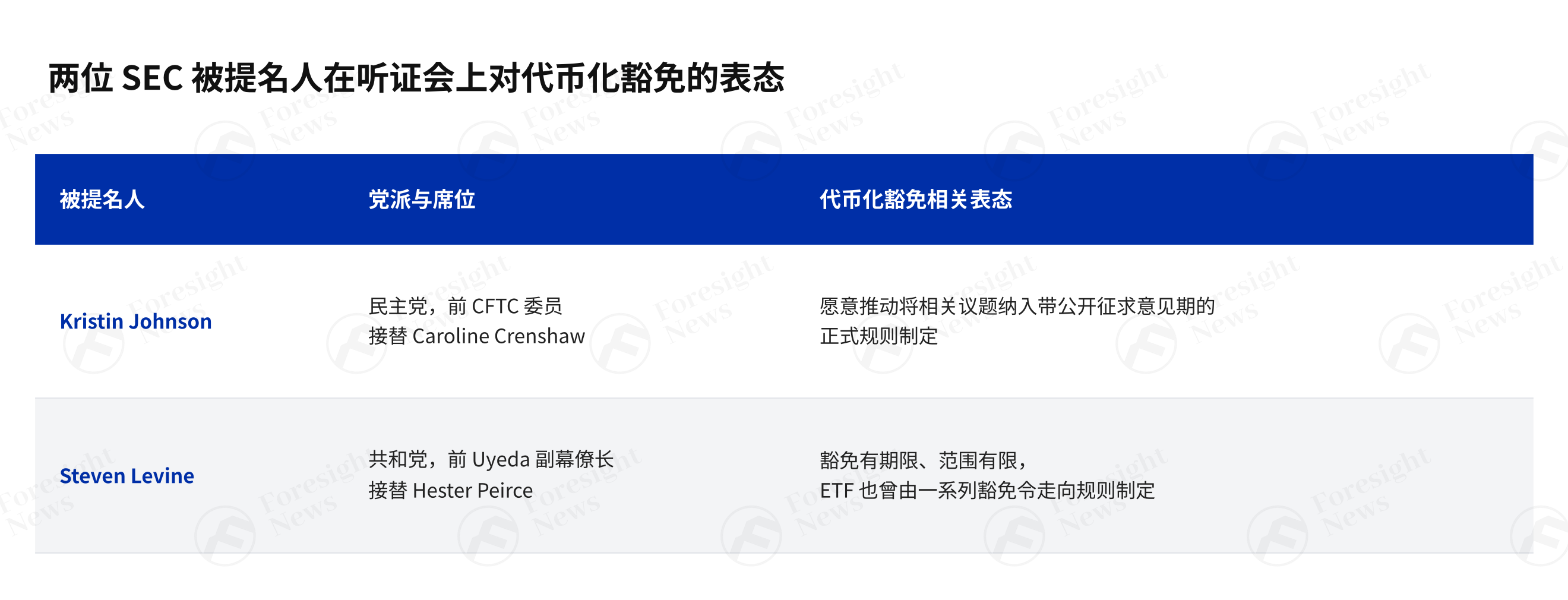
Johnson responded that she was willing to promote the incorporation of relevant issues into formal rulemaking with a public comment period, particularly noting that those raising concerns are market participants and registrants themselves. She also stated that Congress demands independent federal market regulators to create rules through public comment procedures.
Levine stated that this exemption has a time limit and is limited in scope, citing ETFs as an example, pointing out that many innovations initially began with a series of exemptions and eventually transitioned to rulemaking.
In her written testimony, Johnson wrote that AI, tokenization, stablecoins, and decentralized platforms are expected to reduce costs and expand access but also bring about real issues regarding conflicts of interest, data governance, and accountability; she has been focusing on strong governance, conflict of interest rules, and customer asset segregation in the digital asset market. Levine's written testimony did not mention crypto assets, only noting that U.S. capital markets are undergoing "transformative innovation."
Cortez Masto also steered the topic toward prediction markets, accusing relevant platforms of illegally trading "security-based swaps" in the form of perpetual contracts. She specifically targeted the CFTC's practice of allowing individual stock perpetual futures. Levine did not comment on this, while Johnson stated that this involves critical issues of the committee's jurisdiction and authority.
CFTC Hearing Focused on Prediction Markets
Under Chair Michael Selig's leadership, the CFTC claims "exclusive jurisdiction" over event contracts, proposing rules that treat prediction market contracts as swaps subject to federal commodity regulation rather than state gambling laws. States regard these platforms as illegal gambling operations, and tribes are concerned about the impact on their gambling agreements with states. Currently, nearly 12 states are suing the CFTC, with varying court rulings, and the cases may ultimately reach the Supreme Court.
During the hearing, Rowland cited the CFTC's Rule 40.11 passed in 2011, which prohibits registered exchanges from listing or clearing specific event contracts related to gambling, terrorism, war, and assassination. He expressed "very much understanding" of state and tribal concerns but found it difficult to comment on ongoing litigation.
Anonick stated that the CFTC has the authority to determine whether contracts violate public interest, with "gambling" being at the heart of the controversy, and described this topic as "very emotional." Democratic Senator Tina Smith immediately countered, asserting that this is a legal issue, and the jurisdiction over sports betting belongs to states and tribes.
The most heated statements during the hearing came from Democratic Senator Adam Schiff. He claimed that Selig had described himself as a "blank slate" on the issue of sports event contracts at the November 2025 nomination hearing and would follow court rulings, yet later submitted briefs to the court urging companies to disregard unfavorable judgments for prediction markets. Schiff remarked that he "did not know if he had ever been so openly deceived by a nominee."
When asked if a sports event contract for an NFL game is equivalent to sports betting, neither nominee directly answered, only stating they would fully support the Supreme Court's final ruling. Rowland anticipated that the Supreme Court may rule on this in the next or the following session.
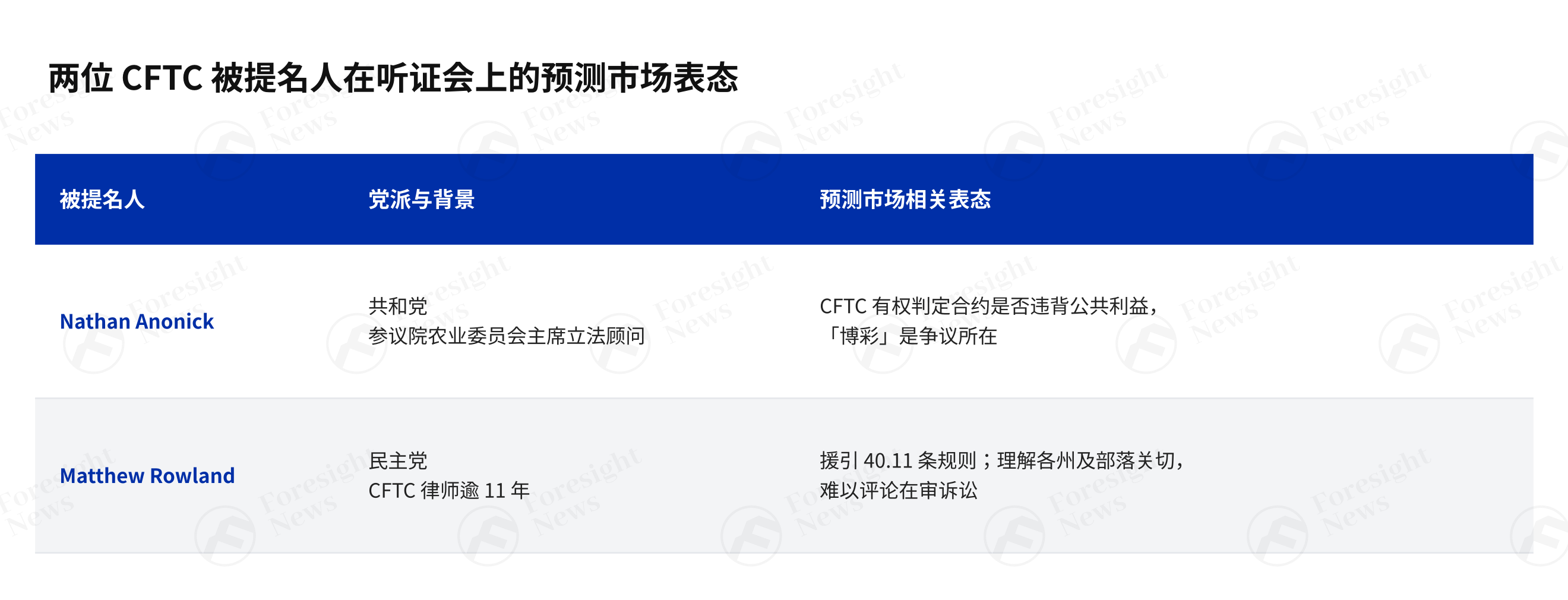
Crypto-related content mainly appeared in Rowland's written testimony. He has served as a lawyer at the CFTC for over 11 years and was a senior advisor to Johnson, also involved in crypto market structure legislation. In his testimony, he used FTX as an example, stating that when FTX collapsed, the CFTC-regulated FTX subsidiary did not file for bankruptcy, and its customers' assets were protected.
He wrote that event contracts, crypto derivatives, and securities futures are rapidly growing new markets, with farmers concerned that 24/7 trading and perpetual futures affect the hedging market. The CFTC needs to reassess and strengthen customer protection rules. Anonick's written testimony did not mention crypto assets, only stating that regulation needs to keep pace with technological and market evolution.
Last-Minute Rush During the Lame-Duck Session
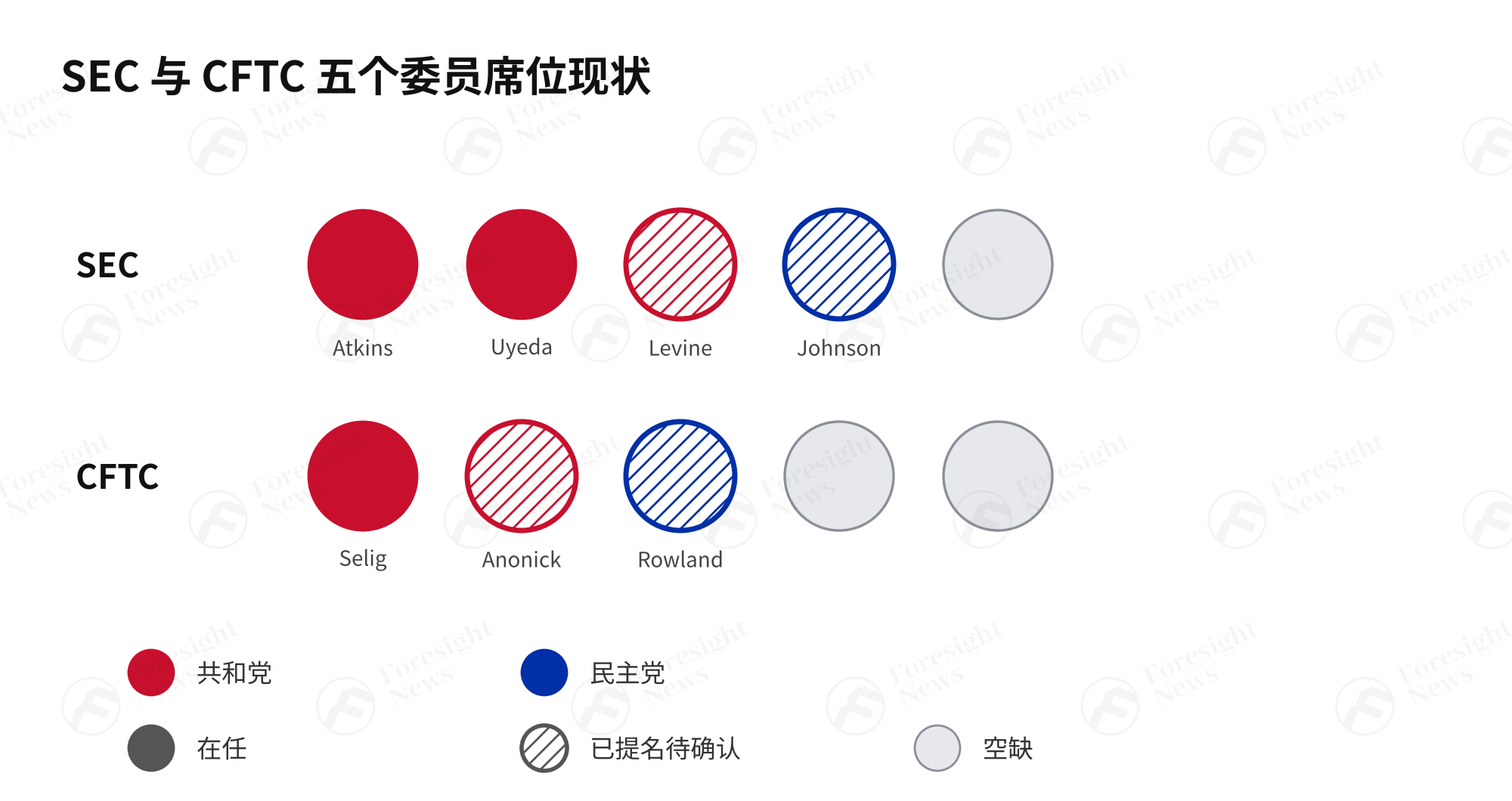
Both regulatory agencies are currently understaffed. Of the five SEC positions, only Atkins and Mark Uyeda are currently serving, and with the confirmation of Johnson and Levine, the number will increase to four, resulting in a configuration of three Republicans and one Democrat.
The CFTC's situation is even more extreme, with Selig serving as the sole commissioner for nearly a year. Agriculture Committee Democratic Chief Amy Klobuchar stated in her opening remarks that the CFTC, as designed by Congress, is not "an agency governed by one person."
Staff attrition is also a prominent issue. Some lawmakers pointed out during the hearing that the CFTC has lost about a quarter of its staff during Selig's tenure, and both nominees expressed their willingness to add personnel as needed. Even if Anonick and Rowland are confirmed, there will still be two vacant commissioner positions at the CFTC.
The nomination confirmation timeline is also tight. The Democrats won both chambers in the mid-term elections on November 3, and the new Congress will be sworn in in January 2027. Uncompleted nominations generally need to be resubmitted at that time. All four need to pass a vote in their respective committees before going for full Senate confirmation.
On the legislative front, the CLARITY Act failed to pass a Senate vote to end debate with 49 votes against 50 on September 15. If the lame-duck session does not resume, it will lapse on January 3, 2027, along with the current Congress.
As of November 20, neither the Senate Agriculture Committee nor the Banking Committee has announced a vote date for the nominations of the four individuals.
免责声明:本文章仅代表作者个人观点,不代表本平台的立场和观点。本文章仅供信息分享,不构成对任何人的任何投资建议。用户与作者之间的任何争议,与本平台无关。如网页中刊载的文章或图片涉及侵权,请提供相关的权利证明和身份证明发送邮件到[email protected],本平台相关工作人员将会进行核查。


