
Author: Nancy, PANews
The founder's lending turmoil has not subsided, and illegal funding controversies have arisen again. In just a few days, negative news about Sky has followed one after another, resulting in continuous market panic and a sharp decline in the price of SKY tokens.
Following the founder's Rune's exposure of massive SKY collateral used to borrow huge amounts of funds, the liquidity of related lending pools is on the verge of depletion, raising market concerns about protocol risks. Additionally, it has been revealed that Sky's core infrastructure, the Peg Stability Module (PSM), was extensively exploited for illegal funding, with approximately $2.7 billion in USDC reserves facing potential freezing risks, further exacerbating market panic and leading to large-scale withdrawals of funds overnight.
This series of upheavals represents not only a test of trust for Sky but also an unavoidable regulatory dilemma faced by DeFi protocols as they move towards the mainstream market.
Sky exposed to illegal funding exploitation, $2.7 billion reserves or may face freezing risks
On November 19th, a report from CoinDesk pushed the Sky protocol into the public spotlight.
The report cited an investigation by crypto risk analysis company Inca Digital, indicating that Sky's Peg Stability Module (PSM) had been utilized by numerous wallets associated with illegal activities, involving transaction amounts as high as $518 million across a total of 422 relevant addresses, which included hacking attacks, phishing scams, and sanctioned entities. Among these, approximately $101.9 million is directly related to North Korean hackers.
Inca Digital disclosed that in February 2025, North Korean hackers stole approximately $1.5 billion in assets from Bybit. Within 10 days of the attack, wallets funded by these stolen assets transferred about $91.5 million through the PSM. Even after the FBI publicly attributed this attack to North Korea, nearly $30 million was still transferred through the PSM.
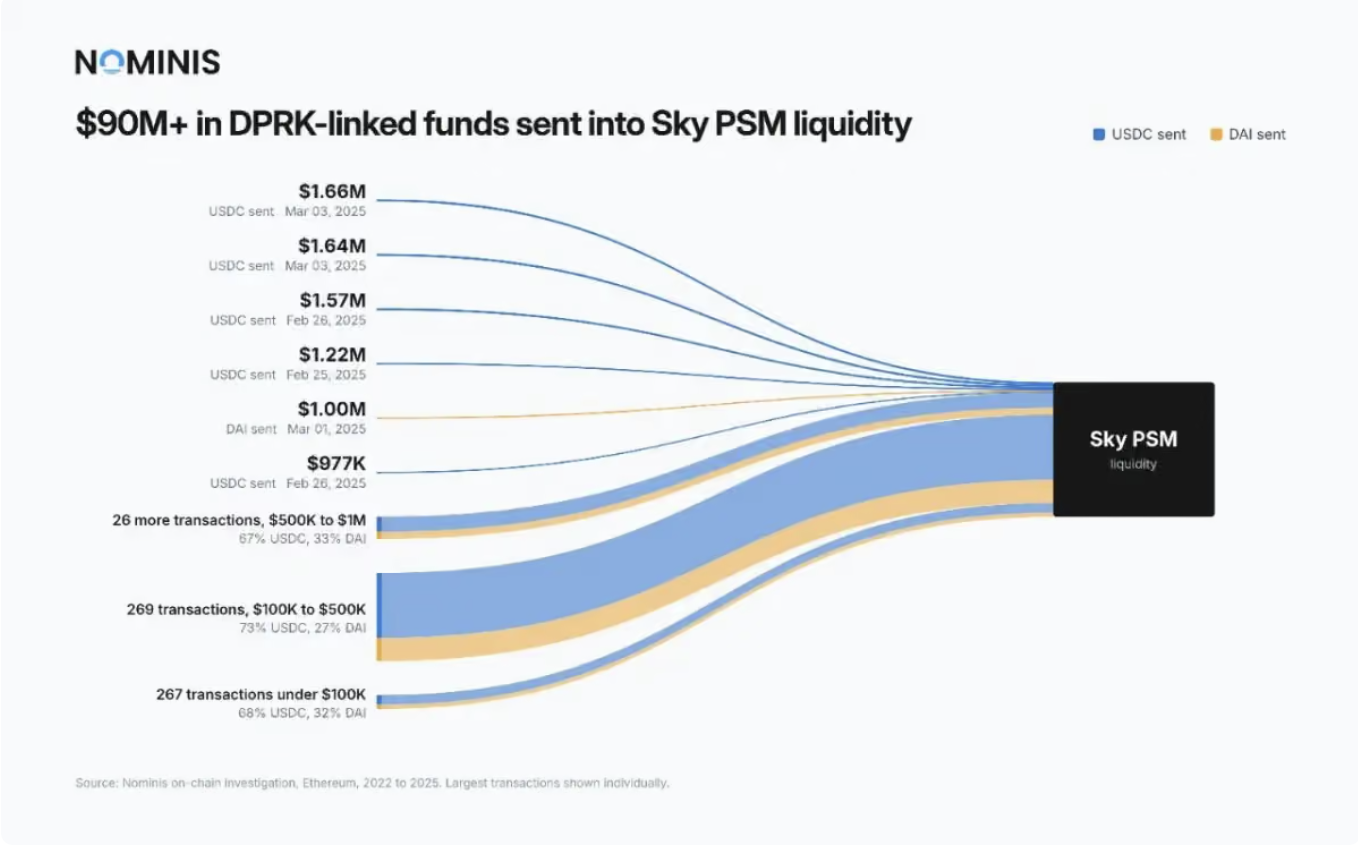
The exchange mechanism of the PSM is the primary reason it has been targeted by hackers.
As the core mechanism for Sky to maintain the price peg of stablecoins, the PSM essentially serves as an on-chain stablecoin exchange window, allowing users to exchange USDC for USDS and DAI at a fixed ratio of 1:1. Unlike regular trading methods that require market matching, the PSM does not depend on market buy and sell orders and is largely insulated from trading slippage.
This means that regardless of how the market price of USDS fluctuates, users can exchange it for USDC through the PSM at the fixed rate preset by the protocol and take advantage of the price difference between the exchange price and the market price to arbitrage, thereby pushing the USDS price back to the pegged level. For example, when USDS falls below $1, users can buy USDS at a low price and then exchange it for USDC through the PSM for profit; when the price of USDS exceeds $1, users can exchange USDC for USDS and sell it to increase supply and lower the price.
It is this convenient, low-slippage exchange mechanism that has made the PSM an important infrastructure for Sky to maintain stablecoin prices, but it has also provided a channel for illegal funds to circulate. Unlike stablecoins like USDC, which are managed by centralized issuers that can freeze assets at specific addresses, DAI and USDS, as decentralized stablecoins, do not have their addresses and capital flows directly controlled by a single centralized institution. Any user can conduct transactions and exchanges on-chain, and this characteristic of difficult-to-freeze assets presents greater compliance challenges for the PSM.
Inca Digital warned that about $2.7 billion in USDC is concentrated in the same wallet address within the PSM. If this address is blacklisted by the USDC issuer Circle, the related reserve funds could face an overall freeze, which would in turn impact the redemption capacity and price stability of USDS and DAI.
Crypto analyst 0xLoki pointed out that as a decentralized entity, Sky’s anti-money laundering (AML) obligations differ from those of centralized exchanges like MEXC, and thus it is not expected to face a total service cut-off sanction. However, there remains the possibility that a court may issue an asset freeze order, freezing funds associated with sanctioned entities. The problem is that these funds are stored at the same address as the remaining reserves in the PSM. If that address is ordered frozen, it could lead to an overall freeze of all funds therein, not just the implicated funds. In the short term, this could completely interrupt the redemption mechanism for USDS and DAI; in the long term, Sky might be forced to bear corresponding financial losses or spend significant time seeking unfreezing through judicial processes.
In fact, this is not the first time Sky has faced such risks.
In 2022, the U.S. Treasury Department's Office of Foreign Assets Control (OFAC) added the privacy mixer protocol Tornado Cash and its associated addresses to the sanctions list, accusing it of aiding North Korean hacker organizations in money laundering. Subsequently, the USDC issuer Circle quickly took action, blacklisting the relevant addresses and freezing over $75,000 in USDC.
This incident caused quite a stir in the DeFi community. At that time, USDC had already become a widely used stablecoin in the on-chain financial ecosystem and was also one of the essential collateral assets for the Sky protocol. Due to the high proportion of USDC in DAI's collateral, Circle's freezing actions made the community realize that even decentralized stablecoins could be affected by external sanctions because of their reliance on centralized institutional collateral. As a result, Rune considered reducing the protocol's dependence on USDC, including exchanging USDC in the PSM for ETH and developing contingency plans for potential sanction risks, such as executing emergency shutdowns in case core contracts were sanctioned.
Years later, the PSM has once again been exposed for involving large-scale illegal capital flow. The compliance and risk control issues that were previously discussed now seem to be placed in front of Sky again.
Over $2.2 billion lost from USDS in a single day, Sky emphasizes over-collateralization and initiates token buyback
Due to the negative news, market confidence in USDS has been impacted, leading to large-scale capital withdrawals.
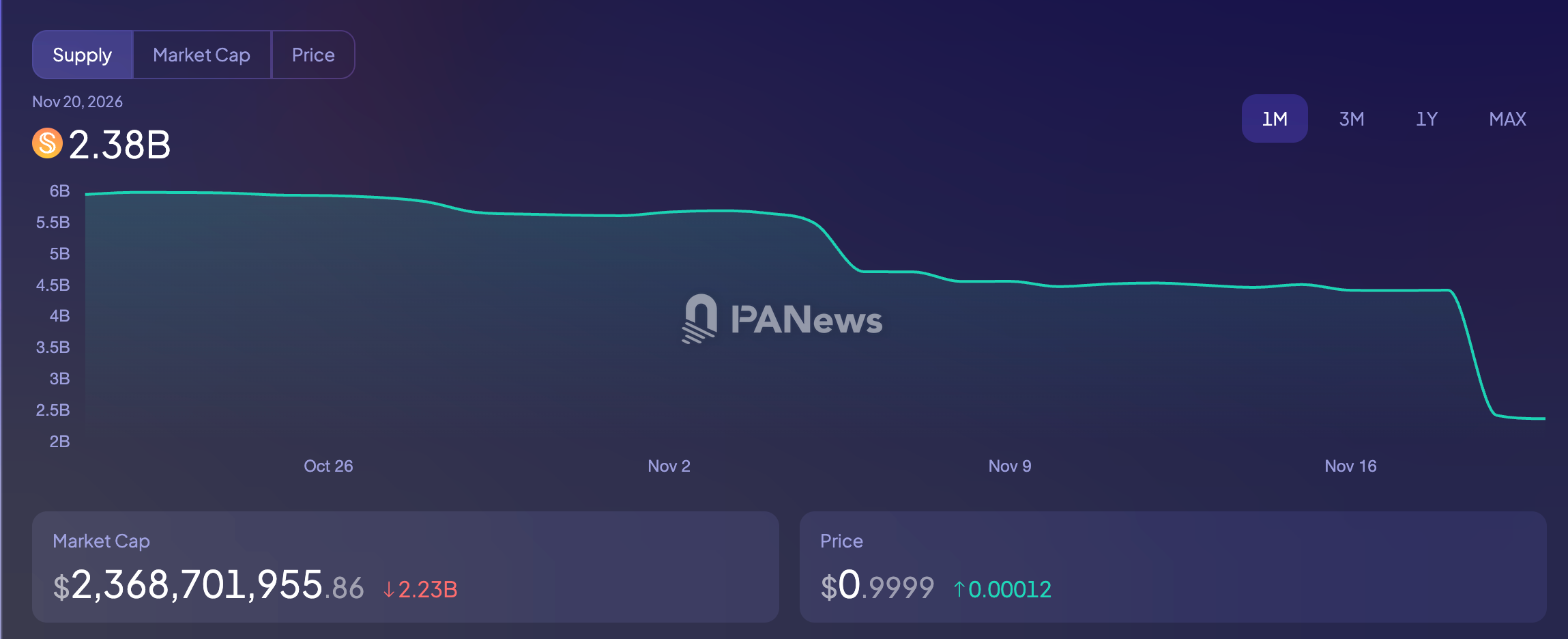
According to data from the official website, since November 19, the circulating supply of USDS has dropped in just one day from $4.42 billion to approximately $2.37 billion, a reduction of over $2.22 billion.
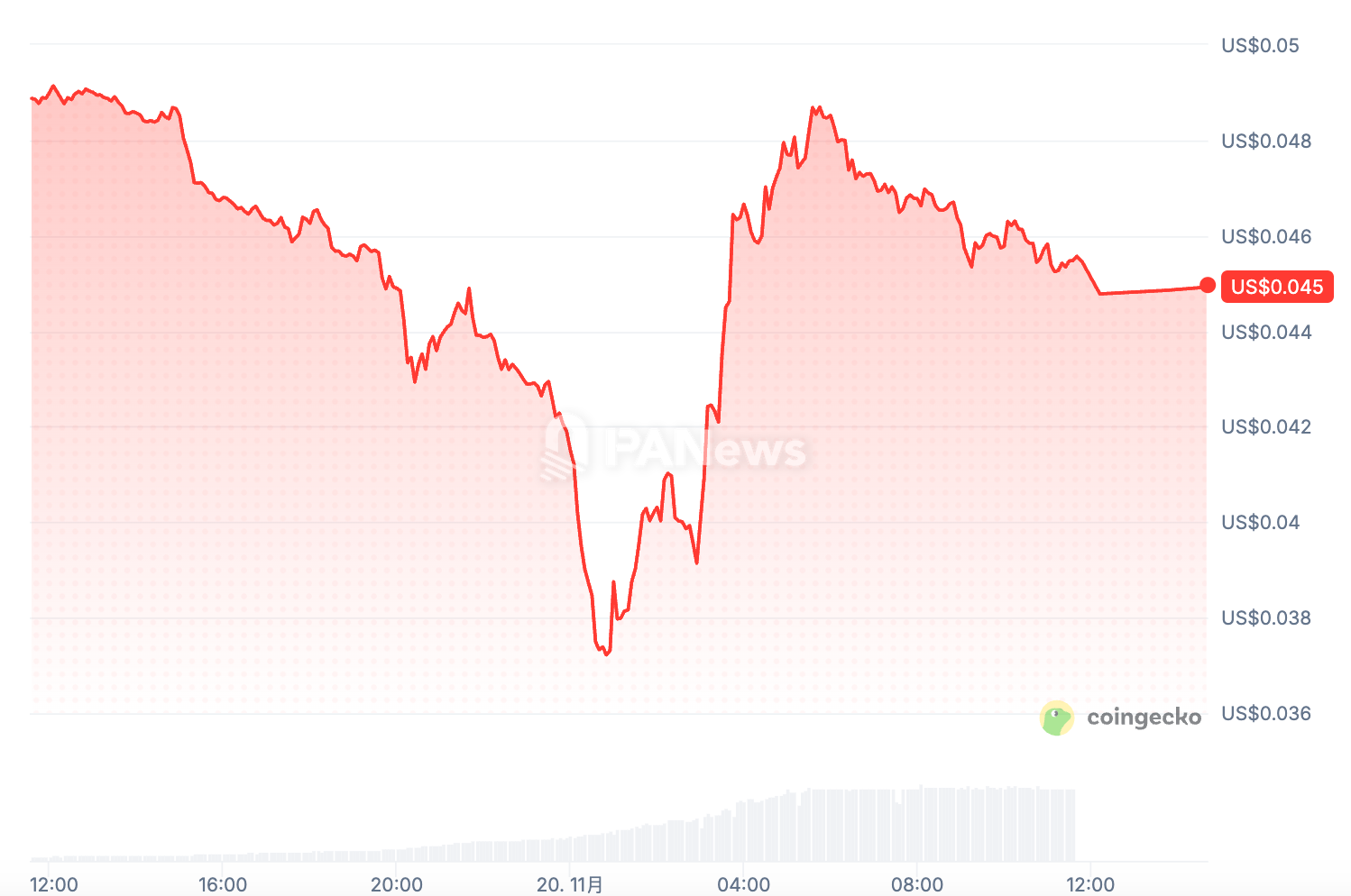
At the same time, the price of SKY tokens has also experienced a short-term sharp decline. CoinGecko data shows that within the past 24 hours, SKY briefly fell to $0.037, with a maximum drop of over 24% that day, before rebounding to around $0.045.
In response to community panic, Sky later stated that the related activities mainly occurred on third-party unlicensed platforms. Since its launch, the PSM has processed a total trading volume of over $968 billion, and the amount involved in this report only accounts for about 0.03% of the cumulative trading volume. Sky emphasized that the PSM itself is an open on-chain infrastructure that maintains the price peg of USDS and DAI through a 1:1 exchange mechanism for stablecoins. Furthermore, all front ends within the Sky ecosystem, including Spark, Grove, SkyMoney, and Osero, have screening mechanisms in place to block marked addresses and restrict access from users in sanctioned areas.
Rune also stated that the related report contains exaggerations, and that the protocol is currently operating normally, with USDS still maintaining over-collateralization, supported by assets amounting to approximately $10 billion, allowing holders to continue normal usage, savings, and redemptions.
Regarding the issue of capital outflows, Rune revealed that over $2 billion in funds outflows were processed by Sky in the past 24 hours, but the liquidity of stablecoins used to maintain the USDS peg has consistently remained above $2 billion and has currently rebounded to over $2.25 billion. Additionally, Sky's revenue over the past year is approximately $400 million. To stabilize market confidence, Sky has also launched a one-time SKY token buyback plan, intending to use $750,000 USDS daily for the next seven days for buybacks, totaling an investment of $5.25 million USDS.
On the concern of liquidity tightness in the stUSDS lending pool, Rune emphasized that stUSDS is an independent voluntary participation product and does not belong to the supporting assets of USDS, so holders of USDS and sUSDS do not need to bear the risks associated with stUSDS. However, regarding external doubts about cashing out by pledging large amounts of SKY, as well as the specific repayment timeline of related debts, Rune has not provided a direct response.
This turmoil surrounding Sky is also a microcosm of the challenges faced by DeFi protocols as they strive for mainstream acceptance. The value of decentralized stablecoins like USDS lies not only in providing a stablecoin pegged to the dollar but also in the open, permissionless financial system behind it. Users can participate in exchanges, lending, and other on-chain financial activities without approval from traditional financial institutions. This is also the core advantage that distinguishes DeFi from traditional finance.
In the view of crypto researcher CM, by 2026, there will be no decentralized stablecoins left. The three early social experiments—Basis Cash, Empty Set Dollar, and Olympus DAO—failed, AMPL was abandoned by the market with a market value of only a few million dollars; LUNA, the largest algorithmic stablecoin, collapsed during its transition; LQTY is not deemed a failure but has seen its market value dramatically shrink; Frax has compromised on compliance, and its market value has declined; Sky has also compromised on compliance and is currently in a survival phase. As the trend towards compliance for centralized stablecoins becomes more apparent, the once alluring and engaging narrative of Crypto has come to an end.
KOL @zuoyeweb3 pointed out that if it were Tether and Circle, the market generally expects them to act as good gatekeepers, and timely freezing is their inherent duty. If it is USDS (such a decentralized stablecoin), then it inevitably must bear all "risk premiums" in exchange for permissionless access, and should not simply implement blanket restrictions on capital flow. Now, almost all stablecoins, including USDS, are basically pegged to USDC or U.S. Treasury bonds, leaving the only stories of institutional adoption and real-world payments to tell. If USDS is ultimately pressured to completely align its operational mechanism with compliance priorities, then the story of DeFi would have reached its conclusion.
In fact, as DeFi gradually moves toward mainstream acceptance, regulatory compliance has become an inescapable reality. If protocols want to attract more institutional capital and gain wider market recognition, they must establish more robust risk control and compliance mechanisms. However, at the same time, overly strict access restrictions may also undermine the core attributes of DeFi, which are open and permissionless.
Finding a balance between meeting regulatory requirements and preserving decentralized features has become a long-term challenge that the entire DeFi industry must confront.
免责声明:本文章仅代表作者个人观点,不代表本平台的立场和观点。本文章仅供信息分享,不构成对任何人的任何投资建议。用户与作者之间的任何争议,与本平台无关。如网页中刊载的文章或图片涉及侵权,请提供相关的权利证明和身份证明发送邮件到[email protected],本平台相关工作人员将会进行核查。


