If Circle blacklists the address where Sky stores USDC, the entire 2.7 billion dollars will become inaccessible.
Written by: Krisztian Sandor
Compiled by: Chopper, Foresight News
According to research by fintech and crypto risk analysis firm Inca Digital, the decentralized protocol Sky behind the stablecoin USDS, which has a market cap of 4.6 billion dollars, has been used by North Korean hackers and other illegal actors.
In a report provided to CoinDesk, Inca tracked 518 million dollars worth of such transactions, all executed via Sky's Peg Stability Module (PSM). This feature allows users to exchange Circle's USDC for Sky's USDS and DAI, effectively converting dollars from "freezeable stablecoins" into "unfreezeable stablecoins."
Of the 518 million dollars, approximately 101.9 million dollars are directly related to North Korean hackers, with some of the wallets' funds coming from the crypto assets stolen from Bybit last year.
These findings point to a potential vulnerability in Sky's reserve system, which acts as the first line of defense for Sky's two stablecoins (USDS and DAI, which has a market cap of 3.8 billion dollars). Because the deposits are mixed in one address, Sky is unable to simply isolate suspicious funds. Inca found that if a court orders the reserve to be frozen, it could instantly lock down billions of dollars, disrupting the redemption process and putting pressure on the stability of both stablecoins.
As Sky's business expands beyond its DeFi scope, this issue also highlights the growing conflict between crypto open infrastructure and regulated finance. Through partners, Sky invests funds into institutional lending and investment products, including a credit line to Galaxy Digital and tokenized funds associated with Securitize and Janus Henderson. Meanwhile, Coinbase pays rewards for Sky's USDC pool, while Inca found that this pool had received funds from wallets associated with illegal activities.
Inca's concerns arise against a backdrop where the scale of crypto thefts is growing ever larger, the most recent being last month's 6.3 billion dollar Binance hack, which has put pressure on stablecoin issuers to freeze funds before attackers can convert the stolen assets into unfreezeable tokens.
Sky's PSM sits precisely on both sides of this issue. It provides users with a way out of freezeable USDC, while the USDC left in Sky's pocket supports a financial system that is increasingly closely tied to regulated entities.
A Perfect Escape Route
The Bybit hack in February 2025 demonstrated how stolen funds flowed through Sky's infrastructure. Inca found that within 10 days of North Korean hackers stealing approximately 1.5 billion dollars from the exchange, wallets funded by these stolen assets transferred 91.5 million dollars through the PSM.
Inca pointed out that nearly 30 million dollars of these transactions occurred on February 26, after the FBI publicly attributed the theft to North Korea. The agency identified the TraderTraitor group, part of the North Korean state-sponsored hacking organization Lazarus Group, as responsible. TraderTraitor is also believed to be the mastermind behind the Binance case.
At CoinDesk's request, crypto compliance and investigation firm Nominis separately reviewed PSM activity related to the Bybit case, analyzing over 560 transactions across more than 320 blockchain addresses, confirming associations with North Korean hackers.
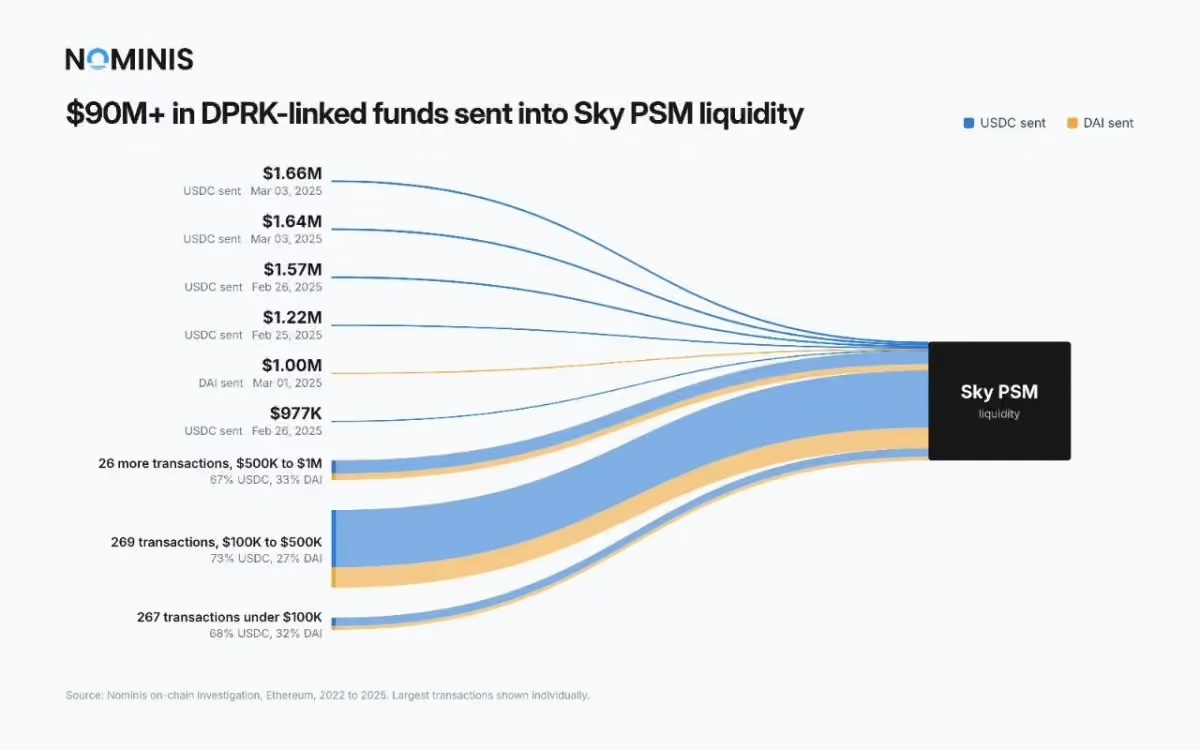
Blockchain wallets associated with the Bybit hacking incident interacting with Sky, source: Nominis
Nominis founder and CEO Snir Levi stated that these transactions align with patterns observed in multiple prior investigations by the firm.
"When they exchange, they choose the protocols with the best liquidity, showing a clear preference for decentralized protocols and assets that cannot be frozen," Levi said, "and they act quickly. The window of opportunity is very short before the funds are converted."
Inca identified a total of 422 wallets that completed 518 million dollars worth of transactions through the PSM, and these wallets are linked to hackers, phishing operations, sanctioned entities, as well as addresses blacklisted by centralized stablecoin issuers Circle and Tether.
These activities are not limited to Bybit. FTX account thieves traded 26.1 million dollars through the PSM during the exchange's collapse in November 2022; on the same day that the payment card issuer Infini was hacked in February 2025, hackers exchanged 49.5 million dollars' worth of USDC for DAI.
Inca explained that these numbers reflect "transactions made by wallets attributed to illegal actors," and they do not necessarily all stem from funds that can be directly traced to a specific incident.
The PSM does not perform any identity checks or transaction screenings. Inca found that 95% of transactions entered through decentralized exchange aggregators, including 1inch, ParaSwap, and MetaMask Swaps.
Inca described the PSM as "an outlet to escape from freezeable USDC."
From DeFi's "Central Bank" to Engaging Institutions
Sky evolved from MakerDAO. MakerDAO was originally an experiment: to create a stablecoin that maintains a value of 1 dollar solely backed by cryptocurrencies (initially just Ethereum). The protocol is governed by a community of Maker token holders, who can vote on proposals.
Early users locked cryptocurrencies into smart contracts as collateral and borrowed DAI. This system came under pressure during the crypto price crash in March 2020, leading to the introduction of the PSM to help stabilize DAI.
Essentially, the PSM is a window through which anyone can exchange Circle’s dollar stablecoin USDC for DAI at a fixed rate of 1:1, so when DAI deviates from 1 dollar, traders can profit from arbitrage, helping restore the price. But it also comes at a cost; the PSM makes the protocol and its stablecoins increasingly reliant on Circle and USDC.
In 2024, MakerDAO was renamed Sky, launching the SKY governance token (which exists alongside the old MKR) and creating a second stablecoin, USDS. At the time, MakerDAO founder Rune Christensen told CoinDesk that the goal was "to scale DeFi to massive levels, as big as Tether, or even bigger."
Its lending model also changed. Sky no longer does everything itself, but collaborates with independent units referred to as "Sky Agents": these units borrow USDS from the protocol and invest the funds into yield strategies, often with traditional financial institutions on the other end. However, the protocol still retains the PSM (now called LitePSM) as one of its supports for its stablecoins.
"Sky's evolution means it embodies characteristics of both systems," said TokenBrice, a pseudonymous founder of the stablecoin risk platform Pharos, "the original Maker model was built on permissionless crypto collateral, while today's Sky increasingly relies on real-world assets and regulated counterparties."
A Single Freeze Could Impact Billions
As crypto theft scales grow, stablecoin issuers have been rapidly freezing stolen funds. After the 6.3 billion dollar Binance theft last month, Binance reported that approximately 2.8 billion dollars of stolen assets have been frozen or intercepted, of which over 2.3 billion dollars are USDT and USDC frozen by Tether and Circle.
This freezing ability of centralized issuers poses a risk to Sky. Its PSM holds approximately 2.7 billion dollars of USDC in a single Ethereum wallet set up via Coinbase Prime. Sky claims that the independent private key of this wallet was destroyed after its establishment, and the PSM controls fund movements.
If Circle blacklists this address, for example, under a court order or law enforcement request, the entire 2.7 billion dollars will become inaccessible. Circle cannot freeze individual amounts within the wallet, meaning legitimate reserves would be frozen alongside funds related to illegal activities.
Amey Dandawate, head of stablecoin ratings at Bluechip Ratings, believes that the possibility of freezing is low but not impossible.
"I think this is a low-probability outcome, but it's not purely hypothetical," he said, citing an example: in May this year, at the request of a California judge, approximately 12 million USDC was frozen in a Zama contract.
He said that freezing Sky's reserve address would simultaneously block the PSM's two-way exchanges and could "have a high-impact chain reaction on DeFi protocols."
Maker has already exposed such risks after the U.S. sanctioned Tornado Cash in 2022 and Circle froze USDC in sanctioned addresses, which raised concerns about whether DAI could still hold up after Circle "froze the PSM." Christensen discussed reducing DAI's reliance on USDC at that time and preparing contingency measures for the extreme case of "Circle freezing the PSM."
An Open Protocol, Who is Responsible?
Ari B. Good, a partner at Cogent who provides sanctions and anti-money laundering (AML) compliance advice to crypto and financial services firms, indicated that the permissionless design of Sky does not necessarily exempt its governance participants from U.S. sanctions law jurisdiction.
The key question is how much control "identifiable individuals" retain over the protocol. A federal appellate court ruling in 2024 involving Tornado Cash determined that immutable smart contracts did not constitute "property" that could be seized under the sanctions authority of the Treasury at that time.
Good stated that if developers or governance participants could upgrade contracts, pause functions, or change the way the protocol operates, the analysis would change.
"Claiming to be 'decentralized' while retaining admin keys, collecting fees, and pushing for upgrades does not count as decentralized in the eyes of sanctions law," he said.
According to governance records reviewed by Inca, Sky governance can vote to modify, migrate, or halt the PSM. Inca added that a governance exception passed in 2024 also allows the facility to be halted without the usual waiting period.
Good mentioned that knowing about illegal activity is also significant. If developers or governance participants are aware that sanctioned actors are using a protocol, yet continue to operate without taking remedial action, they could face greater legal risks.
The global anti-money laundering standard setter FATF stated in a report that when an individual or legal entity exercises "control or sufficient influence" over a DeFi arrangement, that arrangement may be subject to its virtual asset standards.
The report listed the centralization of governance tokens, management authority, control over upgrades, and economic interests as signs that "an ostensibly decentralized system may still have identifiable controllers."
It remains unclear whether Sky itself has a legal obligation to screen every PSM transaction.
He pointed out that the Treasury also noted in a statement that DeFi services engaged in activities covered by the Bank Secrecy Act, regardless of whether they claim to be decentralized, have AML obligations.
Risks Beyond Sky
As Sky's relationship with institutional investors and the broader financial system tightens, its exposure to illegal-related transactions could become a problem for partners and counterparties.
Inca warned that even if reserve freezes do not occur, exchanges, partners, and asset management firms may face compliance scrutiny regarding the source of funds or restrict dealings with Sky.
For example, Galaxy established a strategic partnership with Sky, holding 100 million dollars in sUSDS (a yield-bearing version of USDS) and a number of undisclosed SKY governance tokens. It also accepts sUSDS as loan collateral, while Sky's agent Grove provided Galaxy with a 500 million dollar credit line, funded with USDS. Spokespeople from both Galaxy and Grove did not respond to requests for comment.
Sky also invests funds into other credit strategies through its Sky agents, as well as into on-chain investment funds associated with Securitize, Maple Finance, and Centrifuge's Janus Henderson fund.
Coinbase has another layer of connection. The USDC in the PSM is held in a self-custody wallet set up using Coinbase Prime, and the exchange pays rewards for that balance. According to Inca's report, this address has received deposits from wallets related to illegal activities. A Coinbase spokesperson stated that customers control their self-custody wallets, the exchange cannot move their assets, and the company also collaborates with law enforcement to monitor and report illegal activities.
This exposure is also passed down to public investors through publicly traded companies: the U.S.-listed crypto reserve company Stablecoin Development Corp. held approximately 10% of the SKY token supply and governance voting rights as of the end of June.
"When a funding pool is identified as a potential money laundering conduit for stolen funds, its appeal and viability for institutions decline significantly," Delphi Digital's research director Ceteris told CoinDesk.
Sky Defends Its Open Design
The Sky Frontier Foundation, which supports the Sky ecosystem, told CoinDesk that it "takes any concerns about illegal activities in DeFi seriously." The foundation stated that it has reviewed marked transactions, most of which occurred by value from 2021 to 2024.
It emphasized that Inca's numbers reflect "activities conducted by wallets associated with illegal actors," and are not necessarily traced to specific theft cases. The foundation noted that nearly all transactions appear to enter the PSM via third-party transaction aggregators, with none being processed through Sky's own website, which would screen wallets and restrict access from sanctioned jurisdictions. The foundation added that the marked transactions accounted for less than 0.06% of PSM's over 930 billion dollars in transaction volume, and less than 0.03% of LitePSM's transaction volume.
"Sky Protocol, including DAI and PSM, is open decentralized infrastructure that third parties can access outside of the Sky governance framework," the foundation stated, "ensuring that DeFi is both open and secure is a challenge for the entire industry."
However, the line between "screened entry" and "open protocol" is at the heart of Sky's dilemma. MakerDAO was built on permissionless, cryptocurrency-collateralized lending, but today's Sky increasingly relies on institutional credit and regulated counterparties, placing pressure on its open-access model.
"I look forward to seeing stronger transaction screening, identifiable counterparties at institutional entry points, clearer legal ownership and recourse over reserves, and actionable processes for sanctioned funds and legitimate freeze requests," said TokenBrice, founder of Pharos.
免责声明:本文章仅代表作者个人观点,不代表本平台的立场和观点。本文章仅供信息分享,不构成对任何人的任何投资建议。用户与作者之间的任何争议,与本平台无关。如网页中刊载的文章或图片涉及侵权,请提供相关的权利证明和身份证明发送邮件到[email protected],本平台相关工作人员将会进行核查。


