On the new table where cross-market assets circulate all day long, Binance has revealed its AI trump card.
Written by: ChandlerZ, Foresight News
In the past decade, whether it was cryptocurrency-native trading platforms or traditional internet brokerages, the underlying logic for expansion has been highly consistent: to put more assets on the shelf and deepen the liquidity at the moment of matching buy and sell orders. However, today, as stocks, ETFs, commodities, and cryptocurrency derivatives gradually flow into the same account, the competitive barrier built solely on asset expansion is reaching its ceiling. The strategic battleground for global financial platforms has significantly shifted forward to the long chain before users press the buy button.
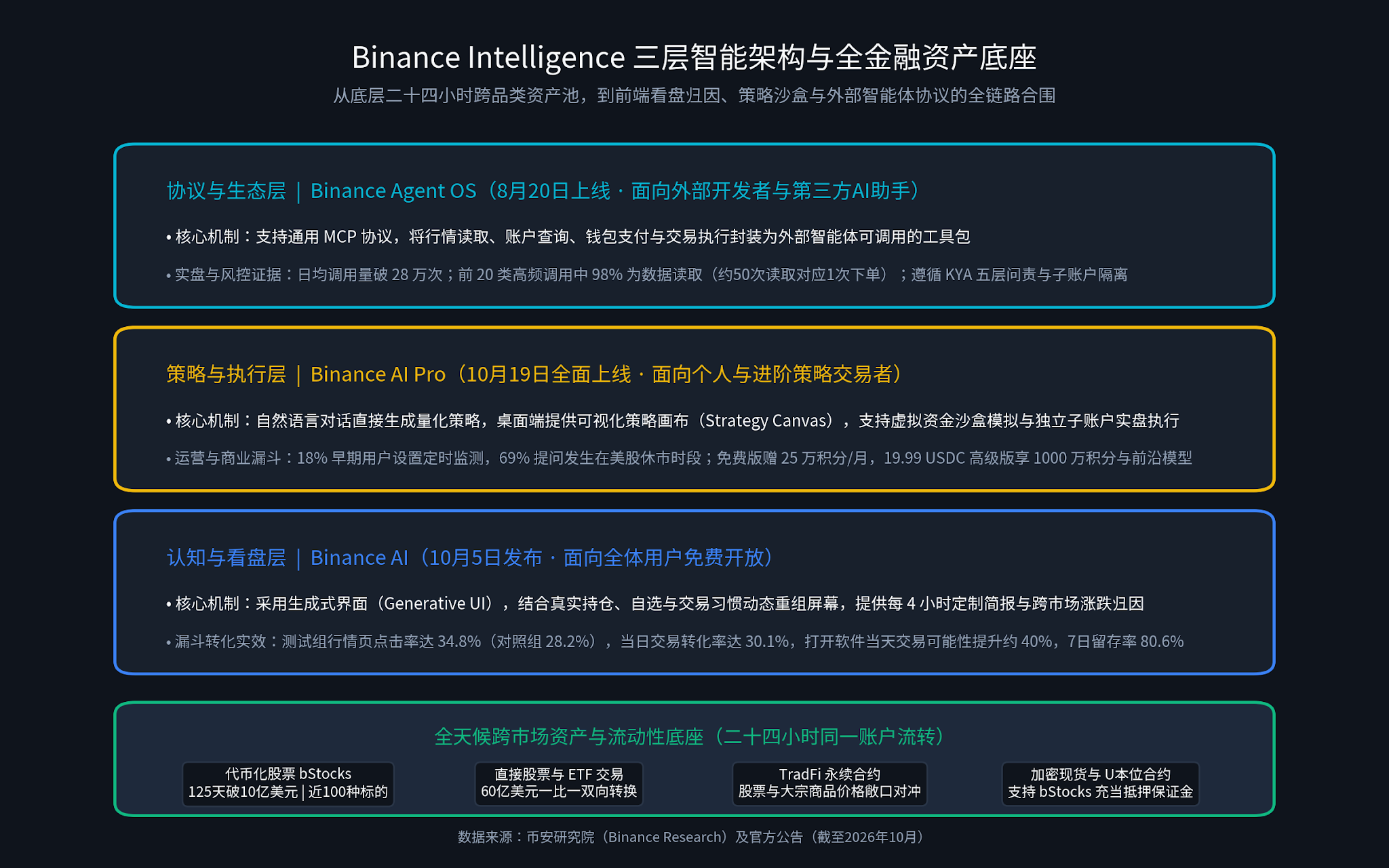
In October 2026, Binance delivered important AI business progress, bringing this strategy to the forefront. On October 5, Binance announced the launch of its AI product stack Binance Intelligence, which includes three products: free Binance AI for all users, Binance AI Pro that converts natural language into executable strategies, and Binance Agent OS for developers to build AI applications.
On October 19, Binance AI Pro was opened to all users globally, covering both the web and Binance App. This is an AI Agent focused on the financial sector, allowing users to describe their trading ideas through conversation, which the system then converts into a visual automated strategy workflow without the need for programming. Strategies can first be tested through simulated trading and, after user approval, be deployed to real trading, with each real-world strategy running in a separate sub-account where funds can only be manually transferred by the user.
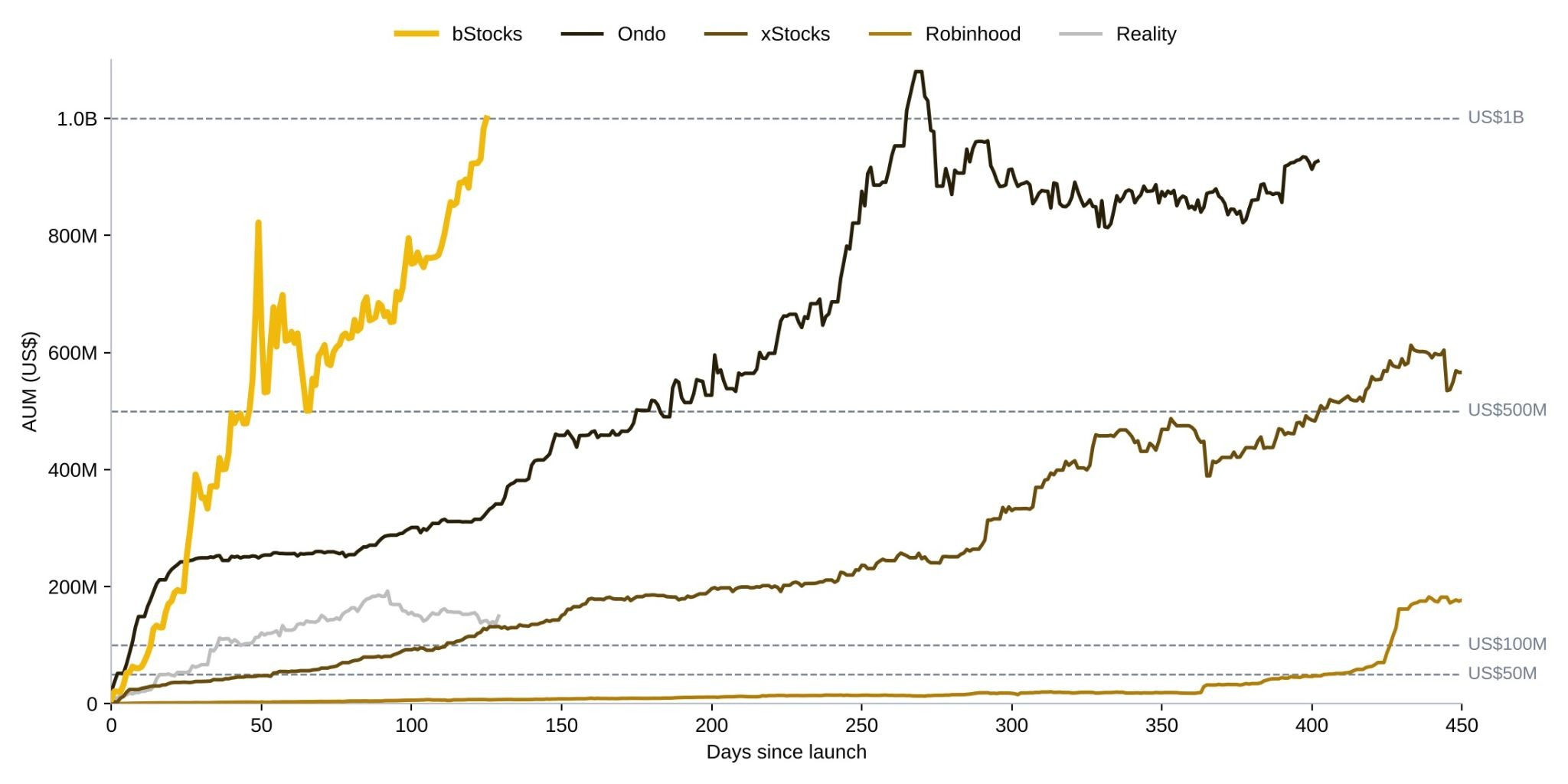
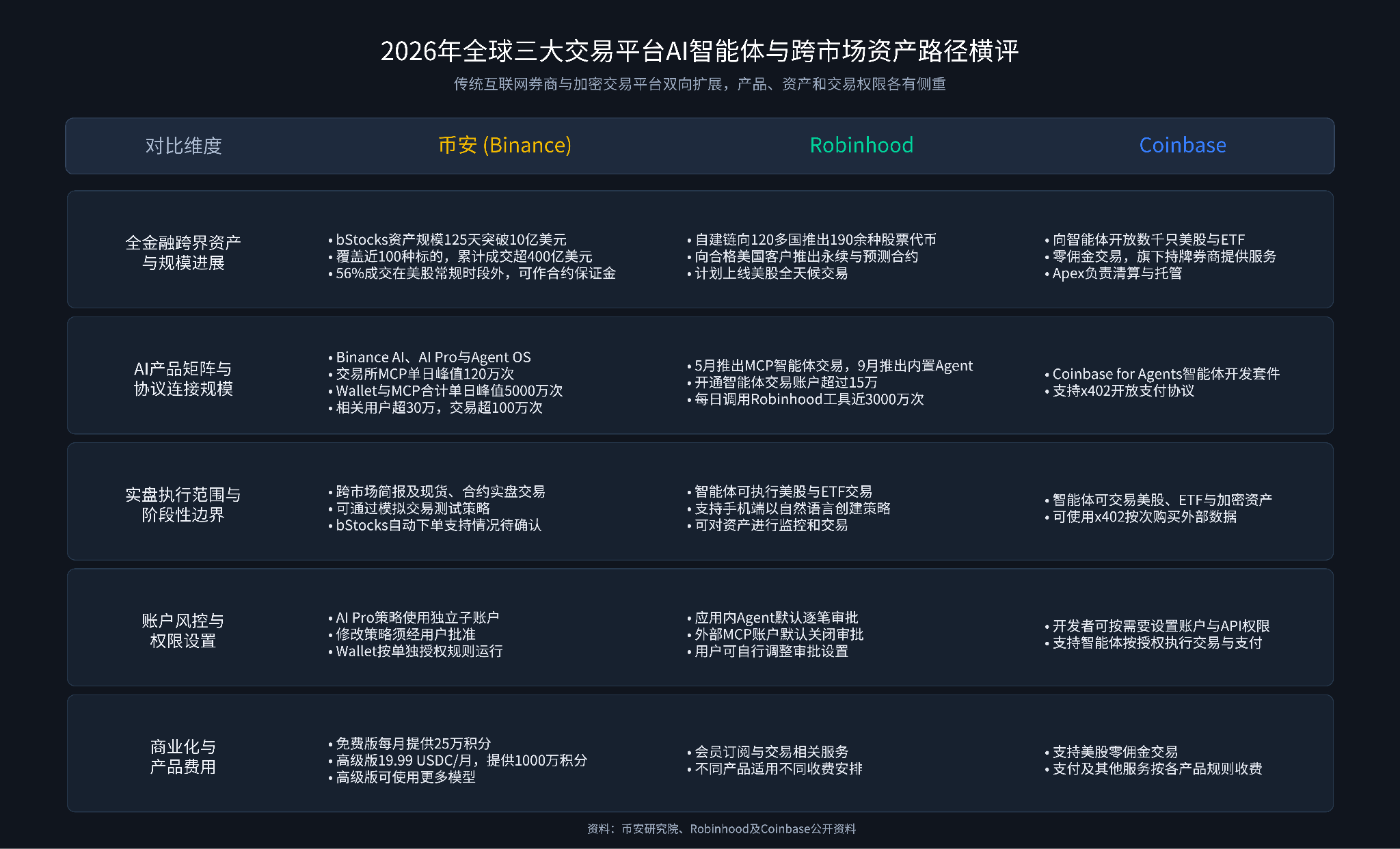
Just a few days before the full opening of AI Pro, Binance also crossed a critical scaling point in connecting traditional financial assets. The tokenized stock product bStocks, launched on June 11 this year, broke through a $1 billion asset management scale in just 125 days, with a cumulative turnover exceeding $40 billion.
These two business lines converged in the same autumn, outlining Binance's strategic chess game in a new cycle and igniting a new round of competition among trading platforms. On one side is Robinhood and Coinbase, intensely stuffing agents, US stocks, and perpetual contracts into the same application, while on the other side, Binance expands its all-weather asset pool with tokenized stocks, using three layers of AI tools to rewrite scanning, testing, and ordering processes. In this pivotal moment where the way humans interact with financial markets is rewritten by large language models, a positional battle around the next generation of global asset trading entry has fully begun.
Global Asset Convergence, the AI Revolution in Trading Rooms
The speed of integrating traditional financial assets into cryptocurrency accounts is faster than the market expected.
Since the beginning of this year, the global tokenized stock market scale has soared from about $700 million at the start of the year to over $3 billion by the end of September, becoming the fastest-growing real-world asset class in 2026. In this wave, Binance's bStocks reached a scale of $500 million in just 46 days, and crossed the $1 billion threshold on the 125th day, taking less than half the time of another major issuer in the same track, Ondo (265 days), while another platform, xStocks, took 403 days to reach $500 million.
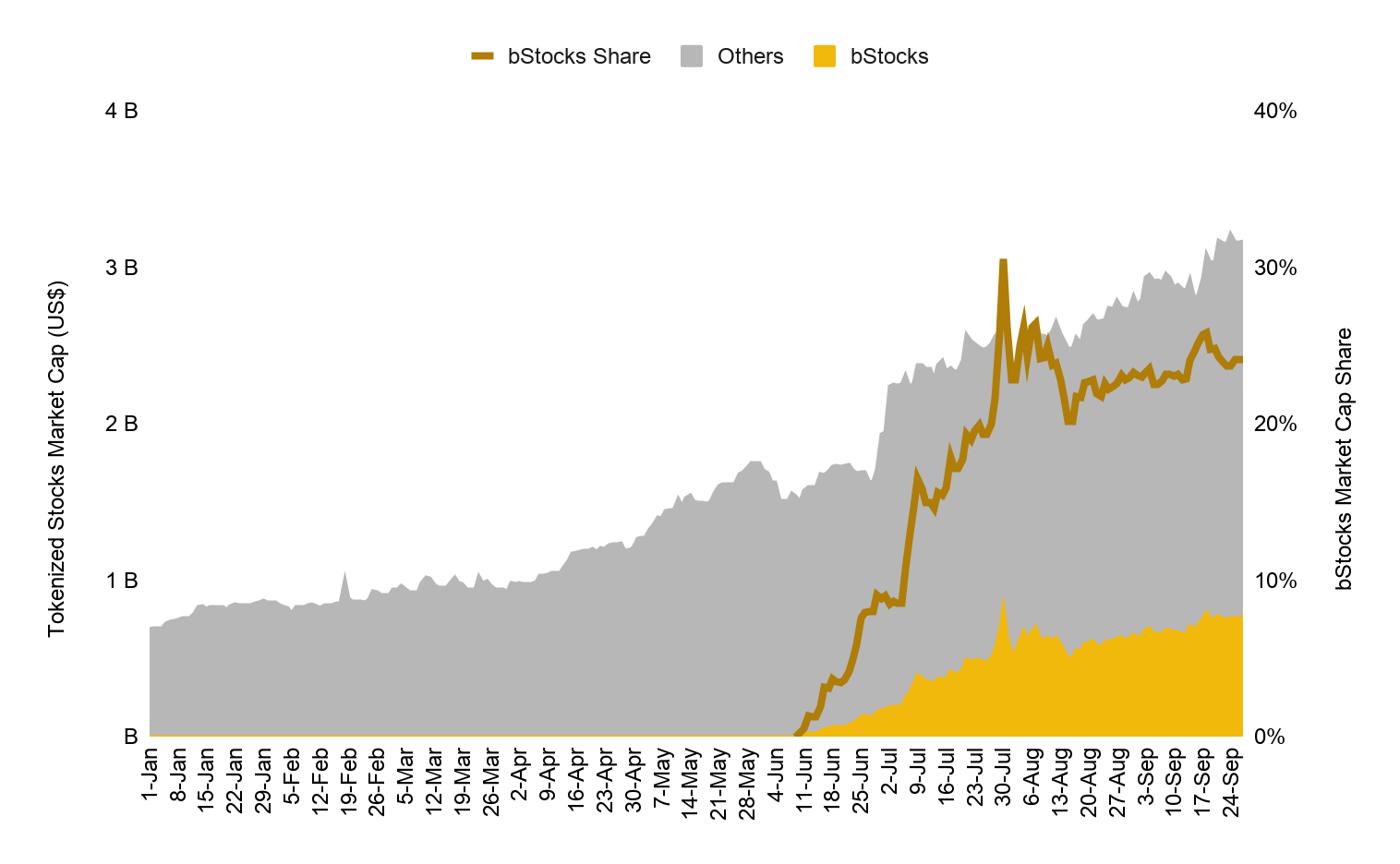
In just four months, the number of bStocks assets expanded from 5 to nearly 100 US stocks and ETFs, contributing over 60% of the entire tokenized stock market’s growth during the same period, with its market share jumping from less than 1% to 34.2%.
Furthermore, these assets linked to US stock economic exposure have been frequently integrated into all-weather trading. Data shows that the one-to-one conversion scale between direct stock holdings and bStocks has reached $6 billion, with about 56% of transactions occurring outside regular US stock trading hours. By October 19, approximately 17% of bStocks equivalent to an active management scale was deployed in decentralized finance protocols for lending or providing liquidity. In terms of user demographics, the younger Generation Z accounted for 46% of total bStocks users, with 11.5% of them trading on weekends, significantly higher than the 6.9% level of other age groups.
As nearly 100 types of US stock exposures, commodity contracts, and cryptocurrency assets pulse simultaneously in a 24-hour market, traditional market software, used for over a decade, immediately reveals its shortcomings. Facing a stream of public information arranged by popularity, ordinary investors find it challenging to figure out in a few minutes how an after-hours tech stock report or macro news over the weekend relates to their holdings spanning US stocks and Bitcoin.
To digest this cross-market complexity, Binance has turned over more than 100 AI model experiences accumulated in internal risk control and compliance systems over the past few years into the user-facing Binance Intelligence system.
At the first layer, starting from October 5, is the free Binance AI made available worldwide. It abandons the fixed software layout, adopting generative interface technology to dynamically reorganize screen content based on each account’s real holdings, watchlist, and knowledge level, consolidating charts, news, social sentiment, and on-chain data into the same access point, generating customized text and audio briefings every four hours.
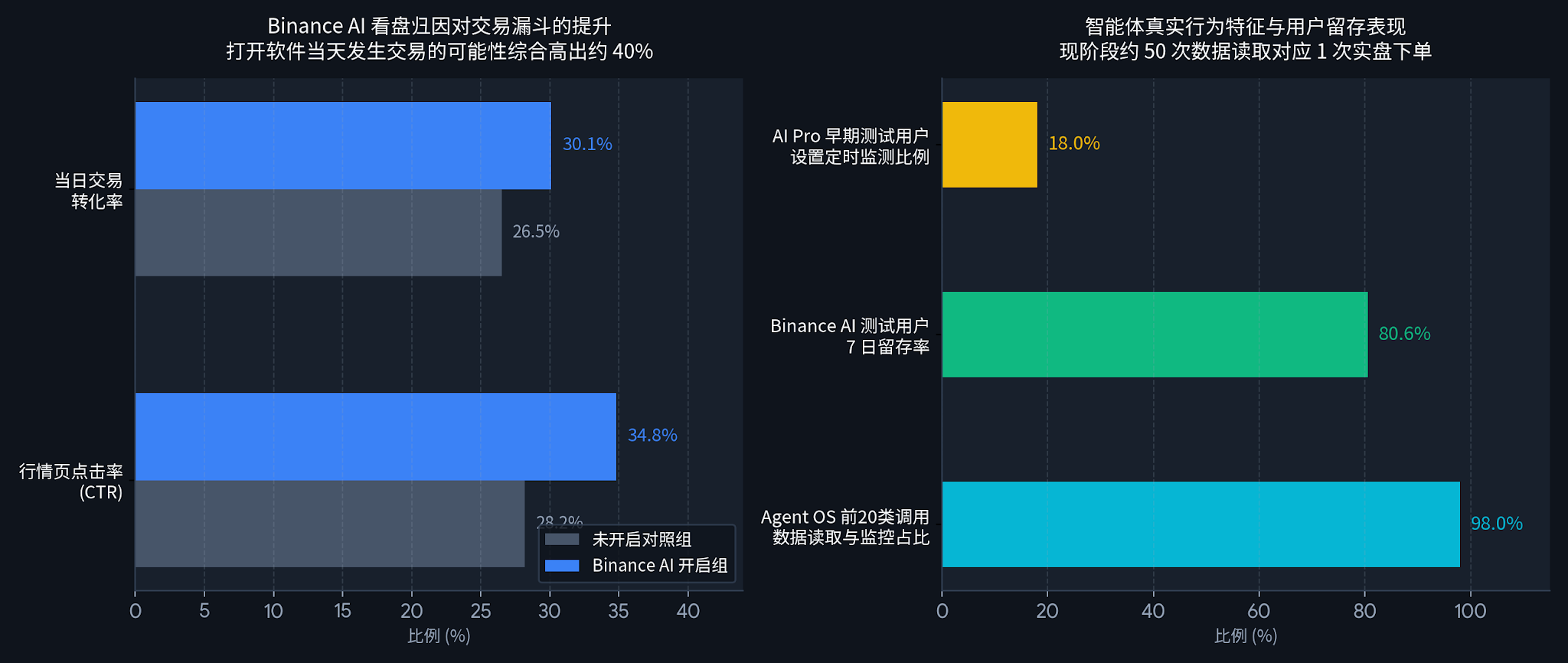
According to Binance Research’s comparison test as of October 4, this set of tools directly drove the conversion of the trading funnel, with the click-through rate of the market page for the test group users reaching 34.8%, higher than the control group's 28.2%, and the daily trading conversion rate rising from 26.5% to 30.1%. The overall likelihood of users trading on the day they opened the software was about 40% higher, and the seven-day retention rate remained high at 80.6%.
Once users understand the market, the next step is turning their trading ideas into automated strategies. Binance AI Pro specifically targets personal investors who do not know how to code. Users can describe target assets, buying and selling conditions, and risk limits in everyday language within a dialogue box, and the system will call upon Binance's internal market research and external data sources to automatically fill in missing parameters.
On the desktop, AI Pro generates a visual flowchart named Strategy Canvas beside the chat window, allowing users to click on any module to check details, modify parameters, or add or remove steps. On mobile, the entire building and code generation process is completed entirely through conversation. Each user can run up to 10 strategies simultaneously, covering simulated trading, real trading execution, or signal alerts. Internal testing statistics show that 18% of early test users have used it for scheduled monitoring or daily report tasks, with 69% of inquiries occurring during the US stock market's off hours.
External Agents Forcing Open the Ledger
If Binance AI and AI Pro are transforming the internal experience of Binance software, then the developer infrastructure Agent OS, launched on August 20 this year, aims to respond to a more radical trend: an increasing number of traders are leaving traditional software interfaces and starting work directly in external AI assistants.
This change is also related to how AI tools connect to external services. The Model Context Protocol (MCP) provides a unified connection method for AI applications to call external data and tools. For example, users can have their AI assistants query market conditions, read account information, or submit trade instructions within the authorized scope. With tools like Claude, ChatGPT, and programming assistants being used to handle investment tasks, the entry points for users to obtain information and interact with their accounts are also increasing.
Binance opens market reading, account querying, order submission, and wallet-related capabilities to external agents through Agent OS. When using the exchange’s MCP service, users are required to scan a code to log in and complete identity verification. According to provided data, the peak daily call volume for just the MCP service of Binance's centralized exchange business has reached 1.2 million.
The intelligent agent service of Binance Wallet similarly requires code scanning for login and identity verification, allowing users to authorize agents to use the on-chain wallet within the specified range. Driven by Agent ID activities, the total daily peak for Wallet-related calls combined with exchange MCP calls can reach 50 million. In terms of user scale, the relevant users have exceeded 300,000; among them, each Wallet user can create one Agentic Wallet, and with identity verification, the users can be recognized.
On the trading level, the number of trades related to agents has exceeded 1 million, with contributions from both Web3 and centralized exchange businesses. In a real-world case disclosed by Binance, trader Crypto Eagle integrated Agent OS with the external programming agent Codex, issuing instructions in natural language to buy BNB with USDT. After the order is confirmed by the user, the system returns the average transaction price, fees, and the latest balance.
When external software begins to touch real funds, the boundaries of authority and responsibility immediately become the sword of Damocles over all financial institutions. In this regard, Binance and American internet brokerages present starkly different risk control orientations.
At the end of May this year, Robinhood launched an agent trading feature based on the MCP protocol, allowing users to connect third-party agents to specially designated brokerage accounts. Robinhood later rolled out in-app agent features, enabling users to set manual approval for each transaction, with this option defaulted to be turned on and adjustable by the user.
Binance, on the other hand, chose a more cautious principle of limited autonomy. In October this year, Binance's global policy team published a compliance framework report titled “Know Your Agent” (KYA), responding to the runtime safety framework (SAFR) launched by the Monetary Authority of Singapore in July this year, as well as the UK's financial AI adoption plan. This report proposed that beyond traditional KYC, the financial industry must establish a five-layer accountability mechanism to strictly differentiate the analytical recommendation powers of agents from their trade execution powers.
This concept is directly written into the underlying code of AI Pro and Agent OS. In Binance's system, agents used solely for market research do not have access to trading permissions, and any strategy approved for real trading must operate in a dedicated sub-account isolated from the main account. Users must manually transfer funds to sub-accounts, as AI cannot autonomously allocate principal from the main account, nor is it permitted to initiate withdrawals to external addresses. Every time a strategy parameter is modified, it must go through manual approval again, and users can always press an emergency stop button to cut off all connections to external agents.
The All-Financial Platform Competition in the AI Era
Looking further back, it becomes clear that Binance’s intense card play in autumn 2026 is part of a bidirectional siege by leading global trading platforms. Traditional internet brokerages are aggressively entering the fields of cryptocurrency derivatives, all-weather trading, and on-chain tokenization, while cryptocurrency trading platforms are also cutting in on stock assets and agent access.
The most aggressive offensive comes from Robinhood. After launching stock tokens based on derivative contracts in Europe last year, Robinhood launched its self-built blockchain mainnet on July 1, offering over 190 types of on-chain stock tokens backed one-to-one by real stocks to wallet users in more than 120 countries worldwide. On September 29, Robinhood CEO Vlad Tenev announced that since opening third-party agent trading in May, 150,000 customers have activated agent trading accounts, with nearly 30 million calls to Robinhood tools every day.
Another crypto giant, Coinbase, is cutting in from the compliance side of US stocks and micro payments. After launching its agent tools in June this year, Coinbase officially opened zero-commission trading on thousands of US stocks and ETFs for its agent service by late September, with clearing custody handled by its licensed broker and Apex. More uniquely, Coinbase tied stock trading to its x402 payment protocol, allowing AI agents to purchase externally paid data directly using USDC stablecoin in the account without interrupting tasks or requiring manual credit card input or key management. As of September, the x402 protocol has processed over 230 million transactions, totaling over $54 million, and market data provider Massive has integrated with this protocol, enabling agents to buy real-time US stock data for a few cents and immediately complete an order within the same closed loop.
In this multi-faceted melee, Binance holds two trump cards that opponents find difficult to replicate in the short term. The first is an enormous scale of real liquidity and cross-scenario asset reuse. bStocks not only achieved a trading depth of $40 billion in four months but also allowed users to use it as collateral for contracts, leading to an increase in the outstanding loan ratio from 5.5% at the end of June to 46.2% by mid-September for the bStocks assets deposited as collateral. This efficiency of capital reuse across spot, contracts, and on-chain protocols within the same account is challenging for traditional brokerages to reach.
The second trump card is based on a user base of 300 million for commercial funneling. Binance designed a clear points measurement system, allowing all users to receive 250,000 points each month for building and testing strategies for free, with a premium version costing 19.99 USDC per month that increases the limit to 10 million points, unlocking access to cutting-edge large models such as ChatGPT Sol, ChatGPT Astra, and Claude Opus, as well as point recharge permissions, through Binance Pay. High-frequency monitoring tasks and automated strategies will continuously consume points, thus naturally converting active traders into paid subscribers and generating stable software service revenue beyond traditional trading fees.
From Every Transaction, Into Daily Investment
Looking back from the point of the fourth quarter of 2026, the competitive dimensions of global financial trading platforms have changed completely.
In the past, there were clear boundaries between different platforms: looking at US stocks from brokerages, buying Bitcoin from cryptocurrency exchanges, writing quantitative strategies on specialized code hosting platforms. Now these boundaries are simultaneously melting away. bStocks depositing over $1 billion in assets within four months proves the speed at which on-chain infrastructure can support traditional equity exposures, while the rollout of Binance Intelligence’s three-layer products marks Binance's systematic takeover of investment research and engineering work before users press the trading button.
Of course, this positional battle around AI and the all-finance landscape has only just entered the deep waters, but an irreversible trend is already etched on the table. As financial markets become a precision machine operating 24 hours a day, the era of solo struggles by individuals relying solely on personal effort is coming to an end. Those who can use safer agents to help ordinary people process complex information across markets will be able to transform the reasons why users open software from occasionally buying and selling an asset into truly managing daily investments.
免责声明:本文章仅代表作者个人观点,不代表本平台的立场和观点。本文章仅供信息分享,不构成对任何人的任何投资建议。用户与作者之间的任何争议,与本平台无关。如网页中刊载的文章或图片涉及侵权,请提供相关的权利证明和身份证明发送邮件到[email protected],本平台相关工作人员将会进行核查。


