Recently, Anthropic is going public, and people are concerned not only about the issuance price but also a more practical question: how do AI companies actually make money, and how high is the market willing to value them? Let's start by discussing its business.
Founded in 2021, Anthropic includes many former core members of OpenAI in its founding team, with Claude being the most familiar product they have created.
Like ChatGPT, it supports conversation creation, document organization, and code processing; however, in the past two years, Claude has excelled in programming scenarios and enterprise implementation.
Developers can use it to debug code and locate bugs, and enterprises can utilize it to batch process massive documents, conduct data analysis, and build automated office processes. Companies are willing to pay for tangible efficiency gains, which is also the core reason the capital market is keeping an eye on this AI startup.
Now let's take a look at the core data for this IPO.

According to the prospectus, a total of 825 million Class A common shares will be issued, including newly issued shares as well as existing shares for sale, with an initial pricing range of $70–78. Based on the upper limit of $78, the total issuance could reach approximately $64.35 billion; it should be clarified that this figure is not the net fundraising amount the company will receive.
In addition, there are seven tech giants including NVIDIA, Google, Microsoft, and AMD, who have pledged to subscribe to approximately $26 billion of another type of share at the IPO price, with NVIDIA also being among these investors.
Anthropic's training and execution of large models rely heavily on vast GPU computing power, and NVIDIA is the most crucial link in the entire AI computing power supply chain. Model vendors depend on computing power for their operations, and power vendors are getting a steady stream of orders from the AI wave, creating increasingly close business connections, with investments from model companies also influencing upstream power vendors.
People are also concerned about its commercialization progress.
Publicly disclosed information shows that as of the end of October 2026, Anthropic's annualized revenue run rate is approximately $81 billion. It is important to clarify that this is an annualized metric based on current revenue and does not reflect already realized annual revenue. This figure also indirectly confirms that the pace of commercialization for leading AI companies is accelerating.
Now, when the market assesses an AI company, it is no longer just a competition of model capability; factors like corporate paying customer base, sustainable income, and whether this income can withstand high computing power investments must be considered as a whole.
Is rapid income growth necessarily a good deal in terms of valuation?
The initial valuation suggested by Anthropic was already high, with reports indicating that demand for subscriptions before the IPO was very strong, and underwriters are also assessing the possibility of raising the issue price. However, as of the live broadcast, the official issue price has not yet been finalized, and the higher quoted prices circulating in the market are merely speculative.
A reminder: A high valuation merely indicates that the market is betting on its long-term growth potential, not that the current pricing necessarily provides value for money. Anthropic will need to continue investing heavily in power procurement, talent acquisition, and model development. If revenue growth cannot keep up with the ongoing cash burn, the valuation could easily be under pressure; however, if product advantages remain stable and corporate clients continue to expand, the market may still offer a higher premium.
Thus, this IPO is essentially a stress test for the entire AI industry: How much is the capital market willing to pay for the distant future of AI companies?
Now let's turn our attention to NVIDIA's latest financial report.
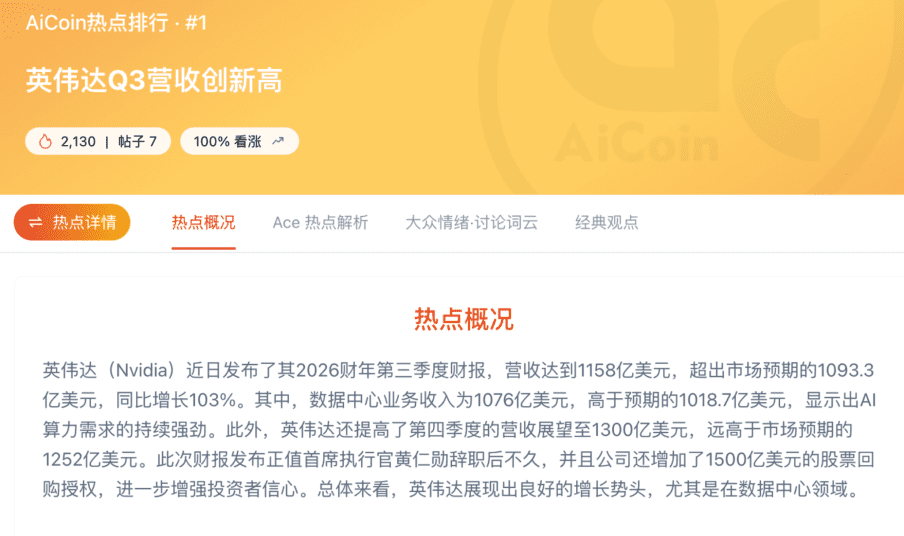
The fiscal year noted in the graphic is incorrect; it should be corrected to the third quarter of the 2027 fiscal year, according to NVIDIA's official disclosure.
This quarter, NVIDIA's revenue reached $115.8 billion, a year-on-year increase of 103%; among this, the data center business revenue was $107.6 billion, a year-on-year increase of 110%, which accounted for the vast majority of its revenue. Tech giants such as Microsoft, Google, and Amazon continue to ramp up investments in building AI data centers, and the resulting influx of GPU and server orders directly reflects in these results.
This quarter's GAAP gross margin is 74.8%, with a net profit of $65.3 billion and earnings per share of $2.70, indicating strong profitability. However, the gross margin guidance for the next quarter has been adjusted down to 71%–72%, below the current level; even though the company projects next quarter's revenue guidance to reach $130 billion, the decline in profit margins remains a signal to watch.
Additionally, the new generation Vera Rubin NVL72 has started shipping, with future focus on tracking customer delivery and large-scale deployment of data centers.
In the third quarter, NVIDIA returned $28.1 billion to shareholders, and as of the end of the quarter, there remains approximately $227.3 billion in share buyback authorization.
In summary, three core points from this financial report: the demand for computing power remains robust, the new generation of hardware is entering the delivery phase, but the guidance for gross margin in the next quarter is weakening. The real concern for the market is whether NVIDIA can continue to deliver results that exceed expectations.
Recently, after the news of Jensen Huang's resignation submission spread, NVIDIA employees, investors, and partner companies all voiced their support, with online petitions appearing, hoping he could return to the CEO position.
This is not difficult to understand; since founding NVIDIA in 1993, in thirty-three years, Jensen Huang has led the company from the graphics chip race to the pinnacle of the AI computing wave, remaining the soul of the company. Huang has also stated that if the board determines that this move aligns with the company's and all shareholders' interests, he is willing to resume the CEO position.
However, on November 17, board chairman Harvey Jones gave a clear response: the board has unanimously accepted the resignation request, and there are currently no plans to reinstate him. The board has begun the selection process for a new CEO, with former CFO Colette Kress serving as interim CEO.
At the same time, NVIDIA is also facing investigations related to export controls. Jensen Huang is expected to attend a hearing in front of the relevant committee of the U.S. House of Representatives on December 1, and the follow-up developments are worth continuous tracking.
Looking ahead, there are three unresolved questions surrounding NVIDIA: Who will ultimately be appointed as the new CEO? Will the congressional inquiries release new variables? Can the interim CEO stabilize the company's operational rhythm and maintain core client orders?
This management upheaval is far from over, and personnel changes may subtly alter the market's long-term valuation of NVIDIA.
In the past two years, giants like Microsoft, Google, Amazon, and Meta have continuously poured significant amounts into AI, including data center infrastructure, GPU clusters, and supporting power facilities, all necessitating enormous capital expenditures. Everyone harbors the same question: When will this investment begin to pay off?
If enterprises are willing to consistently pay for AI services, the initial heavy asset investment will have an opportunity to yield returns. Conversely, even if the user base continues to expand, if revenue does not keep up with growth and GPU cluster utilization is low, the large investments can become a heavy financial burden.
Looking ahead at the AI industry's prosperity, I will focus on three indicators: capital expenditure intensity, commercialization revenue, and computing power utilization rate. Are the giants still expanding production? Can the willingness of corporate clients to pay be stabilized? Are the procured computing resources truly being utilized rather than sitting idle in data centers?
Along the mainline of computing power, what other directions in the AI industry chain deserve our continuous attention?
In addition to GPU main chips, I will also focus on four supporting aspects:
1. HBM (High Bandwidth Memory): To match the massive data throughput requirements of AI chips;
2. Optical modules and high-speed networks: To facilitate high-speed communication between numerous GPUs within data centers;
3. Power supply and cooling solutions: To support stable electricity supply and temperature control for high-power AI data centers;
4. Cloud computing and data center services: To provide on-demand computing power for small and medium enterprises without self-built computing capabilities.
Of course, a thriving sector does not guarantee that related assets will rise in price; it ultimately depends on the real orders materializing, revenue realization, and the match between valuation.
Looking forward, an unavoidable question in the AI industry is whether these investments can translate into stable cash flows. AI Agents also represent a highly promising application direction moving forward. When viewed in the context of the cryptocurrency market, AI innovations open new avenues of narrative, but short-term trends still have to be assessed in conjunction with the macro environment and funding situation, and decisions should not rely solely on thematic speculation.
Risk Disclaimer: The above is merely industry information sharing and does not constitute any investment advice, nor promises returns.
We have live broadcasts every day, welcome to keep following AiCoin friends! Reserve your spot in advance 👇
https://www.aicoin.com/zh-Hans/live/list?tab=upcoming
Join our community, let's discuss and grow stronger together!
Official Telegram community:
AiCoin Chinese Twitter:
Hype rebate:
https://app.hyperliquid.xyz/join/AICOIN88
Binance rebate【Referral Code: aicoin668】:
https://jump.do/zh-Hans/xlink-proxy?id=3
Coinbase rebate【Referral Code: Y8L23JL】:
https://jump.do/xlink?checkProxy=true&proxyId=25
免责声明:本文章仅代表作者个人观点,不代表本平台的立场和观点。本文章仅供信息分享,不构成对任何人的任何投资建议。用户与作者之间的任何争议,与本平台无关。如网页中刊载的文章或图片涉及侵权,请提供相关的权利证明和身份证明发送邮件到[email protected],本平台相关工作人员将会进行核查。