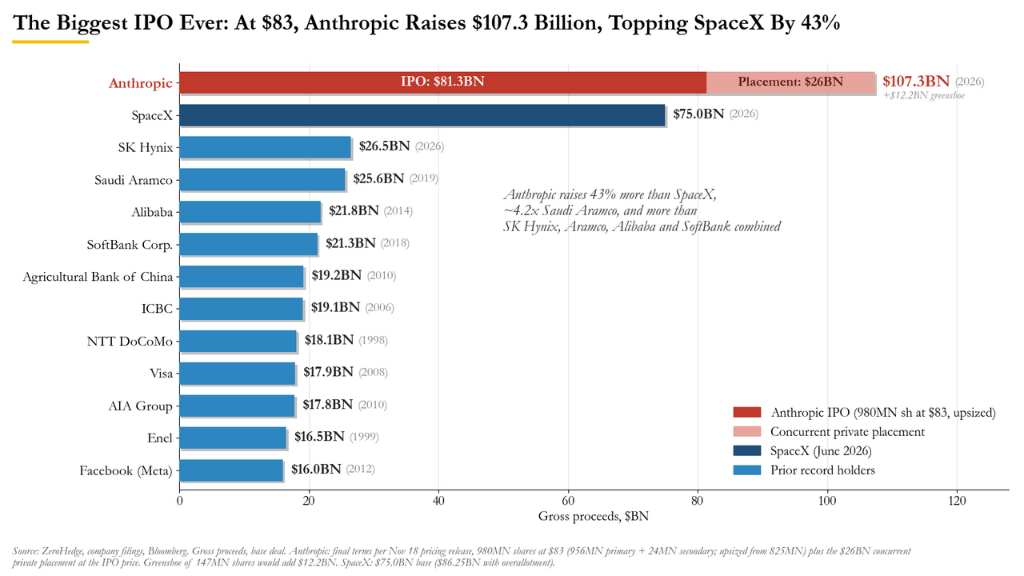
According to reports from American media, Anthropic priced its IPO at $83 per share, raising over $107 billion, setting a new record in global IPO history.
Written by: Bao Yilong, Yang Chen, Wall Street Watch
The artificial intelligence company Anthropic has completed the largest IPO in history, pricing above the issuance range and raising a total far exceeding all previous records, marking a formal extension of capital market bets on the AI field from chip infrastructure to cutting-edge model platforms.
On Wednesday, Anthropic priced its Class A common stock IPO at $83 per share, approximately 6.4% above the upper limit of the issuance range of $78, while expanding the issuance scale from 825 million shares to 980 million shares, an increase of about 19%.
Analysts believe that the pricing strategy is intended to let the stock price increase by 20% post-IPO, thus breaking the $100 mark. Should expectations not be met or the closing price drop, investors need to be cautious.
The company and its founders raised approximately $81.3 billion, combined with $26 billion from seven tech giants like Google and Nvidia in private placements, bringing the total amount raised to over $107 billion, about 24% more than SpaceX's IPO record from June this year.
The underwriters also received an overallotment option to purchase up to an additional 147 million shares within 30 days ("green shoe"), which if fully exercised, would further increase the total fundraising to approximately $119.5 billion.
Based on a fully diluted basis, this issuance is expected to value the company at approximately $1.5 trillion. The stock is expected to list on Nasdaq on Thursday, November 19, with the ticker symbol "ANT".
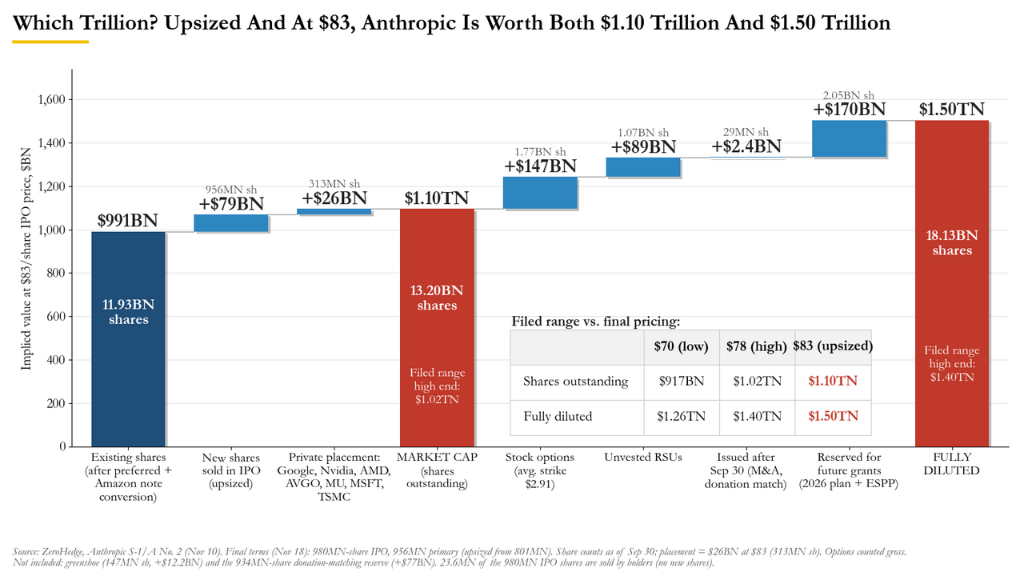
According to calculations by ZeroHedge, based on the share price of $83, after the transaction is completed, the number of outstanding shares will be approximately 13.2 billion, with a market value of about $1.1 trillion, which will also be the figure used by index providers, higher than the pre-increase valuation of $1.08 trillion.
Adding the 1.77 billion employee stock options, with an average exercise price of $2.91, the 1.07 billion unvested restricted stock units (RSUs), and the 2.05 billion shares not yet granted, the final fully diluted market value is calculated at $1.5 trillion.
Subscription Boom, Pricing Above Range
According to Bloomberg, the order scale for Anthropic's IPO neared seven times the shares available for issuance, with institutional investors from Wall Street, London, and Tokyo vying to subscribe. Bankers indicated to potential investors that existing shareholders would have priority in allocations, with some buyers potentially receiving allocations below expectations.
Ultimately, the company raised the issuance scale from the initially planned 825 million shares to 980 million shares, overall expanding the issuance scale by approximately 19%.
Of these, Anthropic itself sold about 956.4 million shares, with the seven co-founders collectively selling about 23.65 million shares, approximately 3.38 million shares each, netting about $280 million each at $83 per share, totaling about $2 billion for the seven.
The underwriters also received an overallotment option to purchase up to an additional 147 million shares within 30 days ("green shoe"), which if fully exercised, would further increase the total fundraising to approximately $119.5 billion. This IPO is co-led by Goldman Sachs and Morgan Stanley, along with participation from 20 other banks.
Valuation Geometry: $1.1 Trillion or $1.5 Trillion
The market value figures for Anthropic show significant variation due to differing metrics.
Based on the post-pricing outstanding shares, the actual market value is approximately $1.1 trillion; if including the 1.77 billion employee stock options (average exercise price of approximately $2.91), 1.07 billion unvested RSUs, and 2.05 billion reserved shares yet to be granted, the fully diluted valuation is approximately $1.5 trillion.
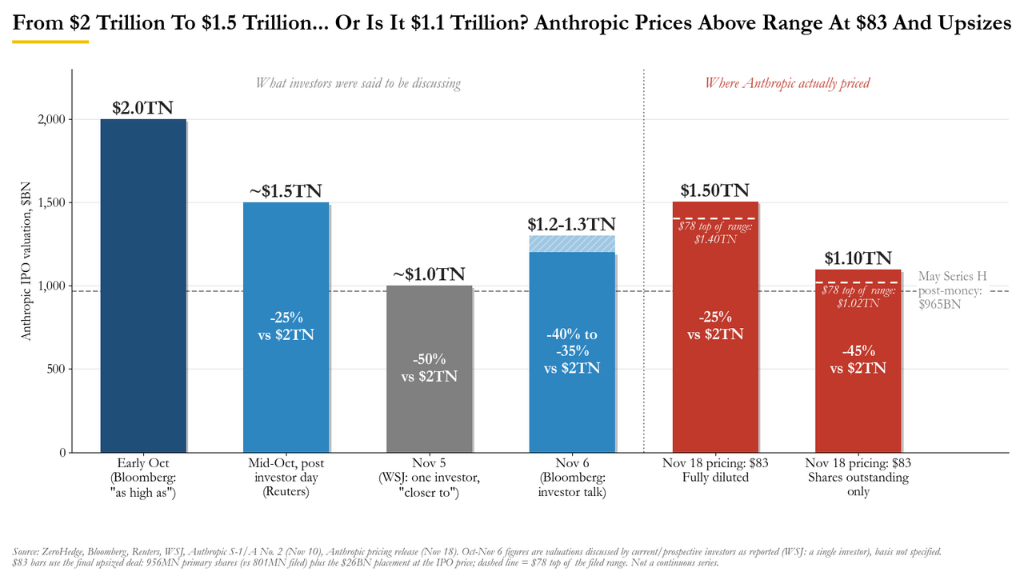
In comparison, this valuation is about 25% lower than the "over $2 trillion" figures circulating in the market in early October this year (fully diluted basis), but roughly 55% higher than the $965 billion valuation during the Series H financing in May this year, aligning closely with the "over $1.5 trillion" target previously pushed by bankers according to the Financial Times.
According to Bloomberg data, with a fully diluted valuation of $1.5 trillion, Anthropic would rank among the top 15 listed companies globally by market value, roughly on par with Tesla and surpassing Eli Lilly.
Supplier Equity: The Logic of $26 Billion Circular Capital
A notable structural feature of this IPO is the source composition of the $26 billion private placement. The seven companies subscribing to this class N stock are Google and Nvidia each contributing $10 billion, along with AMD, Broadcom, Micron, Microsoft, and TSMC.
It is noteworthy that these seven companies are also suppliers of chips or cloud computing to Anthropic. This means that the $26 billion "investment" may actually flow back as payments for computing resource bills.
Since Google had previously made related commitments, the actual "new" funds may be closer to $16 billion, potentially nearing zero when the chip procurement costs are deducted.
Additionally, nearly half of Anthropic's revenue is sold through the cloud computing market channels of these large-scale cloud service providers, which also constitute the primary source of its accounts receivable, with the identities of suppliers, customers, and shareholders highly overlapping.
Financial Reality: One-Time Profit and Trillion-Dollar Bills
Behind the impressive fundraising figures, Anthropic's financial data shows several pressure signals.
According to its revised prospectus, third-quarter revenue grew by 47% quarter-on-quarter to $16.96 billion, although the growth rate sharply slowed from 144% in the second quarter.
During the same period, a $567 million operating loss was recorded, following a historical first operating profit of $974 million in the previous quarter, with the current quarter shifting back to a loss primarily due to a rise of about $5 billion in short-term computing resource procurement costs. Additionally, pricing incentives and discounts resulted in a revenue decrease of about $600 million in Q3.
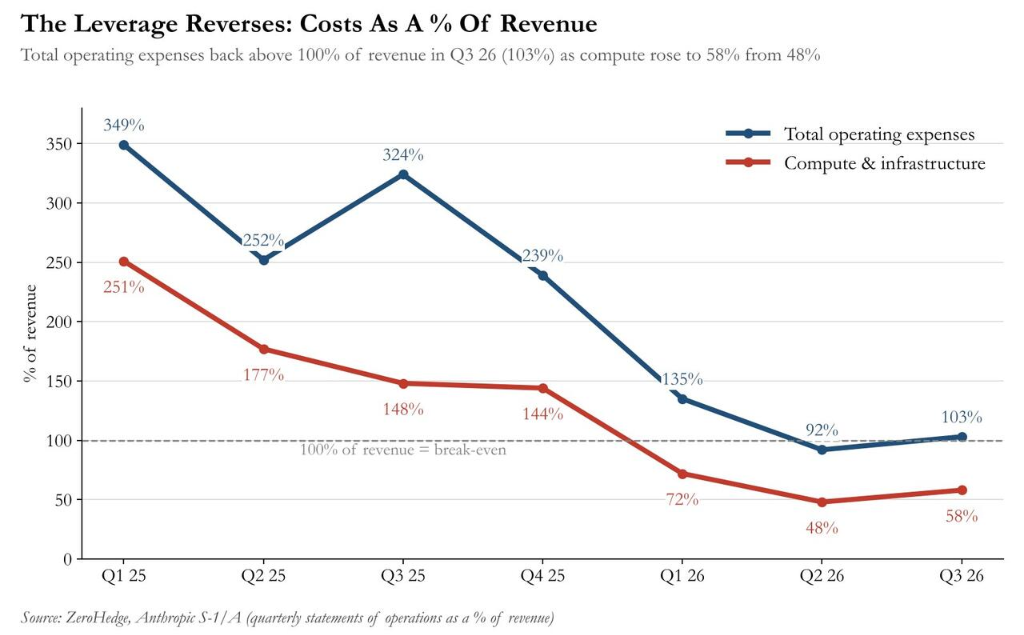
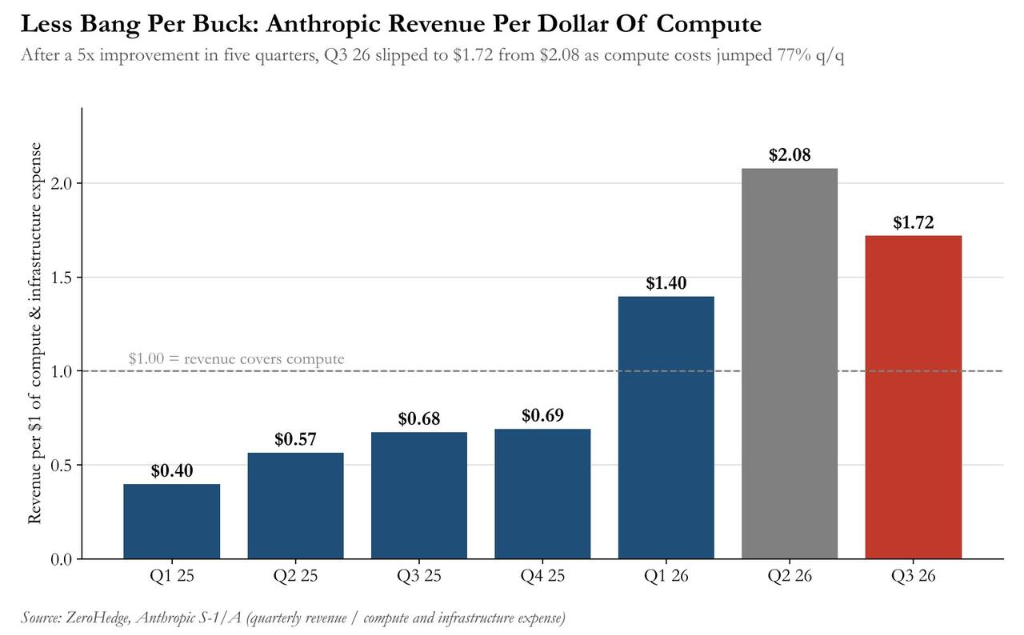
The improvement in operating leverage reversed within a single quarter: total operating expenses returned to 103% of revenue, with computing and infrastructure costs accounting for revenue rising from 48% to 58%.
Revenue generated per $1 spent on computing resources dropped to $1.72, down from $2.08 in the previous quarter.
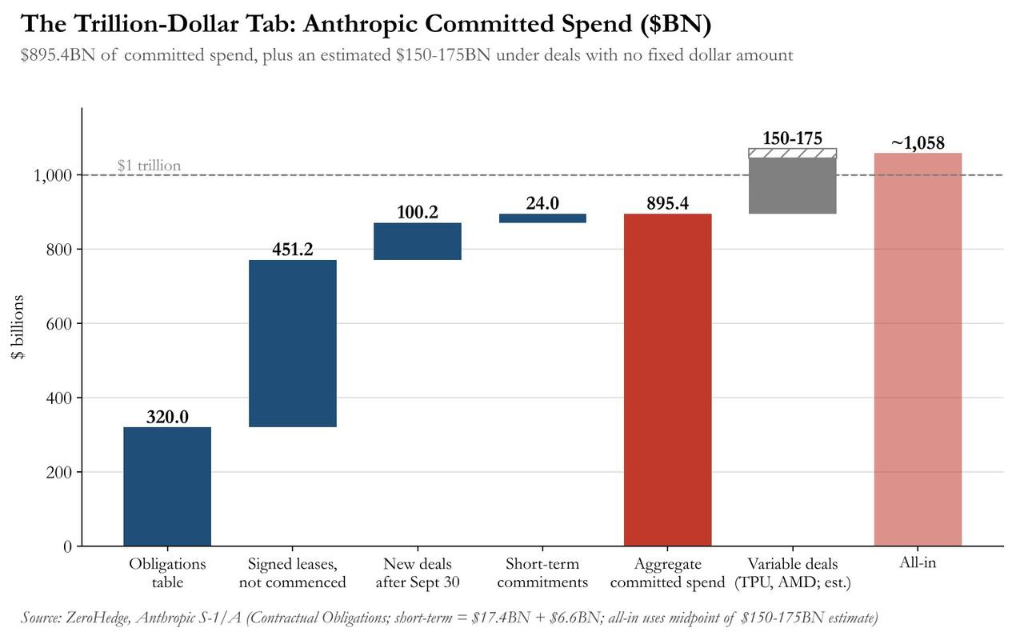
Greater pressure comes from committed expenditures. Taking into account all contractual obligations, signed but not yet started leases, and short-term commitments in the prospectus, Anthropic's total committed expenditures are approximately $895.4 billion, with an additional $150 billion to $175 billion originating from indefinite amount agreements, totaling close to a trillion dollars.
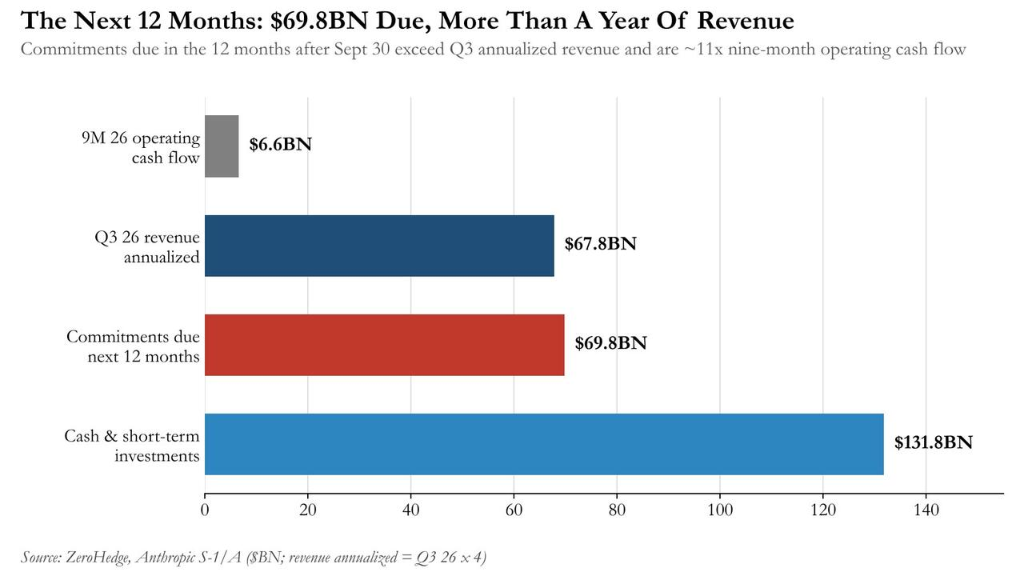
Of this, $69 billion will mature in the next 12 months, exceeding the annualized revenue level for Q3 and is about 11 times the operating cash flow for the first nine months.
Limited Shareholder Voice in Public Markets
Public market investors acquiring Class A shares must also accept Anthropic's unique equity structure:
- Seven co-founders hold a single Class F stock, enjoying 51% of the fixed voting rights;
- The long-term benefit trust holds a single Class T stock, enjoying the right to nominate four of the seven directors;
- Class A shareholders' voting rights are restricted to under 49.9%, having no substantive impact on board seats.
- Amazon and Google hold approximately 12% and 14.99% of shares, respectively, but have no voting rights;
- Class N shares convert to Class A shares immediately upon sale.
Moreover, the Public Benefit Fund has special dilution provisions: whenever the share price increases by 50% compared to the IPO price, the fund may receive up to 2% of the company's shares, with the first trigger point at around $124.5 per share. This means potential dilution will initiate exactly when the stock performs strongly.
H.C. Wainwright analyst Mike Colonnese believes that Anthropic's successful IPO will become "an important valuation benchmark for the AI industry."
Peter Thiel's partner Jack Selby expressed another concern, stating that if Anthropic's IPO performance is poor, it could trigger a "massive valuation correction" in the AI industry, especially after the lock-up period expires.
免责声明:本文章仅代表作者个人观点,不代表本平台的立场和观点。本文章仅供信息分享,不构成对任何人的任何投资建议。用户与作者之间的任何争议,与本平台无关。如网页中刊载的文章或图片涉及侵权,请提供相关的权利证明和身份证明发送邮件到[email protected],本平台相关工作人员将会进行核查。


