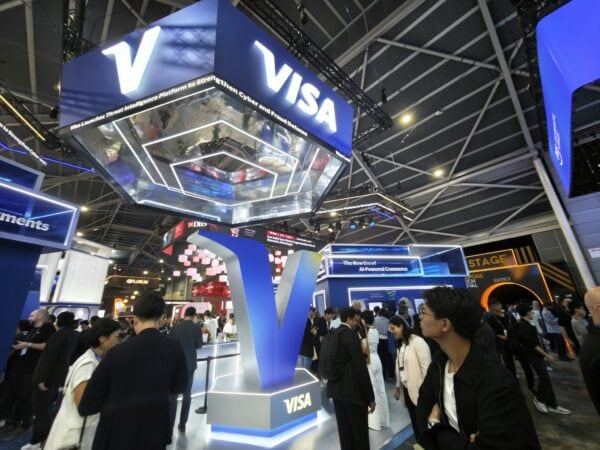
On November 18, Visa announced four new releases at the Singapore FinTech Festival, two of which are closely related to Hong Kong: users of Samsung Wallet in Singapore and Australia can scan to pay at Alipay+ merchants in Hong Kong, while Bank of China Hong Kong, Hang Seng Bank, and ICBC Asia participate in AI agent transaction testing. Visa also announced the launch of the Threat Intelligence Platform (VTIP) in the Asia-Pacific region and the expansion of Visa Direct's stablecoin prepayment feature to regional pilots.
The four services announced by Visa are at different stages of development, with Scan to Pay already launched in specified markets, VTIP officially launched in the Asia-Pacific region, while the second phase of Agentic Ready and Visa Direct stablecoin prepayment are still in the testing stage in the region. The progress of each service and its relevance to Hong Kong is as follows:
Scan to Pay connects to Alipay+ allowing Hong Kong merchants to utilize QR payment systems for overseas wallet payments
Visa partnered with Ant International's Alipay+ to launch Scan to Pay, enabling Samsung Wallet users in Singapore and Australia to use eligible Visa cards to scan and pay at Alipay+ merchants in Hong Kong and Malaysia. Additionally, Google Wallet users visiting Singapore from supported markets can also use eligible Visa cards to scan and make payments at local Alipay+ merchants.
This new partnership increases the channels for the retail and food and beverage industries in Hong Kong to receive payments from overseas travelers, eliminating the need for designated overseas wallet payment systems. However, currently, only eligible users of Samsung Wallet from Singapore and Australia can use this service in Hong Kong, limiting its coverage. Visa indicated that it will expand to more wallets and destination markets in the future but did not provide a specific timeline or disclose the number of supported merchants in Hong Kong or if related merchant transaction fees would change.
Neil Lu, Chief Product Officer of Alipay+, noted that Alipay+ aims to connect digital wallets, card organizations, various payment systems, and merchants to create a seamless payment ecosystem across different markets. The collaboration with Visa allows merchants to reach more overseas customers and supports cross-border travel and business activities.
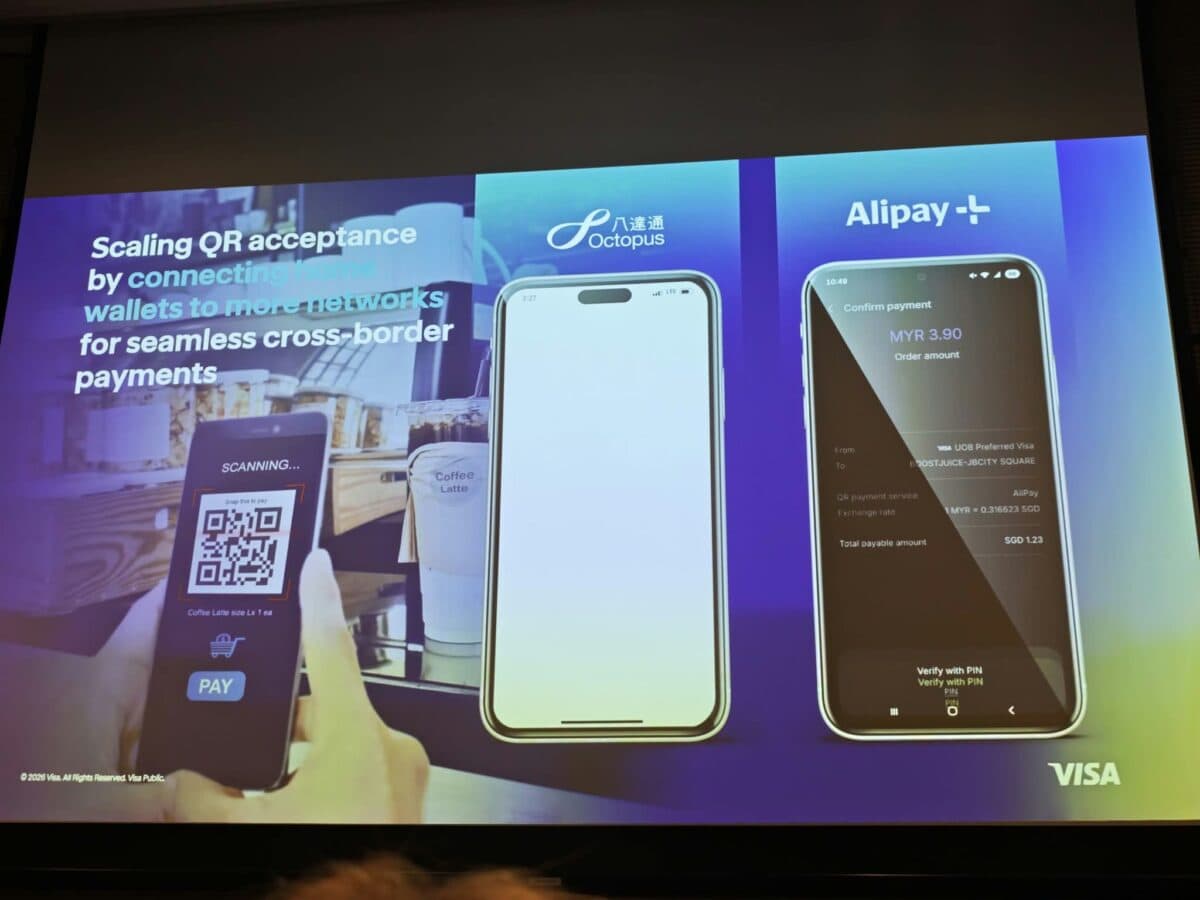
This is Visa's recent expansion of the QR Code payment network in Hong Kong. Visa previously announced a partnership with Octopus, allowing travelers using apps such as Hyundai Card, Woori Card, Samsung Card, and VNPT Money to scan and make payments at Octopus QR Code merchants. Along with this Alipay+ integration, Visa Scan to Pay has now connected to two local QR merchant networks in Hong Kong, although the overseas wallets supported by both networks differ.
Agentic Ready enters the acquiring phase with Bank of China Hong Kong, Hang Seng, and ICBC Asia participating in AI agent transaction testing
Visa announced the expansion of the Agentic Ready program to its second phase, shifting the focus from issuing institutions to merchant acquiring and transaction processing systems. Participating institutions include Bank of China Hong Kong, Hang Seng Bank, and ICBC Asia, helping assess whether the existing payment infrastructure can securely process Visa transactions initiated by AI agents.
The first phase of Agentic Ready was launched in April 2026 in the Asia-Pacific region, focusing on testing the preparedness of issuing institutions to process AI agent transactions in a controlled, production-grade environment, with participation from over 100 issuing institutions across 10 markets to date. The second phase includes over 50 institutions such as acquiring institutions, payment service providers, payment gateways, and designated merchants, and Visa expects more partners to join by 2027.
The testing covers the identification of trustworthy AI agents, as well as supporting product searches, checkouts, and after-sales services led by AI agents. The payment systems must also assess tokenized payment credentials, authentication, and transaction processing capabilities.
For instance, when consumers authorize an AI agent to search for products and complete payments, merchants must identify whether the transaction request comes from a trusted agent, verify the agent's operational permissions, and ensure that current payment and after-sales processes can handle the relevant transactions. Participating institutions will evaluate their existing systems with Visa to identify deficiencies through real-world testing.
In addition to the aforementioned three banks in Hong Kong, the list of acquiring partners also includes AsiaPay and Airwallex, with enabling partners including SHOPLINE, Eats365 POS, and Reap Technologies.
T.R. Ramachandran, Visa's Senior Vice President of Products and Solutions for the Asia-Pacific region, stated that to broaden the application of AI agent transactions, merchants and payment service providers must possess secure and reliable transaction processing capabilities while retaining control over the customer experience. Agentic Ready can assist institutions in evaluating their current systems in preparation for future support of AI agent shopping and payments.
For merchants in Hong Kong, participating acquiring institutions provide the opportunity to assess whether their payment and order processing systems can accommodate AI agent transactions. However, Agentic Ready is still a testing and preparation program; this announcement does not indicate that Hong Kong merchants officially support AI agent payments, and consumers cannot directly use the related services yet.
VTIP Threat Intelligence Platform integrates cybersecurity and payment fraud data
On the same day, Visa launched the Visa Threat Intelligence Platform (VTIP) in the Asia-Pacific region, integrating cyber threat intelligence with payment risk data to help financial institutions identify potential cyber attacks that may evolve into fraud and financial losses.
VTIP includes five intelligence modules targeting indicators of malware intrusions in the financial sector, vulnerability intelligence related to institutions, brand impersonation detection, digital identity threat intelligence directed at management and staff, and financial intelligence. The financial intelligence module can collect payment credential data leaked from channels such as the dark web and combine it with VisaNet data to help risk management teams assess the relationship between threats and payment transactions.
Visa stated that the company intercepts approximately 90 million cyber attacks and 11 million phishing emails every month across its networks in over 200 countries and regions. These figures were provided by Visa's Chief Information Security Officer during an interview with CSO Online and are self-disclosed data by the company. VTIP will make some of the threat intelligence capabilities originally used to protect the Visa network available to financial institution clients.
Visa also announced the results of a 2026 Asia-Pacific survey conducted by Forrester Consulting commissioned by the company. Among them, 60% of managing personnel at surveyed financial institutions indicated that fraud techniques have become more complex over the past 12 months, 57% noted that the speed of fraudulent activities has increased, and another 44% pointed out that fraud has begun appearing earlier in customer process stages. Surveyed institutions recorded an average payment-related fraud loss of $12.8 million during the same period, equivalent to approximately HKD 100 million.
The survey also found that only 37% of the surveyed institutions used real-time decision-making or adaptive fraud management, while 63% considered the lack of analysis, intelligence, and real-time decision-making capabilities a significant or serious challenge.
Serene Gay, Senior Vice President of Value-Added Services at Visa Asia-Pacific, pointed out that cyber attacks are becoming more frequent and targeted, making it difficult for financial institutions to detect threats early, which can ultimately evolve into fraud. VTIP consolidates the two types of intelligence to enable financial institutions to take action before relevant threats cause financial losses.
Visa Direct stablecoin prepayment expands in Asia-Pacific with Singapore's dtcpay as the first pilot
Visa Direct will expand the stablecoin prepayment feature to the Asia-Pacific region, allowing eligible businesses to use supported stablecoins to pre-fund cross-border payments issued via Visa Direct, with the final recipient still receiving fiat currency.
Visa Direct's global money transfer network connects over 18 billion endpoints. The new feature provides businesses with an additional choice when managing short-term liquidity and cross-border payment funds. Rhidoi Krishnakumar, Visa Direct manager for the Asia-Pacific region, stated that stablecoin funding helps businesses manage cross-border liquidity more effectively and optimize treasury and operational fund management.
Visa began testing stablecoin prepayment and payment functionalities in 2025 and officially launched commercial operations in the U.S. in October 2026 with Inyo Global. The current stage in the Asia-Pacific region involves a pilot with Singapore's digital payment company dtcpay, utilizing supported stablecoins to pre-fund cross-border fiat currency payments issued via Visa Direct.
Visa emphasized that the company does not provide regulated digital asset services; such services are independently provided by licensed digital asset partners. Whether businesses can use related features also depends on eligibility and location.
Visa has not announced any companies participating in the pilot in Hong Kong, nor has it provided a timeline for services in Hong Kong, so it cannot be considered that Hong Kong enterprises can use stablecoin prepayment for cross-border payments via Visa Direct at this time.
This article is reproduced from unwire.pro, and the copyright belongs to the original author and original media.
免责声明:本文章仅代表作者个人观点,不代表本平台的立场和观点。本文章仅供信息分享,不构成对任何人的任何投资建议。用户与作者之间的任何争议,与本平台无关。如网页中刊载的文章或图片涉及侵权,请提供相关的权利证明和身份证明发送邮件到[email protected],本平台相关工作人员将会进行核查。


