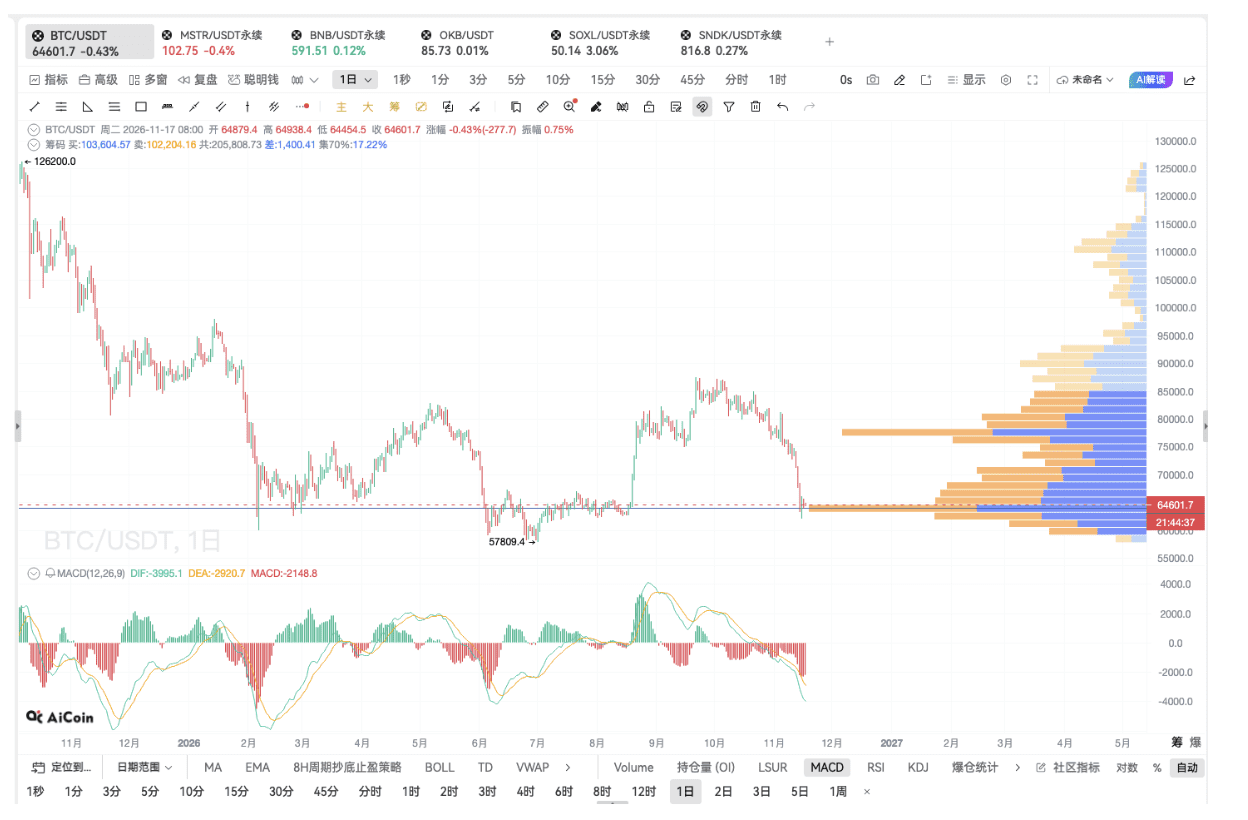
On November 17th, Eastern Time, the latest funds data for the U.S. Bitcoin spot ETF showed a significant reversal: According to statistics from SoSoValue and Farside Investors, the entire market recorded approximately $240 million in net outflow that day, with BlackRock's IBIT accounting for nearly $209.5 million of that on a single day, becoming the absolute leader in capital withdrawal. Despite the overall outflow pattern, funds were not exiting entirely; Morgan Stanley's MSBT recorded a net inflow of about $2.9 to $2.9263 million, and Grayscale's Bitcoin Mini Trust ETF (BTC) also saw a net inflow of about $1.1299 million, continuing its accumulation characteristic as shown by its historical net inflow of approximately $839 million. On the same trading day, the U.S. Ethereum spot ETF also experienced a net outflow of about $29.1 million, indicating that both Bitcoin and Ethereum ETF products were "bleeding" simultaneously. Given that the Bitcoin spot ETF was approved for listing in January 2024 and daily fund data is viewed as a key emotional indicator, this dual net outflow combination was interpreted by the market as a signal of a more cautious risk preference in the cryptocurrency sector in the short term.
$240 Million Outflow in One Day: Bitcoin ETF Funds Hit the Brakes
Understanding the overall net outflow of about $240 million on November 17th within the context of Bitcoin spot ETF development adds significant reference value to the contraction of funds. Since its approval for listing in January 2024, the U.S. Bitcoin spot ETF has rapidly become a key channel for institutional and individual participation in Bitcoin, with daily fund flows remaining relatively stable on most trading days, often displaying structural differentiation between products. The direct recording of approximately $240 million in single-day net outflow implies that funds did not merely rotate from one product to another, but rather were withdrawn from the sector at a broader level in the form of redemptions; this "sharp brake" is a significant event in this year's daily data.
From a statistical perspective, both SoSoValue and Farside Investors provided a consistent estimate of the net outflow scale for the U.S. Bitcoin spot ETF on November 17th, pointing to a market-level outflow of around $240 million, enhancing the reference value of this data as an indicator of fund sentiment on that day. This type of fund data is a routinely updated statistical result based on trading days and carries a quantitative aspect of fund preferences and allocation directions, rather than a direct attribution to a single cause. Current public information does not indicate any significant redemptions by a particular institution or any specific event that led to this outflow, and in the absence of confirmed incentives, attributing it to "some negative news" or the actions of specific entities exceeds the boundaries of the data itself. For the spot ETFs that have become the main entry point for Bitcoin, such a prominent overall single-day net outflow is typically viewed by the market as a signal of a phase shift towards a more conservative risk preference, rather than a normal internal rebalancing between products.
IBIT Leads the Withdrawal: Major Product Net Redemption Amplifies Signals
Looking at specific products, the funds withdrawn on November 17th were almost entirely attributed to BlackRock's IBIT. According to statistics from Farside Investors, IBIT recorded about $209.5 million in net outflow that day, accounting for the vast majority of the overall net outflow of about $240 million for Bitcoin spot ETFs. Considered one of the largest and most influential products among U.S. Bitcoin spot ETFs, it had previously maintained a high cumulative net inflow, serving as the "leading sample" for observing market participation willingness. In this context, the rare significant net redemption of IBIT is often interpreted as a temporary contraction in exposure from major funds, rather than scattered adjustments by fringe products.
Due to the lack of specific triggering factors in the current public information, this large net outflow cannot simply be attributed to a specific news event or the actions of a single institution. However, general situational hypotheses are still worth investors' reference: for instance, during fluctuations in macro interest rate expectations, economic data disturbances, or heightened regulatory discussions, some funds may choose to reduce leverage through leading products temporarily; following a period of rising Bitcoin prices with overall holdings in a high floating profit range, concentrated redemptions may also merely represent planned profit-taking or reallocation among products. Regardless of the hypothesis, the key is that the withdrawal from IBIT as the main channel amplifies external interpretations of short-term trends and confidence changes, making the $240 million overall net outflow on this day resemble an observation sample of an emotional inflection point that requires ongoing tracking, rather than dismissible daily noise.
MSBT and Grayscale Mini Trust Attract Funds Against the Trend
In stark contrast to IBIT's net redemption of over $200 million that day, Morgan Stanley's MSBT recorded approximately $2.9 million (Farside) to $2.9263 million (SoSoValue) in net inflow on November 17th, making it one of the Bitcoin spot ETFs with a notable net inflow that day. Against the backdrop of an overall net outflow of about $240 million, this "counter-trend" data indicates that funds were not retreating uniformly from all products but rather exhibited structural redistribution between products, with some funds opting to flow from established leading products to newer products with more competitive fees and channels.
From the accumulated data perspective, MSBT has absorbed approximately $839 million in historical net inflows since its launch, continuing to maintain positive accumulation amidst multiple rounds of market fluctuations and funding volatility this year, reflecting a trend of medium to long-term funds consistently allocating Bitcoin through this channel. On the same trading day, Grayscale's Bitcoin Mini Trust ETF (BTC) recorded a net inflow of about $1.1299 million, and while its scale is less than that of MSBT, in a situation where both Bitcoin and Ethereum ETFs are "bleeding," these two net inflows together reveal a signal: funds are not simply withdrawing from this asset class but are making more refined choices among different product structures and fee levels, illustrating that "risk preference cooling" and "selective channel accumulation" can coexist on the same day.
Sympathetic Outflow of Bitcoin and Ethereum ETFs on the Same Day
On November 17th, a synchronized withdrawal of funds in Bitcoin and Ethereum ETFs was observed: statistics from SoSoValue and Farside Investors showed that the Bitcoin spot ETF had a total net outflow of approximately $240 million that day; at the same time, BlockBeats cited Farside data indicating that the U.S. Ethereum spot ETF also experienced an overall net outflow of about $29.1 million. Since Bitcoin and Ethereum are the two core varieties in the cryptocurrency market, their ETFs have become key channels for institutions and individuals to allocate these two assets, and this "dual core variety ETF outflow on the same day" is naturally interpreted as a phase of cooling in risk preference at the sector level rather than an isolated event for a particular asset.
However, relying solely on fund flow data to infer cross-asset emotional resonance has both value and limitations. On one hand, daily net outflows reflect actual subscription and redemption actions and provide direct reference value for observing whether funds are systematically reducing risk exposure; the simultaneous significant net outflows for Bitcoin and Ethereum ETFs on the same trading day indeed increase the probability of "broad risk preference cooling." On the other hand, in the absence of performance data for the spot prices that day, specific details of institutional operations, and clear macro or industry events, such connections can currently only be regarded as synchronized contractions at the fund level and cannot simply be elevated to trends or conclusions driven by single causes. Overall, the simultaneous net outflow of Bitcoin and Ethereum spot ETFs on November 17th serves as an important clue for observing sentiment in the cryptocurrency sector, but it still needs to be validated as a stronger risk preference signal in conjunction with subsequent fund data and more complete information.
Next Steps for Crypto ETFs Amidst Fund Differentiation
On November 17th, the overall net outflow of approximately $240 million for the U.S. Bitcoin spot ETF saw BlackRock's IBIT contribute about $209.5 million, while Morgan Stanley's MSBT and Grayscale's Bitcoin Mini Trust ETF (BTC) recorded net inflows, with MSBT's historical cumulative net inflow reaching approximately $839 million. This reflects not a uniform retreat of funds from the entire sector, but rather a structural redistribution from leading products to later entrants with advantages in terms of fees and channels, as well as differentiated strategic products. Since its approval in January 2024, the Bitcoin spot ETF has become a key tool for institutions and individuals to allocate Bitcoin. In the absence of daily price paths, specific institutional actions, and official comments, fund flows themselves remain an important window for observing market sentiment and allocation behavior; interpretations must, however, clearly acknowledge their boundaries based on limited data. Based on the data from November 17th, more importantly, is not to provide a single cause, but to continue tracking the net inflows/outflows, fee adjustments, scale changes, and holding structure evolution of each product, dynamically calibrating allocation preferences based on the time series from reliable public data sources such as SoSoValue, Farside, and BlockBeats. What truly deserves attention is the relative changes in funding scale, fee structures, and holding structures of various crypto ETFs over time, rather than any "dramatic" single day data itself.
Join our community, let's discuss, and get stronger together!
Exclusive Hyperliquid benefits for AiCoin: https://app.hyperliquid.xyz/join/AICOIN88
Exclusive Aster benefits for AiCoin: https://www.asterdex.com/en/referral/9C50e2
On-chain Telegram community: https://t.me/AiCoinWhaleData
On-chain community: https://www.aicoin.com/link/chat?cid=N6OVMor5g
AiCoin on-chain Twitter: https://x.com/aicoinwhaledata
免责声明:本文章仅代表作者个人观点,不代表本平台的立场和观点。本文章仅供信息分享,不构成对任何人的任何投资建议。用户与作者之间的任何争议,与本平台无关。如网页中刊载的文章或图片涉及侵权,请提供相关的权利证明和身份证明发送邮件到[email protected],本平台相关工作人员将会进行核查。