Original Author: Bao Yilong
Original Source: Wall Street Insider
In just one week, several key systems in the United States have faced consecutive failures, from Microsoft's productivity software, nationwide flight grounding, and disruption of trading at JPMorgan Chase, to the paralysis of the U.S. National Security Agency's confidential network and widespread disruption of Apple services. This series of technological failures is shaking public confidence in core digital infrastructure and has pushed the question of "whether legacy systems can withstand the rapid iteration pressures of the AI era" to the forefront.
On Tuesday, the National Security Agency (NSA) confirmed that its NSANet network used for internal confidential communications was briefly interrupted due to routine software maintenance, affecting some employees' access to work systems, prompting the agency to implement staggered work arrangements.
At the same time, Apple Inc. experienced widespread service outages due to internal update operations, affecting the employee portal, internal login system, and remote work VPN channels, while retail store sales, repair, and customer service operations were also forced to halt. Apple stated that the issues were not a result of a cyberattack, and most systems have since been restored.
The FBI issued a FLASH (Fast Action) level security alert on the same day, warning that cybercriminals and state-linked hackers are exploiting the AI penetration framework ARTEX, further amplifying market concerns about the vulnerability of technological infrastructure.
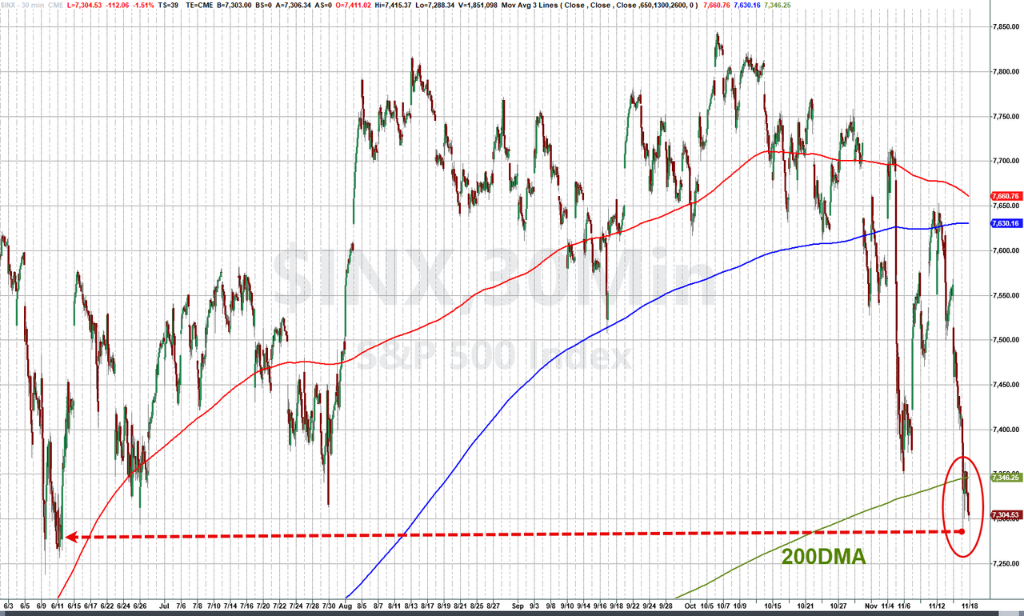
The market responded sensitively, with the Nasdaq index dropping, and the S&P 500 index falling below the 200-day moving average.
NSA Confidential Network Interruption, Rated "Level 2 Alert"
The interruption of the NSA's confidential internal communication network NSANet has drawn significant external attention.
According to Mike Nelson, a researcher at the National Security Institute, who was interviewed by Nexstar's NewsNation, this interruption may stem from malicious attacks. However, a report from The Wall Street Journal pointed to a software patch update as the cause.
NSA officials later confirmed to The New York Times that the failure has been classified as a "yellow code" event, which is the second-highest level in a three-tier alert system. An NSA spokesperson stated:
The National Security Agency experienced a brief downgrade during routine scheduled maintenance. Some internal systems were affected, but core mission capabilities remained fully operational, and the ability to safeguard national security was not impacted.
Former senior U.S. intelligence official Beth Sanner assessed that a cyberattack is the least likely scenario.
This system is protected by firewalls and overseen by the world's most capable cybersecurity entities. Had it not been for the current special context, this incident likely would not have made headlines at all.
Apple's Internal Update Triggers Widespread Cross-Platform Shutdowns
Apple Inc. confirmed on Tuesday that an internal update led to extensive service and system interruptions.
The affected internal systems included the employee portal AppleWeb, the internal login system AppleConnect, and the VPN channels for remote employees.
Reports citing insiders revealed that employees also faced issues downloading internal software versions, accessing the company calendar, and booking meeting rooms, with even the internal website responsible for tracking outage statuses going down as well.
The consumer side was also impacted, with iCloud access and features for directly registering AppleCare on devices experiencing anomalies, while services aimed at schools and businesses were affected. The sales, repair, and customer service operations of multiple Apple retail locations were interrupted as a result.
Apple stated in a statement:
An internal update this morning caused some systems to go offline, and many systems have since been restored. We are working to bring the remaining systems back online as quickly as possible.
Apple also emphasized that this failure was not due to a cyberattack.
Intensive Failures Occur in Quick Succession, Five Major Interruptions in One Week
The failures at Apple and the NSA are the latest two in a sequence of technological incidents in the U.S. over the past week.
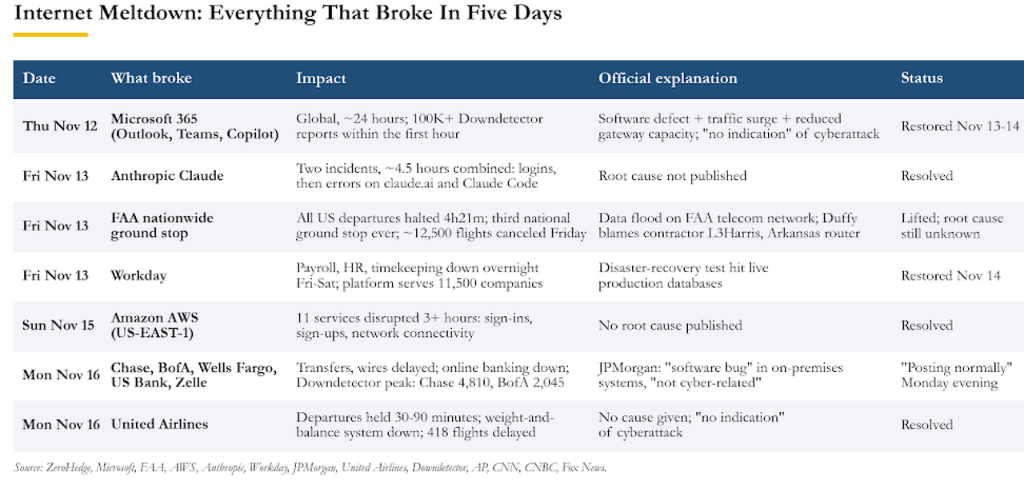
Last Thursday, Microsoft 365 experienced widespread disruptions with Outlook, Teams, and the Copilot assistant all affected, with the outage lasting until Saturday. Microsoft attributed the cause to a "technical fault" occurring during routine user traffic rerouting and denied any connection to cyberattacks or AI systems.
Last Friday, the Federal Aviation Administration (FAA) issued a rare nationwide grounding order, affecting tens of thousands of flights for over four hours. Investigations revealed that the incident was triggered by a contractor replacing aging copper cables at a remote facility in Arkansas, which overloaded a network router that had been in operation for about 25 years, causing cascading failures.
U.S. Secretary of Homeland Security Markwayne Mullin later stated:
I can tell you with complete certainty that we were not under attack.
On Monday, JPMorgan Chase experienced a "technical issue" that caused delays in processing some transactions, with clients from institutions such as Bank of America and U.S. Bancorp also reporting problems. JPMorgan later attributed the cause to "a software bug in the local hardware system." On the same day, United Airlines faced approximately an hour-long system interruption, leading to multiple flight cancellations.
Panic Spills into Consumer Markets, Officials and Conspiracy Theories Compete for Discourse
The unease caused by technological failures has spilled over from professional discussion circles to ordinary consumers.
Sales of non-perishable food, drinking water, and batteries at Costco surged sharply, prompting analysts to raise their target stock price from $1100 to $1150; the high-end generator products on the company's website were nearly sold out by Sunday.
In the absence of authoritative and timely explanations, conspiracy theories have proliferated on social media, with some viral posts claiming that the U.S. is under coordinated attack from foreign, or even "extraterrestrial" governments, while others interpret the technological upheaval as a harbinger of some disaster.
The Trump administration has taken a low-key stance. When questioned about the outages at JPMorgan Chase and Microsoft during a visit to Asia, Trump responded:
Everything will be well controlled. That's life. When you have a large scale and ample financial resources, these sorts of things will occur. It's no big deal.
AI Accelerates Vulnerability Discovery, Aging Infrastructure Strains Under Pressure
The occurrence of multiple failures in quick succession prompted external focus on a deeper structural issue: artificial intelligence is discovering system vulnerabilities at an unprecedented speed, raising the question of whether infrastructure established decades ago can withstand the accompanying rapid patch pressure.
U.S. Senator Mark Warner, a Democrat from Virginia, stated in a press release regarding the outages that this series of events seems to be "the consequence of AI rapidly changing the landscape of cybersecurity." He explained:
AI enables the identification of a vast number of system vulnerabilities at an unprecedented speed, putting enormous pressure on businesses and government agencies to patch vulnerabilities immediately, often requiring simultaneous updates, which places significant strain on systems not designed to cope with such rapid changes.
Joe Slowik, the threat research and cyber engineering director at risk intelligence firm Dataminr, noted that the concentration of so many high-profile incidents in a short period is rare and concerning. He said:
We are overly dependent on infrastructures that are already precarious in terms of stability and have insufficient redundancy—whether due to errors, failed updates, or cyber events—any of these can trigger the worst-case scenario.
Christiaan Beek from cybersecurity firm Rapid7 cautioned that there are no indications in publicly available records that the outages were caused by urgent security updates. He pointed out that a more general risk lies in organizations relying on outdated processes to cope with the wave of AI-assisted vulnerability discoveries. Christiaan Beek stated:
Complex system failures often stem from mundane causes rather than adversarial attacks. These mundane causes are not harmless—what is worrisome is that it suggests our relied-upon systems have become so fragile that they can collapse without the need for an attacker; we can do it ourselves.
The warning issued by the FBI on Tuesday highlighted another side of the problem that cannot be ignored. The FBI posted on social media stating that a FLASH level alert had been issued, warning that cybercriminals and state-sponsored hackers are exploiting the AI-driven penetration testing framework ARTEX to launch automated attacks against global businesses and institutions.
The FBI indicated that ARTEX can reduce the time from initial targeting to gaining privileged access to under three hours and has previously been used in the October supply chain attack against ConnectWise.
免责声明:本文章仅代表作者个人观点,不代表本平台的立场和观点。本文章仅供信息分享,不构成对任何人的任何投资建议。用户与作者之间的任何争议,与本平台无关。如网页中刊载的文章或图片涉及侵权,请提供相关的权利证明和身份证明发送邮件到[email protected],本平台相关工作人员将会进行核查。


