Original |Odaily Planet Daily(@OdailyChina)
Author|Golem(@web3_golem)

On November 17, after U.S. stock market trading hours, Nvidia released its first financial report since Jensen Huang's departure, overall exceeding market expectations, and Nvidia officially entered the era of quarterly revenues exceeding $100 billion.
The financial report shows that Nvidia's revenue for Q3 of fiscal year 2027 is $115.8 billion, higher than the market expectation of $109.1 billion, a year-on-year increase of 103%, and a quarter-on-quarter increase of 20%; data center business remains the core revenue source, with revenue reaching $107.6 billion, a year-on-year increase of 110% and a quarter-on-quarter increase of 21%; Q3 net profit is $65.3 billion, higher than the market expectation of $60.406 billion, a year-on-year increase of 115% and a quarter-on-quarter increase of 9%; GAAP and non-GAAP gross margins are 74.8% and 74.9% respectively, and GAAP and non-GAAP diluted earnings per share are $2.70 and $2.68 respectively, both exceeding market expectations.
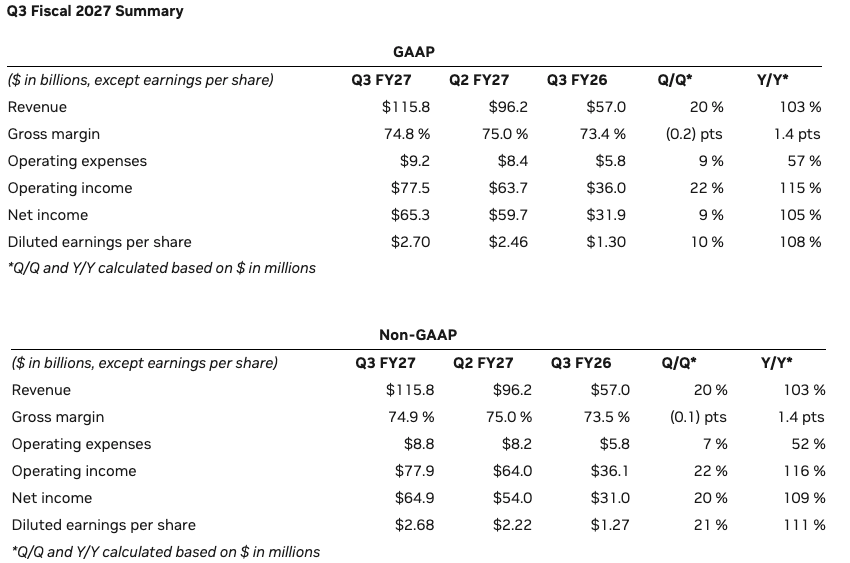
Nvidia expects revenue for Q4 of fiscal year 2027 to be $130 billion, higher than the market expectation of $125.2 billion. In addition, the company's interim CEO and CFO Colette Kress also provided a higher growth expectation for revenue in 2028 during the investor conference call, raising the growth rate from 70% to about 75%. The reason Nvidia can provide such a high future revenue guidance comes from Colette Kress's repeated emphasis during the investor call that "demand far exceeds supply."
Due to the impact of the financial report and conference call, Nvidia's stock rose over 4% in after-hours trading, alleviating market concerns about Jensen Huang's departure. During the investor call, Nvidia's executive team did not respond to any questions regarding Jensen Huang's resignation and the ongoing investigations.
Demand is Expanding Towards More Areas in the AI Industry
From the financial data provided by Nvidia this time, there are still no signs of demand cooling down.
Interim CEO and CFO Colette Kress revealed during the call that the cloud computing industry's backlog of orders has reached $2.5 trillion, whereas three months ago this figure was still $2 trillion. A mere quarter saw an increase of $500 billion, indicating that cloud service providers still have significant infrastructure construction needs yet to be fulfilled in the coming years.
Moreover, this demand is not only coming from traditional hyper-scale cloud providers. Nvidia stated that current demand covers Hyperscalers, Neoclouds, cutting-edge AI laboratories, enterprises, and governments, with a customer base that is becoming more diverse.
Nvidia expects that this year, major cutting-edge model laboratories will contribute approximately 15% of its data center revenue. Taking Anthropic as an example, as of the end of October, its annualized revenue run rate has reached $81 billion. The commercialization ability of model companies is strengthening, which means they have more funds to continue investing in computing power infrastructure.
The GPUs being procured have not been idly sitting as the market questioned. Nvidia stated that the computing resources provided to major hyper-scale cloud providers and Neoclouds are currently still at 100% utilization, with customers still making full use of the GPUs deployed as much as possible.
Nvidia's demand expansion is no longer limited to model training.
Nvidia mentioned during the call that weekly token usage on OpenRouter has increased 35 times year-on-year, and has grown 3.5 times in just the past three months, with Agentic AI workloads accounting for approximately 80%. As AI Agents begin to autonomously invoke tools and execute tasks, model inference is no longer a simple question-and-answer but could run for a longer duration, further increasing the demand for GPUs, CPUs, and network infrastructure.
At the same time, sovereign AI and enterprise AI are also becoming new sources of growth. Nvidia revealed that sovereign AI revenue increased more than double year-on-year in Q3, and physical AI revenue nearly doubled year-on-year, with expected annual physical AI revenue exceeding $25 billion. The performance of financial services on the enterprise side has been particularly prominent, with on-premise revenue nearing $5 billion in the past 12 months, more than doubling year-on-year.
Therefore, it is not just hyper-scale cloud providers that are buying GPUs; AI computing power demand is also expanding towards more industries and application scenarios. Model training, inference, Agents, enterprise deployment, sovereign AI, and even robotics are all becoming new consumers of computing power, and all will become Nvidia's customers.
Supply Chain Continues to Expand, Gross Margin Exceeds Expectations
Previously, the market was concerned that advanced processes, HBM memory, and CoWoS advanced packaging capacity might become bottlenecks for the continued volume release of Blackwell and Vera Rubin. Especially with rising memory prices, the market worried that Nvidia, even with ample orders, might sacrifice profits due to rising supply chain costs.
During this call, Colette Kress specifically addressed supply chain issues. She stated that Nvidia is working with partners to expand the production capacity of critical components such as wafers, substrates, and advanced packaging. In terms of substrates, new agreements were reached with Kinsus and Samsung Electro-Mechanics this season; in terms of advanced packaging, new agreements were reached with SPIL. These arrangements are built on the expansion plans announced in September with Amkor, KYEC, and Unimicron.
Apart from supply chain issues, gross margin is also a significant highlight of this financial report.
Previously, as prices for high-bandwidth memory such as HBM rose, the market had been concerned that Nvidia would face increasing cost pressures. After all, products like Blackwell do not solely sell GPU chips but involve memory, networking equipment, advanced packaging, and a complete server system; any increase in costs at any point could impact final profits.
However, in this quarter, Nvidia's GAAP and non-GAAP gross margins reached 74.8% and 74.9% respectively, both exceeding the previous guidance of around 74%, primarily benefiting from the improved product mix brought by Blackwell Ultra, with product structure optimization offsetting some supply chain cost pressures.
However, the gross margin does face pressure. Nvidia expects the gross margin for Q4 of fiscal year 2027 to fall to 71% to 72% and become a temporary bottom, after which it is expected to rise back to the range of 72% to 73% in fiscal year 2028.
This indicates that the impact of rising memory and other supply chain costs will continue to manifest, and at least in the short term, Nvidia will need to pay a certain price for product iteration and supply expansion. However, from management's judgment, this pressure is seen as temporary, and the company does not perceive a long-term trend of gross margin deterioration, though they are still giving the market a warning.
Vera Rubin's First Quarter Approaches $20 Billion, CPU Revenue Expected to More Than Double Next Fiscal Year
Meanwhile, as the supply chain continues to expand, Nvidia's next-generation products have also begun to contribute revenue, namely Vera Rubin.
In this quarter, the first quarter of production for the Vera Rubin platform generated close to $20 billion in revenue, making it the fastest-growing product platform in Nvidia's history.
In terms of delivery progress, the Vera Rubin NVL72 began mass production and shipping in August this year, and just three months later, the related server cabinets have begun to enter the data centers of major hyper-scale cloud providers and Neoclouds. Nvidia revealed that it only took about a month for hyper-scale cloud providers to move from receiving Vera Rubin to putting it into production, requiring only half the time compared to Grace Blackwell.
The Vera Rubin is not just an upgrade of the GPU. With the rise of Agentic AI, AI systems require more CPUs to handle task scheduling, tool invocation, and data processing; CPUs are becoming a new bottleneck for computing power. Nvidia stated that Agentic AI is driving CPU demand to far exceed supply, and the company's own Vera CPU has thus gained more customer adoption.
This quarter, CoreWeave, Meta, Nscale, and OpenAI have joined the ranks of Vera CPU customers, while AWS, Oracle Cloud Infrastructure, and SpaceX AI have also announced the adoption of relevant products. Colette Kress expects Nvidia's CPU business to achieve more than double growth in revenue by fiscal year 2028.
Nvidia's networking business is also expanding simultaneously. This quarter, Nvidia's networking business income exceeded $21 billion, indicating that investment in AI data centers is no longer just about procuring GPUs but also requires the concurrent construction of high-speed interconnect networks, server cabinets, and complete cluster systems.
Nvidia has also launched the DSX POD reference architecture, hoping to pre-integrate and verify the entire AI factory, delivering it to customers in a modular format. According to management, this approach can shorten the data center deployment cycle from months to weeks. For a market where computing power demand far exceeds supply, reducing deployment time itself translates to faster revenue generation.
Looking at all these businesses together, Nvidia's role as the "AI industry architect" is becoming more evident. What it sells to customers is no longer just GPUs, but a complete AI infrastructure from GPUs, CPUs, and networks to software and entire data center architectures.
Nvidia is shifting the competition from single chips to complete AI infrastructures, which is also why Nvidia is not overly concerned about large model manufacturers developing their own ASIC chips.
Does Nvidia No Longer Need Jensen Huang?
On November 17, Jensen Huang made his first public statement after resigning on social media, stating that he has received calls from employees, investors, partners, and customers since his departure, and he is willing to return as CEO if the board believes his return is in the best interests of shareholders, employees, the company, and the United States.
Hours later, board chairman Harvey Jones stated during the conference call: The board unanimously accepts the resignation and has no intention of restoring his position. They have hired Heidrick & Struggles to lead the formal CEO search, considering both internal and external candidates and will appoint upon finding a suitable person. The board also established a new National Security and Export Control Supervisory Committee, with members including some independent directors, senior external advisors, and legal advisors.
From the financial report itself, the backlog of orders in the cloud industry continues to grow, existing computing power is operating at full capacity, supply chain expansions are underway, Vera Rubin contributed nearly $20 billion in its first quarter, the next quarter guidance is $130 billion, and the revenue growth guidance for fiscal year 2028 has been raised from 70% to 75%, all seemingly indicating a bright future for Nvidia.
However, the black swan event of Jensen Huang's departure has shifted some investors' attention from gross margin, supply chain bottlenecks, and other issues in the Q3 fiscal year 2027 report to corporate governance, which also increases the uncertainty in Nvidia's future performance.
After all, the accomplishments this company has achieved so far have all been completed under Jensen Huang's leadership, and it remains unknown whether successors can maintain supply chain-related collaborations or if they will change Nvidia's long-term strategic direction to take responsibility for short-term stock prices in the next quarter and fiscal year 2028.
Historically, there have only been cases of large-scale companies successfully transitioning from a founder model to a professional manager model, such as Apple. Nvidia's next important task is to find its own “Cook.”
免责声明:本文章仅代表作者个人观点,不代表本平台的立场和观点。本文章仅供信息分享,不构成对任何人的任何投资建议。用户与作者之间的任何争议,与本平台无关。如网页中刊载的文章或图片涉及侵权,请提供相关的权利证明和身份证明发送邮件到[email protected],本平台相关工作人员将会进行核查。


