

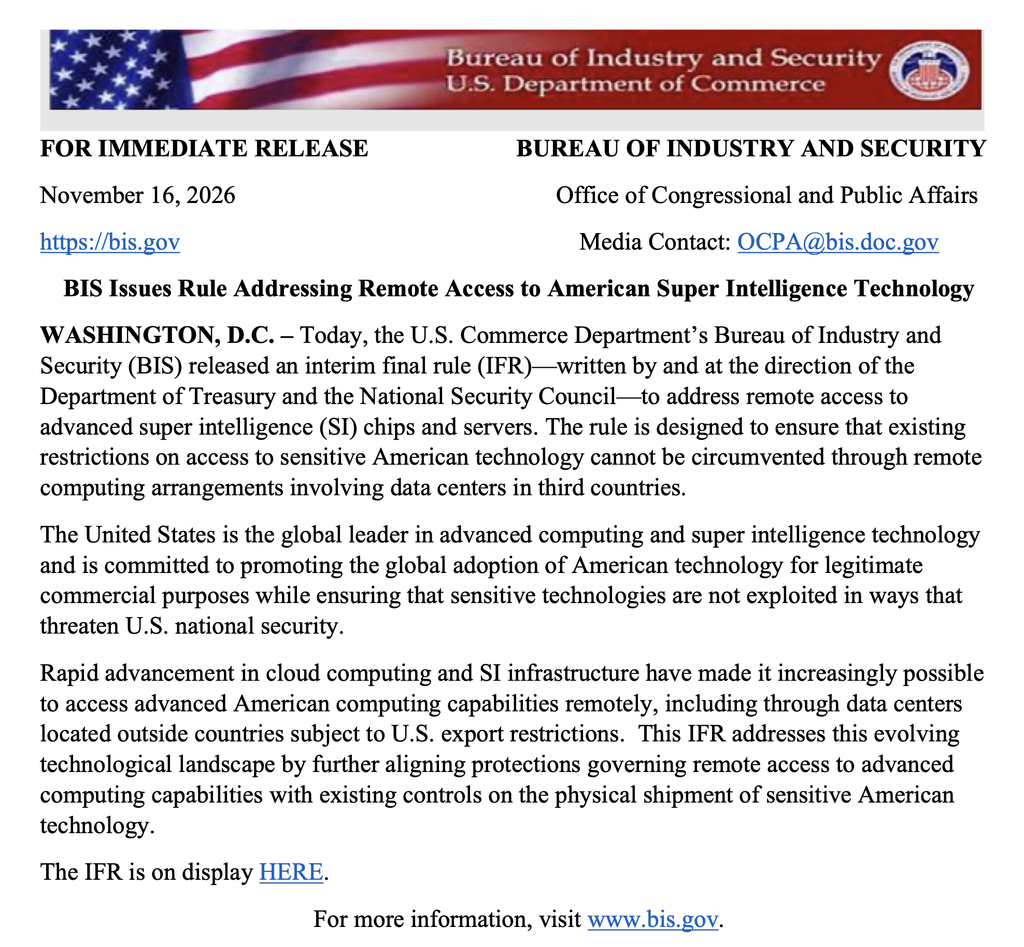
As U.S. President Trump is about to attend the APEC meeting in Shenzhen, China, and meet with President Xi Jinping, the U.S. Department of Commerce's Bureau of Industry and Security (BIS) has recently officially issued an Interim Final Rule, announcing further tightening of export controls on advanced artificial intelligence (AI) chips and server computing power. This new regulation is drafted under the leadership of the U.S. Department of Treasury and the National Security Council (NSC), aiming to extend the current export ban on physical chips to the cloud level, completely closing policy loopholes that allowed enterprises in sanctioned countries to "remotely rent computing power" through overseas data centers.
Blocking Remote Computing Power Transfer from Third-Party Data Centers
Previously, U.S. export restrictions mainly focused on the shipment and resale of physical hardware. However, with the rapid development of cloud computing and Super Intelligence (SI) infrastructure, some enterprises located in sanctioned countries (such as China, Russia, Iran, and others in the "D:5" group) have been able to train and operate cutting-edge AI models through renting cloud services from overseas third-party data centers, without the need for physical import of chips.
According to the newly announced rules, any data center located outside the U.S. that provides remote access services for large-scale advanced AI computing power to enterprises headquartered in sanctioned countries must apply for an export license from the U.S. government in advance. The new regulations also set a computing power threshold (12 million TPP, approximately equivalent to the computing power of 750 NVIDIA H100 or H200 chips); even if a company distributes chips across multiple interconnected server rooms, as long as they serve the same training task, they will be counted together.
Five High-Risk Countries Subject to Strict Scrutiny
In addition to the restrictions on remote cloud access, BIS will also include five countries considered by the U.S. to have a higher risk of chip transshipment or computing power outflow—Singapore, Malaysia, Thailand, Indonesia, and Brazil—into a stricter range of physical chip export controls. Future exports, re-exports, or domestic transfers of advanced semiconductors to these five countries must obtain U.S. permission, except for specific conditions met by domestic U.S. enterprises.
Suppliers and data center operators that are granted licenses must implement strict "Know Your Customer" (KYC) review mechanisms and regularly report to authorities on the corporate structure involved in transactions, parent company background, and the final use and destination of the chips. However, the new regulations also provide exemptions for "business recommendation systems" purely used for e-commerce or social media, stating that such applications do not pose the same level of national security threat.
90-Day Transition Period and Abolition of Old Tiered System
This policy comes at a time when the market is highly concerned about the flow of chips from Asian data centers. Meanwhile, the U.S. has also abolished the "AI Diffusion Rule" introduced in early 2025, replacing the previous country-tiered quota system with a more direct "physical + cloud" dual restriction.
According to the arrangement, the new regulations will take effect after being officially published in the Federal Register, and there will be a 60-day public consultation period. As for existing data centers that have provided relevant overseas computing power services to sanctioned customers before the new regulations take effect, they will be granted a 90-day grace period to apply for licenses; if not approved within the time frame, relevant services must be terminated immediately, or they will face chip supply cuts and trade blacklist sanctions.
This article is reprinted from PCM, with all rights reserved by the original author and original media.
免责声明:本文章仅代表作者个人观点,不代表本平台的立场和观点。本文章仅供信息分享,不构成对任何人的任何投资建议。用户与作者之间的任何争议,与本平台无关。如网页中刊载的文章或图片涉及侵权,请提供相关的权利证明和身份证明发送邮件到[email protected],本平台相关工作人员将会进行核查。


