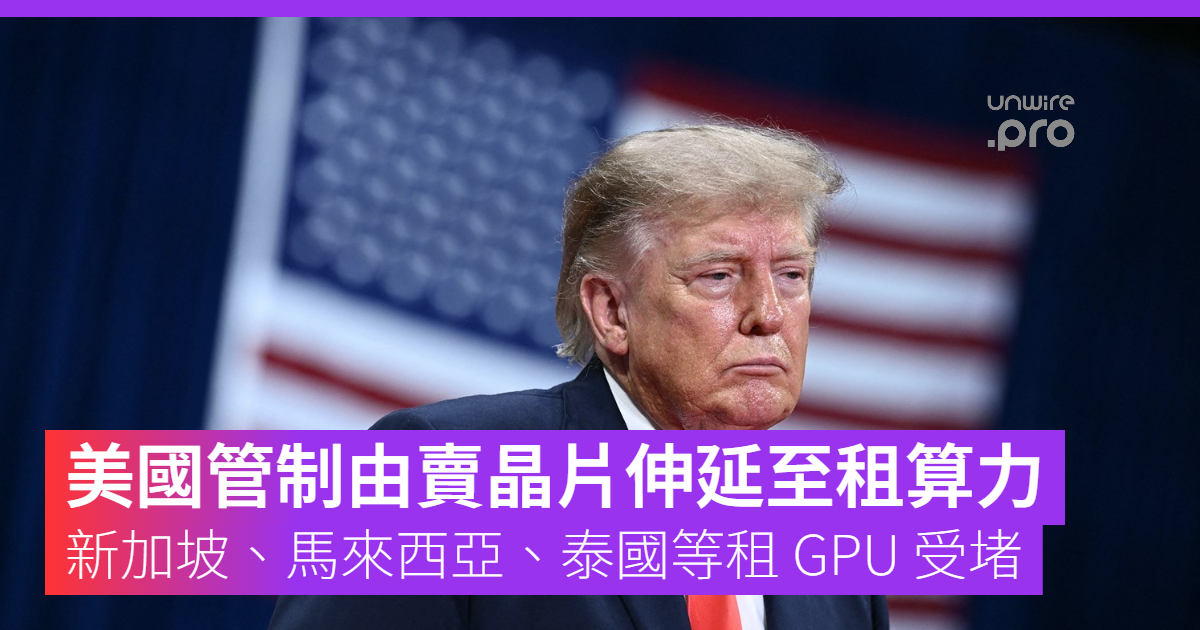
The U.S. Department of Commerce's Bureau of Industry and Security (BIS) announced a temporary final rule for advanced AI chips, expanding export licensing requirements to Singapore, Malaysia, Thailand, Indonesia, and Brazil, and setting threshold requirements for remote computing power provided to companies in China and other regions based on data centers. For Chinese companies relying on renting GPUs from overseas data centers, the licensing requirements will be influenced not only by the destination of the chips but also by the service targets and scale of computing power of the data centers. The rule is expected to take effect after being published in the Federal Register on November 19, U.S. time.
The new regulations cover the export, re-export, and domestic transfer of chips to the aforementioned five countries, requiring case-by-case review of applications. If global data centers provide access to computing power exceeding 12 million total TPP to companies headquartered or ultimate parent companies located in Macau or countries in the D:5 group, export or transfer of advanced chips to those data centers will also require permission; applications involving Macau and D:5 are generally not approved. TPP is a metric used by the U.S. to measure chip computing capabilities, and D:5 refers to a group of countries subject to U.S. weapon export bans. The Commerce Department stated that the new regulations aim to prevent companies from circumventing existing restrictions through remote computing arrangements via third-country data centers.
Data centers serving Chinese enterprises must obtain licenses within 90 days of effectiveness
BIS's new regulations require data centers that have provided substantial computing power to companies in Macau and D:5 countries to obtain licenses within 90 days after the rules take effect, or they will face subsequent export restrictions. Computing power may only be used for compliant commercial recommendation systems, which can be exempted from remote computing power licensing requirements but still must be reported to BIS; systems with or integrating generative AI capabilities do not qualify for the exemption.
Exports to companies with headquarters or ultimate parent companies located in the United States are not subject to the licensing requirements for the aforementioned five countries, but transactions must be reported to BIS monthly, with submissions due on the first working day of the month following the transaction at the latest. Reporting data includes the parties involved in the transaction, final destination, Export Control Classification Number (ECCN), product name and SKU, TPP, quantity, and export date.
The new regulations also tighten rules on chip manufacturing. Wafer front-end manufacturing plants and outsourced assembly and testing (OSAT) vendors producing advanced logic chips for design companies without U.S. approval or authorization will have their chips presumed to be controlled advanced chips; design companies headquartered or ultimately owned by D:1, D:4, or D:5 group countries can no longer overturn this presumption through due diligence processes.
The temporary final rule will open for 60 days of public consultation and will officially revoke the AI diffusion rule from the Biden administration; BIS noted that this rule was never implemented.
Southeast Asian data centers identified as channels for Chinese enterprises to rent GPUs
Southeast Asian data centers have been identified as channels for Chinese enterprises to rent GPUs remotely. Reports indicate that between 2021 and 2024, the U.S. has continuously required domestic cloud providers not to service Chinese clients, while cloud providers in other regions do not have the same obligation, thus creating a market for Chinese clients to remotely access computing power.
It is widely believed that the construction boom of data centers in Malaysia and Thailand targets Chinese clients seeking to rent GPUs but unable to import chips independently. Additional reports suggest that demand from Chinese AI developers Alibaba and ByteDance has driven Southeast Asia to become a data center hub, particularly in Malaysia and Thailand, while Indonesia remains in the early stages of development; Singapore is not a major data center location but is suspected of being used as a nominal shipping point, with servers then rerouted to China.
The new regulations' data center thresholds are not regionally limited, applying equally to data centers outside Southeast Asia; interconnected data centers will also be combined to calculate total TPP. Data centers serving companies whose headquarters or ultimate parent companies are based in Macau or D:5 group countries must apply for permission to obtain advanced chips, and related applications are generally not approved, though the regulations do not explicitly prohibit them outright.
Reportedly, the U.S. introduced new computing power regulations days after Jensen Huang's resignation
It is reported that the U.S. introduced the new computing power regulations amid allegations of espionage involving Nvidia, and as U.S. chip export controls come under increased scrutiny, only days after Jensen Huang's resignation from Nvidia; there has not yet been an official announcement from Nvidia confirming the resignation. Reports indicate that Huang admitted to having an extramarital affair with Alice Huang, a former executive at Singapore's Megaspeed International, before his resignation, with suspicions that Alice Huang is a Chinese spy. Megaspeed is currently under investigation by the U.S. for potential violations of export control, which the company denies any wrongdoing.
There are also differing opinions within the U.S. government regarding chip regulation. The Commerce Department stated that the new regulations were drafted by the Treasury Department and National Security Council and developed under their guidance. Treasury Secretary Scott Bessent previously criticized Commerce Secretary Howard Lutnick for ineffective enforcement of existing controls; U.S. President Donald Trump stated he had no intention of replacing Lutnick, indicating that he may be slowing down export control work to avoid provoking China during sensitive trade negotiations.
Former senior Commerce Department official and partner at law firm Wiley Rein, Nazak Nikakhtar, believes the regulations should have been introduced earlier, highlighting that the issue lies in enforcement, questioning which government department will lead enforcement if the Commerce Department keeps its distance from the regulations.
Counterpoint: New regulations may temporarily limit computing power for Chinese enterprises
Neil Shah, Vice President of Research at market research firm Counterpoint, believes the new regulations will create significant short-term computing power bottlenecks for Chinese tech giants. He noted that data center operators in hubs like Singapore, Malaysia, and Indonesia will face large-scale "Know Your Customer’s Workload" requirements, needing to prove to U.S. regulators that computing power is not flowing back to sanctioned countries, or they risk losing access to U.S. chips.
Neil Shah also anticipates that in the long term, the new regulations will greatly catalyze decoupling, forcing Chinese capital and engineering talent to increase investment in fully autonomous solutions, accelerating the development of ecosystems such as Huawei's Ascend. Singapore’s Ministry of Trade and Industry and Ministry of Digital Economy stated they are carefully studying the new measures and engaging with companies to understand the potential impacts; the Brazilian government stated it is closely monitoring the situation but has yet to assess the impact on imports.
If data center operators must prove the destination of customer workloads, enterprises renting GPUs in Southeast Asia might need to disclose their parent company's location and the use of workloads to service providers, and computing power contracts may also face additional scrutiny.
This article is reprinted from unwire.pro, with all copyrights belonging to the original author and original media.
免责声明:本文章仅代表作者个人观点,不代表本平台的立场和观点。本文章仅供信息分享,不构成对任何人的任何投资建议。用户与作者之间的任何争议,与本平台无关。如网页中刊载的文章或图片涉及侵权,请提供相关的权利证明和身份证明发送邮件到[email protected],本平台相关工作人员将会进行核查。


