He dodged FTX, the Terra collapse, and USDC at 0.88, but lost to the "industrialization" of this industry.
Written by: Santisa
Translated by: Chopper, Foresight News
The neutral strategy in the cryptocurrency market is a niche I have devoted all my energy to over the past decade.
Historically, cryptocurrency market neutrality has concentrated on a type of strategy: low probability of default, but extremely severe losses once a default occurs. Those involved must remain constantly alert because when the final whistle blows, those who pull the trigger first (that is, withdraw first) will survive. Interestingly, the act of pulling the trigger is almost always costless. The rest can only listen to projects telling them, "We will definitely compensate you," empty words.
This is a way of living under great pressure. However, cryptocurrencies offer you a possibility: to earn a risk premium that is significantly disconnected from the underlying risks. It’s hard for anyone to deny that Binance’s Bitcoin basis trading in 2021 yielded 70%, or that a tokenized hedge fund you like could leverage its PT (principal token) to achieve 100% annualized returns in 2024—these are all high positive returns. But high returns do not mean they are suitable for all portfolios. The reality is that the DeFi market is fiercely temperamental, and the sword of Damocles could drop on any position at any time. This means you have to keep an eye on that thread of the hanging sword and set up a bunch of alerts that could be falsely triggered, waking you and your partner in the middle of the night just to confirm whether the thread has truly broken, allowing you to stay clear of the blast radius.
The premium in DeFi was absurdly high at first, partly because the risks were indeed high, but more importantly: large institutional investors were restricted by their investment mandates and couldn’t touch these opportunities; they carried huge reputational risks and lacked the relevant expertise. On one side, there were projects with ample funding, VC support, and a desperate desire for deposits; on the other side, there were individual investors entering due to risks and novelty who would turn to stablecoins for hedging after making money on-chain. The combination of the two allowed those with some risk management capability to enter the highest-yielding strategies globally over the past twenty years.
I was fortunate not only to participate personally but also to build my own career around it. Economies of scale are more efficient; more hands make light work, and resources are more advantageous than fewer people. At that time, I realized there was a huge demand for stablecoins on-chain, but the supply was very limited. With some financial knowledge and a bit of technical understanding, one could earn hefty rewards; and this wasn’t a slight mismatch; there was a structural gap between serious allocation institutions and DeFi, which was then considered "toxic junk." Personally, I was a homebound keyboard warrior, studying DeFi and blockchain technology, far from the person you are fortunate to encounter today. At that time, I met a future partner who persuaded me to package this stuff into products and told me there was real demand in the market. As long as we explained the risks clearly and transparently, we could do good business leveraging his network of clients. He was right.
We only recruited some brave LPs (Limited Partners) after they fully understood that "under pressure, losses can indeed be 100%." Later, we sacrificed sleep, sacrificed physical and mental health, rushing into the frenzy of "liquidity mining" and other projects that now seem like a fever dream. This business did very well in the crazy bull markets of 2020 and 2021. We checked forked projects one by one, mined using the same stablecoin across multiple protocols, monitored a myriad of addresses for signs of pressure and opportunity, and also dealt with the lousy tools available in the industry at the time.
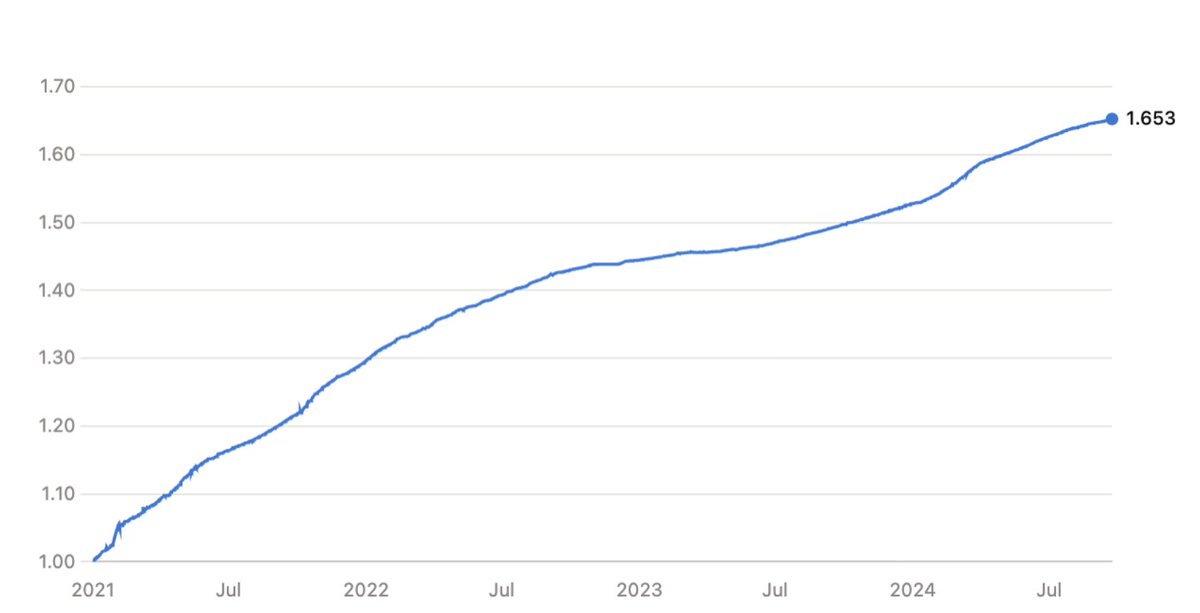
Returns of cryptocurrency market neutral strategy funds from 2021 to 2024
Some might say that the returns above are not sexy enough in a bull market. But please understand this chart: during this period, monthly drawdowns were zero. Events like FTX, BlockFi, Celsius, the Terra crash, and USDC de-pegging did not affect our returns.
Yes, the sword of Damocles hung over us all those years, but being able to achieve such returns with zero losses in that environment is something I take pride in.
Throughout these years, the price of this return was many instances of "minor heart attacks": trades disappearing from cross-chain bridges for no reason, only to suddenly return four hours later; USDT frequently de-pegging; USDC briefly dropping to $0.88; hundreds of billions of UST going to zero; and many agreements we dealt with in the past being destroyed due to smart contract vulnerabilities or operational security issues.
The operational alpha comes down to three points: 1) mastering finance; 2) having a moderate understanding of technology/smart contracts; 3) in a track built for gamblers, being a lender instead of a gambler.
This track is not suitable for the faint-hearted, but the returns are enough to compensate for the cost to one's health. The type of leveraged trading we engaged in is worthy of the returns we received. This is a generational opportunity tightly held; I will always be grateful for this time and the partner who pushed me to take risks and grow it.
In the following years, returns gradually thinned out, and we began to buy U.S. Treasury bonds, doing nothing as we watched the company bleed out operationally. Because the returns were gone, and our mandates were very strict: if the perception of risk exceeds the return, we do not invest. We persevered through massive intense discussions and LP redemptions, just to keep our analysis objective and evaluate the various risks each position faced across the tech stack. Sometimes the risk levels reached seven layers deep, covering finance, custody, mismanagement, regulation, operations, opacity, and smart contracts. This naturally made many investments impractical, and those projects whose yields were compressed below SOFR (Secured Overnight Financing Rate) had participants who could not leave DeFi; for them, having any return is better than none.
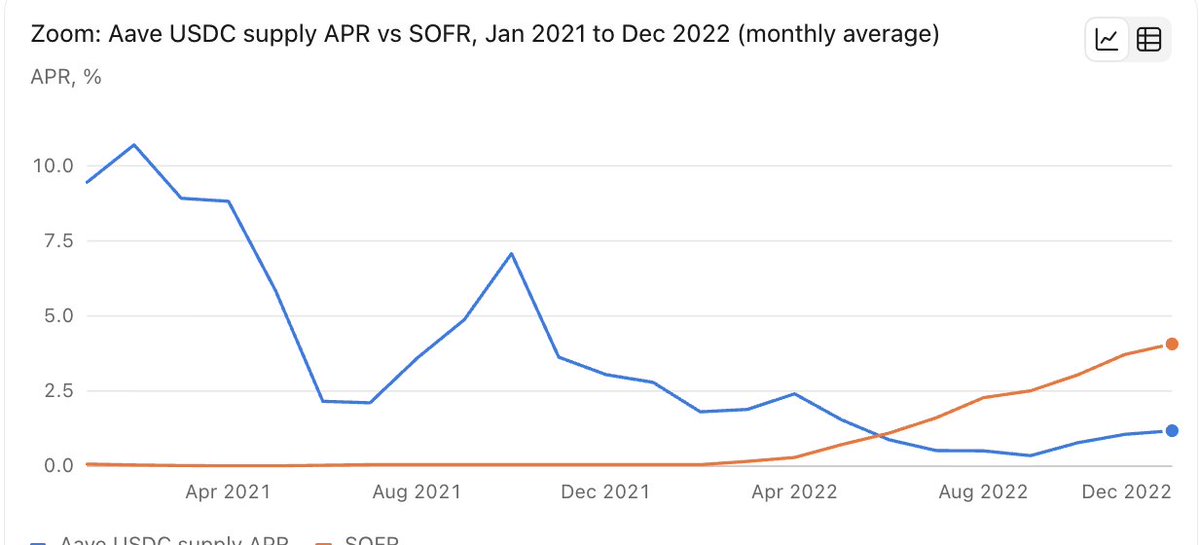
USDC Rates on AAVE vs SOFR
As the bull market slowly returned in 2023, this track had changed significantly. Now, there are some professional, well-funded players whose practices in DeFi lending, mining, arbitrage, and general market neutrality have surpassed us. We can still find some smaller opportunities to accommodate funds, but returns sharply compressed after risk adjustment; for me, the responsibility to the LPs brings a significant psychological cost. No matter how transparent your risk authorizations and disclaimers are, if people don't look at those and just blindly trust you, you bear a heavy responsibility, which does not align with my vision of "true fund management." The returns are no longer sufficient to compensate for the pressure I carry.
So in 2024, I turned to providing non-custodial yield strategies, focusing on family offices and cryptocurrency exchanges, who have a clear understanding of strategy risks. But this is still a very manual operation; communication between the clients (holding custodial assets) and us is poor, our proposed strategies and monitoring of those strategies yield almost nothing after fees.
It was then that I saw a new paradigm in neutral management in the cryptocurrency market. Institutions in this track fully manage their balance sheets, seek optimal yields, manage risks, with employees distributed across different time zones, equipped with a full set of expensive monitoring tools, and highly complex key management infrastructures. I found myself in an awkward position: I wanted to maximize alpha, but lacked the infrastructure and funding to do so efficiently. So there were only two paths left:
Raise funds for market-neutral GPs (General Partners/Fund Managers) and then also raise for LPs, which is like going back to square one;
Join those mature players who are already efficiently harvesting on-chain premiums with large structures and security budgets.
At my core, I am a fund manager. The reason I went into management, fundraising, and team building was simply that there were no other options. At that time, there were not many truly reputable market-neutral funds on the market, so I had to start one myself. The cryptocurrency market in 2025 is already very different; I am fortunate to know some talented people who happen to be deploying sizeable funds on-chain.
In July 2025, my Spark journey began. At the time of writing this article, Spark had deployed about $3.3 billion on-chain, primarily in over-collateralized blue-chip lending, engaging in Spark’s own lending market and using Bitcoin in qualified custody as collateral; it is also the largest stablecoin market maker in this track and operates the best USDT products. Doing "the market itself" and "operating in the market" are entirely different things.
I have mastered the art of watching the thread; my lifelong career is tied to this. I will continue to diligently keep an eye on that thread, trying not to blink, while my neck remains under the sword. Only after I move my neck away will I rest.
免责声明:本文章仅代表作者个人观点,不代表本平台的立场和观点。本文章仅供信息分享,不构成对任何人的任何投资建议。用户与作者之间的任何争议,与本平台无关。如网页中刊载的文章或图片涉及侵权,请提供相关的权利证明和身份证明发送邮件到[email protected],本平台相关工作人员将会进行核查。


