
Invested in over 350 technology companies.

Author: Zan Zhu
Handcrafted volume | 100%
In ten years, placed within the process of industrialization of China's technology, it is enough to experience several rounds of complete shifts in technical paradigms. For a CVC, it means continuously seeking its own position among the parent company's strategy, technological evolution, and capital return.
In 2026, Lenovo Capital Ventures celebrates its tenth anniversary. If we align their investment portfolio with the evolution of China's technology industry on the same timeline, we can discover a resonant correlation.
From early explorations in the industrial internet and intelligent computing to the comprehensive chain layout of semiconductors, CPUs, and GPUs, followed by foundational models, AI applications, and embodied intelligence, a number of companies that have now become significant forces in the industry entered this investment institution's sight in different stages and were precisely captured.
Along the way, this CVC of Lenovo Group has invested in over 350 technology companies, with 27 portfolio companies successfully listed, including 8 companies with a market value of 200 billion, among which 3 have surpassed one trillion.
In addition to four computing companies, Cambricon, Hygon Information, Moore Threads, and Muxi, Lenovo Capital Ventures' portfolio includes over 60 unicorns in niche sectors and over 60 national-level specialized and innovative "little giants".
These numbers, in the context of a CVC, are particularly worth observing. Compared to financial investment institutions, CVCs must always answer a more complex question: they must follow investment rules to achieve financial returns while serving the long-term strategy of the parent company.
Since its establishment, Lenovo Capital Ventures has always played the role of Lenovo Group's “technology watchtower”.
This positioning means that they need not only to pay attention to Lenovo Group's current business and technical needs, but also continuously observe future changes and trends in IT and industry, ultimately connecting Lenovo Group's long-term technical needs with the growth of excellent entrepreneurs to achieve "dual empowerment".
Today, this long-term mission has resulted in concrete industrial outcomes. Currently, over 70 portfolio companies of Lenovo Capital Ventures have established deep business synergy with Lenovo Group, with cooperation extending from technology research and development to product definition, intelligent manufacturing, supply chain, and commercial applications.
This makes the theme of Lenovo Capital Ventures' 2026 CEO annual meeting, "Walking Together, Technology Towards New", even more tangible, while also showcasing its unique investment value—not just by providing funds to accompany the growth of enterprises, but also through the mutual verification of technology, products, and industry over a long period.
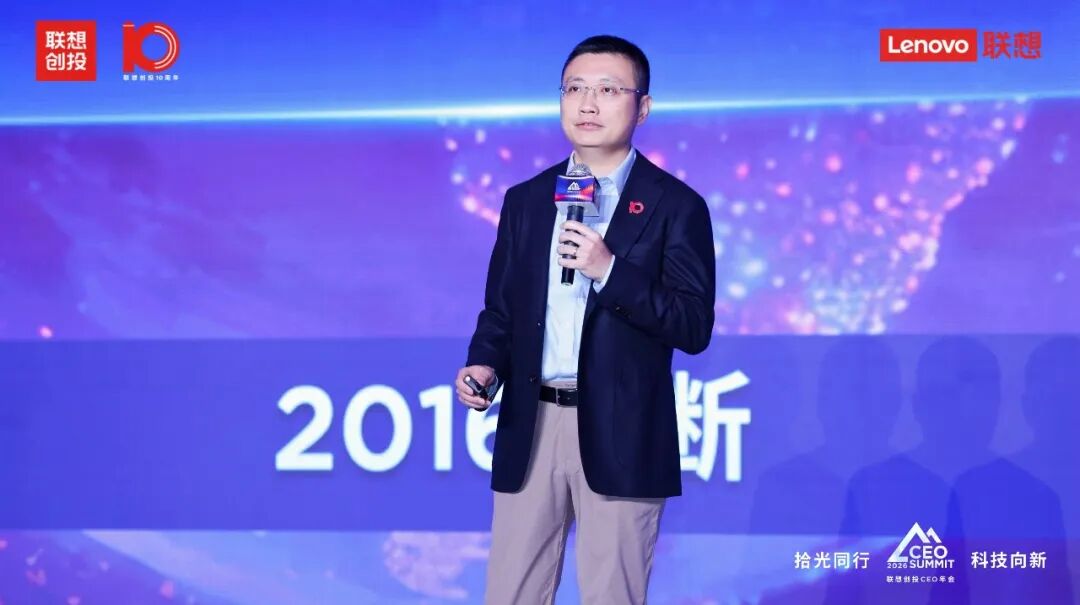
Image/ Wang Guangxi, Vice President of Lenovo Group and Managing Partner of Lenovo Capital Ventures, delivering a keynote speech at the 2026 Lenovo Capital Ventures CEO annual meeting
Under the ongoing changes in the parent company's business priorities, industrial environment, and capital markets, it is worth questioning how Lenovo Capital Ventures can establish a pre-emptive investment rhythm in a continuously changing cycle and how it can transform this precise judgment into sustainable returns and organizational capability.
Before consensus, beyond experience
Good technology investment is not about blindly chasing trends, but rather about understanding the pulse of the industry before consensus forms. The key lies in the ability to identify innovative forces that may change the industrial structure ahead of time while the technical routes remain divided and commercialization is not yet completed.
For investors, this is akin to a continuously evolving capability, allowing them to see structural changes in industrial demand earlier than others and even promptly adjust direction when investment judgments go awry.
Looking back at Lenovo Capital Ventures' ten years of layout switches, they often predicted the arrival of industry turning points in advance while maintaining their own investment rhythm, ultimately achieving a rare resonance with the technology industry cycle.
From the smart internet in 2016 to the successive layouts of semiconductors, CPUs, and GPUs starting in 2021, and then to recent foundational models and embodied intelligence, Lenovo Capital Ventures has always centered its focus on computing and data intelligence, while continuously searching for underlying technologies that could reshape industrial productivity.
Behind the long-term accuracy in hitting industry turning points lies Lenovo Capital Ventures' unique gene and deep understanding.
As early as 2005, Lenovo Group began conducting annual technology outlooks, discussing technological changes over the next 5 to 10 years while forecasting trends in user behavior, business environments, and technological changes along with opportunities for industrial technological innovation.
Before the establishment of Lenovo Capital Ventures in 2016, He Zhiqiang had served for many years as Lenovo's CTO and Director of the Lenovo Research Institute, participating long-term in the group's technology outlooks. After the establishment of Lenovo Capital Ventures, He Zhiqiang served as its president and managing partner, inheriting the previous tradition of technological judgment.
“Lenovo Group has always been at the forefront of computing, products, and industrial applications. The establishment of the venture capital arm aims to harness the power of capital and entrepreneurs to discover technological opportunities for the next decade in advance,” explained He Zhiqiang.
During approximately three months of concentrated industry research each year, Lenovo Capital Ventures seeks opportunities through a network of scientists, technical route analysis, and industry chain surveys, and then combines this with cross-verification of Lenovo Group's R&D, products, supply chain, and client needs to form core judgments that can guide investment.
In their judgment, China's technology industry will gradually move from innovations primarily based on internet business models to an era of "super technological engineering" that relies more on original technologies, systems engineering, and industrial collaboration, where computing power will become the infrastructure of the AI era.
Following this direction, when the mobile internet wave was robust and no one was paying attention to the chip track, Lenovo Capital Ventures began to systematically layout the semiconductor industry around 2017. At that time, the long-term construction of domestic core computing capability provided significant opportunities for local companies with technological accumulation.
Meanwhile, deep learning had already displayed its application value in tasks such as vision, while terminals, data centers, and automobiles posed different demands for computing power. Lenovo Group's own practices in terminals and servers also allowed the verification of chip technology routes against real product demands.
Cambricon thus came into Lenovo Capital Ventures' sight. In 2017, He Zhiqiang met Cambricon's founder, Chen Tianshi, for the first time at the Chinese Academy of Sciences. His first impression of Chen Tianshi was that he was quiet and possessed a typical technical genius quality. By that time, Chen Tianshi and his team had already begun exploring processors specifically designed for neural network computations.
This technology attracted Lenovo Capital Ventures for two reasons: the specialized chip architecture could significantly enhance the efficiency and energy efficiency of related computing tasks; and as artificial intelligence transitioned from algorithm research to widespread applications, the underlying computing power was expected to create a long-term demand. While they recognized their technology, there were still concerns within the team.
First was the valuation. Cambricon's Series A valuation was already high, and some on the investment team felt it was expensive, hesitating whether to submit the project for investment decision-making. Another concern came from the entrepreneur himself; Chen Tianshi had a deep scientific research background, but whether a scientist could become an entrepreneur and convert cutting-edge technology into scalable chip products still held significant uncertainty.
After several discussions, Chen Tianshi's demonstrated ability for business thinking, combined with the investment team's judgment that demand for computing power would grow hundreds of times, gradually alleviated the previous concerns. Ultimately, Lenovo Capital Ventures chose to invest, participating in four rounds of financing for Cambricon, accompanying the company to its public listing.
The key to this investment was that while the technology had not yet become a market consensus, they understood its potential long-term value and identified the entrepreneur who could propel the technology over the threshold of industrialization. The judgment on the persistent growth of computing power demand also led Lenovo Capital Ventures to not limit their research and investment solely to AI-specific processors.
Around 2021, Lenovo Capital Ventures successively laid out investments in Hygon Information, Moore Threads, and Muxi. Among them, Hygon Information represents CPU and related computing ecosystems, while Moore Threads and Muxi entered from full-function GPUs and data center GPUs, respectively. They thus formed a large computing power portfolio centered around long-term computing needs and achieved precise layouts before the explosion of large models.
However, long-term research-based experience can also fail in the face of new technological paradigms. During the AI 1.0 period, Lenovo Capital Ventures accumulated investment experience around companies like Megvii and Fourth Paradigm, forming a method for evaluating AI startups. When foundational model startups emerged, they initially continued to apply relatively strict evaluation criteria, thus missing part of the early financing windows for companies like Zhipu AI.
As foundational model technology evolved rapidly, Lenovo Capital Ventures began to reassess its previous investment framework. During this period, breakthroughs from DeepSeek brought new competitive pressures, but they did not simply base investment decisions on model rankings at any one point; instead, they further studied the team’s technical capabilities and product development potential in long-term competition.
After revisiting and researching, they focused on observing the talent density of Zhipu AI's founder, Tang Jie, and his team's ability to continuously catch up with frontier models, as well as whether their route aimed at enterprise clients could form differentiation. After judging that global foundational model competition is a long-term dynamic chasing process, Lenovo Capital Ventures invested in Zhipu AI in 2025.
Similar studies are extending into the field of embodied intelligence. After the wave of large models, the investment of Lenovo Capital Ventures gradually formed a full-stack layout covering computing power chips, AI infrastructure, foundational models, native applications, and embodied intelligence, while also extending its reach into areas such as multimodal, world models, new inference architectures, and AI for Science.
In 2023, Lenovo Capital Ventures made an early investment in Starry Era. Wang Guangxi later recalled that when he communicated with founder Chen Jianyu, he inquired whether the technology could be realized, receiving a firm affirmative response. Subsequently, he visited cutting-edge robotics teams in Silicon Valley and met Chen Jianyu's mentor and peers in Berkeley to understand the technological evolution from autonomous driving to whole-body motion control in robots. These exchanges gradually helped him comprehend the source of the entrepreneur's confidence.
In addition to investing in robotic companies capable of delivering in limited scenarios such as industrial manufacturing, logistics, and services, they continued to observe the explorations of portfolio companies like Starry Era, Xinghai Map, and Tashizhi Hang in embodied models.
According to Song Chunyu, Vice President of Lenovo Group, Chief Investment Officer of Lenovo Capital Ventures, and Senior Partner, the breakthrough in embodied intelligence that is truly worth looking forward to is the generalization capability of foundational models across tasks and environments, establishing a continuous learning mechanism through real-world and simulation data.
With endpoints, edges, clouds, networks, and intelligence as strategic anchors, Lenovo Capital Ventures' investment layout gradually connects multiple significant nodes in the process of China's technology industrialization. Their early industry research consistently leads to new investment actions, which involve both adherence to existing judgments and active adjustments to investment standards in the face of new technologies.
These experiences collectively form the methodological foundation of Lenovo Capital Ventures' ten years of technology investment.
Realizing dual value of long-termism
In the inertia of external perception, the CVC carries the strategic mission of the group, which often means "heavy strategy, light return".
After a decade of practice, however, Lenovo Capital Ventures has provided an intuitive answer. When market-oriented investment judgments combine with industrial resources, this long-termist CVC conducts technology investments through longer cycles and stricter disciplines, ultimately amplifying both strategic value and financial returns.
Their judgment is that most projects still need to exit through capital market paths like IPOs eventually, but "investing in good projects" is only the first step; the real factors that determine returns also include how to manage holdings post-listing, and how to choose timing and methods for exiting. "Going public is not the end of investment work, but an important node for companies to enter a new development stage and for investors to reassess value."
Cambricon exemplifies this principle. Two years after this company went public, facing sharp market adjustments, Lenovo Capital Ventures re-discussed the long-term demand for AI, the foundational infrastructure value of computing power, and the R&D and commercialization challenges that chip companies must face, firmly choosing to continue holding Cambricon.
“We see every follow-up investment and exit as a new investment.” According to He Zhiqiang, continued holding requires new justifications, and exiting also needs a solid factual basis and investment discussion. “On this basis, it is also necessary to balance the overall returns and risks of the portfolio against fund duration, liquidity arrangements, and fiduciary responsibilities.”
Since its establishment, Lenovo Capital Ventures has not only achieved 27 IPOs but also provided Lenovo Group with an average annual profit contribution of over 1 billion yuan. Furthermore, Lenovo Capital Ventures' key metrics for the 2025/26 fiscal year, including annual investment returns, number of IPOs, and ecosystem collaboration amounts of invested companies, have all reached historic highs.
This CVC's secret to achieving a good balance between strategic goals and financial returns is to build a return base through market-oriented investment judgments, and then create unique strategic value using Lenovo Group's industrial resources. Although Lenovo Group's long-term direction can help them determine research scope, specific projects still depend on technology, team, business outlook, and risk-return considerations.
If a technology meets Lenovo Group's current business needs, but the investment conditions of the company are not yet mature, Lenovo Capital Ventures may first engage in product co-creation or supply chain validation. For companies that do not have strong correlation with Lenovo Group's existing business, if the technology represents a future possibility to change computing or industry forms, they remain open to investment as well.
When discussing industry synergies, Wang Guangxi cited the example of Taifang Technology. In 2019, the company's elastic wave touch technology entered Lenovo laptops, but at that time Lenovo Capital Ventures had not invested in it. Through existing product collaborations, Lenovo Capital Ventures could understand the technical capabilities and engineering levels of Taifang Technology in real applications.
Three years later, Lenovo Capital Ventures chose to invest in Taifang Technology. In 2024, Taifang Technology upgraded from a secondary supplier of Lenovo's small components to a primary module supplier. In 2025, Taifang Technology's three-in-one pressure touch solution, developed with Lenovo Group, entered mass production. Throughout this process, Taifang Technology was able to transition from core technology supply to systematic product development, while Lenovo Group gained differentiated interactive experiences and core component innovations.
For Lenovo Capital Ventures, real business scenarios can help in both assessing technologies and driving technologies to become products.
Lenovo Capital Ventures often describes its investment scope using "two circles": one relates to Lenovo Group's current main business, while the other pertains to potential new boundaries in future IT and technology industries. They can both promote current product and business collaborations in the intersection, and also layout in broader future technology sectors ahead, driving the gradual expansion of the overlap between the two circles.
Thus, this CVC has gradually formed a CVC 2.0 model centered on market-oriented investments and dual industrial empowerment. In Wang Guangxi's view, compared to merely providing funds or assisting portfolio companies in business connections, CVC 2.0 emphasizes transforming industrial resources into sustainable, replicable innovation support capabilities.
To this end, Lenovo Capital Ventures has established three ecosystem support mechanisms: the “Spark Plan” focuses on the transformation of scientific research results and early technology validation; the “Bright Plan” supports startups in trial production and scaled delivery based on Lenovo's intelligent manufacturing system; and the “Innovation Accelerator” connects Lenovo Group's R&D, products, supply chain, channels, and customer resources, promoting joint innovation and commercial cooperation.
A set of data shows that in its three years of establishment, the Innovation Accelerator has facilitated collaborations between over 30 portfolio companies and relevant business teams within Lenovo Group. In addition, Lenovo Capital Ventures has now established deep business synergy with over 70 portfolio companies.
The scope of collaboration is also expanding. From Taifang Technology's touch solutions and Nidejia's AR optical technology entering Lenovo's product systems, to computing companies like Hygon collaborating with Lenovo's related businesses, and now robotics companies receiving smart manufacturing support, collaboration has transitioned from single-point technology introduction to multi-faceted product co-creation and ecosystem integration.
Initially, Lenovo Capital Ventures more closely performed the task of discovering future technologies externally and connecting innovative companies. Now, as portfolio companies enter Lenovo's products, supply chains, manufacturing bases, and customer solutions, these external innovations have gradually become part of Lenovo's technical and product capabilities.
CVC is typical patient capital
Over the past decade, China’s CVC industry has experienced rapid expansion, but it has also undergone differentiation and adjustments. Technology investments require patience, and whether this patience can be sustained depends on the support and decision-making mechanisms behind the institutions.
Lenovo Group's long-term support for future-oriented technology research and investment enables the team to focus their research perspectives beyond current core businesses. The professionalized, market-oriented investment system allows decision-making for specific projects to adhere to independent risk-return judgments.
According to He Zhiqiang, Lenovo Capital Ventures has maintained a special arrangement—approximately 80% of investment resources focus on early-stage core technologies while retaining about 20% for strategic flexibility. The latter does not set strict field boundaries and does not limit investment phases, allowing the team to invest in companies of significant long-term value, which might not typically fall into early-stage projects based on industry research results.
Ningde Times exemplifies this flexible mechanism. In 2016, after investing in electric vehicle projects like NIO, Lenovo Capital Ventures continued to research along the industrial chain, seeking new core investment opportunities beyond the whole vehicle. Thus, the power battery company Ningde Times gradually entered their vision.
At that time, Ningde Times was no longer a typical early-stage company and also carried a high valuation. If measured solely by the fixed standards of “investing early and investing small”, this project would likely not make it to the final decision. With the assurance of 20% strategic flexibility, Lenovo Capital Ventures ultimately invested 300 million yuan in Ningde Times.
Whether Ningde Times or Cambricon, both reflect Lenovo Capital Ventures' commitment to long-term investment value—to bear uncertainties before market consensus forms and also to make counter-consensus holding or follow-up investment decisions even when prices seem "too high" or circumstances are most challenging.
Such investment practices gradually crystallize into Lenovo Capital Ventures' internal "venture capital philosophy". Among them, an important principle is “to be friends with time, listen to the voice of truth, and not forget the original intention.” For them, when facing technologies that have not yet become market consensus, it is crucial to rely on solid research and industrial facts to form independent judgments and remain patient throughout longer technological growth cycles.
In addition, this CVC investment will also follow another requirement: to exclude distractions and adhere to fiduciary responsibilities. This also means that they need to be accountable for the funds, comprehensively evaluating technology development, valuation levels, competitive landscapes, and risk-return, avoiding being swayed by market heat or short-term emotions.
“Independent thinking, speaking with facts, data, and ideas,” is throughout every step of industry research, project due diligence, investment decisions, and post-investment management.
Situated in a rapidly changing technological industry environment, this set of investment methodologies continues to evolve. Looking towards the next decade, Lenovo Capital Ventures will mainly focus on the systematic reconstruction of computing, industry, and social production modes by silicon-based intelligence. As artificial intelligence transitions from training large models to inference, intelligent agents, and applications in the physical world, new investment opportunities are emerging on multiple levels.
Firstly, in terms of computing foundations, with advances in pre-training, inference computing, and agentic reinforcement learning, the demand for computing power will become more diverse. Secondly, foundational models and digital world applications, especially AI coding, multimodality, intelligent agents, enterprise workflows, and proprietary data-constructed AI native services. Following that, there are developments in the physical world, including autonomous driving, embodied foundational models, and the industrialization of robotics.
Over longer periods, Lenovo Capital Ventures continuously focuses on AI for Science and foundational models for research, as well as directions like quantum computing, optical computing, new energy, bio-manufacturing, advanced medical care, low-altitude, and commercial space ventures—"not every new technology has entered a mature investment window, but the earlier it is, the more it needs driven research and connections with frontier scientists.”
When and how these technologies still in exploration will enter industries remains a matter of ongoing research and validation. For Lenovo Capital Ventures, the work for the next decade will continue from here: discovering worthwhile investment opportunities and accompanying entrepreneurs through the long process from technological breakthroughs to industrial applications.
免责声明:本文章仅代表作者个人观点,不代表本平台的立场和观点。本文章仅供信息分享,不构成对任何人的任何投资建议。用户与作者之间的任何争议,与本平台无关。如网页中刊载的文章或图片涉及侵权,请提供相关的权利证明和身份证明发送邮件到[email protected],本平台相关工作人员将会进行核查。


