License judgment ultimately comes down to these specific business actions, rather than lingering on the product name "crypto payment".
Written by: Shao Jiadian
"What licenses do we need?" This is the first question payment companies ask when bringing stablecoin payment solutions to Hong Kong. The number of licenses cannot be directly inferred from the product name; the key is what roles the company assumes both on-chain and off-chain: Does it collect payments for customers, or does it buy and sell stablecoins itself? Does it settle money into the merchant's bank account, or does it allow the merchant to keep the balance on the platform for continued use? Does the platform hold the wallet and private key for the merchant?
The same payment could simultaneously go through stablecoins, bank accounts, and platform balances, but this does not mean that one "crypto payment license" can cover them all. Currency exchange and cross-border settlements involve MSO; whether the merchant can retain balance and continue payments involves SVF; the company itself engaging in virtual asset trading, controlling customer assets, or issuing stablecoins would separately enter the analysis of VATP, VA Dealing, VA Custody, or Stablecoin Issuer License. License judgment ultimately comes down to these specific business actions, rather than lingering on the product name "crypto payment".
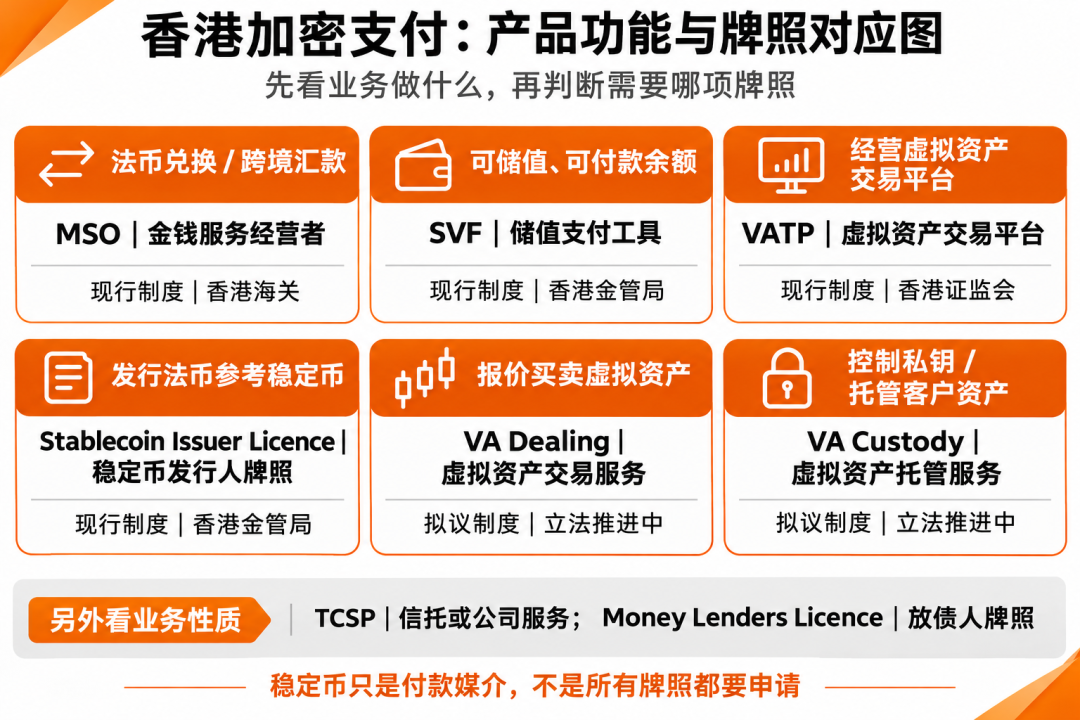
Corresponding chart of Hong Kong crypto payment product functions and licenses
01 MSO and SVF, corresponding to two business arrangements
MSO covers currency exchange and cross-border remittances
When stablecoin payments are credited to the merchant's account, there is usually an additional "outgoing" step: the buyer pays in stablecoins from overseas, and the platform or its settlement arrangement converts the value into Hong Kong dollars, so the merchant eventually receives Hong Kong dollars in their bank account. For payment companies, the focus is not on "which currency was used," but on whether the company has accepted customer instructions in Hong Kong to arrange for this Hong Kong dollar cross-border payment. The MSO license covers services like currency exchange and remittance—sending or arranging for payment to be sent overseas, receiving or arranging for payment to be received from overseas, and arranging to collect payments abroad. The bank is responsible for the final transfer and does not automatically remove the payment company from the transaction chain.
There is a point that can be confusing: converting stablecoins into Hong Kong dollars does not equate to "currency exchange" in the MSO sense. MSO manages the exchange and remittance of fiat currencies and does not automatically grant authorization for stablecoin trading or virtual asset trading just because a company holds an MSO. In other words, payment companies may need to handle two separate lines: trading or exchanging at the currency end and receiving, remitting, and settling at the Hong Kong dollar end. Whether the latter falls under MSO depends on whether the company is receiving money on behalf of the customer, arranging cross-border payments, or promising the customer when Hong Kong dollars will arrive.
If the company itself undertakes Hong Kong dollar collections and cross-border remittances, it should prepare according to the application conditions of MSO: submit materials related to local offices, management office, and book storage locations according to the business premises arrangement, and undergo appropriate candidate reviews; the anti-money laundering system and descriptions of fund flows and delivery channels are also within the review scope. But note that MSO addresses fiat money services and does not cover stablecoin purchases. When companies prepare to integrate stablecoins into cross-border settlement processes, they should design and evaluate the two services separately; the existing MSO license cannot be considered a pass for stablecoin business.
SVF does not trigger just because there is a "balance"
The backend of a payment platform usually has a "balance" page, but the legal nature of the balance cannot just be viewed based on how the page looks. The platform merely records each transaction and funds the merchant's bank account on the settlement date; this is more like a settlement ledger; if the merchant can leave money on the platform and then use it to pay suppliers or transfer to other users, the platform is doing more than just bookkeeping; it is allowing a value to circulate repeatedly within the system. This is precisely where SVF needs to pay attention.
SVF is licensed by the Hong Kong Monetary Authority and governs the issuance or assistance in issuing defined stored value payment instruments. Non-bank applicants generally also need to meet requirements of at least HKD 25 million in paid-up capital or equivalent financial resources, and establish deposit protection, risk management, and anti-money laundering systems. The Monetary Authority allows SVF licensees to additionally provide remittance or currency exchange services, but this is a regulatory arrangement of "primarily stored value payments, with other services as auxiliary," and it should not be inverted to mean: as long as a payment platform has a balance page, it is automatically SVF. SVF licensees that meet the Monetary Authority's described ancillary service arrangements do not need to apply for MSO licenses for those remittance or currency exchange services.
In judgment, only one question can be asked: is this money waiting for settlement, or can it continue to be used for payments? The former is typically just a record of receivables and payables; the latter might already have stored value and payment functions. Whether the merchant can leave the balance on the platform, whether it can be transferred to a third party, and whether the platform has the responsibility for redeeming the balance is often more critical than "is there a balance on the product page".
02 Other licenses depend on whether the product enters the corresponding business
VATP applies to operating virtual asset trading platforms
Stablecoin payment products often connect to trading platforms, but connecting to trading platforms and operating trading platforms are two different things. The VATP license corresponds to regulated virtual asset trading platform operations. Payment companies that only provide collection and settlement services for merchants usually do not need to operate a set of electronic facilities to enable trading parties to frequently conclude virtual asset buying and selling. If the product regularly makes or accepts binding virtual asset buying and selling offers or frequently introduces trading counterparts to enter into such transactions, and the company directly or indirectly holds customer funds or virtual assets, it needs to evaluate whether it has entered the platform business scope according to Schedule 3B of the Anti-Money Laundering Ordinance.
Specific conditions for Class 1 intermediaries to engage in virtual asset trading
Class 1 regulated activities deal with securities trading. Intermediary institutions that meet the applicable licensing conditions can provide virtual asset trading services according to the requirements of the SFC and the Monetary Authority, for example, executing trades for qualified clients via licensed platforms’ consolidated accounts. For related stablecoins issued by licensed stablecoin issuers in Hong Kong, the SFC has additional applicable regulations. Payment companies purely completing stablecoin exchanges for merchants do not need to automatically obtain Class 1 licenses simply because the transaction objects are digital assets.
Stablecoin issuer licenses correspond to issuance and redemption
Only if a company intends to issue fiat-referenced stablecoins on its own does it have reason to evaluate issuer licenses and the ensuing reserve, redemption, and ongoing regulatory obligations. The Hong Kong Monetary Authority has issued the first batch of licenses to Dingdian Financial Technology and HSBC in April 2026. Ordinary payment companies that use third-party stablecoins focus on confirming whether they actually assume trading, custody, or payment services.
If the company's Hong Kong operations offer specified stablecoins to customers, it must also confirm which institution provides the offer, and whether that institution qualifies as a "recognized provider" under Section 9 of the Stablecoin Ordinance. For specified stablecoins that are not authorized for issue by a Hong Kong license, and do not fall under the prohibition in Section 8, recognized providers can only make offers to professional investors; there are statutory exemptions. If the product adds an entry for "buying coins on the platform," this issue needs to be handled separately.
TCSP for trust or company services
TCSP licenses target trust or company services. Payment companies that establish Hong Kong companies on behalf of clients, provide registered addresses or company secretary services, or act as trustees in explicit trusts in a business manner will fall within the scope of this license. Payment companies that only provide collection, exchange, and settlement services usually do not have TCSP businesses.
TCSP often appears in virtual asset regulatory materials because the current VATP framework requires platforms to hold clients' assets in trust through a qualifying wholly-owned related entity, and that related entity needs to hold a TCSP license. TCSP here qualifies as trust or company services and does not equate to independent virtual asset custody licenses. A payment company holding a TCSP license does not thus gain authorization for currency exchange, payments, or general virtual asset custody.
Lender licenses for operating merchant loans
Lender licenses pertain to another type of product: payment companies providing financing to merchants using their own funds, with repayment of principal by the merchant per agreement. Companies operating lending in Hong Kong need to evaluate the lender license unless exempted under the Lenders Ordinance. This license is determined by the licensing court, the registry is responsible for the application and renewal procedures, and the police are responsible for review and enforcement. Collection, exchange, or remittance licenses do not cover merchant loans.
When "early payment" is involved in payment products, it needs to be assessed in conjunction with contracts. If the platform merely advances payment for transactions that already belong to the merchant, it usually falls under settlement arrangements. If the platform uses its funds for advancement and requires the merchant to repay principal even when future sales are insufficient, it is closer to a loan. If the contract arranges for the purchase of the merchant's future receivables, it must also consider whether the receivables are genuinely assigned and whether the merchant still bears a separate primary repayment obligation. The Hong Kong Court of Final Appeal in the Global Merchant Funding case recognized a specific future credit card receivable arrangement as a sale due to the legal effect of the contract. Delivery or repayment of financing with stablecoins will require separate analysis of asset transactions and custody arrangements.
03 Currency exchange and custody are the easiest areas for payment products to cross boundaries
Payment companies are most likely to cross original product boundaries in two areas. First, the company starts quoting to customers and buying and selling stablecoins in its own name. Second, the company no longer merely transmits payment instructions, but long-term controls the wallets and private keys of merchant assets. The former relates to the proposed virtual asset trading service system, while the latter relates to the proposed independent virtual asset custody system.
The consultation summary on the trading system has clearly stated that the purpose of payment itself does not exclude virtual asset exchanges from the system. If payment service providers provide virtual asset exchange in a business manner, they may fall within the proposed VA Dealing system due to the establishment or offer to enter into agreements for the acquisition or disposition of virtual assets. The proposed system is still in the legislative stage, and the final scope and exemptions will depend on the bill and implementing regulations.
The proposed VA Custody system focuses on who holds the private keys or similar tools necessary to transfer customer assets. Taking multi-party computation (MPC) wallets as an example, it must be seen whether the platform can transfer unilaterally, and whether customers can independently recover access and manage assets when the platform does not participate. If a payment company consolidates merchant stablecoins using its controlled wallets, these permissions need to be clarified. Existing regulatory rules have regulations for licensed trading platforms and recognized institutions that meet the Monetary Authority's requirements for holding customer assets. The proposed system will separately establish licenses for VA Custody services.
Therefore, ordinary payment companies currently most need to clarify the boundaries of trading and custody. Providing investment advice or managing portfolios only enters the analysis scope if the product truly extends to these functions. For payment products that are about to launch, determining the actual functions according to existing rules first, and then focusing on end-of-year legislative amendments and subsequent details, is usually closer to business reality than incorporating all licenses into the plan.
04 Compare your products item by item
Listing together the functions the company intends to provide is often more useful than directly counting licenses. The table below puts common business actions and their corresponding licensing scope together, facilitating the comparison with your own products: which are part of the payment process itself, and which have extended into virtual asset trading, asset custody, stablecoin issuance, or merchant financing.
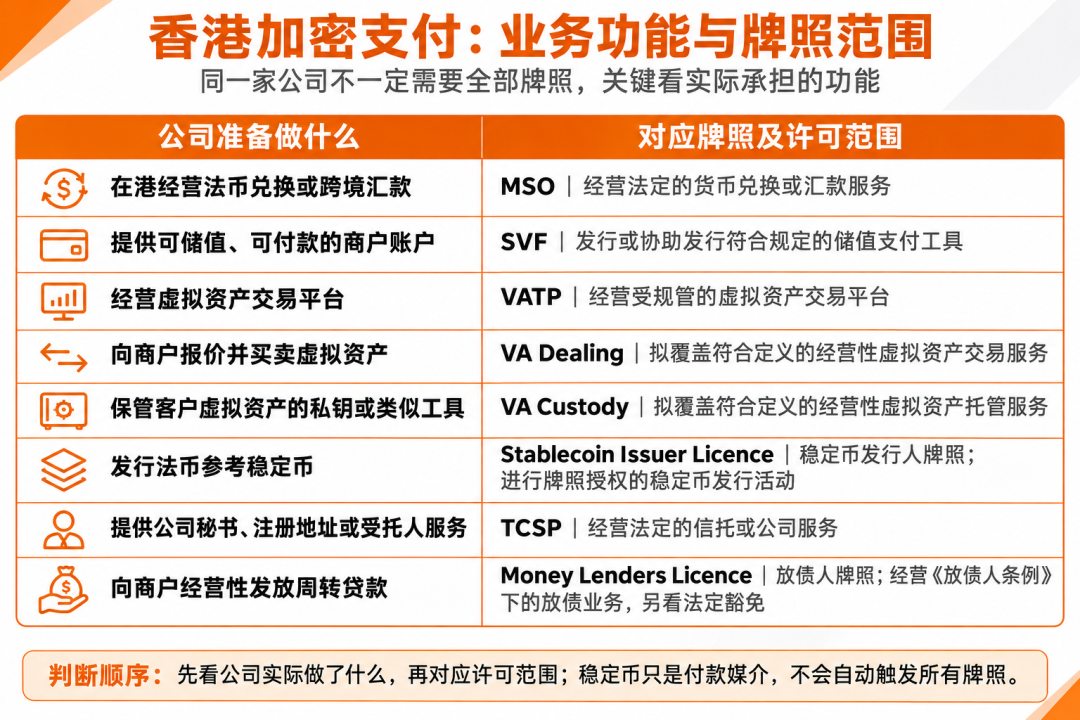
Functions of Hong Kong crypto payment businesses and licensing scope
Conclusion
For companies preparing to engage in crypto payments in Hong Kong, license judgment does not need to start from "how many licenses there are in Hong Kong." What needs to be clarified are several specific arrangements: who is responsible for currency exchange and cross-border payments, whether the platform has created a balance that can continue to be consumed, whether the company buys and sells virtual assets itself, who controls the wallets and private keys, and whether it lends money to merchants.
Once unpacked, the relationships between licenses are not that complicated: MSO and SVF are usually the systems that payment products must first evaluate; VATP and Stablecoin Issuer License only enter core analysis when the company operates a trading platform or issues stablecoins; VA Dealing and VA Custody will have to see legislative progress; TCSP and Money Lenders License depend on whether the company really provides trust or company services or finances to merchants.
Therefore, before landing, the most worthwhile thing to do is not to list all licenses, but to clarify the flow of funds, asset control, and customer relationships, then compare item by item with the licensing scope. This way, one can determine whether the current design can be launched directly, which functions need to be narrowed, and which issues should be resolved after the new system and details are clarified.
References:
Hong Kong Customs "Guidelines for Licensing Money Service Operators" (MSO)
Hong Kong Monetary Authority "Licensing Explanations for Stored Value Payment Instruments" (SVF)
Hong Kong Securities and Futures Commission "Licensing Handbook for Virtual Asset Trading Platforms" (VATP)
Joint Circular from SFC and Monetary Authority on Virtual Asset-Related Activities of Intermediaries, December 22, 2023
SFC Circular on Handling Related Stablecoins by Intermediaries, May 27, 2026
Hong Kong "Stablecoin Ordinance" (2025 No. 17 Ordinance)
Hong Kong Monetary Authority: First Batch of Stablecoin Issuer License Announcement, April 10, 2026
Hong Kong Treasury and SFC "Consultation Summary on Virtual Asset Trading Services" (VA Dealing)
Hong Kong Treasury and SFC "Consultation Summary on Virtual Asset Custody Services" (VA Custody)
Hong Kong Companies Registry: Lender License Regulating Authority
Hong Kong SAR Government Legislative Council Q&A: Legislative Progress on Virtual Asset Trading and Custody System, November 4, 2026
免责声明:本文章仅代表作者个人观点,不代表本平台的立场和观点。本文章仅供信息分享,不构成对任何人的任何投资建议。用户与作者之间的任何争议,与本平台无关。如网页中刊载的文章或图片涉及侵权,请提供相关的权利证明和身份证明发送邮件到[email protected],本平台相关工作人员将会进行核查。


