"We tried blockchain and it didn't work," this statement needs to be overturned.
Written by: Paul Brody, Founder and CEO of Nightfall Networks
Translated by: Chopper, Foresight News
Do you remember Pets.com? It raised $110 million from investors like Amazon to run a business that allowed people to order pet toys and dog food online.
The company has gone out of business, and everyone learned an important lesson: delivering 50-pound bags of dog food to customers' doorsteps is not profitable.
As e-commerce entrepreneur Ed Baum wrote in a retrospective in 2001, "Did Pets.com’s business plan assume that transportation had been invented that could magically deliver bags of dog food to customers' homes without shipping costs?"
Please, whatever you do, don’t tell this to the people at pet supplies e-commerce Chewy; they may not yet realize their business model does not hold. Chewy recorded $12.6 billion in sales and $223 million in net profit in the most recent fiscal year.
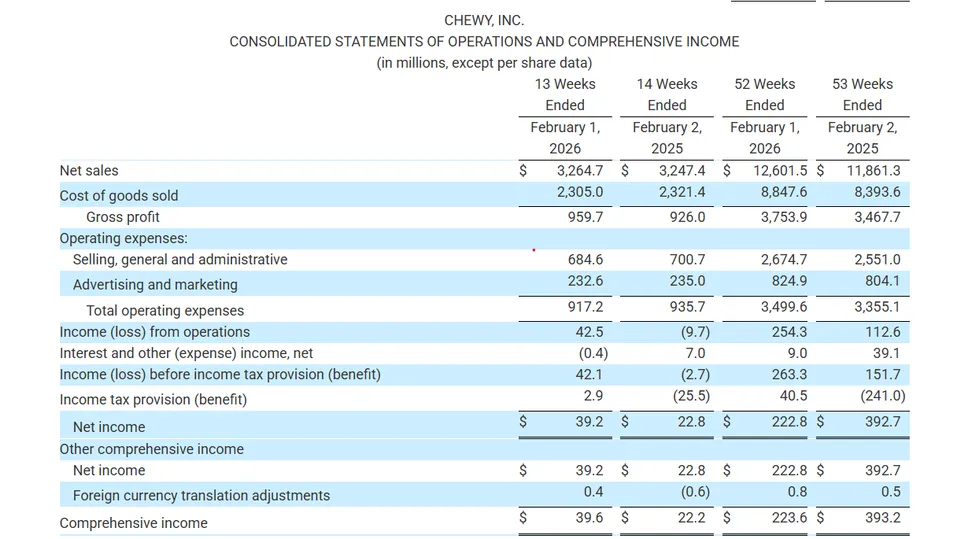
Chewy's reported net profit for the latest fiscal year is $223 million. Source: Chewy
The real lesson from Pets.com is not that "delivering dog food is a bad idea," but that the idea came too early; the logistics, consumer habits, and unit economics to support it did not yet exist.
Pet toys and dog food were like this, and perhaps enterprise blockchain is too.
Between 2017 and 2023, the entire cryptocurrency industry burned through money on this, probably not less than Pets.com and perhaps more. But those few companies working on enterprise blockchain are not delusional; they were just too early.
Why Enterprises Need Enterprise Blockchain
At least on the surface, the appeal of enterprise blockchain solutions is not hard to understand. Today, almost all enterprise systems fail at the boundaries between companies. There are two ways this failure manifests:
First way of failure (the oldest one): collaborative information is never synchronized.
In this world, enterprise IT systems are islands communicating asynchronously through digital messages and spreadsheets in emails. They have low setup costs and low barriers — as long as you don’t mind that the information you're holding is always slightly off.
Second way of failure: expensive, real-time proprietary integration. Powerful industry leaders politely "ask" key suppliers and partners to join their closed but perpetually online networks.
This type of solution is very expensive but does work well, and it causes everyone to develop a sort of business Stockholm syndrome where you start appreciating the thoroughness and efficiency of this digital control.
Blockchain offers another way: sharing information and business logic in an open ecosystem. You get real-time visibility and efficiency like proprietary systems without carrying the risk of being locked in.
About 2017, this seemed obviously to be a good idea. Investments flowed in, alliances were formed, press releases were drafted and sent out, and then almost everything collapsed. TradeLens, We.Trade, Contour, B3i, ASX Chess, Everledger — all these companies bloomed and withered in just a few years.
The details of these stories vary, but they generally have one commonality: they had to do a lot of "non-blockchain" things to compensate for the deficiency of privacy capabilities inherent in blockchain.
What Enterprises Want is Privacy, Not Transparency
No company wants its competitors to see what it’s doing. Consequently, the common approach is to build a private/permissioned chain and then make a lot of non-blockchain alterations both on and off the chain, trying to hide information. The result is uniformly slow, expensive, and unmarketable.
It’s difficult to describe the scale of that "bloodbath"; the number of companies and startup teams that attempted enterprise blockchain but failed is too numerous to count. A quick search on the internet and historical references found 18, some quite well-known.
Many of them backed by big names: from large banks like Deutsche Bank and HSBC to tech companies like IBM. A prestigious background and a strong brand were not enough; the lack of privacy resulted in poor outcomes.
Some survivors have "de-blockchained" themselves: abandoned the facade of blockchain and reverted to the classic SaaS (Software as a Service) model. Many companies that have trialed these permissioned enterprise systems left with a clear conclusion: we tried blockchain and it didn't work.
This is quite believable because everything is different now.
Today's Blockchain: Scalable, Private, and Liquid
Blockchain is scalable. In 2020, Ethereum processed 1 million transactions a day, with gas fees sometimes soaring, and at that time, there were reports of "whales profiting from high gas fees while retail investors were pushed out of DeFi." Today, most transaction costs are under a penny, and capacity is moving towards billions of transactions per day. No one talks about the "impossible triangle" anymore. Ethereum is both decentralized and scalable.
Privacy is also different than before. Privacy is still not the default setting, but now there are many privacy tools and systems available: from privacy pools to zero-knowledge rollups, and full privacy chains. Additionally, Ethereum is building a series of tools that add fundamental privacy elements at multiple layers of the network. The result is that businesses can now operate at scale under high privacy conditions.
Finally, there’s liquidity. Everything is on-chain. Global regulators have cleared stablecoins, leading to a tsunami of liquidity and record trading volumes.
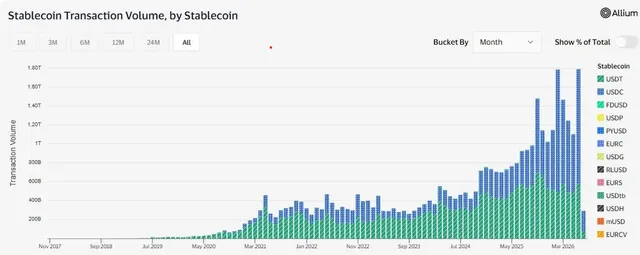
Adjusted stablecoin trading volume in June was slightly below $1.8 trillion. Source: Visa Onchain Analytics
If we combine blockchain's operational advantages with financial advantages, we get something enterprises have never truly possessed before: a single ecosystem where you can not only buy, sell, and transfer assets but also receive payments for assets.
The return on investment for each component of this equation is substantial, and combined it can yield significant advantages. McKinsey partners have even estimated that digital supply chain tools could achieve 35%-75% inventory reduction through better planning.
More conservatively, based on my experience in this field: simply by not using layered spreadsheets and electronic data interchange messages, most supply chains can reduce inventory by about 20% at the same service levels. In most industries, this means billions of dollars in operating capital.
Even better, smart contracts compress the handling time of many commercial contract rules from days to minutes, cutting management costs in half. Microsoft has begun moving the royalty settlement of its Xbox gaming network to smart contracts, reducing the time to obtain monthly royalty reports from 45 days to 4 minutes while processing over 2 million transactions daily.
Once inventory, contracts, purchase orders, and invoices are on-chain, operational capital can be directly improved because each one can be verified.
When you can prove your purchase orders come from a top buyer, you can get credit at a lower cost; when you have complete visibility into inventory and delivery status, you can immediately and efficiently do accounts receivable financing.
The possibilities are vast, the returns are great, and the use cases are clear. So, it’s time to try again.
免责声明:本文章仅代表作者个人观点,不代表本平台的立场和观点。本文章仅供信息分享,不构成对任何人的任何投资建议。用户与作者之间的任何争议,与本平台无关。如网页中刊载的文章或图片涉及侵权,请提供相关的权利证明和身份证明发送邮件到[email protected],本平台相关工作人员将会进行核查。


