Author: Michael Dempsey, Managing Partner at Compound
Translation: Deep Tide TechFlow
Deep Tide Overview: In the technology and venture capital market, the cycle of technology hype is rapidly shortening, from the previous 48 months down to only 12 to 36 months. The choice of "narrative cycle entry point" when startups go public has upgraded from a public relations embellishment to a critical strategic decision that pertains to life and death.
Michael Dempsey, Managing Partner at Compound, delves into the four major evolutionary stages of the narrative cycle: the Obscurity Phase, the Wave of Rising Conviction & Consensus, the Peak Fervor & Euphoric Apex, and the Rise from the Ashes. Each stage has distinctly different offensive and defensive physical laws, and blindly applying a one-size-fits-all template will only turn companies into victims of noise.
Whether defining categories in the early phase, dissecting micro-narratives in the mid-phase, or fighting for differentiation and distribution capability at the peak, top teams view narrative construction as equally important as product development. Only by clearly understanding which slice of the cycle they are in can they firmly build a cognitive moat amidst the onslaught from capital and competitors.
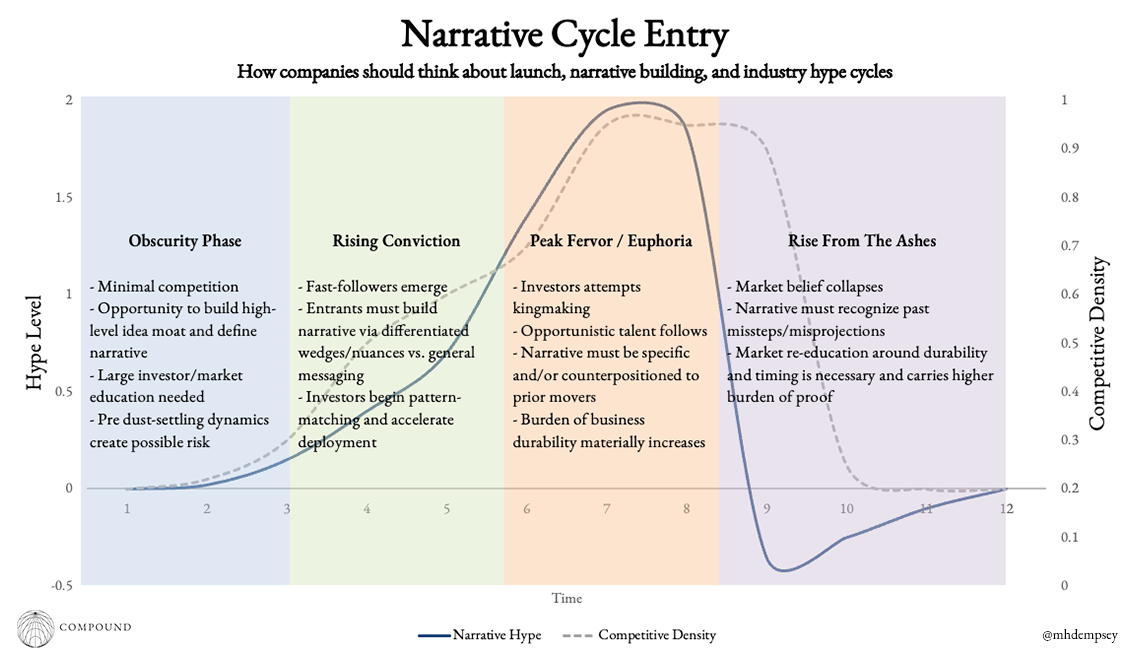
When startups make their formal external announcements, founders must be acutely aware of their current position in the narrative cycle. At Compound Venture Capital, we always believe this work requires careful crafting, prudent handling, and strategic intent; this is also a core topic we frequently refine with the teams we invest in.
From the perspective of a simplified model, the technology narrative cycle can generally be divided into four progressive stages:
First, the Obscurity Phase. In this very early stage, external attention is extremely limited, with only a few core circles paying attention, and virtually no intense competition on the same dimension. This means that founders must take on the heavy responsibility of market enlightenment education, projecting narratives in advance of establishing certainty in the industry.
Second, the Wave of Rising Conviction & Consensus. In this mid-evolution stage, the hype gradually intensifies, multiple batches of competitors enter the arena and collectively elevate various adjacent narratives, while talented individuals and investment institutions rapidly transition from passive curiosity to staunch believers.
Third, Peak Fervor & Euphoria. In this late-stage heating up, the intensity of hype, industry consensus, and competition density all reach their peak, resulting in a surge in product differentiation difficulty, with evident excess capital leading to a flood of speculative followers.
Fourth, Rise from the Ashes. After the collapse of excessive prosperity, market expectations reset completely, and former enthusiastic believers become skeptics. The media, talent, and investment community often respond with extremely negative sentiment towards the commercial viability of that technology direction or track.
These stages are interlinked and progress sequentially. At different phase slices, teams must match entirely different methodologies and communication strategies to accurately penetrate the market and establish effective dialogue amidst varying intensities and types of external noise.
Obscurity Phase (Early)
The Obscurity Phase of the narrative cycle covers a wide range but is often a golden bed for creating miracles, capable of defining an entirely new category from scratch or significantly broadening people's recognition boundaries of certain technological possibilities.
In the current entrepreneurial rhythm, this phase typically lasts 12 to 36 months, with the first 12 months often proceeding extremely quietly and stealthily off the market radar.
The central advantage of publicly appearing at the dawn of the narrative cycle is that you can establish a macro-level intellectual moat and occupy the narrative of the category. Looking back at early commercial space (NewSpace), government technology (GovTech), deep learning, and synthetic biology fields, none are exceptions to this.
By seizing this first-mover advantage, companies enjoy a vast narrative space in public relations and market communication. The team can initially tell stories based on macro visions that resonate with the general public, then gradually converge to specific product details or functional highlights that concern only professional buyers and talent within the core circle as time goes on.
Another core benefit is that, before the market undergoes intense cutthroat competition, the competition for mission-driven or specific industry experts is relatively mild. At that time, job seekers are more willing to engage in the broader direction of space exploration without insisting on specific aspects like satellite communication or on-orbit manufacturing.
Finally, high-execution early leaders are able to continuously attract capital as the narrative heat ferments and rapidly ascend to become the Schelling Point Company or category banner in the field during the process where investment institutions compete to create icons.
However, entering a specific narrative cycle too early also comes with significant hidden dangers and pain points.
Entering the market too early often exposes companies to the risks of being copied or surpassed by later entrants with stronger execution, even risking becoming a public textbook for rapid followers' trial-and-error. It is increasingly common for startups to encounter two to four venture-capital-backed competitors within the first 24 months of their establishment.
Companies in the Obscurity Phase often struggle to build a commercial moat of sufficient scale in time. As the potential customer base expands, although pioneers secure early ecosystems, later entrants can leverage existing lessons to capture incremental customers and scale by precisely targeting a single core pain point.
Overall, entering too early likely means you are running ahead of the dust settling. Any dramatic variable at the bottom of the industry could force you to turn around and reconstruct the narrative. Early AI shell applications, for instance, fell into this trap, underestimating the impact of the leap in cutting-edge large model capabilities and self-research from labs.
Similar dilemmas have also appeared in the commercialization-slowing tracks of robotics infrastructure, commercial space software, and contract manufacturing synthetic biology. They imply a bet that the industry's scaling speed would exceed reality, ultimately falling into passivity due to the difficulty of validating commercial flywheels every 18 to 36 months in line with venture capital rhythms.
Wave of Rising Conviction & Consensus
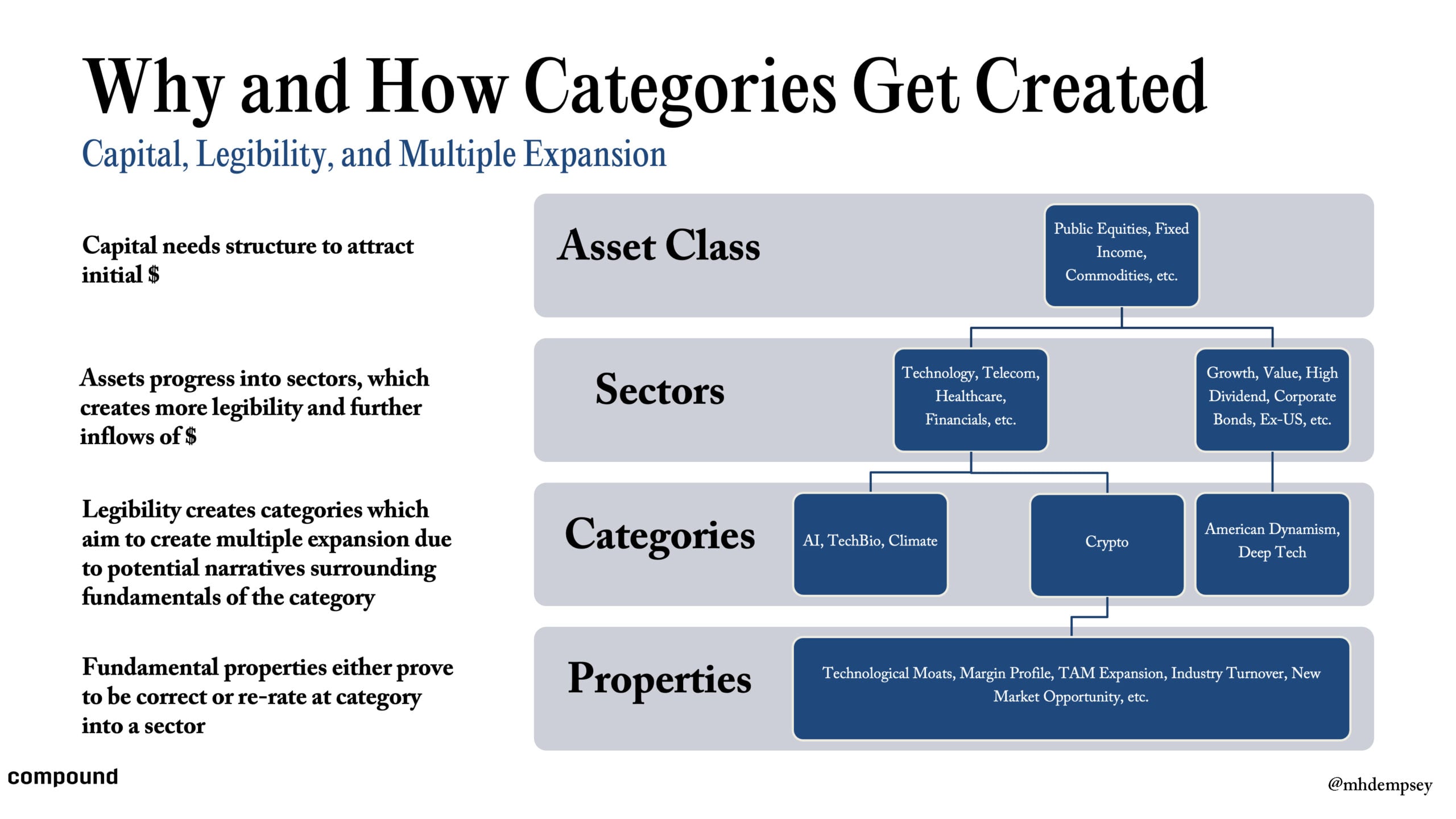
In startups and the tech market, narratives always surge in waves. As categories are established, companies either successfully position themselves at the core Schelling point of the macro category or must vigorously compete for the dominance of micro-narratives within that category.
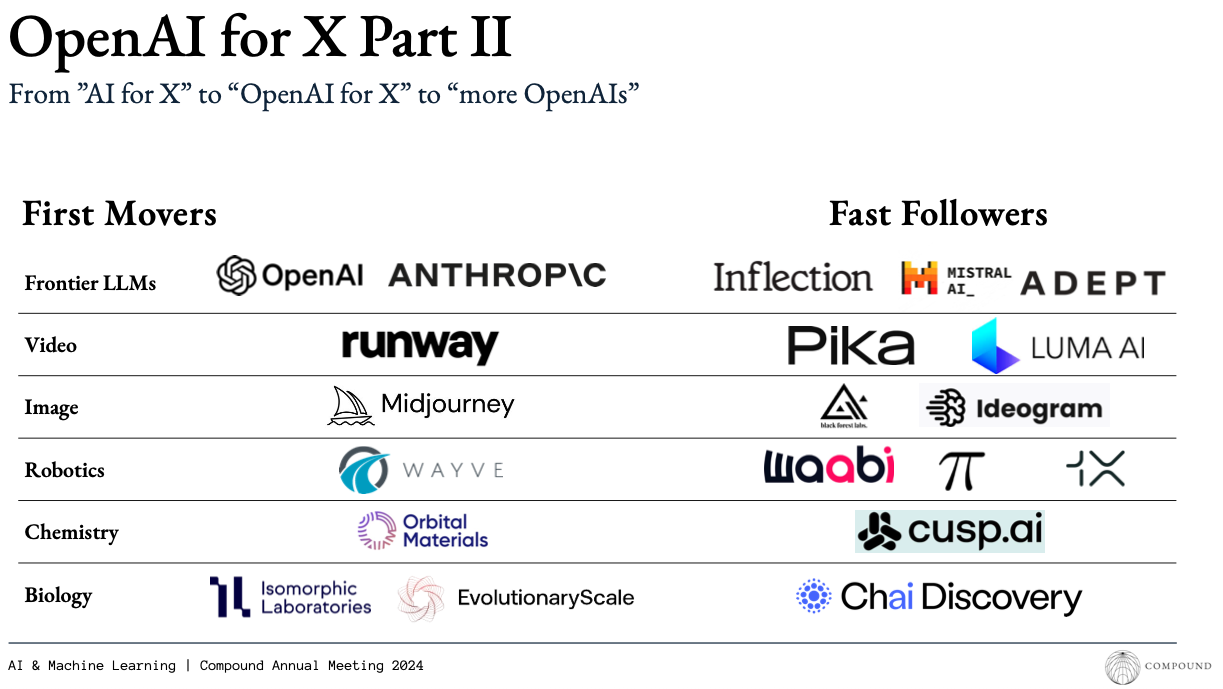
The wave of rising conviction often features a longer evolutionary arc. In this stage, you can not only see the scaling expansions of benchmark pioneers but also witness a large number of rapidly following entrants who have obtained early funding, thereby triggering the initial signs of narrative fatigue.
These follower companies typically cling to the same narrative anchor points, often managed by well-connected standard teams, trying to supercharge their progress by amassing massive capital across various dimensions. This phenomenon arises from venture capital searching for viable samples, blindly following trends, mistakenly believing that waving larger-caliber funding cannons will speed up progress, but the reality is often otherwise.
Faced with a continuous barrage of the same macro concepts over 24 consecutive months, the public, investors, potential employees, and clients tend to fall into aesthetic fatigue and skepticism. The entire track rapidly transforms from an imaginative blue ocean into a congested red ocean melee.
I have previously analyzed the typical dynamics seen when Inflection attempted to penetrate leading AI laboratories in an article discussing open-source AI business models and brand moats:
For this reason, for the vast majority of founders, launching a company mid-wave forces them to present more precise and recognizable core beliefs or compelling proof of why a more focused narrow micro-narrative has commercial value that matches or even surpasses the macro narrative held by early leaders.
Reflecting on precedents: After SpaceX established its leadership position in space (2010 to 2016), the commercial space track rapidly differentiated into multiple highly specialized sub-tracks such as satellite data platforms, rocket launches, on-orbit manufacturing, and space communication, with many cutting-edge technology sectors replaying this differentiation logic.
The advantage of entering mid-wave lies in being able to communicate your differentiation core clearly, giving you ample time to observe industry sedimentation patterns while enjoying the dividends from the market cultivated by pioneers. But this also means a significantly heavier burden of proof; you must rigorously justify why your solution is superior and deserves to be heard.
For founders at this stage, the most practically valuable strategy is to leverage insights from their investors or early benchmark company ex-employees to review why pioneers previously resonated with the public, clients, capital, and talent, as well as at which key points they unfortunately lost focus.
As the narrative cycle approaches its climax, narrative positioning itself becomes like a wave that must be harnessed and followed.
The first five to ten entrants in a specific sub-track will quickly realize that if they cannot become the Schelling Point Company for the entire category, they must gradually unpack downwards from the macro narrative and anchor more specific business scenarios. This gradual path is depicted as below, probing down through the category pyramid to core products and applications:
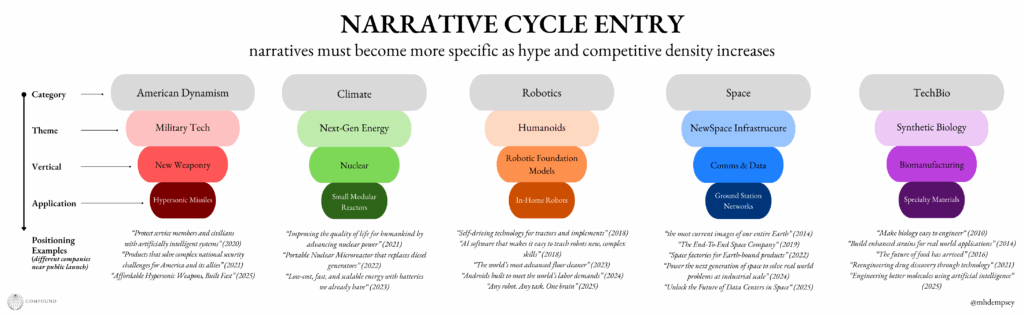
Specific paths of evolution can be observed: a group of companies initially riding the broad banner of climate technology, then focusing on the next generation of clean energy, and further delving into the nuclear energy track, ultimately pinpointing small modular reactors (SMRs) and building their worldview narrative around tangible engineering breakthroughs.
Similar advancements are also reflected in the American Dynamism track, where the narrative pipeline gradually descends from macro strategies to defense technology, new military hardware, and ultimately concrete hypersonic missile development.
If the field has begun to show a large and continuously expanding willingness to commercialize, companies might even skip intermediate transitions and head straight towards extremely vertical and easily comprehensible scenario narratives, such as specialized AI for legal or financial verticals.
The mid-cycle is notoriously challenging to navigate because the feel of early to mid and mid to late transitions are drastically different. Timing the descent of your narrative effectively is an extremely rigorous game. As the track remains in the public eye longer, the burden of proof for commercial efficacy will only grow heavier.
We observe that the best teams can often cover the track with high-frequency market noise over the long term, thereby solidifying themselves as core asset owners of specific intellectual moats. This is no easy task; it requires the team to give top priority to external market dissemination in terms of ideology and organizational resource allocation.
Peak Fervor & Euphoria
When the heat and consensus of a certain track reach their pinnacle, it attracts a significant number of slower lagging followers, while a large number of originally unrelated businesses scramble to pivot, attempting to latch on to the popular concept train.
Looking back at the 2021 crypto wave, numerous traditional businesses hastily donned blockchain facades and rushed onto the scene, overflowing with impatience and clamor.
This scene replayed in 2023 to 2024: a large number of startups, driven by the heat of diffusion models and the momentum of Midjourney and Runway, crazily raised large amounts of funding, creating a batch of so-called creative AI applications that were all the rage on social media for a few days before fading into silence.
The code generation track in 2025 will also be no exception to this fate. Companies ranging from enhanced IDE tools, fully autonomous coding agents to zero-code application generators are fully following up, and in the past 12 to 24 months, many seriously homogenized following financing projects have emerged.
Though in each case, entrants strive to differentiate themselves at presentation by showcasing some specific features or particular vertical scenarios, any rational observer will form an underlying prediction: the final destination of most of these businesses will lead to heightened homogeneity and brutal convergence.
To successfully break through and top the feverish peak of the narrative cycle, you must hold a genuinely disruptive product that possesses qualitative differentiation to penetrate the noise or command scalable distribution channels to secure victory in encounter battles. Simultaneously, massive market investment must be closely accompanied by high-frequency delivery to prevent the narrative from becoming an unsupported castle in the air.
Entering at the peak of excitement, there remains an objective tactical possibility to accurately access narratives and the gap in reality, but this heavily depends on extremely tight dissemination arrangements and solid execution. While it may seem like the worst entry point, for teams well-versed in narrative leverage or adept in strong reverse positioning, it may actually allow them to claim a place among specific believers.
However, the most critical flaw of entering at the peak is that it often constitutes a late compromise for a decoding debut or results in becoming a mediocre follower entirely devoid of barriers, unable to spark any lasting impact on the real user side from the outset.
Rise from the Ashes
The technology industry has always been extremely adept at over-promising in the short term while under-delivering on expectations. This often triggers intense emotional disenchantment, leading the entire market to experience a hard reset of hype and trust regarding specific categories. This is the most challenging release moment for founders, but if historical rhythms repeat, a few phoenixes rising from the ashes will meet enormous opportunities here.
It must be acknowledged that establishing projects from the ruins is rarely an active choice but more often an objective reality following the collapse of previous efforts or an almost stubborn belief from the founding team when facing all uncertainties. Even from a highly rational venture capital perspective, this kind of pure dedication remains invaluable.
As the rampant, disappointed, and hateful frenzy gradually settles, the market will ultimately gather a group craving genuine awe, waiting to reconstruct their worldview for this technology or sector. The best companies can elevate their previous industry failures, transforming them into an essential prelude in their entrepreneurial epics.
If this can be achieved, it often detonates a new cycle of development, leading to a revaluation of the entire category's value and enabling companies to gather abundant capital to withstand the next wave of followers' impact, thereby propelling the narrative flywheel into a new round of spin.
The crypto industry has historically excelled in this regard, rejuvenating old structures each cycle and injecting new speculation and mechanisms; clean energy and climate technology have similarly gone through multiple cycles of hot and cold, robustly advancing amid countless predecessors' paving and reconstruction.
The most intuitive examples today are found in the fields of biotechnology and computational biology. Computational drug development platforms like Recursion, after a decade-long journey, remain fully committed to delivering on early technological promises; while synthetic biology companies like Ginkgo strive to search for commercial closed loops amidst the industry remnants of countless moths drawn to flames.
For these deeply entrenched hard-tech tracks, the industry may only need to witness one or two symbolic turning points that bridge the gap between promise and reality to completely reshape the valuation pricing of the entire asset class and attract significant growth-stage venture capital back into these nearly disconnected deep waters.
The Existential Inquiry of Narrative Strategy
Over the past decade, Compound has invested significant effort in systematically exploring how narratives permeate and spread between technological breakthroughs, elite talent circles, core clients, and financial capital. Ten years ago, carefully designed narratives might still have been viewed as decorative soft power; however, in today's context, controlling the timing of narratives has become a first-order strategic pillar on par with product development and channel expansion.
The technology hype cycle has drastically compressed from 48 months to 12 to 36 months, leaving founders with a sharply narrowed margin for trial and error. Whether pioneering category definitions in the Obscurity Phase, precisely digging into micro-narratives as conviction rises, breaking through amidst peak excitement through high-frequency delivery, or reshaping industry trust from the ashes, commercial success increasingly hinges on whether your narrative composition can accurately align with the physical laws of the cycle you find yourself in.
Truly competitive leading enterprises have internalized narrative construction as a symbiotic part of their top-level strategy, not merely a PR embellishment following product-market fit (PMF). In a brutal market where competitors rise with massive capital in lightning-paced blitzkrieg, firmly establishing a cognitive position through high-dimensional narratives has already transformed from marginal gains into an existential proposition for the life and death of the enterprise.
免责声明:本文章仅代表作者个人观点,不代表本平台的立场和观点。本文章仅供信息分享,不构成对任何人的任何投资建议。用户与作者之间的任何争议,与本平台无关。如网页中刊载的文章或图片涉及侵权,请提供相关的权利证明和身份证明发送邮件到[email protected],本平台相关工作人员将会进行核查。


