Author: Curry, Shenchao TechFlow
Introduction:
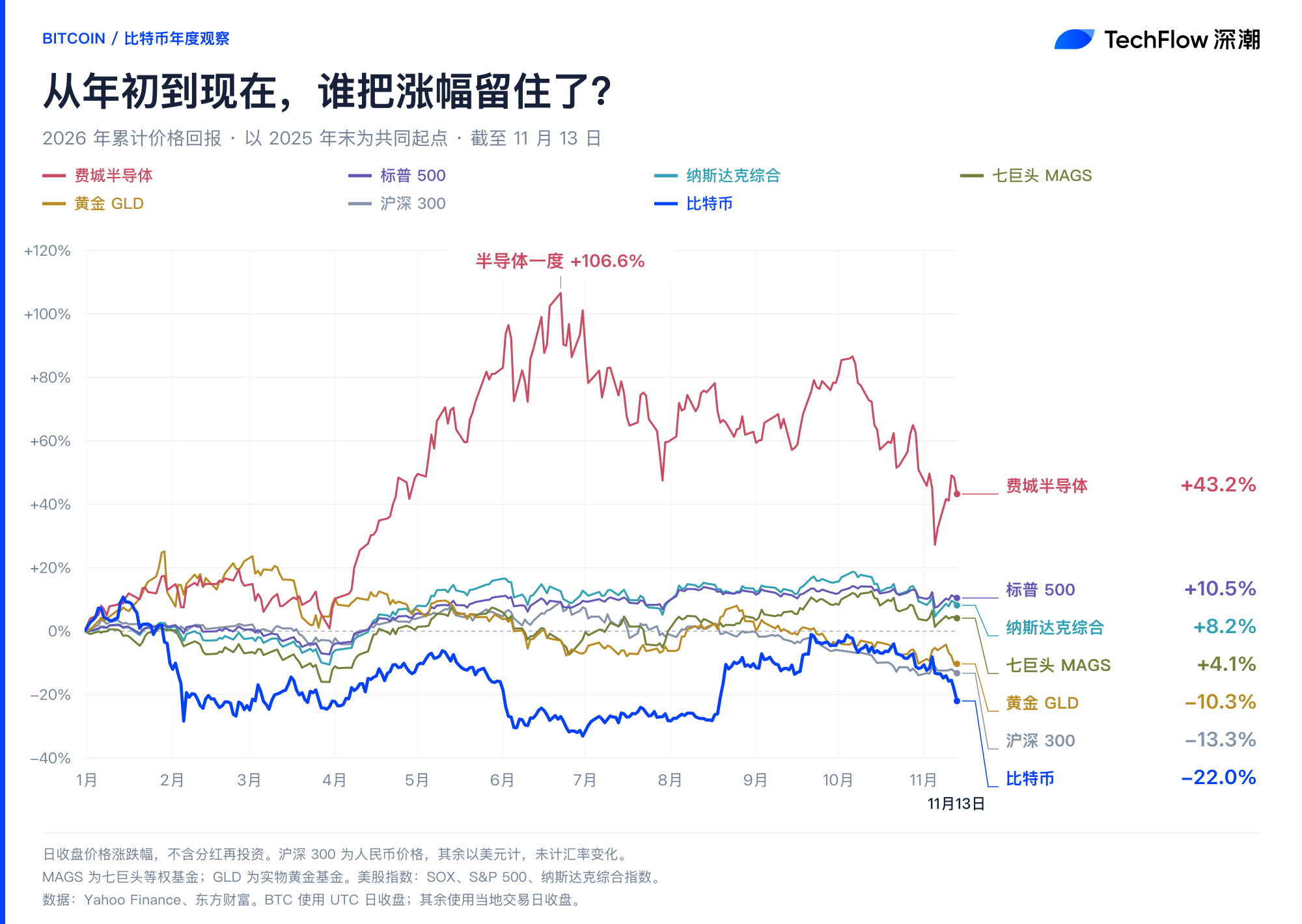
As of November 13, among the major asset returns of 2026, the most glaring gap is not between US stocks and A-shares, but between semiconductors and Bitcoin. The Philadelphia Semiconductor index soared 106% mid-year before sharply retracting, yet it retains an accumulated increase of 43.2%; the S&P 500 and Nasdaq Composite indices also robustly maintained positive returns of 8% to 10%.
Only Bitcoin, which was highly anticipated, briefly crawled back to breakeven in September before diving again, ending up at -22.0%, the bottom among all mainstream assets. This means Bitcoin not only failed to act as an amplifier for the tech bull market, but also became the first liquid asset to be sold off in a volatile market devoid of sustained incremental capital.

If you have been holding onto Bitcoin until mid-November, taking another look at this year's major asset return curve, it might be hard to calm your emotions.
This year, the most dramatic scene in the entire market is captured in the chart below:
Leading the pack, the Philadelphia Semiconductor experienced a feverish spike of 106.6% mid-year, only to face a ruthless halving; yet even with such a drop, as of November 13, it still shows a 43.2% increase on paper.
And what about Bitcoin? It not only failed to catch this wave of liquidity, but has spent most of the year struggling underwater.
In February, it dropped below the surface, constantly scraping along the floor mid-year, barely crawling back near zero between September and October, only to face another cliff-like drop in November, with the accumulated decline expanding directly to -22.0%, placing it at the very end of all mainstream assets.
Even the Shanghai and Shenzhen 300 index (-13.3%) and the recently retracted gold GLD (-10.3%), often mocked for their weakness, are performing better than it.
Many holders envisioned at the beginning of the year: US stocks rise, AI rises, and cryptocurrencies, as high-beta assets, should theoretically outperform in multiples. But the reality is extremely ironic; high elasticities indeed materialized, but only in the downward direction.
The Semiconductor Retreat is Valuation Digestion, Bitcoin's Decline is a Loss of Buy Orders
The core difference lies in the presence of real capital support.
The Philadelphia Semiconductor this year has followed a typical pattern of industry windfall and emotional speculation. In the first half, global giants were madly scrambling for computing power, with hardware supply chain orders extending to the following year, pushing valuations to the moon; in the second half, the market started doubting the monetization speed of large models, leading to a concentrated sell-off of profit-taking that directly reversed over 60 percentage points. But even with such a scary pullback, it was still underpinned by several major tech giants' capital expenditures of tens to hundreds of billions of dollars; as long as orders were still being delivered, it had a layer of performance that couldn’t be easily punctured.
Bitcoin is exactly missing this layer of support.
With the arrival of spot ETF in 2024 to 2025, old money on Wall Street has basically swept up the necessary core positions. As we enter 2026, the overarching macro dividends from large-scale liquidity have yet to appear, and the cryptocurrency industry lacks new narratives that could break the circle and lock in funds, leading to ETF's net inflow gradually transforming from a roaring river into seasonally flowing streams.
Once there are no continuous new buy orders in the market, high Beta becomes a dull knife that cuts flesh. In favorable circumstances, it’s an accelerator for capital chasing bubbles; but in a stock game, it turns into a chip that everyone wants to sell at high prices. The rebound in September appeared vigorous, but as long as it couldn’t attract outside incremental capital, any slight disturbance combined with various CEX hacks and quantum computing negativity would send it back to its original state.
Not a Safe-Haven Asset, Nor a Shadow of Technology
More awkward than being at the bottom of the decline, is that Bitcoin's positioning in asset allocation is losing focus.
In recent years, the crypto space has loved to label Bitcoin with two tags: one is digital gold, used for inflation resistance and hedging; the other is a high-elasticity tech stock shadow, used to capture the premium of macro liquidity.
But a glance at this year's curve reveals that both tags have been shredded.
When tech giants led the Nasdaq and S&P on a steady upward path, Bitcoin not only failed to keep pace with the Nasdaq's 8.2% and S&P's 10.5% steady gains, but also continued to consolidate during the tech stock frenzy. You say it's a shadow of tech stocks, but the real tech money is all in buying Nvidia and foundries, with none spilling over to the blockchain.
You say it’s digital gold, but when global assets collectively contracted in November due to adjustments in macro expectations, and gold faced a sudden drop, Bitcoin fell faster and harder than anyone else.
In short, after Wall Street embraced Bitcoin, its actual positioning is not as a safe harbor, but rather as a liquidity tool with the best liquidity, open 24 hours, and ready to be liquidated at any time.
When institutions face margin calls in other markets or need to lock in profits for the year, the easiest asset to sell off during weekends and nighttime is precisely Bitcoin.
I mean, crypto has indeed entered the mainstream; but the result of being brought to the table by old money is not sitting down to share the cake, but often being the first to be asked to pay the bill.
免责声明:本文章仅代表作者个人观点,不代表本平台的立场和观点。本文章仅供信息分享,不构成对任何人的任何投资建议。用户与作者之间的任何争议,与本平台无关。如网页中刊载的文章或图片涉及侵权,请提供相关的权利证明和身份证明发送邮件到[email protected],本平台相关工作人员将会进行核查。


