Trading can be 7x24, but settlement cannot.
Written by: Andjela Radmilac
Translated by: Luffy, Foresight News
Wall Street is moving towards round-the-clock trading, one key aspect being who provides cash when the main interbank payment system is closed on weekends.
If you want to adjust your positions on Saturday, being able to trade allows you to avoid waiting until Monday. However, the companies behind your trades still need to manage the liabilities incurred before settlement is completed and must assess how much additional business they can take before replenishing cash or collateral.
CME opened weekend trading for cryptocurrency derivatives in May, but settlement still occurs on business days. Some stablecoin providers have allowed customers to receive cash faster by depositing funds in advance with partner banks.
Both arrangements provide investors more actionable time, but they also mean that different companies are now responsible for ensuring that “cash is available when needed.”
In June, we saw the consequences of extended wait times. Two major subsidiaries of DTCC (the Depository Trust & Clearing Corporation) delayed securities settlements by a day, resulting in a significant amount of cash being held in the central counterparty's account at the Federal Reserve and reducing reserves available to banks.
Related companies managed to get through without experiencing the short-term interest rate spikes described later by the Chicago Fed. Extended trading hours require companies to prepare for similar delays, as their usual sources of cash and operational support may become harder to obtain.
The Cost of Extra Day Trading
When an institution buys and sells securities through DTCC's clearing subsidiary NSCC, it can offset the amounts owing for purchases against the amounts due for sales. NSCC positions itself between buyers and sellers in qualified trades to calculate how much each company should ultimately pay for the batch of trades.
DTCC states that the process known as "netting" can reduce stock payment obligations by an average of 98%, thereby reducing the amounts companies need to pay on settlement day.
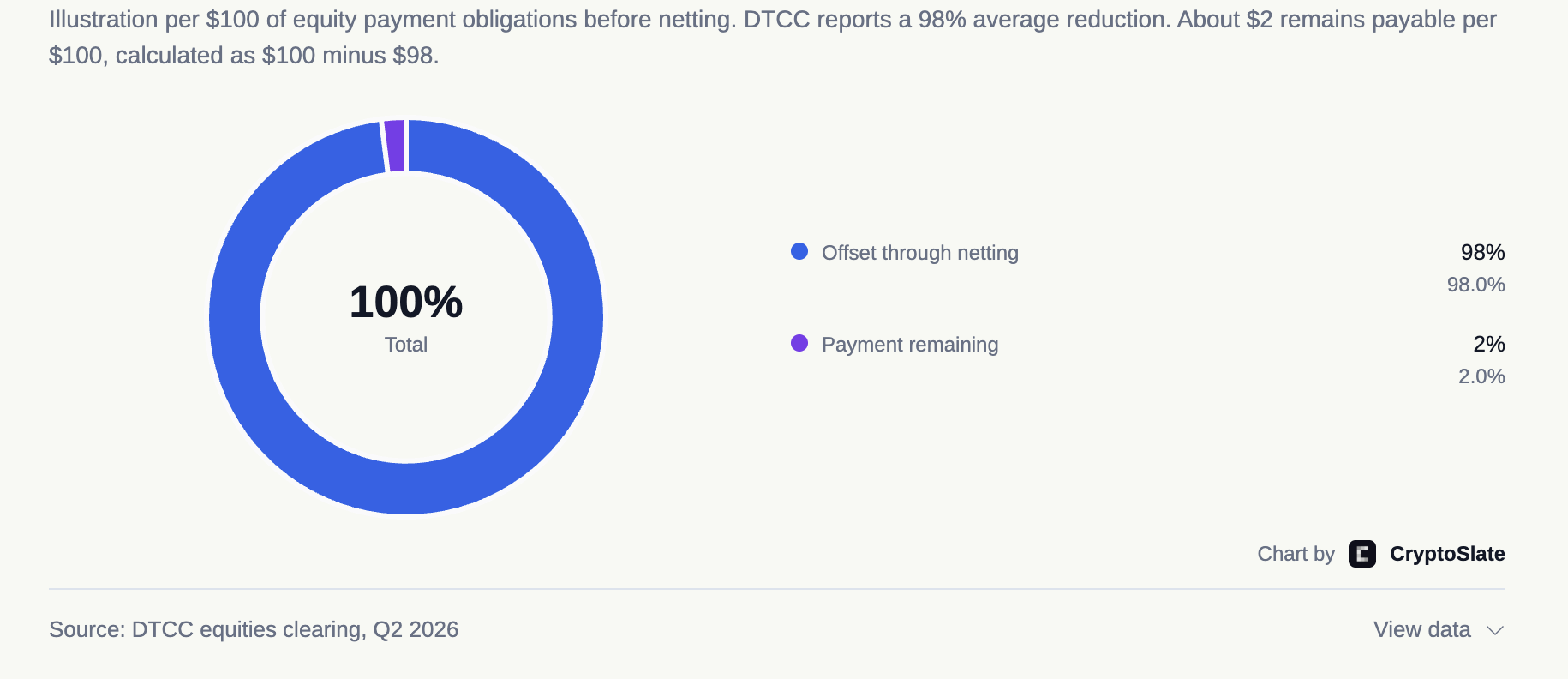
Calculating payment obligations per $100 of stock: DTCC reports an average reduction of 98%, leaving approximately $2 still due
After netting, companies still need to pay the remaining amount. According to a DTCC explanation, a participant submitted an erroneous transaction the previous day, resulting in an unusually large payment obligation.
DTC and NSCC initiated market disruption-related rules and obtained several extensions from the Federal Reserve while attempting to reverse the trade. Ultimately, they did not succeed before the final deadline at 8:30 PM local time, with the balance rolling over to June 30.
The two-day settlement was completed on June 30, but the delay left related companies with outstanding bills. NSCC charged its risk fund a fee to cover another day of trades it had guaranteed; therefore, companies expecting to receive funds had to continue waiting.
Cash was held in the central counterparty's account at the Federal Reserve until the settlement system delivered the funds back to the banks due to receive them.
The balance at the Federal Reserve held by banks is termed "reserves." Some companies responsible for clearing and settlement also have accounts at the Federal Reserve, with those balances recorded separately.
Assuming a bank pays $10 billion to one of the companies, and an operational failure hinders the funds from flowing back to them, all else equal, bank reserves would drop by $10 billion, while that company’s balance at the Federal Reserve would rise by the same amount.
The money is still at the Federal Reserve, but it is held in an account that a bank cannot use to make payments.
The Chicago Fed described this process in its November explanation of the disruption, but did not specify the amount of the reserve decline. Chicago Fed official Cindy Hull provided two possible explanations for the stability of short-term rates: companies believe payments will eventually complete, and the banking system has adequate reserves.
A document from DTCC outlines who bears some of the costs: companies that have not received payments will earn interest based on DTCC's overnight cash earnings, while indebted companies do not incur financing costs. When losses directly related to delays far exceed interest payments, DTCC will consider claims on a case-by-case basis.
Money for the Weekend Needs to Be Prepared in Advance
CME’s round-the-clock 24-hour trading covers cryptocurrency futures and options, with at least a two-hour maintenance window each week.
According to its announcement, trading from Friday evening to Sunday evening is recorded for the next business day, at which point clearing and settlement occur. DTCC has made similar arrangements for trading processed by NSCC, operating on a five-day, 24-hour weekly basis since June 28.
Whether the futures exchange is open or not, your Bitcoin positions may depreciate over the weekend. When the exchange is open, you can reduce this exposure, while the company responsible for clearing must determine how much risk clients can add before the next settlement.
The derivatives clearing organization Nodal proposed two practices for some Coinbase derivatives in a submission to the CFTC:
- First: Members must keep additional weekend trades within half of customer “excess margin,” exceeding collateral left after meeting existing trading requirements.
- Second: Customers can use all excess margin but must deduct losses from positions they still hold; profits on these positions will only count towards purchasing power when margin is recalculated after the weekend. Members supporting weekend contracts also need to pay an additional fee to the guarantee fund.
This is intended to prevent customers from leveraging with “money not yet received.”
The Federal Reserve's plan is to integrate Sunday and holiday banking hours into its large-value funds transfer system and national settlement service by as early as 2028. The new schedule remains Sunday through Friday, with daily operational hours of 22 and 21.5 hours respectively.
The instant payment system FedNow operates on weekends, but its transaction limit, set to increase in November 2025, still falls well below the amounts some clearing firms need to transfer.
Chicago Fed researcher David DeCarlo analyzed data from the third quarter of 2022 to the third quarter of 2025: CME’s basic clearing service discloses the "maximum payment obligations of any participant in the past year" each quarter, with a median of $3.73 billion; in the worst-case scenario, the median estimate is $24.31 billion. Both figures cover a much broader business than weekend crypto trading, and when companies use the same clearing bank, some payments can offset each other.
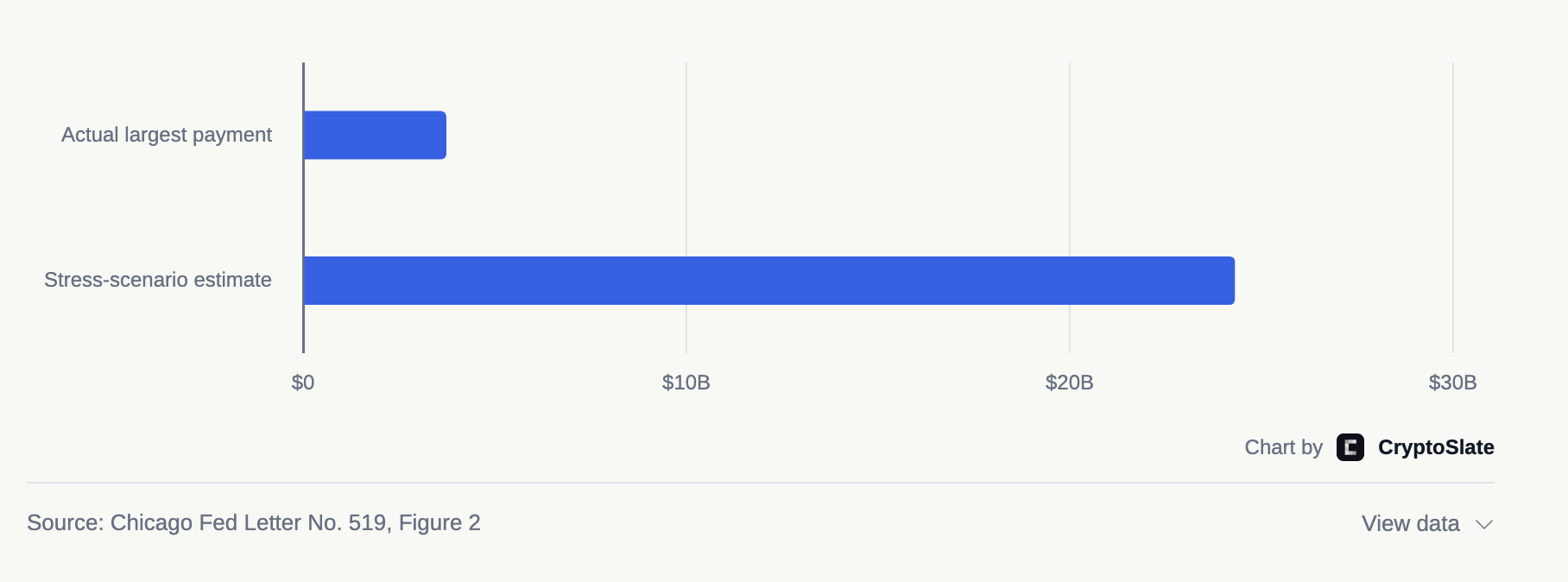
CME basic clearing service. Data shows the median amounts disclosed quarterly from Q3 2022 to Q3 2025
While they are not perfect indicators of the market, they illustrate why "payment scale" is equally important as "operating hours."
Even Faster Money Requires Someone to Advance It First
As long as the payee can accept it, you can transfer circulating stablecoins between wallets outside of banking hours. But if the other party needs dollars in a bank account, the next step is to redeem those stablecoins.
Circle stated in an explanation that qualified platform customers and customers using its payment network can redeem anytime, with near real-time arrival; the standard pathway typically requires up to two business days.
Circle claims it can accomplish this because it has reserved cash in partner banks and arranged mechanisms for transfers when customers require them. The yields on this cash are lower than U.S. Treasuries, so Circle sacrifices some interest to enable faster redemptions.
How much this service can withstand when the number of customers requesting withdrawals exceeds expectations depends on how much cash those banks can pull out.
Once tokenized assets are converted into tokens, they can also circulate outside of banking hours. Already tokenized securities can be transferred on the same blockchain.
DTCC’s tokenization service keeps "conversion orders" within business hours, while digital cash and on-chain netting only appear in future development roadmaps. If you plan to submit tokenized collateral over the weekend, you may need to prepare in advance and confirm if the other party is willing to accept it.
On November 11, OKX and the joint venture OKXICE with the parent company of the New York Stock Exchange, ICE, announced it would provide round-the-clock trading for over 70 expected tokenized securities, including 59 Direxion ETFs. Qualified U.S. customers will trade through a licensed liquidity pool on X Layer, relying on a temporary exemption from the SEC. The announcement did not specify when the relevant banks and redemption services would be available.
When someone transfers assets to you to complete a transaction, you need to know when that transfer ultimately becomes effective and whether what you received can be used.
The principles from the Bank for International Settlements (BIS) cover both points: when the transfer is legally irrevocable and whether the holder can redeem stablecoins at face value under market stress conditions.
Now imagine a payment has issues at 3 AM on Saturday. The payer’s records indicate the instruction was sent, but the payee cannot access usable funds.
During the time employees determine whether the issue is a "message delay" or "transfer failure," someone must decide whether the company can free up funds for a substitute payment and how much settlement the company can withstand if the original payment is delayed.
A CFTC guidance outlines what arrangements trading platforms should have under current rules: who is on duty for operations and risk, how the company responds to disruptions, whether it can contact its relied-upon vendors, and how the platform can use parallel systems to upgrade or roll back software while keeping trading open.
When a payment gets stuck, the person authorized to approve substitute payments also needs to be able to contact banks or counterparties that can actually deliver the funds.
In the June disruption, related companies got through a day without triggering a spike in short-term rates. Weekend trading provided investors with more ways to manage exposure and forced companies to handle delays while clients continue to increase their positions.
If a pending payment gets stuck on Saturday, someone has to have enough cash on hand to cover the next due payment, and have the authority to release it before the regular payment systems reopen.
免责声明:本文章仅代表作者个人观点,不代表本平台的立场和观点。本文章仅供信息分享,不构成对任何人的任何投资建议。用户与作者之间的任何争议,与本平台无关。如网页中刊载的文章或图片涉及侵权,请提供相关的权利证明和身份证明发送邮件到[email protected],本平台相关工作人员将会进行核查。


