Bitcoin has dropped about 15% in 11 days, with $1.91 billion flowing out of the spot ETF for seven consecutive days; CZ stated that Binance has not sold off and admitted to buying during the dips.
Written by: Lockridge Okoth
Translated by: Saoirse, Foresight News
On November 15, Bitcoin fell to $62,006 on the Binance platform, marking a nearly three-month low. This largest cryptocurrency globally has dropped about 15% over 11 days. During the same period, American investors withdrew $1.91 billion from Bitcoin funds listed on US exchanges.
(This article is standardized to Beijing time)
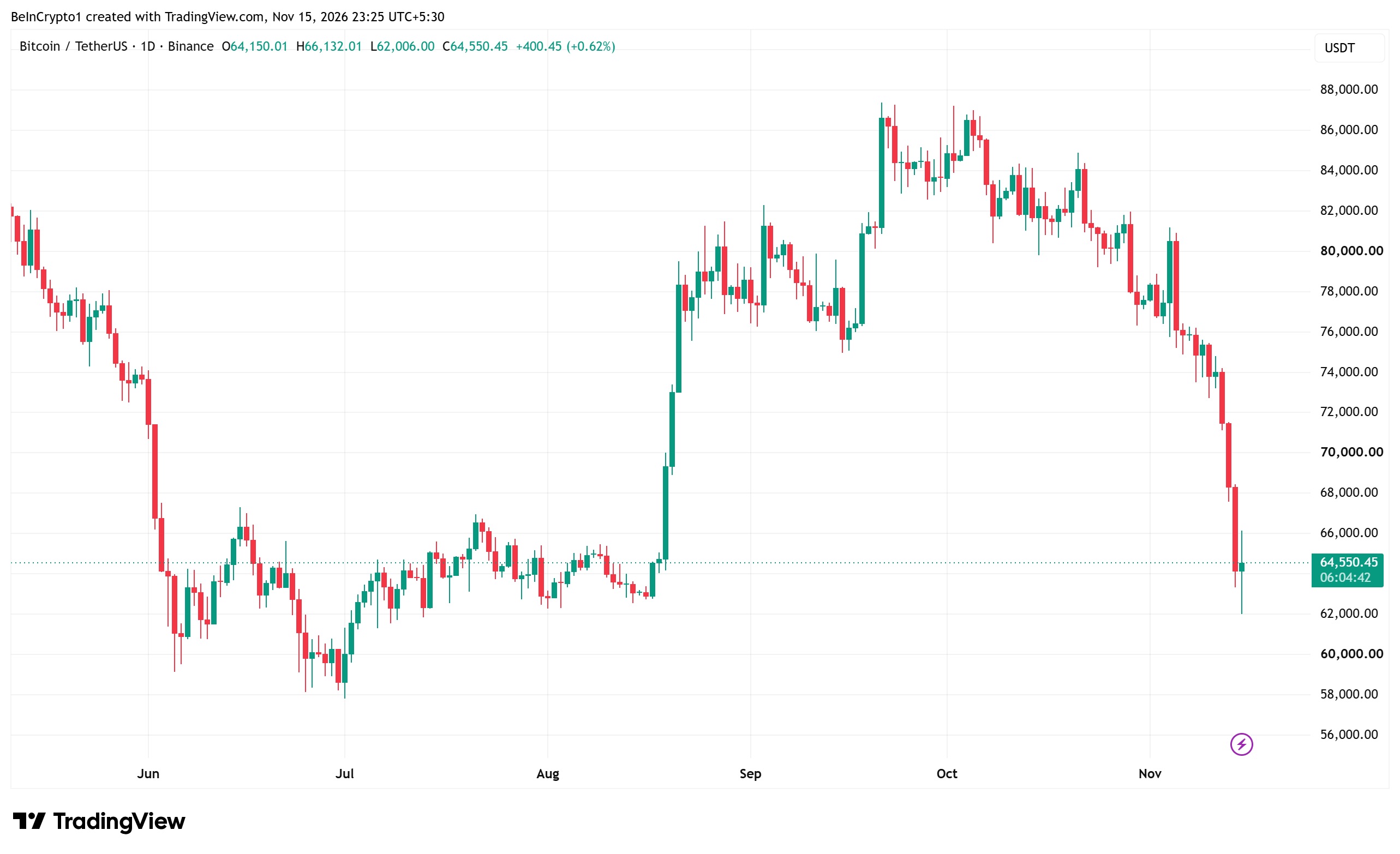
Bitcoin (BTC) price performance. Source: TradingView
Binance co-founder Changpeng Zhao (CZ) listed six potential causes in the early hours of November 16, reminding readers at the beginning:
“Why is cryptocurrency falling? No one can draw a conclusion. Correlation does not equal causation.”
Bitcoin Decline Situation
At the end of September, Bitcoin was trading close to $87,000; as of November 4, the price remained around $81,000. On November 13, the price fell below $70,000 and dropped to $62,006 on November 15, before rebounding to approximately $64,500.
Traders who leveraged their positions experienced the most significant losses. Around $1.96 billion in leveraged long positions were liquidated in 24 hours across the crypto market, of which Bitcoin long positions accounted for about $600 million.
Below are the six possible reasons CZ proposed, along with verifiable information from available public data.
1. Are funds flowing out of the crypto market to participate in the Anthropic IPO?
CZ's first guess: Investors are selling cryptocurrencies to take part in the new stock subscription of Anthropic. To support this view, he cited a tweet from Matt Cole, chairman and CEO of the Bitcoin treasury management company Strive.

Matt Cole compared the Bitcoin market before the IPOs of SpaceX and Anthropic, suggesting that Bitcoin's drop before the IPO might indicate that funds are being pulled out to participate in the new stock subscription.
Tom Lee, chairman of BitMine, also shared similar views.
This IPO is massive. According to a filing amendment submitted by Anthropic to the US SEC on November 10, the AI company behind the Claude conversational model plans to issue 825 million shares, priced between $70 and $78. If issued at the upper price limit, the fundraising could reach approximately $64 billion. The issue price is expected to be determined on November 19, and it will trade under the ticker symbol ANT on Nasdaq the following day.
(Note: The pricing will occur after the US market closes on November 18, corresponding to after 5 a.m. Beijing time on November 19.)
Currently, there is no public data to confirm how many Bitcoins have been sold for this IPO subscription, nor can we confirm the actual existence of such sell orders.
2. Are US investors redeeming Bitcoin funds?
This is indeed true, and it is the only one of the six guesses supported by quantifiable data.
Spot Bitcoin ETFs hold real Bitcoins and trade like regular stocks in the US market, with many American retail investors and institutions allocating Bitcoin through these ETFs.
SoSoValue data shows that from November 5 to 13, for seven consecutive trading days, a total of $1.91 billion flowed out from the related ETFs. On a single day, Friday, there was an outflow of $185.4 million, with BlackRock's IBIT seeing $143.5 million flowing out and Fidelity's FBTC with $41.9 million.
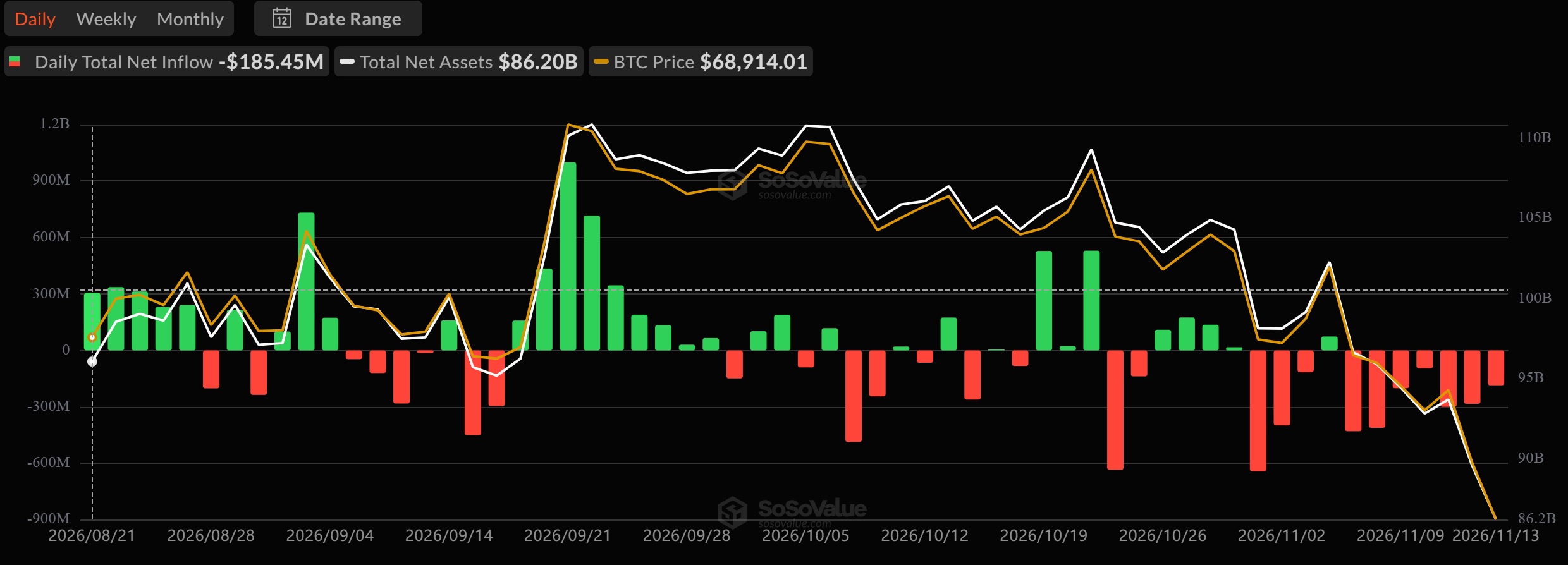
Bitcoin spot ETF fund flows. Data source: SoSoValue
Binance Research noted that this is one of the most severe outflows for the spot ETF since its launch.
3. Did a hacker attack and vulnerabilities cause investor panic?
CZ mentioned a series of recent security incidents: Binance was hacked, iPhone crypto wallets were raided, there were critical vulnerabilities in Chrome, and widespread outages in Microsoft services.
- Binance: On October 30, hackers stole about $6.3 billion from the exchange, marking the largest theft in the crypto industry’s history, which was attributed to North Korean hackers. Binance stated that user funds are safe and approximately 98% of the stolen assets have been replenished.
- iPhone: Security agency CertiK issued a warning on November 6 about an attack kit named DarkSword specifically targeting unupdated systems in iPhone crypto wallets; Apple has fixed the vulnerability in iOS version 26.3.
- Chrome: Industry media SecurityWeek reported that Google fixed a Chrome vulnerability being exploited by hackers on November 9, which was also the eighth critical vulnerability Google has addressed this year.
- Microsoft: On November 12, there was a widespread outage of Outlook and other Microsoft 365 services. A summary from Splashtop indicated that Microsoft stated there was no evidence suggesting that the incident was caused by a malicious cyberattack.
CZ wrote, “Recent security incidents may prevent some investors from wanting to hold crypto assets.”
4. Did inflation data exceeding expectations lead the Fed to reconsider rate hikes?
The US October CPI rose 0.4% month-on-month, higher than the expected 0.3%; the core CPI, excluding food and energy, rose by 0.3%. Federal Reserve Governor Christopher Waller indicated that he leans towards implementing a rate hike in December. Rate hikes raise financing costs and typically put pressure on risk assets.
5. Are rising US Treasury yields and a stronger dollar dragging down Bitcoin?
CZ suggested, “Rising yields and a stronger dollar create pressure on risk assets like cryptocurrencies.” When the risk-free returns from US Treasury securities increase, Bitcoin, which does not generate interest, becomes less attractive.
Finwire cited Coinbase's institutional research data: as of November 13, the futures market was pricing in a total of 64 basis points of rate hikes from the Fed in the next year, compared to only 37 basis points at the beginning of this month.
6. Will the results of the US midterm elections lead to stricter crypto regulations?
The Democratic Party gained control of both the House and Senate in the midterm elections on November 3. The industry has high hopes for the CLARITY Act, which aims to establish a clear regulatory framework for the crypto market; however, it failed to pass in a key Senate vote in September with a result of 49 votes for and 50 against. The market anticipates that after the new Congress convenes in January, the Democrats will introduce another regulatory bill. Senator Elizabeth Warren stated that there is still room for bipartisan negotiations on crypto regulations, but the CLARITY Act will not be reused.
Bitcoin's reaction to the election results was mixed: during the vote counting phase, the price fell to around $75,600, only to rebound to around $81,000 the next day.
Views from Binance Management
CZ stated that Binance did not sell crypto assets during this downturn. “I actually bought cryptocurrencies in the past few days because I just received a stablecoin. (Maybe that’s the reason for the drop),” he joked.
Binance co-CEO Richard Teng and He Yi both posted identical tweets on the X platform on Sunday, with a gap of 70 minutes between postings.
“The market is under short-term pressure, which is a normal response to a tightening macro environment and a shift in AI financing sentiment. However, the long-term logic of Bitcoin and the crypto industry has not changed.”
Binance Research linked this drop to market concerns about AI company financing. During these 11 trading days where Bitcoin dropped by 15.6%, the shares of US AI cloud provider Nebius fell by 27.5% simultaneously.
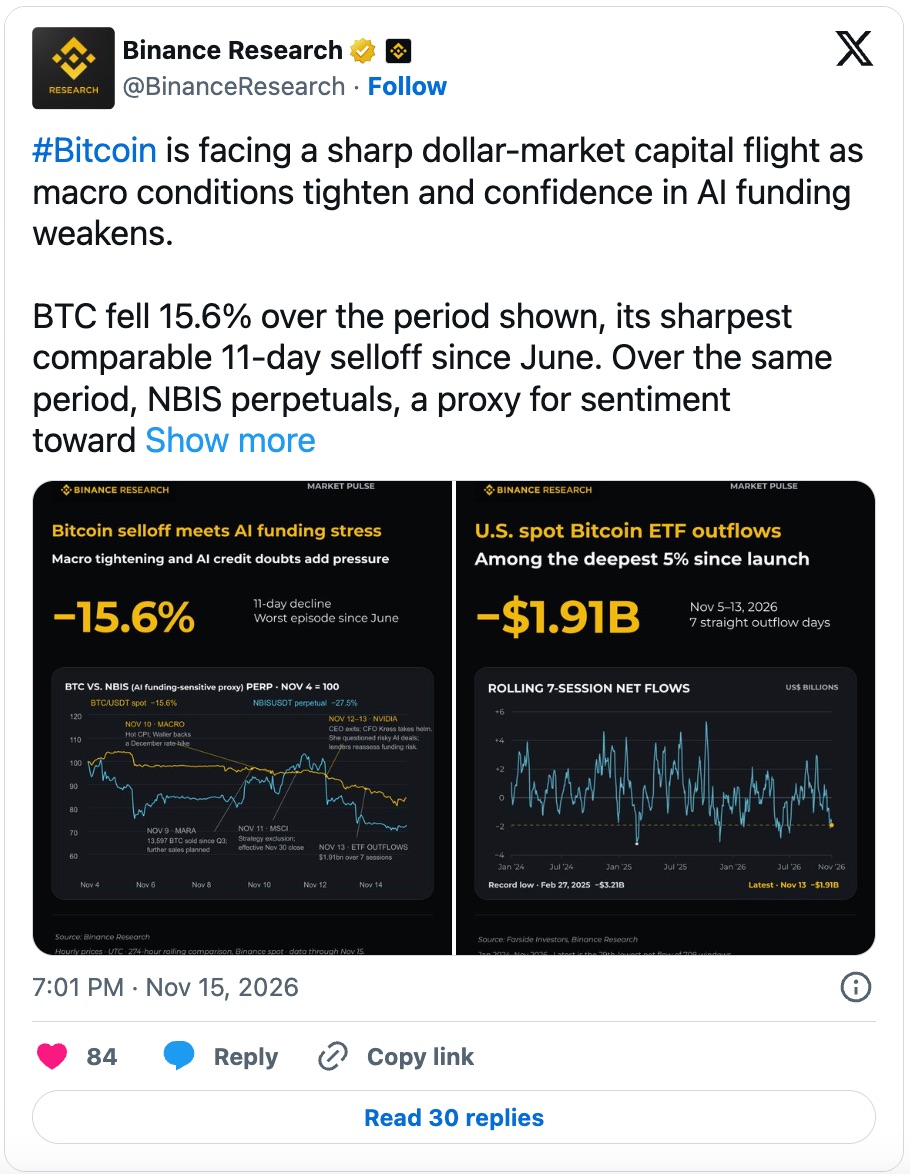
Binance Research noted that the tightening macro environment and weakening confidence in AI financing led to a significant outflow of Bitcoin funds, with Bitcoin dropping 15.6% in those 11 days, while the AI sentiment benchmark NBIS perpetual contracts dropped simultaneously, compounded by consecutive large outflows from the spot Bitcoin ETF over seven days.
The article also pointed out that this correlation in trends does not prove that the capital flight from the AI sector directly caused Bitcoin's drop.
Some traders provided a more concise interpretation. Analyst Michaël van de Poppe believes this is a rare correction led by concentrated long liquidations, with large amounts of long leverage being liquidated; he also mentioned that he is currently accumulating on the dips.
Key Events to Watch Next
This week there are three key points worth tracking:
- November 16: Following the outflows on Friday, the latest ETF fund flow data will be released.
- November 17: Nvidia will release its earnings report. This will be the first earnings announcement since Jensen Huang stepped down as CEO on November 12, with CFO Colette Kress taking over as interim CEO. The Binance research team will focus on management's statements regarding AI financing plans.
- November 19: The issuance price for the Anthropic IPO is expected to be finalized.
CZ finally offered a long-term judgment: “In the medium to long term, the crypto industry will continue to develop. The above only represents personal views and does not constitute investment advice.”
免责声明:本文章仅代表作者个人观点,不代表本平台的立场和观点。本文章仅供信息分享,不构成对任何人的任何投资建议。用户与作者之间的任何争议,与本平台无关。如网页中刊载的文章或图片涉及侵权,请提供相关的权利证明和身份证明发送邮件到[email protected],本平台相关工作人员将会进行核查。


