The traditional sense of the cryptocurrency world no longer exists.
Written by: Liu Honglin
In Liu Cixin's novel "The Three-Body Problem," Wang Miao, who studies nanomaterials, gets caught up in a series of suicides among scientists.
One of them, named Yang Dong, is a theoretical physicist and Ding Yi's girlfriend. Wang Miao wants to know why she reached this point, so he goes to find Ding Yi.
Ding Yi takes him to a billiard table, asks him to sink the black ball into a pocket, then move the table and play again. After several attempts, the ball goes in every time. Ding Yi then asks: what if it is hit the same way, but suddenly flies to the ceiling or even flies chaotically around the room?
He uses billiards as a metaphor for particle collision experiments. Scientists originally wanted to use more powerful accelerators to verify physical theories, but found that under the same conditions, the experimental results varied each time. Yang Dong had hoped to verify her theory through experimentation, but now even the repeatable laws were no longer available.
In her suicide note, this despair turned into a single sentence: "Physics has never existed."
She always believed that the world had rules, and humans could understand these through experiments. The education she received, the research she committed to, and the arrangement of her life were all based on this belief.
What is now shaken is the entire set of methods she used to understand the world.
The disappointments of some veterans in the cryptocurrency world today remind me of this plot.
The experience they believed in for many years has also started to fail: Bitcoin has risen, but the altcoins they hold have remained stagnant; Wall Street institutions have entered, yet funding for crypto projects and investors' exits have not become easier. This doesn’t seem right, as in past cycles, it was always that after Bitcoin rose, money would flow into other altcoins, multiplying tenfold or hundredfold. After several cycles, "waiting patiently for the next cycle" became the basis for many people's investment, entrepreneurship, and even life arrangements.
Admitting this set of experiences may no longer be effective is harder than acknowledging a wrong purchase. However, if the new capital entering has no intention of buying your coins, waiting for another round may not lead to the results of the past.
Yesterday, after reading an interview with Fu Peng, he mentioned that Bitcoin's four-year cycle is over, and crypto assets will gradually be incorporated into traditional asset allocation frameworks. I agree with his assessment of industry changes. Fund managers buying Bitcoin need to consider whether this position fits within the overall portfolio, and after reducing their holdings, can also transfer the money back to bonds or stocks. Retail investors waiting for funds to flow from Bitcoin into altcoins have no obligation to allocate assets in that order.
I retweeted and commented: The traditional sense of the cryptocurrency world no longer exists.
What the old cryptocurrency world relied on
The cryptocurrency world once had a tried-and-tested formula for wealth.
The old cryptocurrency world I refer to is the circle that relied on issuing coins for funding, getting listed to cash out, and then relying on a new round of newcomers to carry the whole chain forward. It provided many opportunities, but also left a legacy of manipulation, fraud, and profit transfer.
By 2026, betting the industry's future on this set of gameplay, I feel it is already impractical.
Products were not yet done, but grand narratives and white papers were already there, fundraising relied on issuing coins. Early investors waited to exit after listings, while users tested products and looked forward to selling the tokens for a good price once received. The team sold tokens under the name of foundations, to pay for development and operational costs. How the product would charge later did not seem urgent.
This approach provided financing opportunities for small teams and supported the construction of wallets, trading platforms, and developer tools. But for those projects that relied on token subsidies to maintain activity, once the token price dropped and subsidies stopped, those collecting airdrops left. At this time, the team realized that not many were willing to pay for the product, and revenues could not support the expenses for the next year.
In the early blockchain ventures, there was also belief in another thing: users distrust banks and large companies and are unwilling to let platforms control their data, hence the need for a decentralized alternative. However, in places where banking and payment services are relatively mature, many people have institutions they trust and are comfortable using. Simply relying on the term "decentralized" makes it hard for them to move.
This cryptocurrency totem, Bitcoin, also has many buyers who choose to hold it through traditional institutions. They want to participate in Bitcoin investment but may not be willing to study private keys or shoulder the loss of irreversible mistakes in wrong addresses. Buying and selling Bitcoin Exchange-Traded Funds (ETFs) through familiar securities accounts allows them to hand over the complications of custody to institutions.
The often-repeated "assets controlled by oneself" may not carry the same importance for these clients as convenience.
Cryptocurrency is becoming the backend of finance
On July 18, 2025, Trump signed the "GENIUS Act" in the White House East Room, establishing a special federal regulatory framework for payment-type stablecoins. Issuers must provide full qualified reserves, disclose the composition of reserves, and fulfill anti-money laundering and other obligations.
Many in the cryptocurrency world saw this as a victory: after so many years of struggles, it was finally accepted by the mainstream market.
But it was ultimately a misallocation.
The White House’s choice of stablecoins was to reinforce the international position of the US dollar, stimulate demand for US Treasury bonds, while bringing issuance and capital circulation under regulation. The crypto industry produced a useful tool, which the US government saw as a means to serve its financial system.
The original ideals of the cryptocurrency world were not the starting point for this policy choice.
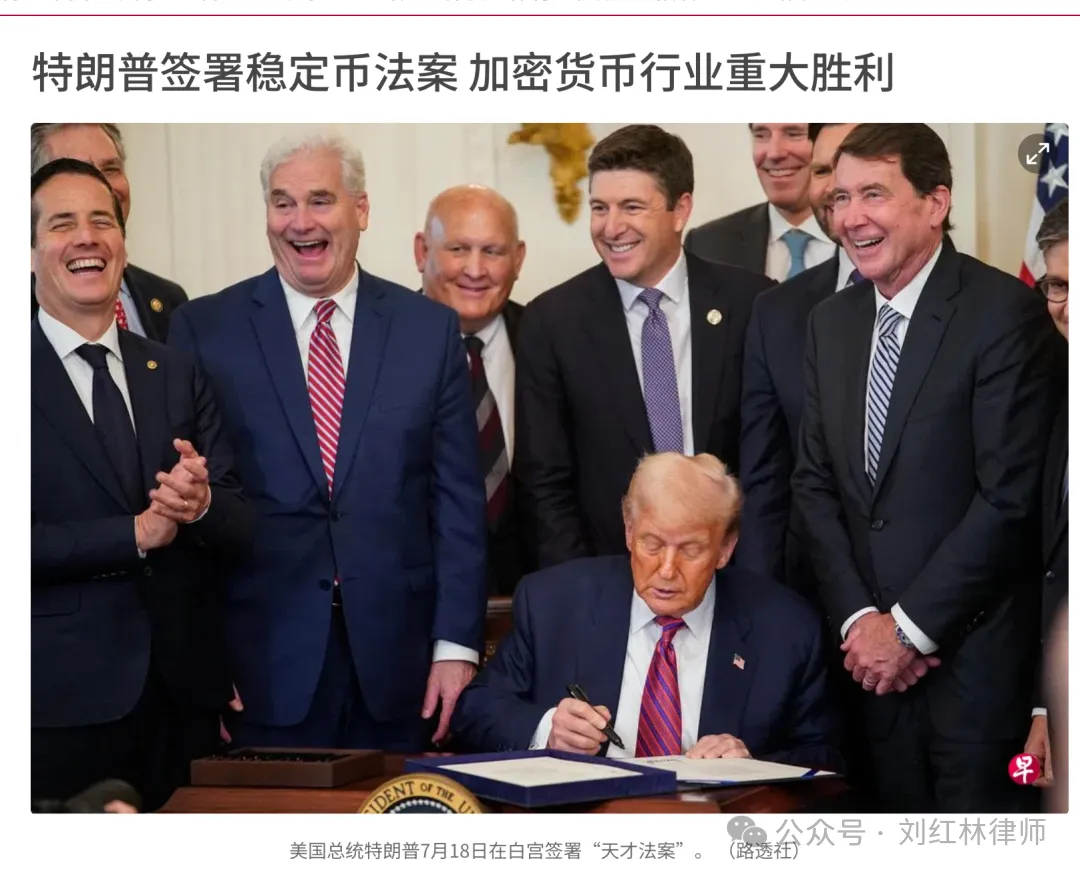
Reported by Lianhe Zaobao: Trump signs the stablecoin bill (Photo: Reuters)
The US government is calculating the dollar's account, and cross-border payment companies like Stripe have their own calculations as well.
These emerging payment companies conduct internet businesses and hope to make their businesses readily available. However, when it comes to cross-border capital movement, what they rely on remains banks and clearing systems. If a payment has to pass through several banks, coordinating their handling times and reconciliation processes, and if it coincides with weekends or holidays, delays ensue. Regardless of how well the front-end product is done, the payment companies find it hard to change this process on their own.
Stablecoins allow cross-border fund transfers to operate around-the-clock on the chain. In July 2026, Stripe announced the provision of stablecoin payment services for corporate expense management platform Ramp. Companies still pay vendor invoices from bank accounts, while Stripe's Bridge converts dollars into stablecoins for the recipient's wallet. Users don’t even need to hold coins beforehand, thus cannot accept the cryptocurrency notion of "owning your private keys means owning your assets."
This practical approach is naturally not rejected by banks that understand it. At the end of September, Visa and Lloyds Bank in the UK announced a seven-day pilot totaling $750,000. Lloyds purchased USD Coin (USDC) through a regulated trading institution and then transferred it to Visa's US entity, with funds arriving within an hour, completing settlement even on weekends.
Settling the same payment obligation sooner offers the chance to occupy less waiting settlement funds. After deducting conversion, custody, and compliance costs, if the entire method is more economical, banks have reason to continue using it.
As for currency freedom, as discussed in the cryptocurrency world, it’s not important for the banks and payment institutions in this business.

It’s not just payment and banking that see the potential and commercial value of applying cryptocurrency technology in finance, but also the traditional stock market.
In October this year, the Depository Trust & Clearing Corporation (DTCC) launched a securities tokenization service, with 20 participating institutions signing on, including JPMorgan Chase and Citigroup. DTC converts eligible securities within the custody system into tokens, allowing approved on-chain transfers, but also enabling a return to traditional forms. Securities remain within the original custody system, and the holder’s original rights and investor protections continue to be retained.
This provides an additional usage method for existing securities without needing to issue a project coin first for funding.
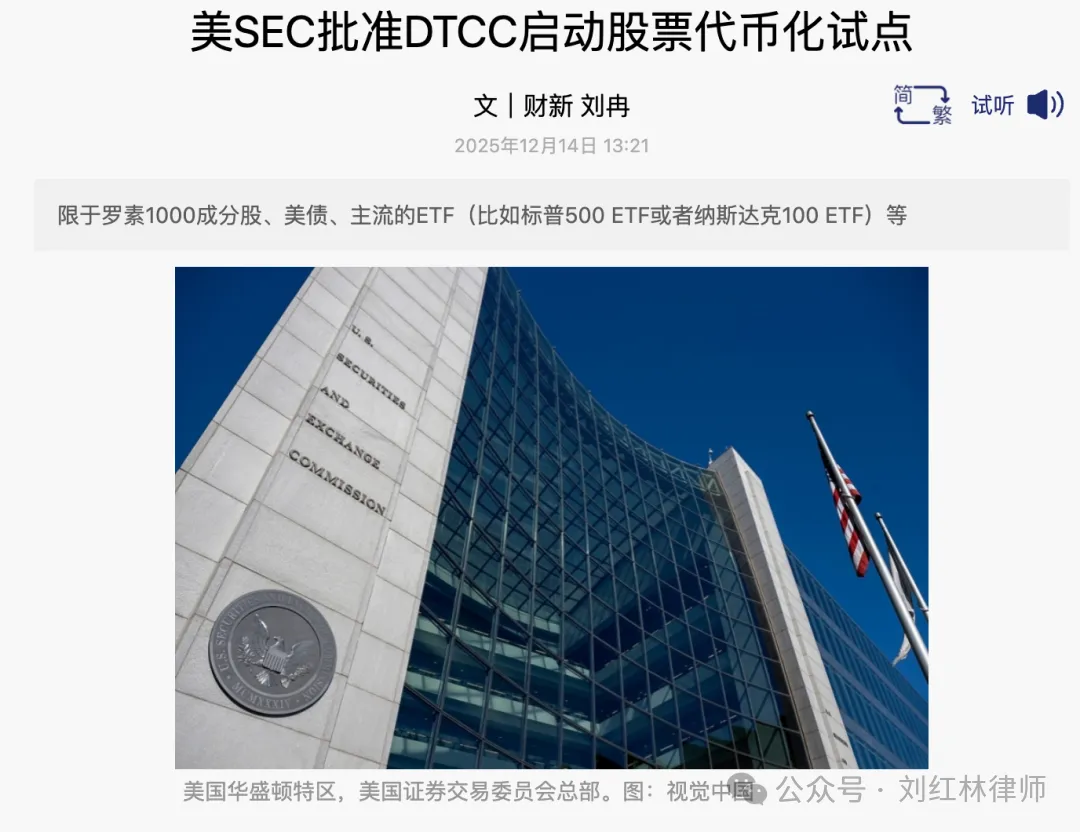
Caixin's report on the DTCC tokenization pilot (December 2025; with an image of the SEC headquarters in the US)
The institutions' focus is on whether existing securities can circulate more promptly and be used as collateral, minimizing asset idleness. They appreciate blockchain technology, but don’t necessarily regard the currently available public chains from the cryptocurrency world with esteem or peace of mind.
The aforementioned DTCC utilized its private network and the Canton network when the service went live. Tokens only circulate among wallets registered with DTC and include built-in compliance controls. Identity verification, anti-money laundering, and regulatory coordination originally required still must be performed on-chain.
These institutions come with their own rules, while leading exchanges like Binance and OKX are also actively aligning.
In the old cryptocurrency world, exchanges were at the top of the food chain, controlling traffic and trading opportunities, creating many wealth stories. But how much assets institutional clients are willing to trade depends on whether the exchange can meet their asset management requirements.
For example, Binance’s tripartite banking arrangement allows qualified institutional clients to leave collateral in governed bank corporate accounts while trading on the exchange. OKX's partnership with Standard Chartered also places collateral in an independent bank outside the exchange. To secure institutional orders, exchanges have incorporated banking custody into their products.
All of this is very different from previous strategies in the cryptocurrency world.
Projects relied on issuing coins for crowdfunding in their early days, promising permissionless, self-controlled data and assets on the internet while participants expected token appreciation; the current operations can already stand without this narrative.
The technology has been integrated into finance; the old cryptocurrency model relying on issuing coins, going public, and waiting for newcomers to maintain the business is unlikely to represent this industry anymore.
I prefer to call it "new crypto finance": traditional financial companies using cryptocurrency technology to solve payment, settlement, and asset transfer issues, while adaptive crypto native companies also cater to these needs.
This approach is as centralized as it gets.
I still have confidence in this industry
Before writing this article, I recorded a short video discussing these viewpoints.
Unexpectedly, many comments misunderstood it as typical bearish sentiment in a bear market, as every time this phase comes, someone always says the cryptocurrency world is ending.
I can understand this reaction, but those friends clearly didn’t grasp what I meant to convey.
My stance has always been clear: I remain bullish on Bitcoin (BTC) and believe in the application of blockchain technology in the next generation of the internet.
What I am bearish about is viewing getting rich overnight as this industry’s long-term way out or believing that simply maintaining absolute decentralization can win over users and the market.
Failing to plan for the long term will lead to immediate worries. The reason I made this short video and wrote this article is to discuss and communicate with the partners who have been deeply involved in this industry for the long term.
In the past, one could finance using tokens, subsidize users, and then wait for token prices to help maintain expenses; what about the future? Those who want to continue working in this industry need to seek clients willing to pay long-term.
In recent months, my colleagues and I at Mankun have frequently discussed similar topics. For the past few years, Mankun has been deeply rooted in the blockchain industry. From decentralized finance (DeFi), blockchain gaming (GameFi), social finance (SocialFi), to non-fungible token (NFT) projects, as well as Bitcoin Layer 2 networks and decentralized exchanges (DEX), we have collaborated with teams from different tracks to provide them with legal and compliance support within our capacity.
This work has given us firsthand experience of the industry's ups and downs, and a greater understanding and recognition of partners willing to work long-term. Today, in discussing new crypto finance, I hope that the technical expertise, experience, and trust between people accumulated over these years can continue to contribute to the longer-term development of the industry.
In serving past clients, we have clearly felt that Web3 users and markets are naturally global. A project's team, users, and funding may be distributed across different countries and regions, and legal and compliance issues will cross different legal jurisdictions. To truly serve these clients long-term, familiarity with only one area’s rules is insufficient.
Thus, we first established a development strategy of "deep in China, broad globally," and based on this goal, laid out in Shanghai, Shenzhen, Hong Kong, and Silicon Valley sequentially. We understand the situation of Chinese entrepreneurs while providing support in the markets where they conduct business; rather than constantly looking for opportunities within the gray and chaotic, I prefer to see the industry step onto the stage and serve real customers within clear rules.
If one simply wants to guard that tiny piece of the cryptocurrency world and waits for the next person to come in to buy coins to turn the market into a zero-sum game, they are underselling the industry.
We are pleased to see stablecoins genuinely being used for payments in more and more countries and regions, the onset of asset tokenization entering financial institutional business, and on-chain finance resurging after the entry of more institutions. We also look forward to a future where stock trading and settlement can utilize blockchain technology.
免责声明:本文章仅代表作者个人观点,不代表本平台的立场和观点。本文章仅供信息分享,不构成对任何人的任何投资建议。用户与作者之间的任何争议,与本平台无关。如网页中刊载的文章或图片涉及侵权,请提供相关的权利证明和身份证明发送邮件到[email protected],本平台相关工作人员将会进行核查。