
Wang Zhaoyang|Ghost Games
Zhou Yi Xiao|smiletalker
In mid-2024, a model entrepreneur shared an interesting anecdote with us. During his studies in the United States, a classmate from Taiwan suddenly reached out to discuss his startup company. Later, it was discovered that this classmate had established a company called Neo Cloud, whereas he had never shown any interest in entrepreneurship before. This surprised him. In subsequent communications, it was revealed that the main reason for the new company’s establishment was that he had family connections with Jensen Huang, allowing him to "get cards from Uncle Huang."
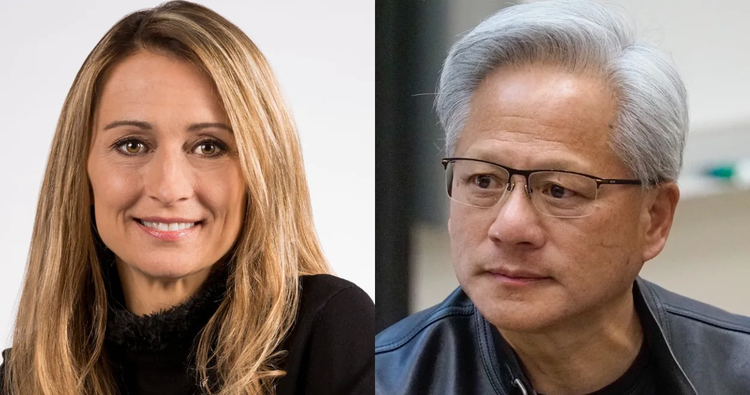
On November 12, 2026, Jensen Huang, who had been at the helm of NVIDIA for 33 years, announced his resignation as president, CEO, and board member, effective immediately.
The immediate trigger was a rapidly escalating personal and compliance scandal, the first of which was the private relationship between Jensen Huang and Alice Huang, the former controlling shareholder of Megaspeed from Neocloud. The potential investigation into chip flows provided various discontented parties in the U.S. with the opportunity to push for his removal. Soon after, more information surfaced, revealing his alleged affairs with directly subordinate executives, including the vice president of NVIDIA's medical business.
Although regulatory authorities have not publicly determined any violations by Megaspeed, under pressure from related judicial and export control investigations and congressional inquiries, NVIDIA's board quickly distanced itself, appointing Colette Kress, who had been CFO since 2013, as interim CEO, while also promoting senior director Harvey C. Jones as the first independent chairman of the board in the company’s history.
On November 12, NVIDIA’s stock briefly fell about 14% during trading, ultimately closing down 4.3%. The Neocloud segment, most closely linked to NVIDIA, also came under pressure, with the industry leader CoreWeave dropping 6.9% on the same day, and Nebius, a European cloud computing representative that announced a revenue guidance cut due to data center delivery delays, falling 16.8%.
“The most obvious feeling about this incident is comparable to losing Optimus Prime for the automotive industry.” A former Neocloud employee remarked during our discussion.
In the past three years, over two hundred new cloud providers specializing in leasing NVIDIA GPUs have emerged globally. Their ability to start from scratch and mobilize hundreds of billions of dollars to build data centers and purchase graphics cards relies not only on the scarcity of GPUs from large model companies but also on the quota bias and credit support led by Jensen Huang.
It can be said that Neo Cloud is an astonishingly large business almost solely built on Jensen Huang's will, filled with interconnected “subprime” attributes. Now, with the sudden departure of this founder, the original expansion logic of the entire industry chain faces enormous challenges.
1
Internal Disputes at NVIDIA Have Long Emerged
With Jensen Huang's departure from NVIDIA, much internal information has been “timely” released by the media.
Among them, disputes surrounding Neo Cloud have been highlighted.
The top management of NVIDIA had actually been in disagreement over the financing support for Neocloud for months.
NVIDIA’s strong backing of these new cloud providers was intended to balance the three traditional cloud giants. Although Amazon AWS, Microsoft Azure, and Google Cloud purchased the most NVIDIA graphics cards, they are all working hard to develop their own AI chips, attempting to reduce dependency on a single supplier. Jensen Huang needed to cultivate a group of substitute cloud providers that were entirely dependent on NVIDIA's hardware system to spread risk and maintain bargaining power. During the past two years of tight capacity allocation, NVIDIA intended to control the quotas of the ultra-large cloud giants, preferring to allocate cards to various Neoclouds.
To accelerate the expansion of these companies, NVIDIA has been increasingly resembling a financial institution over the past two years, with the internal team executing this aggressive strategy having a strong familial touch. In recent years, Jensen Huang’s children, Madison Huang and Spencer Huang, have successively entered NVIDIA as executives, but the one truly on the front lines of Neocloud transactions is his 35-year-old son-in-law, Nico Caprez.

Caprez was formerly a Swiss alpine ski athlete and a consultant at Boston Consulting Group (BCG). He met Madison Huang while pursuing his MBA at London Business School and joined NVIDIA in early 2024. They just got married in September of this year. According to reports from The Information and The Wall Street Journal, Caprez, with no semiconductor background, quickly rose to the position of vice president for global AI infrastructure growth after joining and became a key figure responsible for the expansion of the Neocloud ecosystem.
Caprez's team signed around $20 billion in data center leases, which were then subleased to downstream customers, while providing hundreds of billions of dollars in financing guarantees and quick delivery promises to cash-strapped startup cloud providers, on the condition that the projects deployed NVIDIA chips and shared a portion of future computing revenue or granted stock warrants to NVIDIA. In addition, Jensen Huang also led multiple direct investments by NVIDIA in Neo Cloud companies.
This practice of continuously increasing long-term commitments and potential guarantees was questioned by Colette Kress, the CFO who had been in office for thirteen years.
According to The Wall Street Journal, months ago during an internal meeting discussing whether to continue providing tens of billions of dollars in guarantees to computing vendors unable to prepay for goods, Kress questioned the valuation methods of the guarantee agreements and the return rate calculations and attempted to constrain Caprez's overreaching promises. Jensen Huang interrupted the report on the spot, scolding her for being like "a deer in the headlights," bluntly stating that she was just a “reporting CFO,” unable to assist in strategic decision-making.
The situation was not simply a matter of “one side being aggressive and the other being conservative.” According to The Wall Street Journal, as the scale of guarantees continued to expand and internal indications suggested that strict control clauses might trigger antitrust reviews, Jensen Huang himself began to doubt whether NVIDIA’s financing support had gone too far. He had already sought to control guarantee exposures when convening meetings with the finance team; subsequently, NVIDIA suspended some transactions under the new financing support plan at the end of August, and by October, Jensen Huang personally conveyed stricter resource allocation requirements to cloud providers.
In other words, while Jensen Huang created and promoted this credit expansion model, he was also involved in tightening it before his departure. Now, with Kress, who advocates strict control over financial risks, taking over as interim CEO while continuing as CFO, this contraction will only be executed more thoroughly.
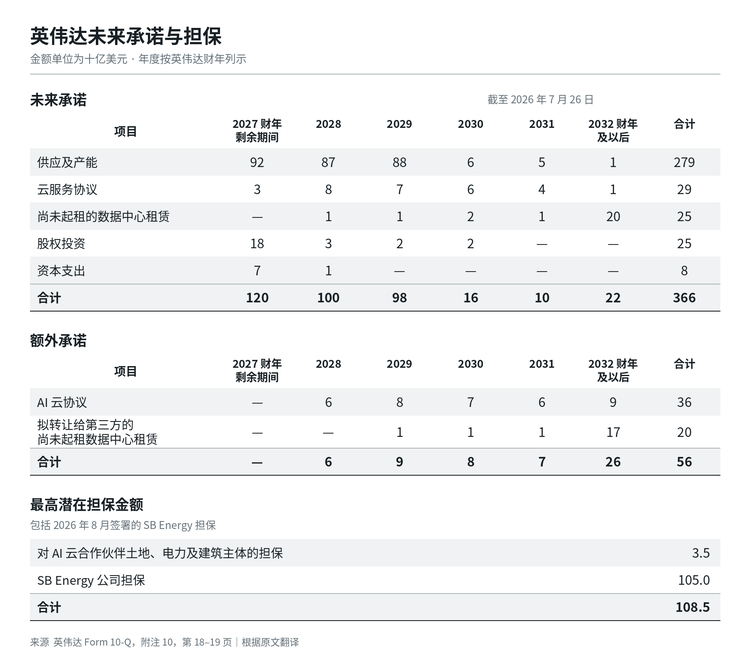
According to the latest quarterly report from NVIDIA, the company's off-balance sheet future commitments of different natures and the maximum potential guarantee amount simply add up to about $530.5 billion. This is certainly not the actual debt or potential loss amount, but it visually reflects the depth of NVIDIA's bundling with upstream and downstream.
Much of it is related to Neo Cloud, including at least $3.5 billion in guarantees for small and medium-sized cloud partners, approximately $36 billion in computing power procurement and leasing commitments to Neo Cloud providers, and approximately $20 billion in proposed subleases to third-party data center leases.
At the same time, NVIDIA's accounts receivable have risen to $63 billion, with the average payment cycle extending from 45 days to 60 days. Faced with such a heavy commitment list, the new management team is unlikely to back high-risk Neo Cloud projects.
1
Neo Cloud Has Not Truly Established Technical Barriers
Kress’s caution regarding downstream cloud providers is not unfounded. Among the over two hundred companies that emerged in the past three years, quite a few have not accumulated much technology and are purely products born from the “chip allocation system” and personal connections.
The card acquisition method mentioned at the beginning of the article is not an isolated instance; it is, in fact, a very common pattern. Jensen Huang is known for his meticulous management style and his “warm-heartedness” in using his own resources to provide assistance in situations you could hardly imagine. In recent years, as GPUs have become hard currency in the industry, he has not hesitated to facilitate those close to him and his companies.
OpenAI and Musk’s various companies were once the talk of Silicon Valley when they received the latest GPUs personally delivered by Jensen Huang, and this privilege was not limited to these giants. From very small and early-stage startups to teams with research ideas, many have shared stories of sending Jensen Huang an email and quickly receiving a response from him to secure scarce computing resources.
Jensen Huang's enjoyment of this “patriarch-like” style of operation has clearly not been limited to this; it has directly become the “startup logic” on which Neo Cloud companies gradually depend.
This has led to the notion that, during the GPU scarcity period from 2023 to 2025, “whether you can get cards” was almost the only barrier. The bulk of the profits during the scarcity period went to NVIDIA, with the leftovers ending up in the pockets of Neocloud holding graphics card resources, resulting in clusters from all over the world, including dozens of nodes from Armenia and over one hundred nodes in Indonesia, being pieced together for lease.
The newly implicated Singapore company, Megaspeed, is an extreme case of rapid expansion. This company, which spun off from gaming operations, had just $33 million in book assets at the end of 2023, but after obtaining NVIDIA's Preferred Cloud Partner (NCP) qualification, its asset scale ballooned to around $3 billion in just one year, accumulating $4.8 billion in procurement of NVIDIA equipment over three years.
Returning to the normal business logic, having access to cards does not equate to being able to run a cloud provider effectively. As the industry shifted from early pre-training to large-scale commercial inference, core competitiveness fell on cluster operations and underlying inference software stacks, such as optimizing memory caching and request routing to increase single-card throughput and decrease costs per million tokens.
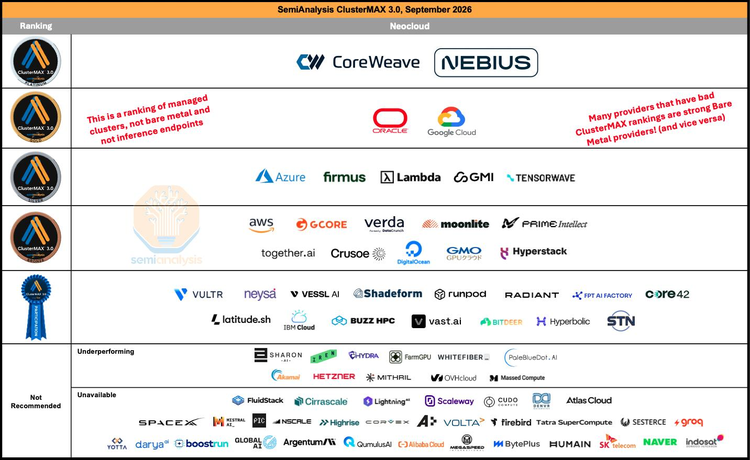
However, the vast majority of Neoclouds have not developed sufficiently solid self-research software stacks and inference engines. In the ClusterMAX tests conducted by computing research firm SemiAnalysis, some Neoclouds have already exposed issues regarding cluster reliability, security, and operational capabilities. In contrast, cloud services that can genuinely support large-scale production environments require far more complex software and operational capabilities than simply deploying an open-source vLLM framework on a cluster to earn high margins.
Lack of software scheduling capabilities directly restricts their ability to sell computing power. Erik Bernhardsson, founder and CEO of the serverless cloud computing platform Modal in Silicon Valley, has analyzed this mismatch between supply and demand. Modal focuses on flexible scheduling of containers and computing power at the software layer, with annualized revenue exceeding $1 billion and a latest valuation of $16 billion, but it doesn't buy a single graphics card, renting capacity from nearly 25 global suppliers and splitting it by the second for developers.
Bernhardsson pointed out that nearly all Neoclouds sell computing power packaged as "fixed volume contracts with delivery in three to six months," which can be visually represented as a rigid three-year block, while most companies' actual inference needs exhibit fluctuating curves characterized by high daytime demand, low night demand, and surges due to business fluctuations. A pure software platform can aggregate the demands of thousands of clients to smooth out fluctuations and allow for on-demand accessibility, thus Bernhardsson believes "software companies should not hold hard assets, just as you should not buy your own office building," warning against allowing the company to become just another Neocloud that sells fixed long-term contracts.
To fill the software gap, leading GPU cloud providers have been spending heavily over the past two years to acquire software companies. CoreWeave spent about $1.7 billion last year to acquire the machine learning platform Weights & Biases and the reinforcement learning tool OpenPipe; Nebius announced this year that it acquired Eigen AI, focused on model and kernel-level inference optimization, in a transaction valued at approximately $643 million while integrating Clarifai's core engineering team and some technology licenses; Crusoe has also open-sourced portions of its inference optimization technology, integrating it into NVIDIA's NVIDIA Dynamo ecosystem.
In conversations with some acquired inference infrastructure companies, they shared their reasons for joining these Neo Clouds from their perspective: the core reason was that they had access to cards. “At that stage, much of your technological research ultimately required cards; without cards, progress was stalled. The appearance of these Neo Cloud companies with abundant cards was the most significant reason we abandoned our independence.”
However, some of the acquired parties privately shared with us that these companies, initially acquired for their technological advantages, often quickly encounter cultural growing pains. What was expected to be a startup-like culture in Neo Cloud quickly gave off a “big company” vibe, with a company style very different from their previous small, technology-oriented teams. The pressure on sales can quickly overshadow the emphasis on optimizing research and development investments in inference technology.
Therefore, after various acquisitions, you can always see these technical teams beginning to shift more toward responsible training, with the company hoping it will bring faster revenue. Card resources also swiftly flow toward this, rather than being invested into the technological breakthroughs that Neo Cloud was supposed to establish in its inference facilities.
Behind this, these Neo Cloud companies are considering that while they must compete for software layers and customer relationships, as open-source inference technologies continue to progress, single-instance inference optimizations are difficult to support high premiums in the long term.
Even transitioning to a software service model, changing from leasing entire GPU packages to charging based on actual token usage does not inherently yield a better business model.
Long-term GPU capacity contracts, while not very flexible, can secure accounting income for the next few years, transferring some capacity idleness risks to downstream customers. Once this shifts to charging based on actual token usage, although potential revenue per unit capacity might increase, cloud providers would need to shoulder more demand variability and resource vacancy risks, which might ultimately sacrifice the revenue certainty originally provided by long-term contracts.
1
Dusk Approaches
“Take a look at those Neoclouds; they are essentially very, very sophisticated financial engineering companies.” Erik Bernhardsson recently summarized his peers with this statement on the AI technology podcast Latent Space.
He also broke down the four-step path to the rapid expansion of these companies.
The first step is to find major buyers like Anthropic and OpenAI to sign five-year computing power procurement contracts. The second step is to take these contracts to Wall Street to monetize future orders for financing. The third step is to use the funds to purchase servers from Dell or Supermicro. The final step is delivery. “You can pre-sell things you haven't even bought yet, so the scale can expand incredibly quickly.”
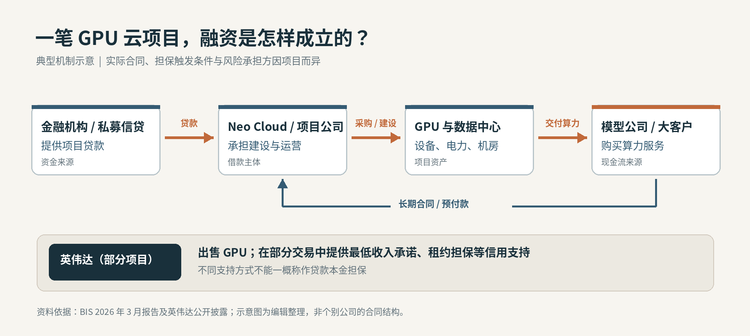
Financing costs are becoming an important variable in Neocloud competition. Every company buys the same NVIDIA graphics cards, and the prices for external leasing are becoming increasingly transparent, but differences in financing rates, contract durations, and customer prepayment ratios can lead to vastly different investment returns. In the past, Jensen Huang's credit support effectively created financing advantages for some Neoclouds; in the future, a company's survival may depend not only on technology and customers but also on how low a cost it can acquire long-term capital.
A report released this year by the Bank for International Settlements (BIS) defines this type of hardware and long-term contract-based data center financing as “shadow lending,” with Morgan Stanley estimating that around $800 billion in private credit support will be required for such constructions between 2025 and 2028. Breaking down this funding chain reveals potential vulnerabilities similar to those of the subprime mortgage crisis in 2008.
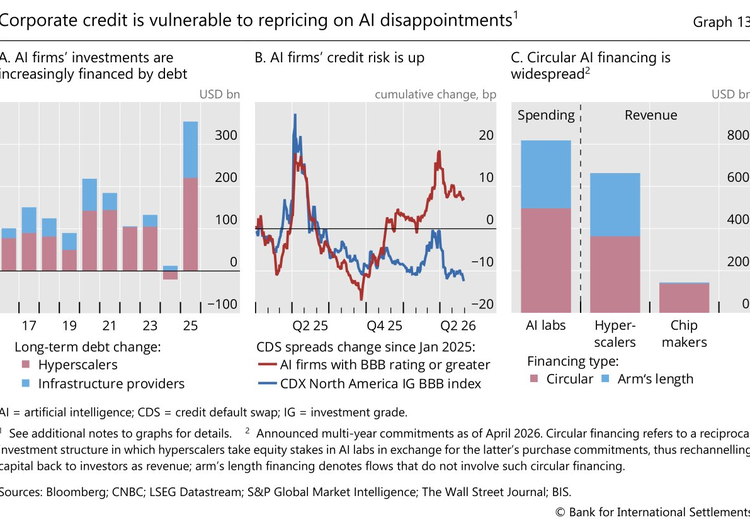
BIS report: AI infrastructure debt financing increases, credit risk rises, and the scale of cyclical financing in industrial chains expands.
The vast majority of Neoclouds have negative free cash flow, and many downstream large model startup companies lack investment-grade credit ratings, making it difficult for traditional commercial banks to approve loans of over one hundred billion dollars for infrastructure. To leverage their positions, a few leading players like CoreWeave, which hold long-term contracts with Microsoft and OpenAI, have established bankruptcy-remote SPVs (Special Purpose Vehicles) with private credit institutions like Blackstone and Magnetar, placing tens of thousands of GPUs in this vehicle and pledging long-term contracts from major customers, borrowing project loans equal to 70-80% of the hardware value (LTV 70% to 80%). Smaller players lacking long-term contracts with major firms cannot access such conditions; often, their loan multiples are compressed below 50-60%, forcing them to pay half of the principal upfront or only to sign high-interest, heavily secured equipment financing leases with guarantees from their parent companies.
Private credit institutions' willingness to lend significantly stems from the fact that NVIDIA previously played a role similar to that of the “Two GSEs” (Fannie Mae and Freddie Mac), providing guarantees through lease agreements or commitments to rent idle capacity at a minimum price, lending its credibility to the entire chain.
Now, with Jensen Huang’s departure, this key link is gone.
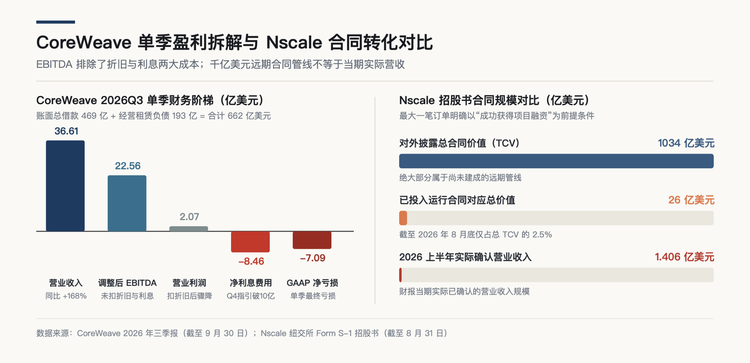
The companies with high-credit large customers, long-term exclusive contracts, and sufficient upfront payments are likely to gradually establish independent financing capabilities that do not rely on a single hardware provider; meanwhile, those that lack support from major firms, relying only on scattered capacity rentals or initially building networks through “Uncle Huang’s cards,” seem to have no means to avoid liquidity disruptions under the dual squeeze of rising credit costs and large buyer pressure on pricing and contract terms.
In the past three years, the market has largely set prices for NVIDIA and the entire AI computing infrastructure based on a "faith premium"; the market believed that computing power demand had no upper limit and that Jensen Huang could use his personal prestige to tightly bond upstream wafer capacity, midstream indebted Neoclouds, and downstream large model labs, enabling them to operate at high speeds continuously. With the sudden exit of this key figure, this expansion model, relying on individual skills and aggressive credit support, may have reached its end.
A few days later, on November 17, Colette Kress, hosting her first earnings call as interim CEO, will face questions from Wall Street about substantial off-balance sheet commitments, extended accounts receivable, and future capital usage rhythms. Will Kress, publicly humiliated by Jensen Huang, continue to maintain the Neo Cloud ecosystem that he designed?
The truly harsh differentiation and screening might be about to begin; the Neo Clouds are ultimately facing dusk.
免责声明:本文章仅代表作者个人观点,不代表本平台的立场和观点。本文章仅供信息分享,不构成对任何人的任何投资建议。用户与作者之间的任何争议,与本平台无关。如网页中刊载的文章或图片涉及侵权,请提供相关的权利证明和身份证明发送邮件到[email protected],本平台相关工作人员将会进行核查。