Author: Zhang Yaqi, Wall Street Journal
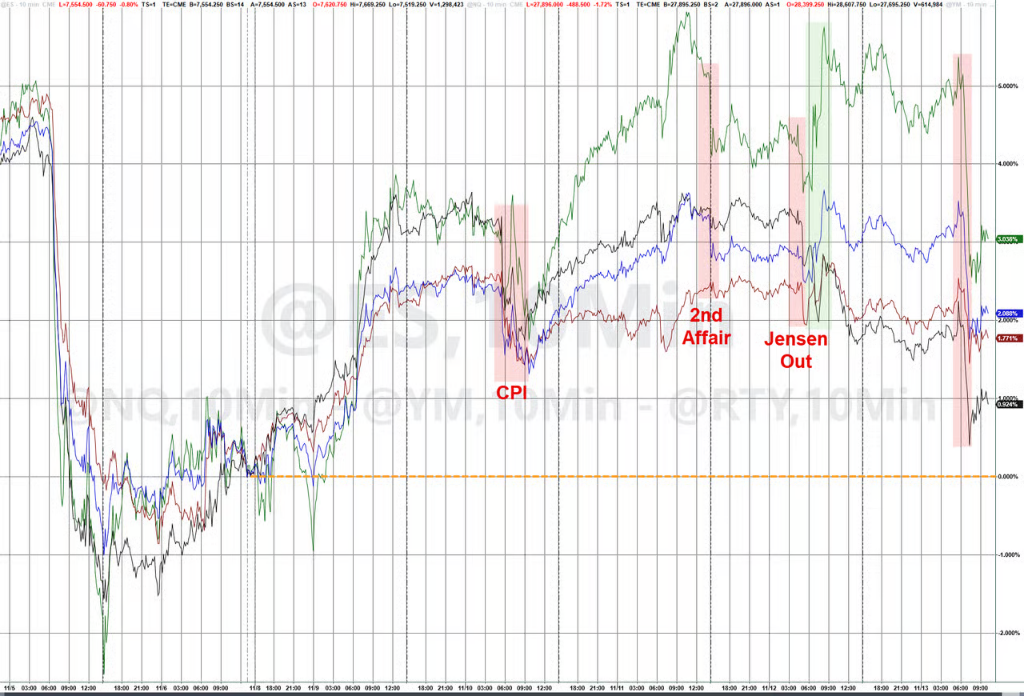
Within a week, after being embroiled in scandals, Nvidia's founder quietly resigned, the U.S. CPI exceeded expectations for the third consecutive month, the PPI soared to a four-year high, and Federal Reserve officials hinted at a 50 basis point rate hike in December—multiple negative factors detonated simultaneously, yet U.S. stocks unexpectedly closed higher, with the S&P 500 rising 2% for the week and the Philadelphia Semiconductor Index achieving its best weekly performance since April.
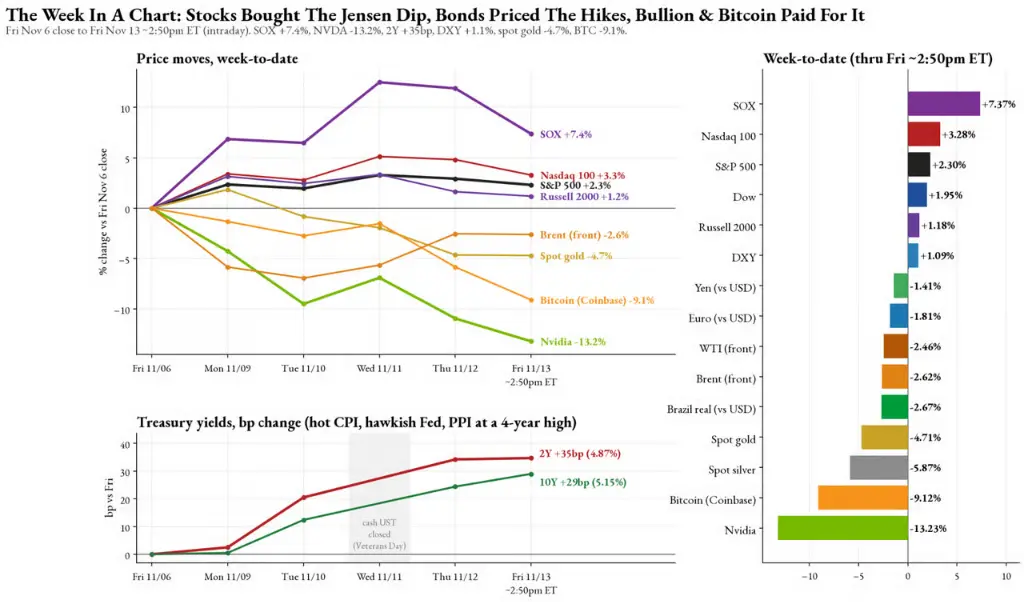
The answer is simple: the shorts have run out of cards to play.
This is a typical “no tickets to sell” short squeeze. According to Goldman Sachs Prime data, hedge funds significantly reduced leverage during the midterm election week, with net long positions dropping to a five-year low. Entering this week, the shorts were basically cleared, and when bad news hit, the market couldn’t find enough selling pressure to sustain, leading to a surge in the stock market instead of a collapse. Meanwhile, the bond market has independently borne all macro shocks—2-year Treasury yields surged 35 basis points in a week, marking the largest weekly increase since October 2024, and the 10-year yield broke above 5.15%.
However, the last two trading days of the week showed signs of fatigue, with the S&P 500 facing resistance at the 100-day moving average, and on Friday, the market began to "understand the debt market's letter." Goldman Sachs senior trader Rich Privorotsky warned:
"The market needs oil prices to stabilize and interest rates to fall, yet neither happened this week."
Nvidia CEO Resignation: AI Trading Changes Direction, Not Goals
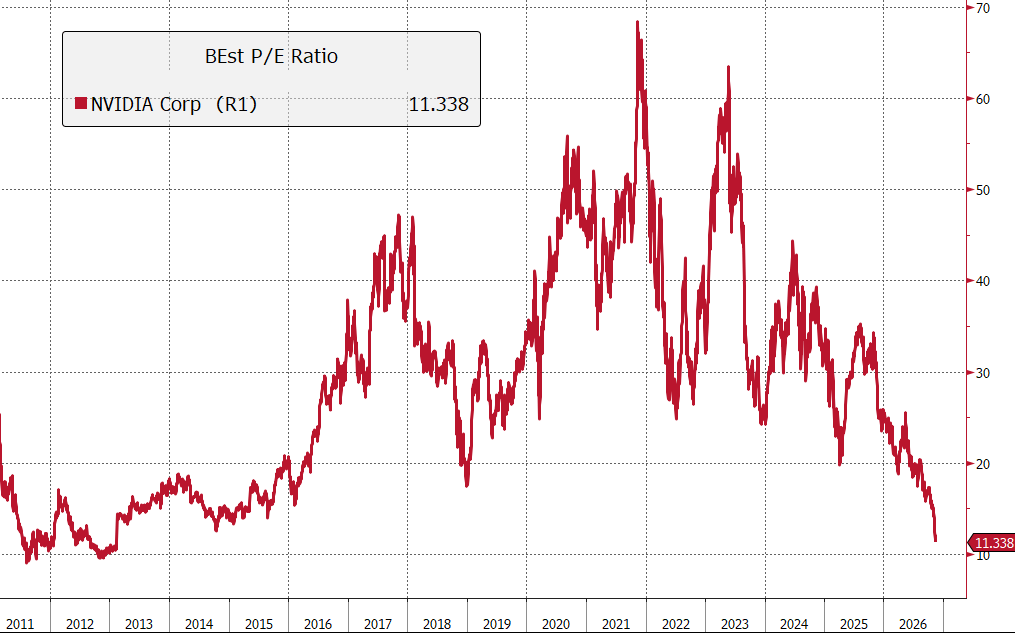
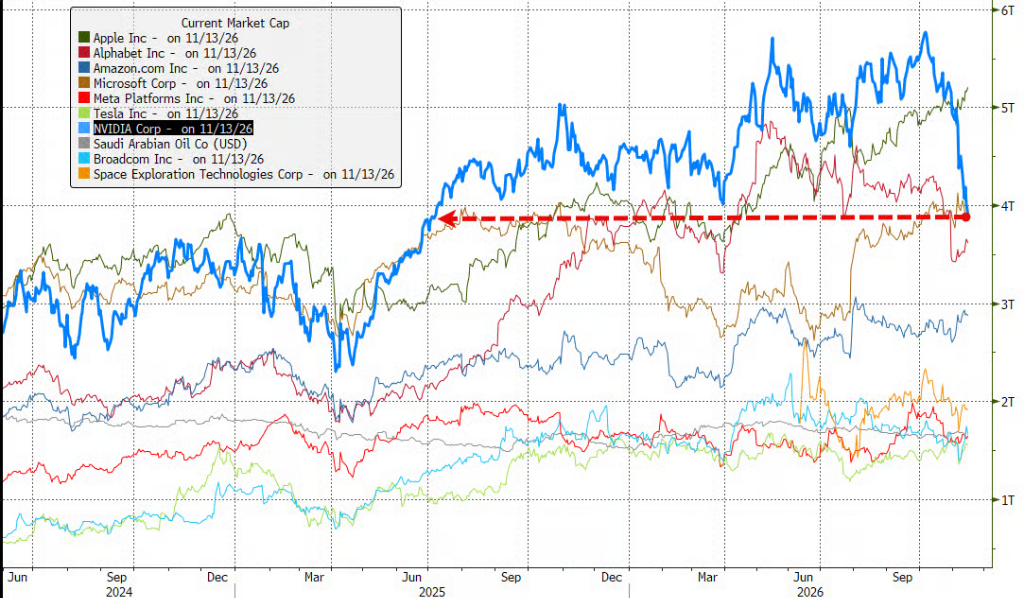
The departure of Jensen Huang, Nvidia’s figurehead for 33 years, was the biggest black swan of the week. Last weekend, Huang admitted to infidelity, and the company promptly launched an independent investigation. On Tuesday, House Republicans considered issuing a subpoena, and Secretary of State Rubio reportedly warned Trump about this; Nvidia's market value has evaporated by nearly $2 trillion from its historical peak.
On Wednesday evening, The New York Times revealed that Huang had a second extramarital affair with the vice president of Nvidia’s healthcare division, while The Wall Street Journal reported that the board was preparing to dismiss him. At 8:48 AM on Thursday, Huang officially announced his resignation. CFO Colette Kress was appointed as interim CEO, and former Synopsys CEO Harvey Jones became Nvidia's first independent board chairman.
The sell-side quickly released 14 research reports overnight, including 3 downgrades and 6 target price reductions. Goldman Sachs analyst James Schneider cut the valuation multiple from 30 times to 22 times, lowering the target price to $220, referencing the devaluation path following Apple's loss of Jobs. Bernstein analyst Stacy Rasgon downgraded the rating, warning in a report titled "Where does he find the time?" that more scandals are likely to emerge.
However, Nvidia's stock opened about 12% lower that day but closed down only 4% to 5%. According to Vanda Research, retail buying of Nvidia hit an all-time high that day, approximately 41 times the normal level, with retail investors re-pricing "Nvidia without Jensen Huang" in just 30 minutes. For the week, Nvidia saw a decline of about 11%, but the funds did not flee the AI sector; they simply changed direction: AMD rose about 30% for the week, Broadcom increased about 24%, and the Philadelphia Semiconductor Index recorded its best weekly performance since April.
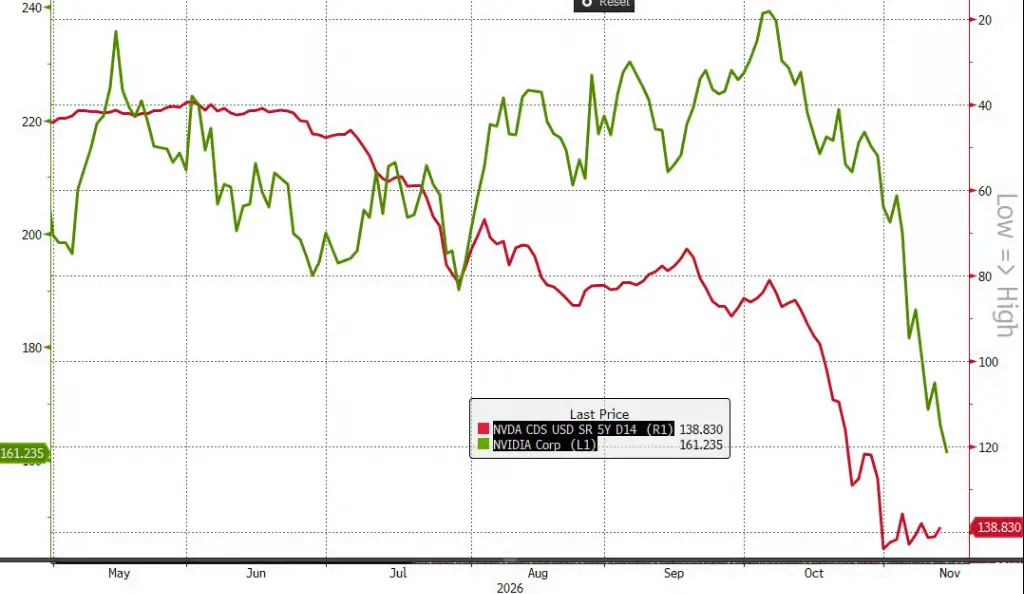
J.P. Morgan analyst Harlan Sur cut Nvidia's target price to $215; the firm's credit team maintained a downgrade rating, warned that the biggest risk comes from Nvidia's involvement as a supplier, investor, or guarantor in GPU financing agreements.
“No Tickets to Sell”: Position Clearance Creates a Short Squeeze
The core logic behind this week's stock market rebound lies not in fundamentals, but in positioning. Goldman Sachs Prime data shows that U.S. long-short hedge funds reduced total leverage by 8.7 percentage points in the midterm election week, marking the largest single-week decline since March 2020; net leverage dropped to 43.3%, a five-year low. Since the de-leveraging began, institutional clients have net sold over $30 billion in tech stocks, and semiconductor positions have "almost completely reversed the gains of 2026."
Thus, Monday evolved into a "full-scale rebound": the S&P 500 rose 2.35% in a single day, the largest single-day increase since the Iran ceasefire, the Nasdaq 100 rose 3.4%, and the Philadelphia Semiconductor Index soared 6.8%. Goldman’s trading desk observed "light volume rebound trades," determining that "today's rise reflects a lack of supply rather than buyer chase." Nomura strategist Charlie McElligott referred to it as "epic volatility compression," with market makers forced to buy in the rising process. The VIX fell 27% for the week to 18.7, registering the largest single-week decline in a year.
Goldman’s volatility trading desk noted that a record 55.8 million put options were traded in the U.S. market last Thursday, followed by protective positions being sold off at one of the fastest paces in history. Goldman’s Lee Coppersmith pointed out that the realized volatility of VVIX (volatility of volatility) reached all-time highs in both 5-day and 10-day windows, "which is another sign that risk appetite remains extremely fragile."
Systematic long-short funds achieved their best two-day performance in nearly three years, with buyback projects running at 1.6 times the previous year's pace, and year-to-date authorized buyback amounts reached a record-high of $1.5 trillion. The only systematic seller is the CTA strategy, and Goldman estimates that regardless of market direction, the CTA will sell about $31 billion in S&P futures.
Inflation's Triple Heat, Fed Hints at Accelerated Tightening
Macro shocks unfolded on Tuesday. Ahead of the CPI data release, Fed Governor Chris Waller stated in London that if core CPI month-on-month reaches "0.3% or higher," "the December meeting should consider a 50 basis points rate hike." Then the data emerged, revealing the core CPI to be nearly double Goldman’s estimate of 0.16%, with only one out of 70 forecasters predicting higher.
Privorotsky commented, "This inflation report is of no help, with the CPI broadly hot... the strong ranges are far beyond energy, spreading into healthcare services, insurance, etc.... It's difficult to simply attribute it to energy transmission effects; underlying inflation has proven sticky." Goldman economist Mike Cahill noted that in the past four months, CPI has exceeded forecasts by about 32 basis points, and no single component contributed more than 4 basis points, "this is precisely what caught everyone off guard in 2021 to 2022."
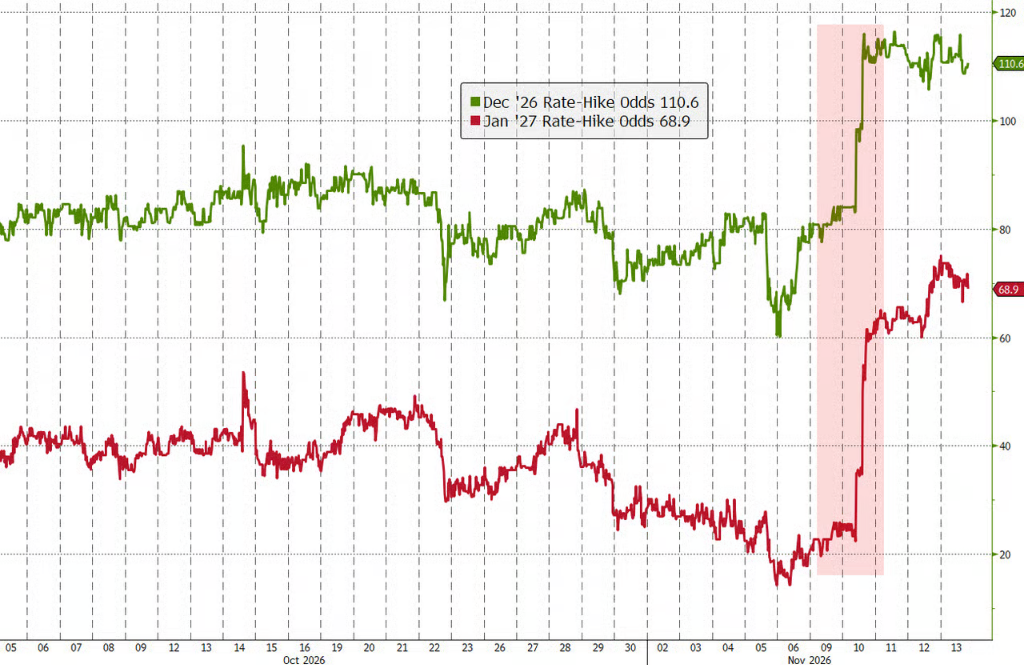
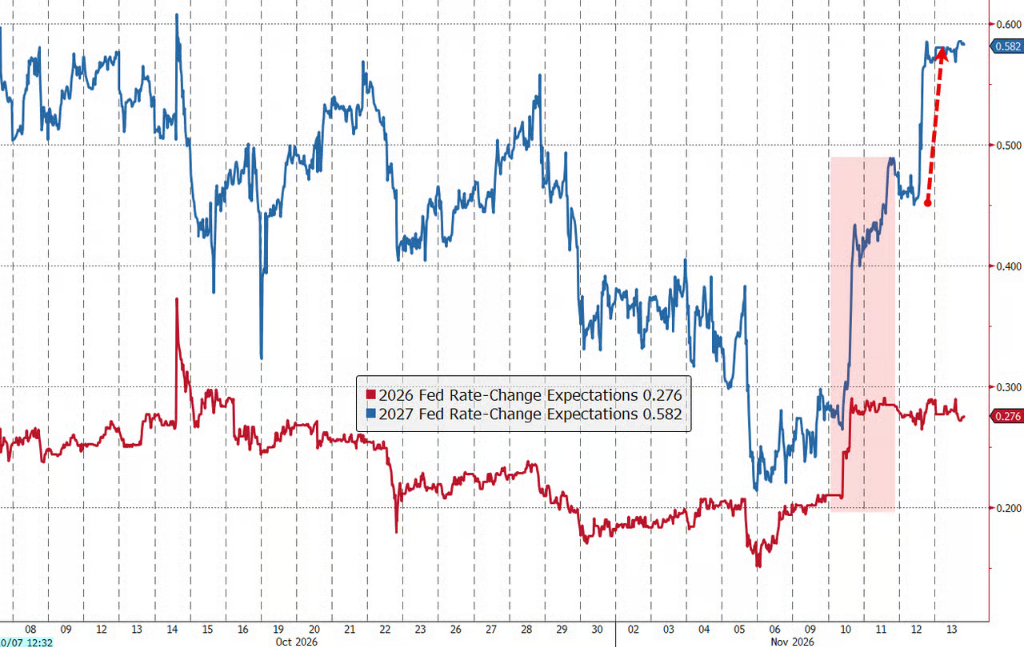
Fed officials collectively raised their bets. Dallas Fed President Lorie Logan stated the FOMC "needs to raise rates at least two more times by 25 basis points"; Governor Bowman expressed support for a December rate hike; San Francisco Fed President Daly mentioned "tending towards further tightening"; Cleveland Fed President Hammack stated "we need to adjust policy to restrictive levels"; and Chicago Fed President Goolsbee warned "we are approaching an area that is very tricky for any central bank," describing the data center construction boom as "historic-scale fiscal stimulus."
Goldman economists immediately added one more rate hike in March 2027, predicting the federal funds rate peak at 4.25% to 4.50%, with the first rate cut delayed until December 2027. Nomura made a similar adjustment, with the market currently pricing a 10% chance of a 50 basis points rate hike in December and about a 70% chance of an additional 25 basis points hike in January next year.
On Friday, the PPI further increased pressure: producer prices rose 6.5% year-on-year, the highest since November 2022; the core PPI increased by 5.0% year-on-year. White House Economic Advisory Council Chairman Christopher Phelan attempted to downplay expectations for a substantial 50 basis points rate hike, but both the bond and stock markets did not buy it.
Bond Market Absorbs Shocks, 30-Year Yields Reach New Highs
In the words of a veteran bond trader, Tuesday was "a complete massacre."
On that day, the 2-year Treasury yield jumped 17.5 basis points, the largest single-day rise since October 2024. Supply pressure made things worse: the Treasury Department concentrated refinancing auctions before the holiday, all three maturities faced "tail differentials" (execution yields higher than secondary market). Monday's 3-year auction tail differential was the largest since May; Tuesday's 10-year auction tail differential was the largest since February, with the indirect bid ratio dropping sharply from 80.3% to 61.2%, the lowest since October 2023; Thursday's 30-year auction had an execution yield of 5.441%, with the tail differential being the largest since June, and the proportion of primary dealers forced to hold was also the highest since June.
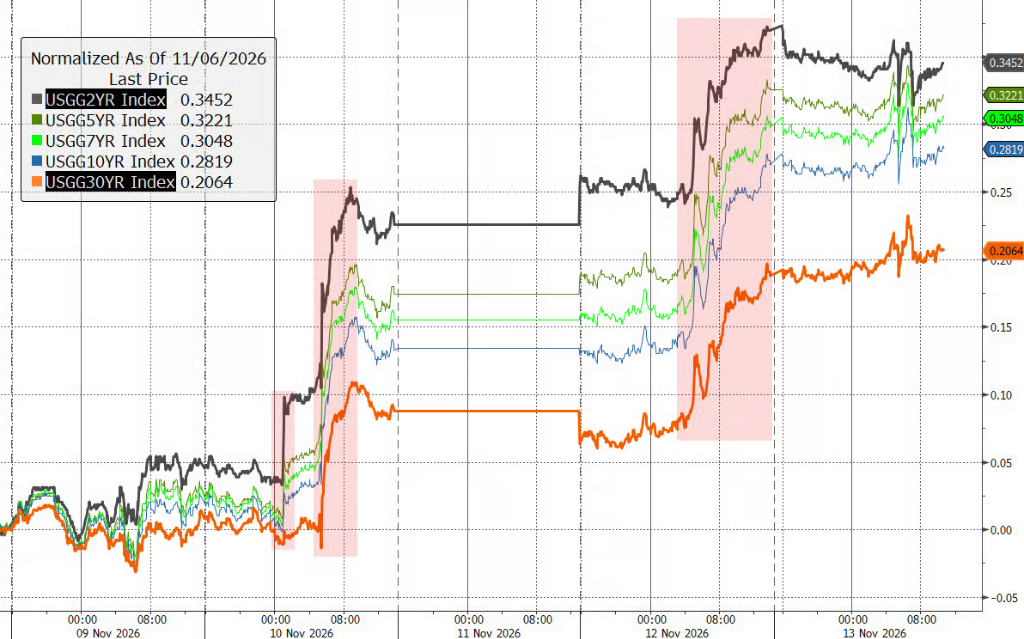
For the week, the 2-year yield rose about 35 basis points, the 10-year by about 28 basis points, and the 30-year by about 20 basis points. The 10-year yield breached 5.15%, only about 15 basis points away from multi-year highs. The 5 to 30-year yield curve experienced bear flattening of about 13 basis points.
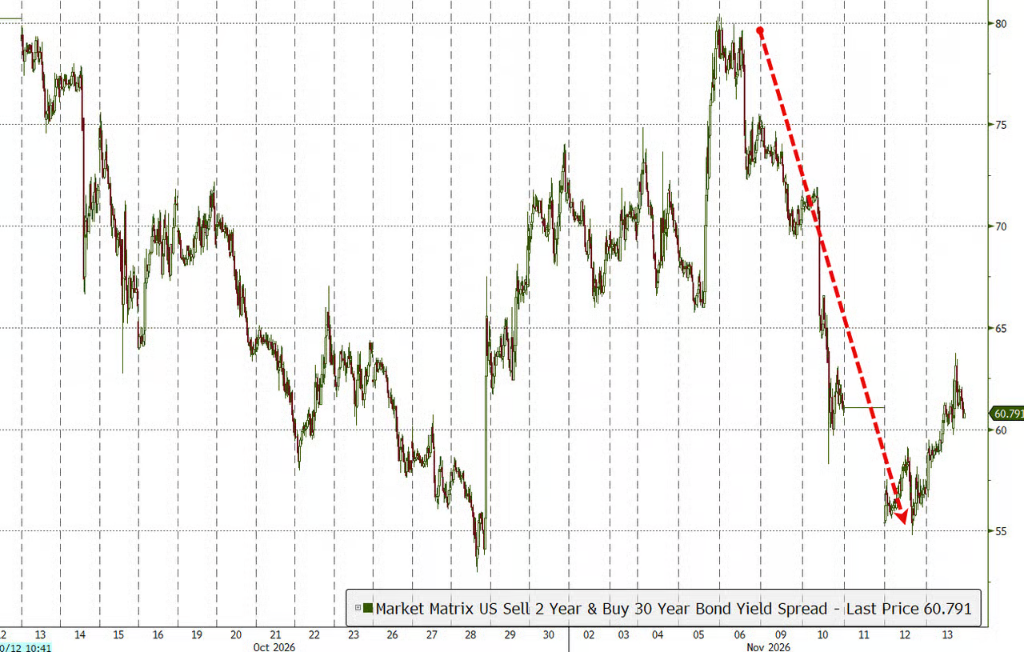
At 2 PM on Thursday, the Treasury Department released October fiscal deficit data, further raising market concerns: the October deficit reached $404 billion, the worst October performance on record, marking the worst start to a fiscal year in U.S. history, primarily driven by a surge in defense spending and $115.5 billion in interest payments, which currently account for 28.2% of total federal revenue, also a historic record.
It is noteworthy that this round of bond market shocks is driven by real interest rates: the 10-year breakeven inflation expectations have barely budged, while TIPS yields have risen for the fifth consecutive trading day, accumulating a 90 basis points increase this year, indicating that the market is pricing in tighter monetary policy rather than higher inflation expectations.
Credit Market: Surface Calm, Underlying Cracks
The credit market remains calm at the index level. CDX investment-grade credit spreads continued to narrow, while the CDS for mega-scale cloud computing companies fell to a one-month low, and data center CDS dropped below 500 basis points again. Goldman investment-grade trader Kevin Boova summarized:
"In brief, there are no signs of panic in the credit market."
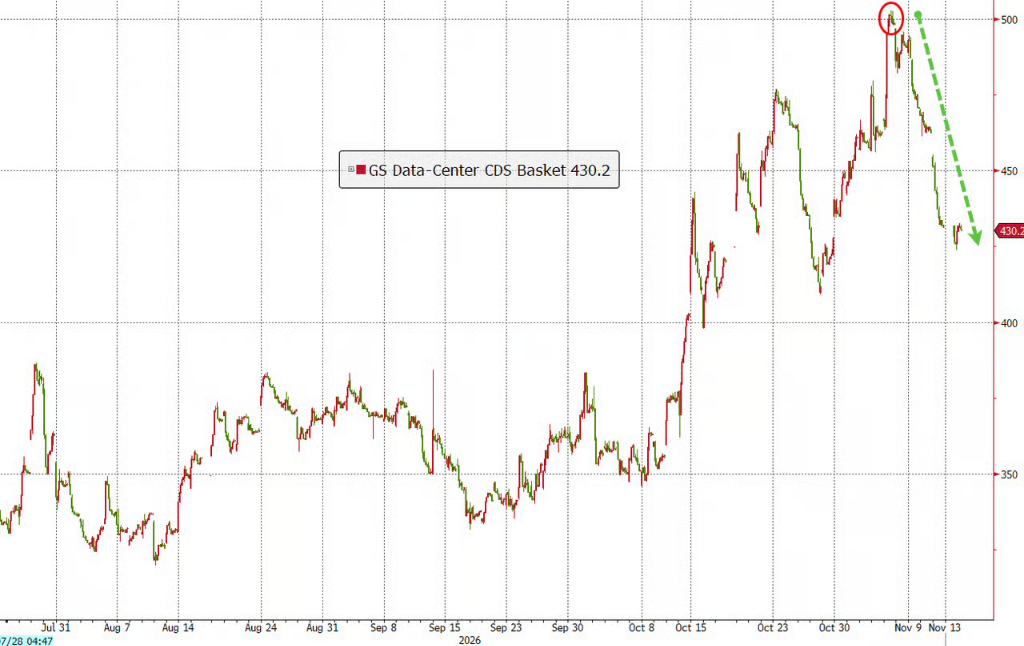
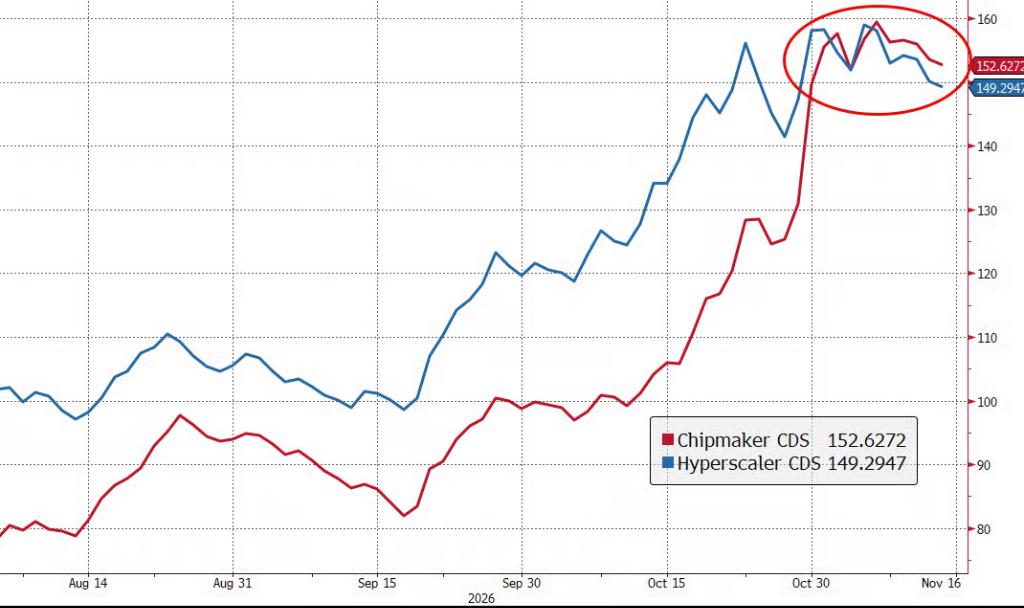
However, beneath the surface, the cracks are widening. The CDS spreads in the chip industry have first exceeded those of mega-scale cloud computing companies. CCC spreads are nearing cyclical highs, widening by 270 basis points over three months, while BB spreads have narrowed. On Tuesday, driven by the Treasury sell-off, investment-grade corporate bonds recorded their worst single-day performance since September 23.
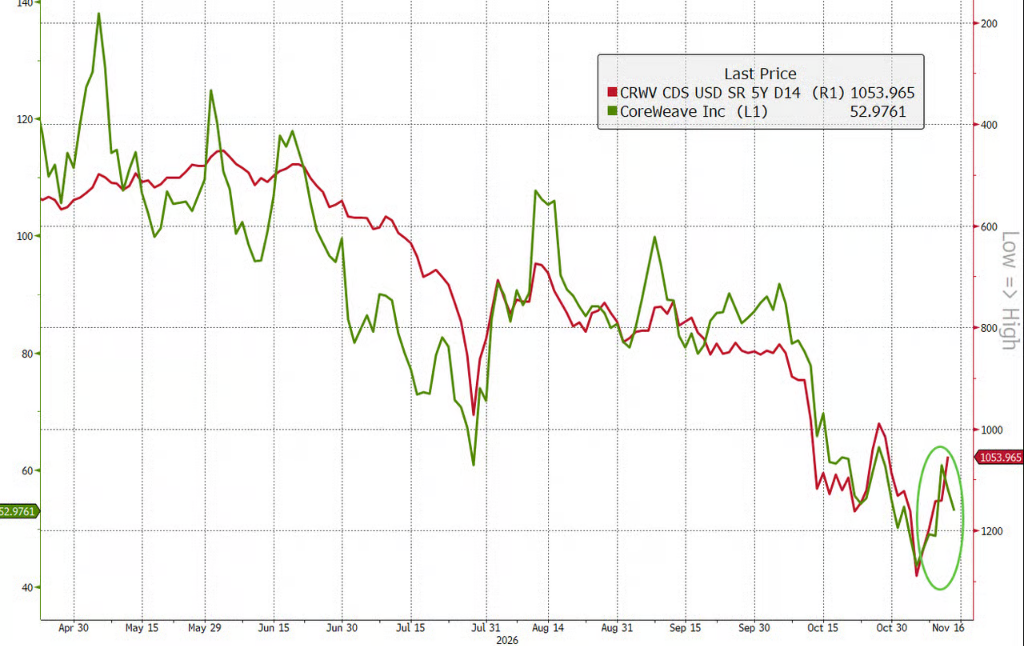
CoreWeave is the current core stress test case. Its bonds maturing in 2032 are priced at a spread exceeding the benchmark by 990 basis points, with its existing unsecured bonds yielding over 15%. Management stated it will cease issuing junk bonds, instead relying on prepayments and secured contracts for financing, including investment-grade loans anticipated at interest rates of 7% to 7.5% and amounts not less than $4 billion. CEO Michael Intrator stated the reason for not repurchasing its own bonds is because "it can deploy capital to higher-return places."
Additionally, SoftBank recorded a $7 billion loss this week due to the write-off of $3.7 billion in AI power equipment deposits, with the stock price dropping by 10%.
Oil Prices: Dramatic Reversal from “Ceasefire Expectations” to “No Need for Agreement”
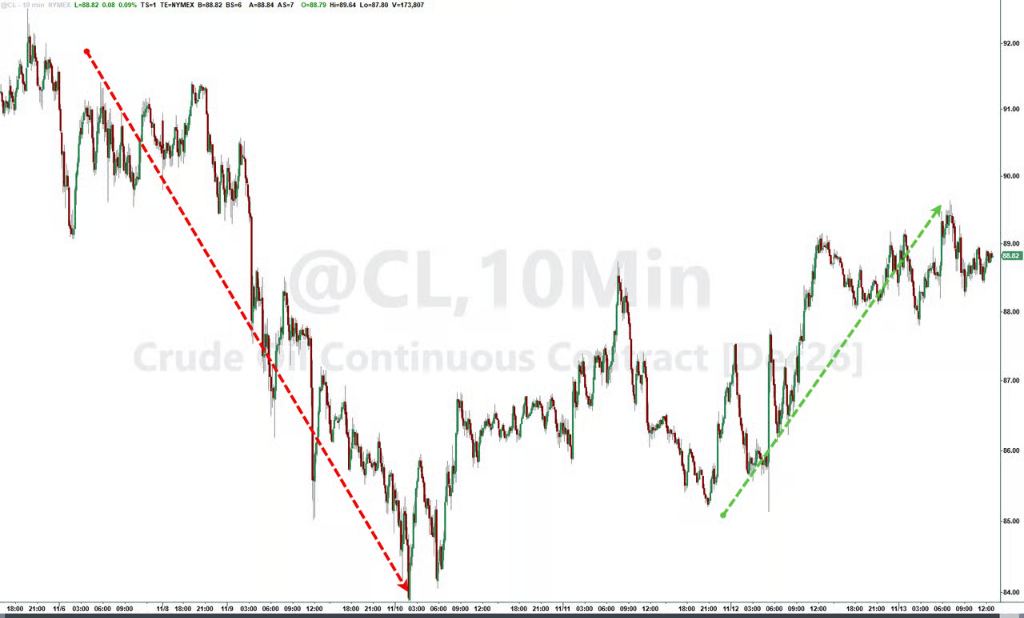
In the first half of the week, oil prices continued their downward trend from last week. Trump stated large-scale strikes were "unlikely," Al Arabiya reported that IAEA inspectors might return to Iran, and Brent crude fell nearly 6% to $92.57 per barrel, briefly dipping below $90 on Tuesday, while U.S. gasoline prices also fell below $4 per gallon.
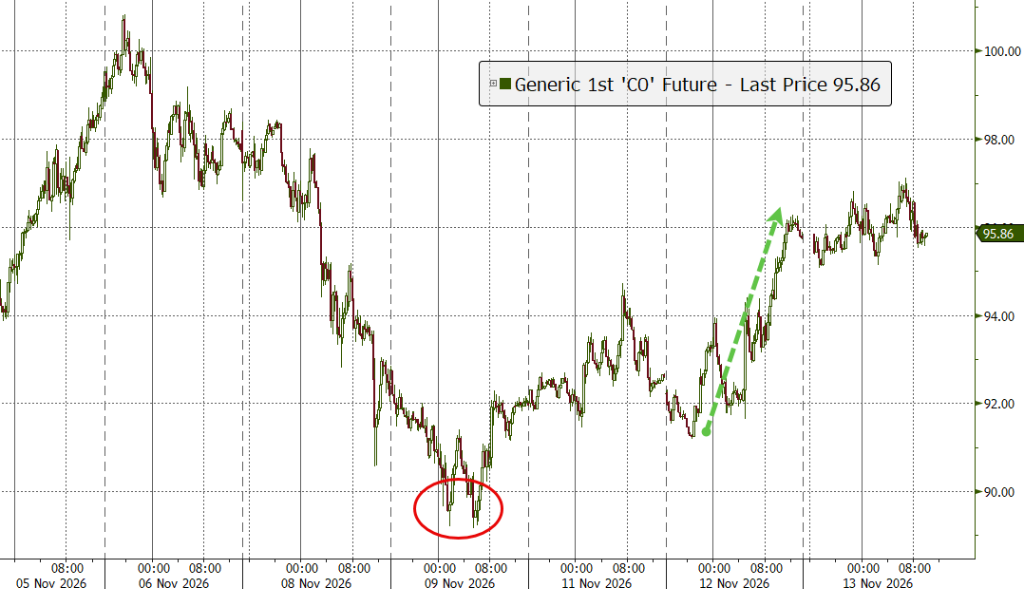
However, the situation took a sharp turn. Daily, oil tankers hit mines in the Strait of Hormuz, the Islamic Revolutionary Guard attacked navigation equipment guiding ships through the southern channel of the Strait of Hormuz, and Iranian officials stated they would not move "even one atom" of enriched uranium out of the country. On Thursday, shortly after The Wall Street Journal reported that Vice President Vance was considering direct talks with Iran, Trump closed the diplomatic door, stating clearly "we don’t need to reach an agreement," adding, "We've taken their money, hundreds of billions, and their strait!" Oil prices then rebounded sharply.
Goldman's EMEA team briefly commented, "It feels like de-escalation is dead." On Friday, the International Energy Agency indicated that the oil market is shifting towards oversupply, which limited the upward momentum of oil prices, with Brent crude closing around $96 per barrel and WTI at about $89, showing a moderate weekly decline.
Capital Flows: Withdrawals from Money Market Funds, Inflows into European Stock Markets
LSEG Lipper's latest data shows that global equity funds had a net inflow of $51 billion this week, the largest single-week inflow since the end of September, marking the eighth consecutive week of net inflows. Among them, European equity funds attracted $35.1 billion, the highest since June 2021, with the Stoxx 600 index hitting multiple historic highs during the same period; U.S. equity funds attracted $6.6 billion, and Asian funds saw inflows of $6.2 billion.
Domestically in the U.S., stock funds recorded net inflows for the second consecutive week, but the scale of $6.6 billion was less than half the previous week's $15 billion. Large-cap funds absorbed $11.6 billion, while small-cap funds saw a total outflow of $3.5 billion, and sector-themed funds had outflows of $2.5 billion. Money market funds experienced outflows of $37.5 billion, giving back part of the previous week’s record inflow, which was the largest single-week inflow since April 2020; bond funds saw a slight outflow of $500 million, thereby interrupting a seven-week streak of inflows.
The flow pattern is clear: capital is flowing back into the stock market, but the destination is Europe and large-cap stocks, rather than the riskier segments of the U.S. market.
Outlook for Next Week: Nvidia Earnings Report and Anthropic IPO as Key Tests
The market enters next week with a cleaner position structure, while facing a Federal Reserve that clearly wants to accelerate tightening, and two key events that will determine whether the AI rebound can be sustained.
Nvidia earnings report (Tuesday, November 17): This is Colette Kress's first earnings report as interim CEO, with an earnings guidance of $108 billion. Given the share price being about 10 times Goldman’s 2027 profit forecast, the numbers themselves are no longer the focus; the market is more eager to know: can this company operate normally without its founder?
Anthropic pricing and IPO (November 18-19): Anthropic officially launched its IPO this week, seeking a maximum valuation of about $64 billion, corresponding to a market value of about $1 trillion (fully diluted about $1.4 trillion); reportedly, the subscription multiple has reached about six times. If the IPO performs strongly, it will instill confidence in AI trading; if it performs poorly, it may become the next "clear-out event" in the hands of the shorts.
Bond supply and foreign capital demand: The 10-year yield is only about 15 basis points away from multi-year highs; the 20-year auction and the 10-year TIPS issuance will be next week’s supply test, with foreign capital demand as a key observation variable—previously, the sharp drop in the indirect bid ratio in the 10-year auction has already served as a warning signal.
Federal Reserve and macro data: Retail sales and industrial production data will be released on Tuesday, along with multiple Fed officials speaking. If they exceed expectations again, a 50 basis points rate hike in December will essentially be cemented.
Geopolitical risks: Trump has clearly stated, "We don’t need an agreement," and a third U.S. aircraft carrier is reported to be en route to the Middle East, with oil tankers hitting mines daily. Iran's ceasefire talks have returned to a deadlock.
As Privorotsky said, "AI trading survived Huang's departure, but Waller is another kind of trouble—because he won’t resign." Nvidia’s earnings report on Tuesday will be the next test, and the December Federal Reserve dot plot will be the real decisive moment.
免责声明:本文章仅代表作者个人观点,不代表本平台的立场和观点。本文章仅供信息分享,不构成对任何人的任何投资建议。用户与作者之间的任何争议,与本平台无关。如网页中刊载的文章或图片涉及侵权,请提供相关的权利证明和身份证明发送邮件到[email protected],本平台相关工作人员将会进行核查。


