Key Takeaways
- CME Fedwatch assigns an 88.5% probability to a quarter-point December hike and 11.5% to a half-point increase.
- Kalshi and Polymarket favor a 25-basis-point hike, with probabilities of 89% and 88%, respectively.
- Bitcoin touched $65,020 on Bitstamp on Saturday morning as inflation concerns and expectations of tighter monetary policy weighed on risk assets.
According to the CME Fedwatch tool and data Bitcoin.com News reviewed Saturday morning, futures traders assign an 88.5% probability to the Federal Reserve lifting its benchmark interest rate by 25 basis points at its Dec. 8-9 meeting. Another 11.5% favors a more aggressive 50-basis-point increase, leaving no probability assigned to unchanged rates or cuts.
The current federal funds target range stands at 3.75% to 4%. A quarter-point increase would raise that range to 4%-4.25%, while a half-point adjustment would place borrowing costs between 4.25% and 4.5%.
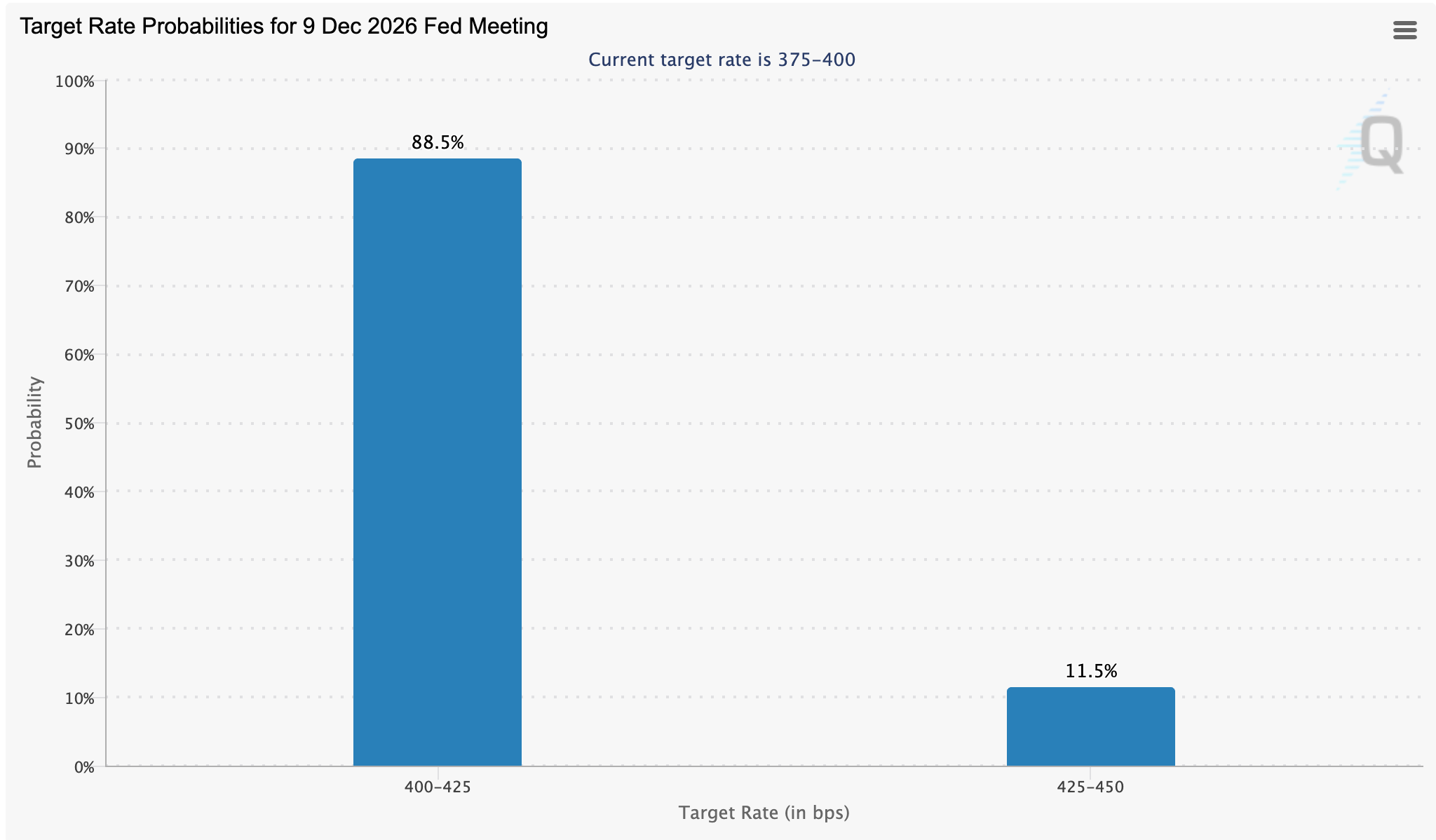
CME Fedwatch tool on Nov. 14, 2026.
Expectations have changed considerably. On Nov. 6, CME assigned a 23.7% probability to unchanged rates and 76.3% to a quarter-point increase. By Saturday, the possibility of a half-point move had entered the equation at 11.5%.
Meanwhile, Kalshi traders priced a 25-basis-point hike at 89%, compared with 10% for a larger increase. The platform recorded approximately $14.3 million in trading volume on its December decision market.
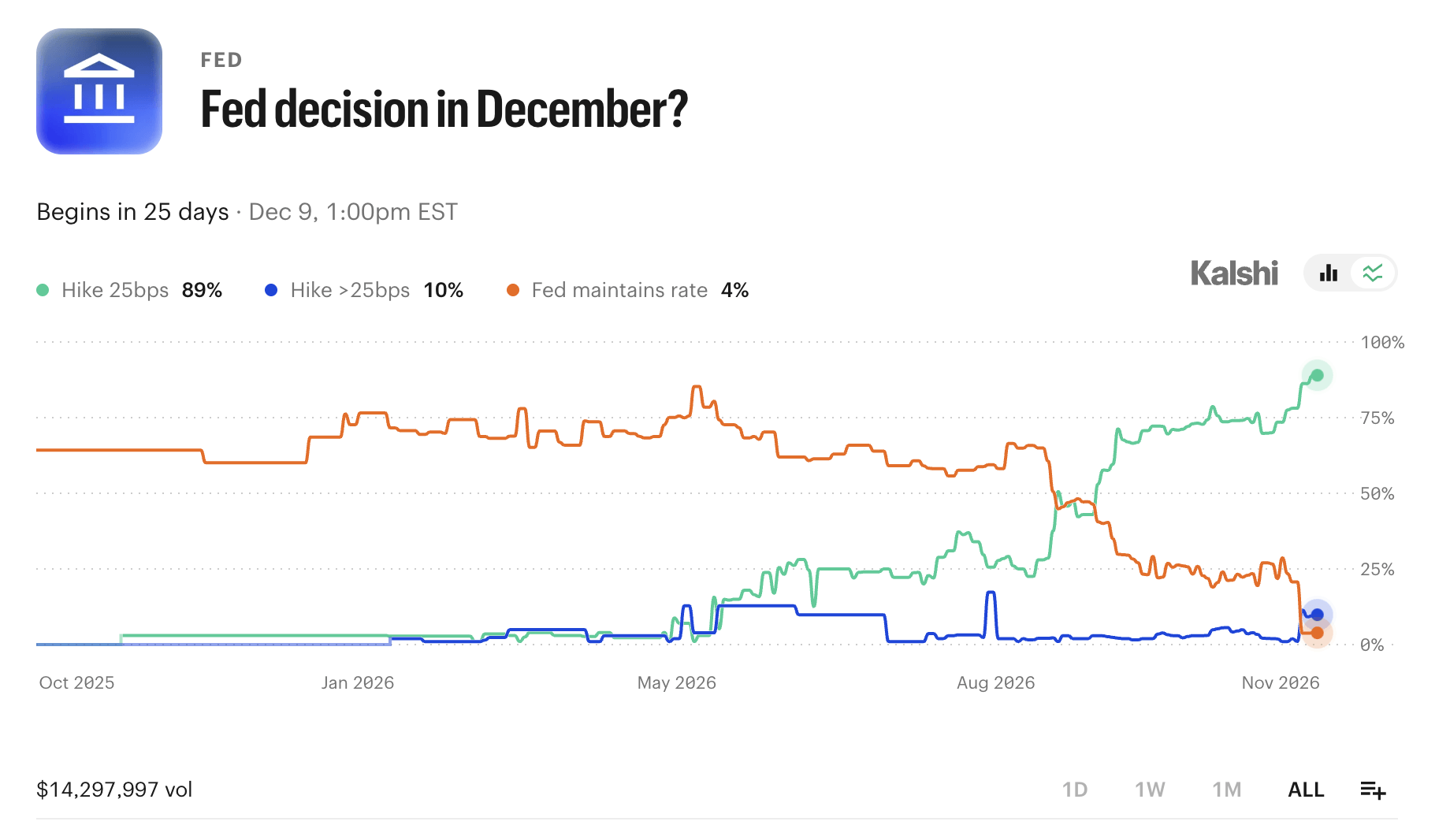
Kalshi Fed market on Nov. 14, 2026.
On Polymarket, the corresponding probabilities stood at 88% and approximately 9%, respectively, with cumulative volume exceeding $33.7 million. Both prediction platforms retained roughly 4% probabilities for unchanged rates, unlike CME’s futures-derived calculations.
These figures represent market expectations rather than confirmed monetary policy, but typically, the market is correct. The Federal Open Market Committee has not announced its December decision, and the three platforms use different pricing methodologies and contract specifications. There’s still a considerable amount of time left until the Fed makes the year-end move.
Inflation has become a central concern. October’s consumer price index increased 0.4%, exceeding economists’ 0.3% forecast, while core inflation advanced 0.3%, also surpassing expectations. Persistent price pressures have strengthened arguments for additional monetary tightening.
Energy costs have complicated the outlook. Brent crude’s advance beyond $100 per barrel and elevated diesel prices have increased transportation expenses, potentially spreading massive price pressures into food, services, and consumer goods.
The labor market has also complicated the case for restraint. October payrolls in the U.S. increased by 165,000, comfortably exceeding expectations near 65,000. Stronger employment figures give policymakers additional room to consider higher borrowing costs.
Federal Reserve Gov. Christopher Waller has advocated additional tightening and raised the possibility of a half-point increase if underlying inflation remained elevated. Other officials have expressed concerns about persistent price pressures, although the appropriate pace of tightening remains contested.
Bitcoin’s price deterioration offers another indication of mounting anxiety across speculative markets. Bitstamp’s 30-minute chart showed the cryptocurrency retreating from $72,128 to $65,020 before recovering modestly to $65,274 around 11:14 a.m. EST.
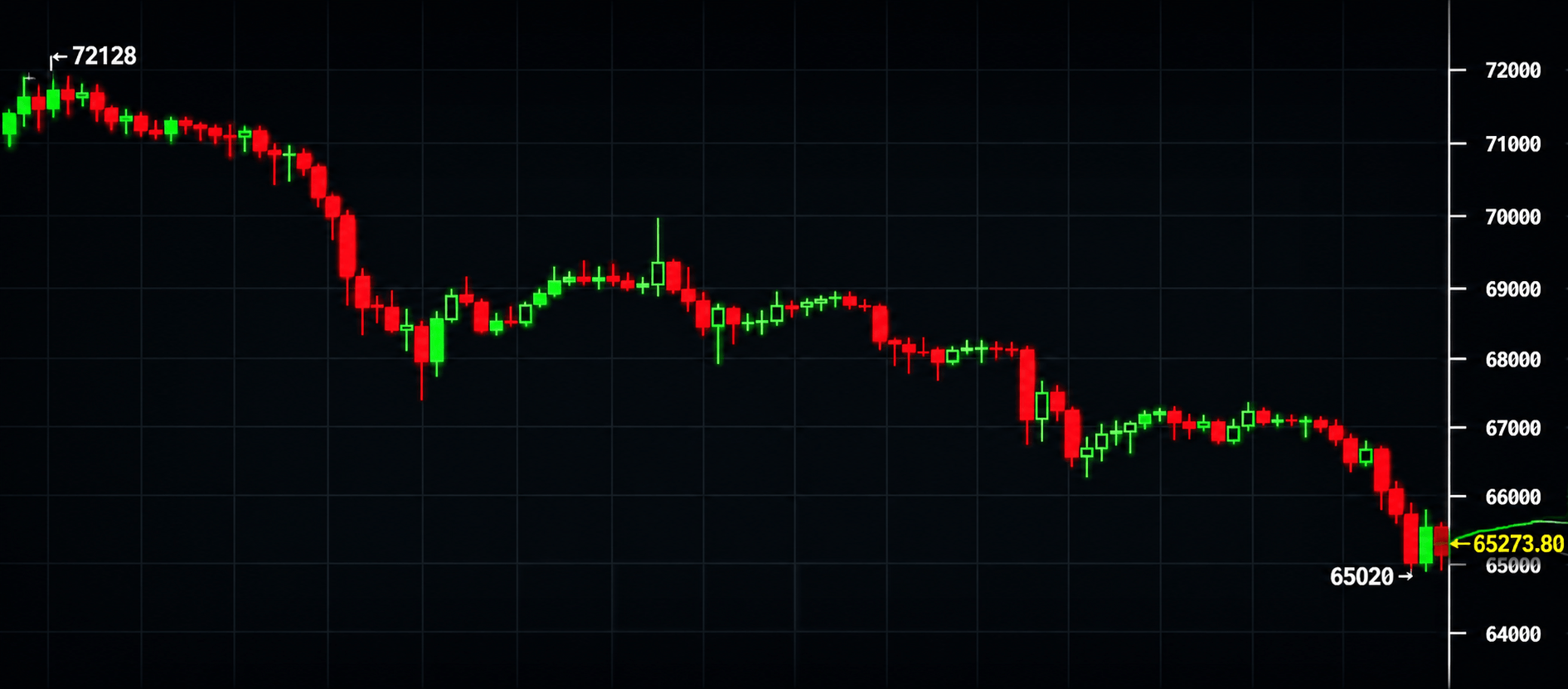
Bitcoin via Bitstamp on Saturday, Nov. 14, 2026, at 8:30 a.m. Eastern time. Chart and data source via bitcoinwisdom.io.
The chart above displays successive lower highs and lower lows, accompanied by elevated selling volume. Immediate support sits near $65,000, while $66,000 represents the first significant resistance threshold. A sustained breakdown could expose the $64,500-$64,000 region. Today’s intraday low of $65,020 per bitcoin brought $1 billion in 24-hour liquidations across the entire crypto market, with $382 million being BTC wipeouts.
Higher interest rates can diminish the appeal of speculative assets by increasing financing costs and making interest-bearing alternatives more attractive. Nevertheless, bitcoin’s decline cannot be attributed exclusively to Federal Reserve expectations. A lot of other factors have come into play, including uncertainty surrounding Strategy’s MSCI index listing and exchange-traded fund (ETF) outflows.
With the December decision approaching, investors face an increasingly uncomfortable proposition: Inflation remains stubborn, monetary policy could tighten further, and bitcoin is struggling to establish a convincing floor. Markets have largely settled on a December hike, but its magnitude and consequences remain unresolved.
免责声明:本文章仅代表作者个人观点,不代表本平台的立场和观点。本文章仅供信息分享,不构成对任何人的任何投资建议。用户与作者之间的任何争议,与本平台无关。如网页中刊载的文章或图片涉及侵权,请提供相关的权利证明和身份证明发送邮件到[email protected],本平台相关工作人员将会进行核查。


