Real estate tokenization has only 200 million dollars. This article breaks down five models' successes and failures, pointing out that credit and index products are the way forward.
Written by: @FourPillarsFP
Translated by: AididiaoJP, Foresight News
The largest asset class in the world is real estate, yet it is one of the smallest asset classes on-chain. Data from RWA.xyz shows that by July 2026, distributed tokenized real estate is approximately 203 million dollars, while the entire tokenized asset market is about 35 billion dollars.
The gap is huge, with numerous attempts and many failures, yet capital is still flowing in. This week, Index Industries emerged from stealth mode, completing a 50 million dollar seed round to create a single index token for U.S. housing prices.
Could real estate tokenization be the next growth engine for RWA? The author believes it could, but the growth will not come from the models built by most in the past. True growth lies in credit and index products. As for breaking a single building into fractional ownership, this is the model most think of first, yet it has the poorest performance and the most complex structure.
1. Doing financial business in real estate is actually easier to succeed
Within the label of "real estate tokenization," there are actually five types of businesses. They offer different things to holders, leading to different successes and failures.
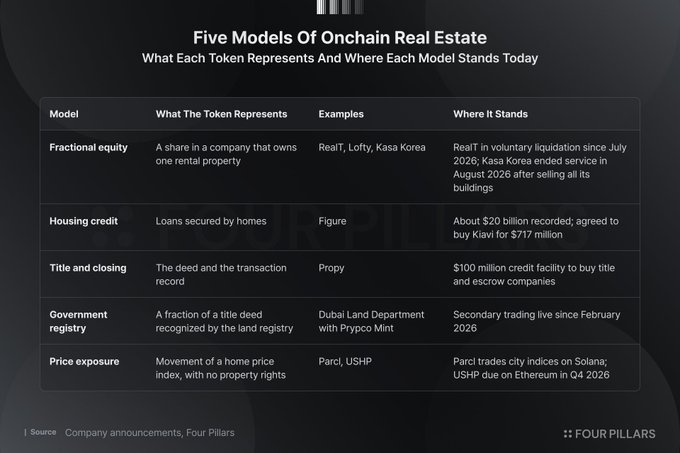
Fractional ownership sells shares of a company or trust that holds a property. Holders receive rental income until they sell, and the platform relies on listing fees and management fees for each small building to maintain operations. These fees do not cover operational costs, making this the weakest model among the five. RealT, Kasa Korea, and Funble have all shut down.
Housing credit places mortgages on the balance sheet, allowing investors to earn interest paid by borrowers. Revenue comes from lending and services. Figure reported net revenue of 393 million dollars and net profit of 132 million dollars in the first half of 2026. This is the most mature model among the five, but it requires achieving scale. Pineapple Financial moved over 1 billion dollars in mortgage records on-chain, but generated only 2.1 million dollars in revenue over nine months.
Ownership and delivery involve verifying ownership, custody, and contract registration, transferring the property from the seller to the buyer. This model does not provide an investment product itself. Propy records contracts and transactions, charging a fee for each delivery, and is currently utilizing a 100 million dollar financing line to acquire ownership companies. Revenue is stable, but growth relies on acquiring licensed companies one by one, with the author predicting that expansion will be slow.
Government registration essentially incorporates the government into the fractional ownership model's structure. The land registration department lists token holders as registered owners, giving holders the strongest legal claim in the five models. The Dubai platform Prypco Mint charges for issuance and trading and is currently only open to residents. The business itself is credible, but it can only follow the pace set by one regulatory body.
Price exposure completely eliminates the property itself. Parcl provides leveraged contracts based on city indices; USHP plans to launch backed tokens based on Index Industries' housing price index in the fourth quarter of 2026. Revenue will come from the asset scale attracted by the index and the resulting trading volume. Daily indices could also be made into perpetual markets, just like Hyperliquid's HIP-3 does for stock indices.
The rule is clear: models that earn money from readily available cash flows like loan interest and delivery fees have already achieved scale. Models that ask investors to bet on a building or a manager face the highest failure rate. Each building has its own tenants, maintenance, and legal issues, making standardization and replication impossible; platforms end up losing on building after building.
2. Why it has never taken off
Investors buy real estate usually for two reasons: stable income and price appreciation. Tokenization promises to lower the barriers, just like U.S. REITs made expensive, illiquid assets affordable and sellable.
On-chain products have failed to deliver on both counts. The author has identified four issues: unsustainable yields, platform losses, minimal token trading, and insufficient price increases.
Yields look high, but very few can withstand scrutiny.
Real estate tokenization products advertise or promise annualized returns between 3.4% and 16%. Few are audited; hence, the source of each number is more important than the number itself.
The platforms advertising the highest yields are precisely those that have failed. RealT advertised rental yields of 6% to 16% but stopped most payments by the end of 2025, formally suspended distributions in February 2026, and announced voluntary liquidation in July.
The remaining high figures are mostly projections or self-reported averages. Dubai's Prypco Mint claims net annual returns of 8% to 12%, which is a projection that adds together rental income and capital appreciation. Lofty claims that as of May 2026, 111 properties had an average rental yield of 9.2%, but did not disclose the calculation method.
Credit products transfer the money paid by borrowers. Figure's home equity pool showed a yield of 9% in February 2026. The Hastra token PRIME, based on the same pool, displayed a native yield of 6.01% on DefiLlama.
The lowest figures are, conversely, the most solid. Lucentblock’s building in Daegu paid approximately 5% annually before selling in October 2025. Mitsui's AEON Omiya land token is expected to yield 3.4% pre-tax under Japanese securities law.
Regulated, realized, or third-party tracked numbers generally fall between 3% and 6%.
Liquidity is still very poor: Japan issues the most, trades the least.
Japan is the largest regulated market for tokenized real estate. In the 2025 fiscal year, 140.8 billion yen of real estate securities tokens were issued, accounting for about 85% of all securities token issuances. BOOSTRY expects public offerings to reach a cumulative 530 billion yen in the 2026 fiscal year.
The market can grow because it is embedded in the existing financial system. Trust banks hold properties, while brokerages like SBI and Nomura sell tokens to retail clients; blockchain replaces backend record-keeping.
The same design explains why it has not developed into an on-chain market, with three prominent limitations.
Secondary trading is nearly nonexistent. Osaka Digital Exchange launched eight tokens in March 2026, valued at 33.6 billion yen, but settlement still takes two working days.
The network is closed. Most tokens are issued on private consortium ledgers, blocking foreign capital and on-chain markets. Progmat only recently moved tokens to Avalanche.
Essentially, it is a savings product. A yield of about 3.4% attracts Japanese savers but offers limited appeal to global investors. Light trading indicates that most buyers hold until maturity redemption.
Japan illustrates that regulated distribution can achieve scale in tokenized real estate; it also demonstrates that simply issuing tokens does not create a liquid market.
Price increases are insufficient.
Housing prices are not rising fast enough to attract capital on-chain. BIS data shows that in the decade ending in 2025, the best-performing U.S. market rose by 84%, averaging about 6% per year. Singapore averages about 4% per year, Japan 3%, South Korea 2%, and mainland China and Hong Kong have nearly returned to starting points.
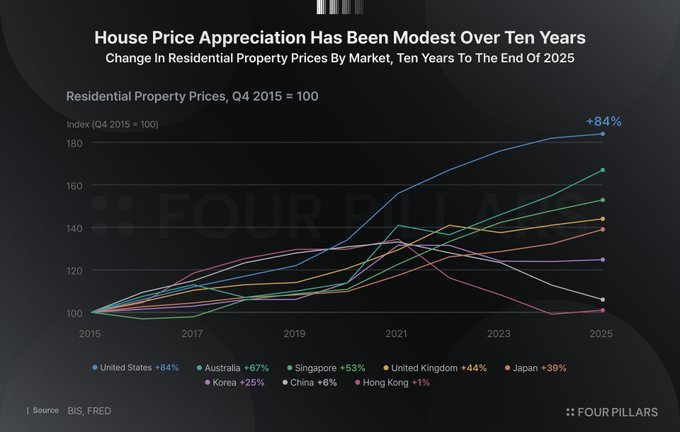
These returns appear thin in comparison to the yields already available to on-chain investors. Housing credit can provide yields of 6% to 9% without exposing investors to price fluctuations. Tokenized government bonds have drawn in 15.9 billion dollars, while real estate has only reached 203 million dollars.
Homeowners enjoy better returns than indices because they financed most of their purchase and live in their assets. Token holders only see unleveraged price changes. Therefore, price exposure must be leveraged or combined with income to be competitive.
3. Lessons from past failures: Move prices and debt on-chain, not specific buildings
Past failures stem from trying to move the buildings themselves on-chain, which resulted in issues with property management, narrow exit opportunities, and platform costs. Two models could succeed because they leave the buildings in place and only move prices and debt on-chain.
The first is to create a marketplace for leveraged trading and hedging.
The demand for exposure to housing prices is real, but building a usable market is challenging for the same reasons as the Pre-IPO market: thin liquidity and no recognized fair price. Parcl failed to seize this opportunity.
Real estate has an advantage: public indices provide reference prices. Trading venues can leverage this to provide leverage to investors who feel that 6% annually is too low and offer hedging to property owners, developers, and lenders who default on long positions.
The second is to create on-chain private credit within a composable ecosystem.
Mortgages generate cash flow; Figure has recorded about 20 billion dollars in mortgages on its books. Once loans are tokenized, they can be sold, staked, or split. Figure Connect sells loans to external buyers, with its home equity pool's PRIME token serving as collateral in the Solana lending market.
Both models do not require platforms to manage tenants or maintenance, which was precisely where early platforms failed.
4. Conclusion: Growth comes from credit and indices
Real estate can become the next growth engine for RWA, with growth coming from products built on credit and indices.
Housing credit has already reached about 20 billion dollars on-chain. RWA.xyz counts it as private credit, not included in the 203 million dollars of real estate figures. USHP had up to 100 million dollars committed before its launch. Its transactions in the first few months will test whether exposure to indices can find liquidity for a single building never before seen.
免责声明:本文章仅代表作者个人观点,不代表本平台的立场和观点。本文章仅供信息分享,不构成对任何人的任何投资建议。用户与作者之间的任何争议,与本平台无关。如网页中刊载的文章或图片涉及侵权,请提供相关的权利证明和身份证明发送邮件到[email protected],本平台相关工作人员将会进行核查。


