Author: AiPlot Research Institute
Focus: RWA / Digital Assets / In-depth Analysis of Financial Infrastructure
Website: https://aiplot.com/?utm_source=aicoin
Recently, discussions about RWA and on-chain finance, starting from macro interest rates, fundamental opportunities in the next round of the crypto market, and the liquidity advantages of Uniswap, point to the same question:
As real assets increasingly enter the blockchain, what can truly sustain value— the issuers of certain assets or the infrastructure that supports transactions and liquidity?
This question is more important than "who can increase tenfold in the next round."
This is because the RWA market is transitioning from a single asset issuance phase to a phase of asset selection, capital rotation, and competition in trading infrastructure. The growth in the scale of tokenized U.S. Treasury bonds, gold, money market funds, and stocks indicates that real assets are entering the on-chain space; meanwhile, the development of stablecoins, DEX, lending protocols, and compliant trading pools determines whether these assets can be continually utilized.
1. High Interest Rates Do Not Automatically Bring RWA Fund Inflows
One viewpoint is that higher short-term U.S. interest rates may increase the yield attractiveness of tokenized Treasury bonds and money market funds, but high interest rates do not mean that capital will automatically flow into RWA.
This distinction is critical.
The yields on tokenized Treasury bonds usually have a strong correlation with short-term interest rates. When short-term Treasury yields are high, on-chain investors can gain relatively stable dollar returns through tokenized money market or Treasury funds. Theoretically, this would enhance the appeal of Treasury-type RWA.
However, whether funds ultimately flow into a particular product depends on the comparison of four variables:
- Is the yield sufficient to compensate for the product risk;
- Is the subscription and redemption process convenient;
- Can the tokens be traded or collateralized in the secondary market;
- Does the product have restrictions such as lock-up periods, geographic limitations, and entry requirements for investors.
As of November 11, the scale of tokenized Treasury bonds was approximately $12.7 billion, a decrease of about $678 million from October 24; during the same period, tokenized commodities increased by about $69.1 million. This data indicates that capital does not simply move according to the one-way logic of "the higher the interest rate, the more popular Treasury RWA becomes," but instead is re-seeking a risk-return balance across different assets.
According to current data from AiPlot, the structure of RWA also exhibits similar characteristics. The scale of U.S. Treasury bonds is approximately $14.1 billion, still the largest asset category, but has decreased by about 0.43% over the past seven days; commodities are approximately $5.33 billion, increasing by about 4.63%; active strategies are approximately $4.72 billion, increasing by about 2.55%; stocks are approximately $3.73 billion, increasing by about 1.09%.
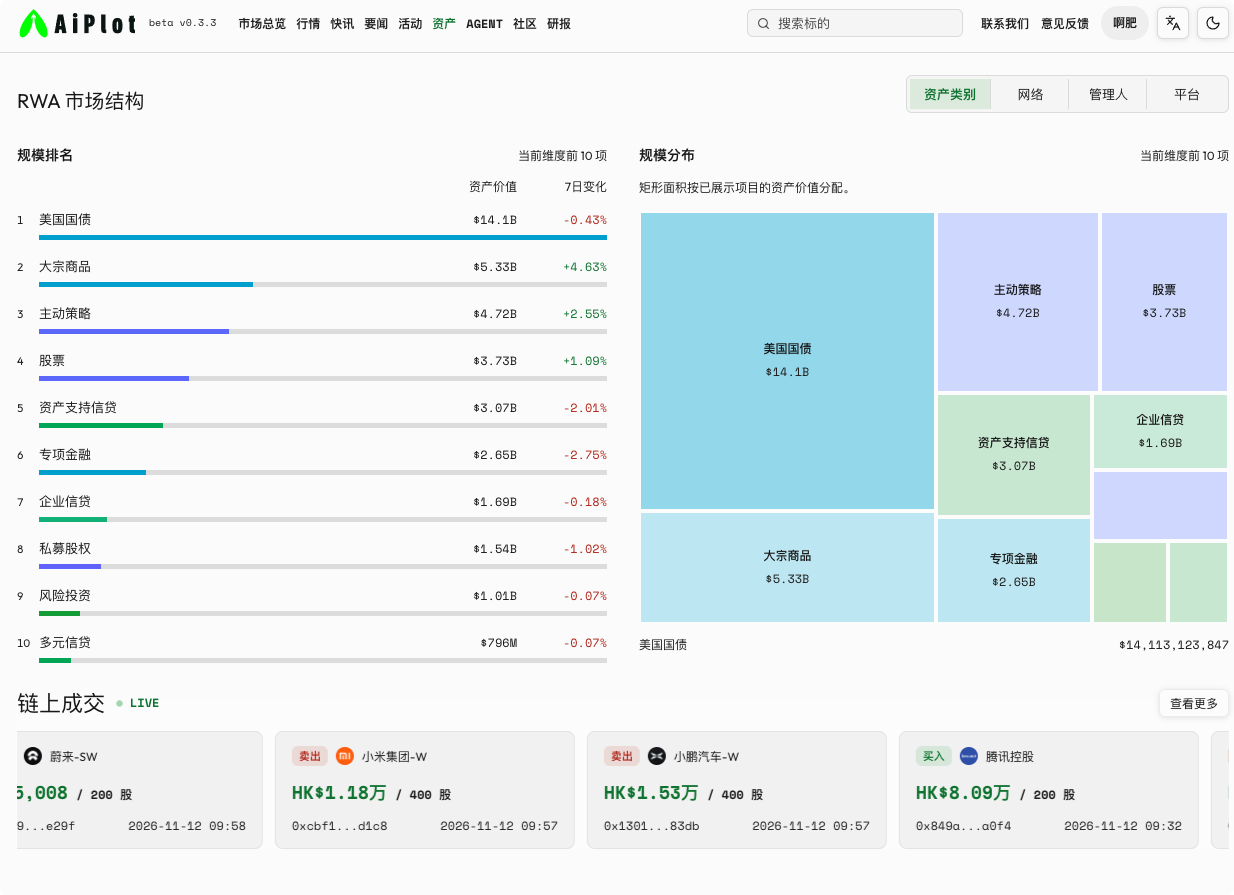
This indicates that Treasury bonds remain the core of on-chain real assets in terms of stock, but the faster-growing segments have expanded to assets like gold, active strategies, and stocks.
2. The Essence of RWA Capital Rotation: Competition Between Yield, Liquidity, and Composability
In traditional finance, investors do not only compare nominal yields. This is also true in on-chain finance.
A private credit product with a higher annual yield may not be more attractive than a low-yield Treasury fund if the redemption period is long, the underlying asset is insufficiently disclosed, and it cannot enter lending agreements.
Conversely, a tokenized Treasury bond product with slightly lower yield may achieve higher overall capital efficiency if it allows for quick subscriptions and redemptions, can circulate across multiple networks, and can serve as a stablecoin liquidity pool or lending collateral.
Therefore, RWA products can be compared using a simple analytic framework:
Risk-adjusted return = Underlying return - Credit risk - Liquidity discount - Compliance and operational costs
Here, liquidity should not be understood merely as "whether it can be bought on a certain interface," but should include:
- Can a counterparty be found at any time;
- Can redemptions be completed quickly;
- Can it be transferred across networks;
- Is it recognized and usable by other protocols;
- Does price discovery still exist under market pressure.
This is also why competition in RWA will gradually shift from "how many assets are issued" to "how efficiently can assets be utilized in more financial scenarios."
3. AiPlot Data Shows that On-chain Real Assets Are Emerging Along Three Main Growth Lines
1. U.S. Treasury Bonds Remain the Base of Yield-based RWA
Current data from AiPlot shows that the scale of U.S. Treasury-type RWA is approximately $14.1 billion, ranking first among asset categories.
In terms of product structure, products like USYC, USDY, BUIDL, BENJI, iBENJI, and JPMorgan's on-chain money market funds represent different paths for fund companies, banks, stablecoin issuers, and digital asset platforms to enter on-chain cash management.
The core demand of this market is not for high-volatility trading, but for converting off-chain dollar cash into programmable, transferable, and composable on-chain yield assets.
2. Commodity Assets Become an Important Direction for Capital Rotation
The commodity-type RWA on AiPlot is about $5.33 billion, with a 7-day growth of approximately 4.63%.
Among these, gold is the most mature on-chain commodity asset. XAUT and PAXG still occupy most of the tokenized gold market.
The advantage of commodity assets is their relatively clear price benchmarks, and they possess strong hedging demand when facing rising inflation and geopolitical uncertainties. However, there are also issues related to custody, auditing, and redemption. On-chain transaction records cannot automatically prove that there is enough gold in off-chain vaults, and investors still need to rely on custodians, audit reports, and the issuer’s redemption arrangements.
3. Stocks and Active Strategies Begin to Address Trading Needs
Data from AiPlot shows that the scale of stocks and active strategies is approximately $3.73 billion and $4.72 billion, respectively, with recent continuous growth.
The significance of these assets is not just in providing yields but in bringing the price exposure of traditional markets on-chain. Users can trade a portion of U.S. stocks, Hong Kong stocks, funds, or strategy products via tokens, and can further incorporate them into portfolios, collateral, and derivative trading.
However, the legal structure of stock tokens is much more complex than that of Treasury funds. Investors need to confirm whether they hold actual shares, custodial receipts, fund shares, trust beneficiary rights, or merely synthetic assets that track stock prices. Different structures can affect rights related to dividends, voting, redemption, and bankruptcy isolation.
Therefore, the growth of stock RWA does not automatically equate to the complete transfer of securities rights to the on-chain space. It is more likely to first develop in the form of compliant closed-end products and restricted transfer products.
4. Why Liquidity Entry May Be More Valuable Than Individual Asset Issuers
Another perspective places stablecoins, RWA, DEX, AI Agents, on-chain lending, and buyback burning within the same framework, proposing to find standards for real income, reasonable valuation, low unlock pressure, and long-term growth tracks.
This is closer to fundamental analysis than merely chasing narratives, but further differentiation is needed at two levels:
The first level is asset growth. A protocol can achieve scale growth by issuing more tokens.
The second level is financial usage. Whether assets generate trading fees, lending interest, management fees, redemption fees, or other sustainable income depends on whether they have entered real financial activities.
For RWA, the second level is particularly important. The asset issuance scale does not necessarily equal protocol income. Only when assets continue to trade, lend, collateralize, or are incorporated into capital management processes can infrastructure potentially capture value.
This makes DEX an important observation target. Regardless of whether the underlying assets are stocks, gold, Treasury bonds, or funds, as long as they need to be exchanged on-chain, price discovery and liquidity will be required.
5. Uniswap's Advantage is Not Just AMM, But the Liquidity Network Effect
In discussions about UNI, Uniswap's core competitive advantages are summarized into four points: long-term persistence, AMM innovation, liquidity, branding, and continuous iteration.
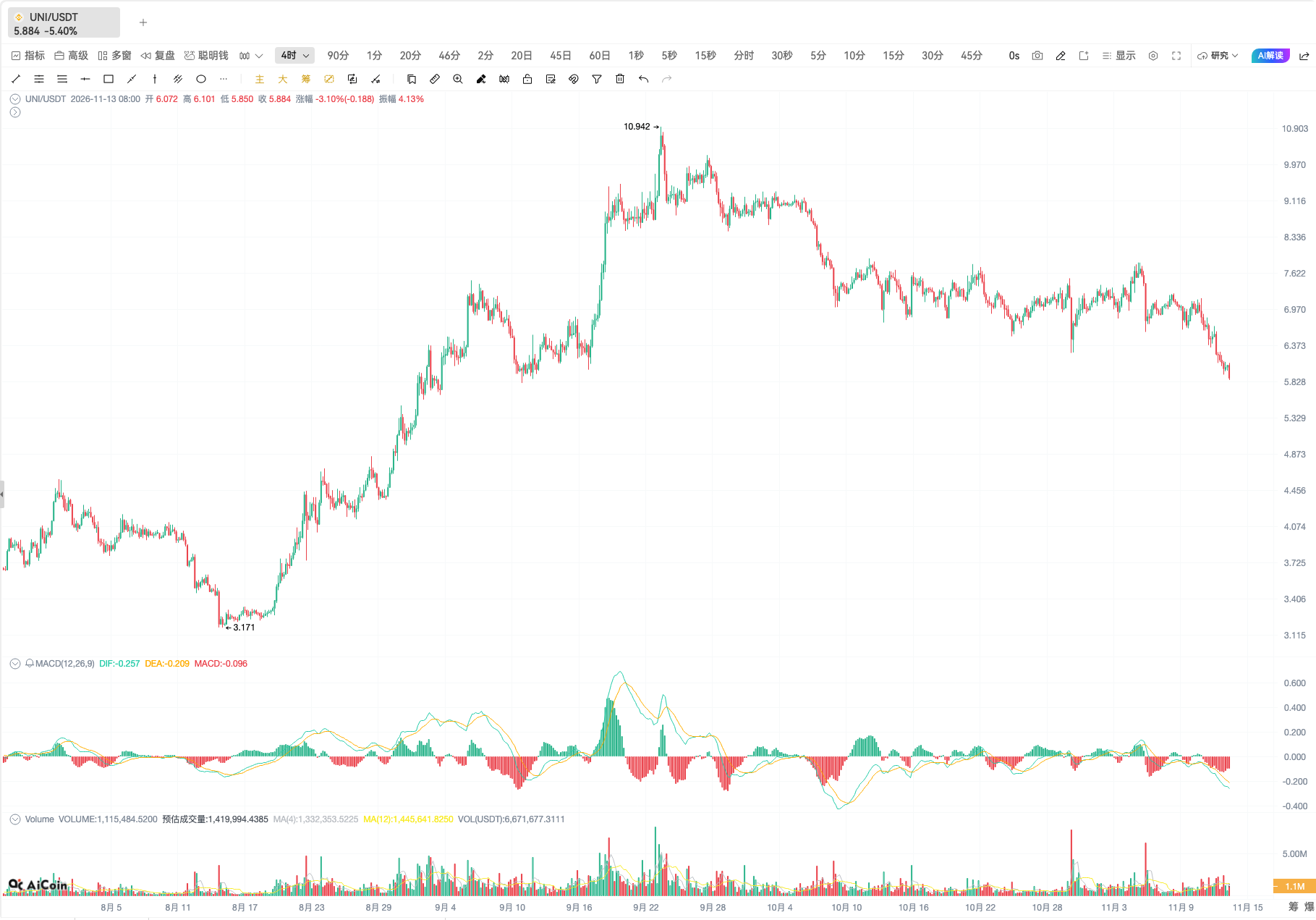
Among these, the most important is the liquidity network effect.
The interface of a trading protocol can be copied, and the smart contract code can be forked, but liquidity is hard to replicate. Liquidity not only means how much capital is in the pool but also encompasses:
- Are market makers willing to continually provide quotes;
- Do aggregators prioritize routing trades;
- Are wallets and trading applications integrated;
- Can new assets quickly find counterparties;
- Whether cross-chain deployments form a unified user and developer network.
Uniswap's official materials indicate that Uniswap v2, v3, v4, and UniswapX have already covered multiple networks; Uniswap has also announced that tokenized securities can be discovered and traded through its Web App, Wallet, and API, and BUIDL has integrated DeFi liquidity via UniswapX.
This means that Uniswap's path into RWA is not to issue Treasury bonds or stocks itself, but to become the trading and distribution layer for these assets.
6. After Uniswap Enters RWA, the Biggest Change is "Permissioned Liquidity"
The core logic of traditional DEX is permissionless asset exchange. However, securities, funds, and some real assets cannot be fully traded in a permissionless token manner.
Issuers may require:
- Only addresses that have completed KYC can participate;
- Only investors from specific regions may purchase;
- Tokens can only be transferred between whitelisted addresses;
- In the event of redemptions or regulatory incidents, issuers can freeze or restrict the assets;
- Different categories of investors have different holding and transfer permissions.
Uniswap is launching the Permissioned Pools framework in 2026, aiming to support regulated assets like tokenized funds in v4 pools and execute issuer rules during each transaction.
The significance of this change lies not in turning Uniswap into a traditional exchange, but in attempting to retain the capital efficiency of AMM while increasing the compliance controls necessary for securities-type assets.
This could form a new type of infrastructure:
The transaction execution layer remains automated on-chain, while the asset access layer is controlled by issuers and compliance service providers.
If this model matures, the future trading market for RWA may not simply divide into "centralized exchanges" and "completely open DEX," but rather feature more on-chain trading pools with permission controls, compliant transfers, and programmable rules.
7. The Value Capture of UNI Has Changed, but Does Not Mean Token Prices Must Rise
The most noteworthy change regarding UNI is not "it is an established project" but that the relationship between protocol revenues and tokens has begun to clarify.
Uniswap's official documentation shows that the UNIfication governance proposal passed in December 2025 activated protocol fees for all v2 pools and some v3 pools. In the activated trading pools, the protocol fees comprise a portion of the trading fees, which are collected into the on-chain contract; the related mechanism also involves converting protocol fees through the destruction of UNI.
This brings three changes to analysis.
First, UNI is no longer merely a governance token. The higher the usage of the protocol, the more protocol fees are theoretically generated, making the economic link of the token clearer.
Second, value capture still depends on governance parameters. The proportion of protocol fees, applicable pool scope, fee conversion methods, and destruction mechanisms can all be adjusted through governance, meaning current rules should not be considered permanent cash flow commitments.
Third, protocol revenue does not equal profits that UNI holders can directly obtain. Investors need to continue tracking fee scales, fee assignments, destruction amounts, token circulation, and governance execution.
Therefore, when analyzing UNI, one should avoid two extremes:
- Assuming there is no value capture without clear dividends;
- Believing that once protocol fees are enabled, UNI will necessarily possess stable equity-like cash flows.
A more prudent judgment is: Uniswap is transitioning from "governance asset" to "network asset with a stronger economic connection to protocol usage," but this transition still needs to be validated through actual revenues and long-term governance execution.
8. What New Demands May Arise from the Combination of RWA and Uniswap
If RWA continues to expand, the liquidity entry of DEX may encounter four new types of demand.
First, Direct Exchange Between Tokenized Assets
In the future, users may not need to first exchange Treasury bond tokens for stablecoins and then for gold or stocks; instead, they can complete exchanges between different assets directly on-chain. This will increase the complexity of trading pool design, price oracles, and liquidity aggregation.
Second, Conversions Between Yield-bearing Assets and Stablecoins
Treasury funds and money market funds can be viewed as on-chain cash management tools. Users may frequently switch between stablecoins and yield-bearing assets, and DEX will take on part of the capital scheduling function.
Third, Composite Trading of RWA Collateral
If stocks, gold, and Treasury bond tokens are accepted by lending protocols, they can further form collateralized lending, leveraged trading, and structured products. DEX will need to address stricter pricing, clearing, and asset permission issues.
Fourth, Cross-network Liquidity Routing
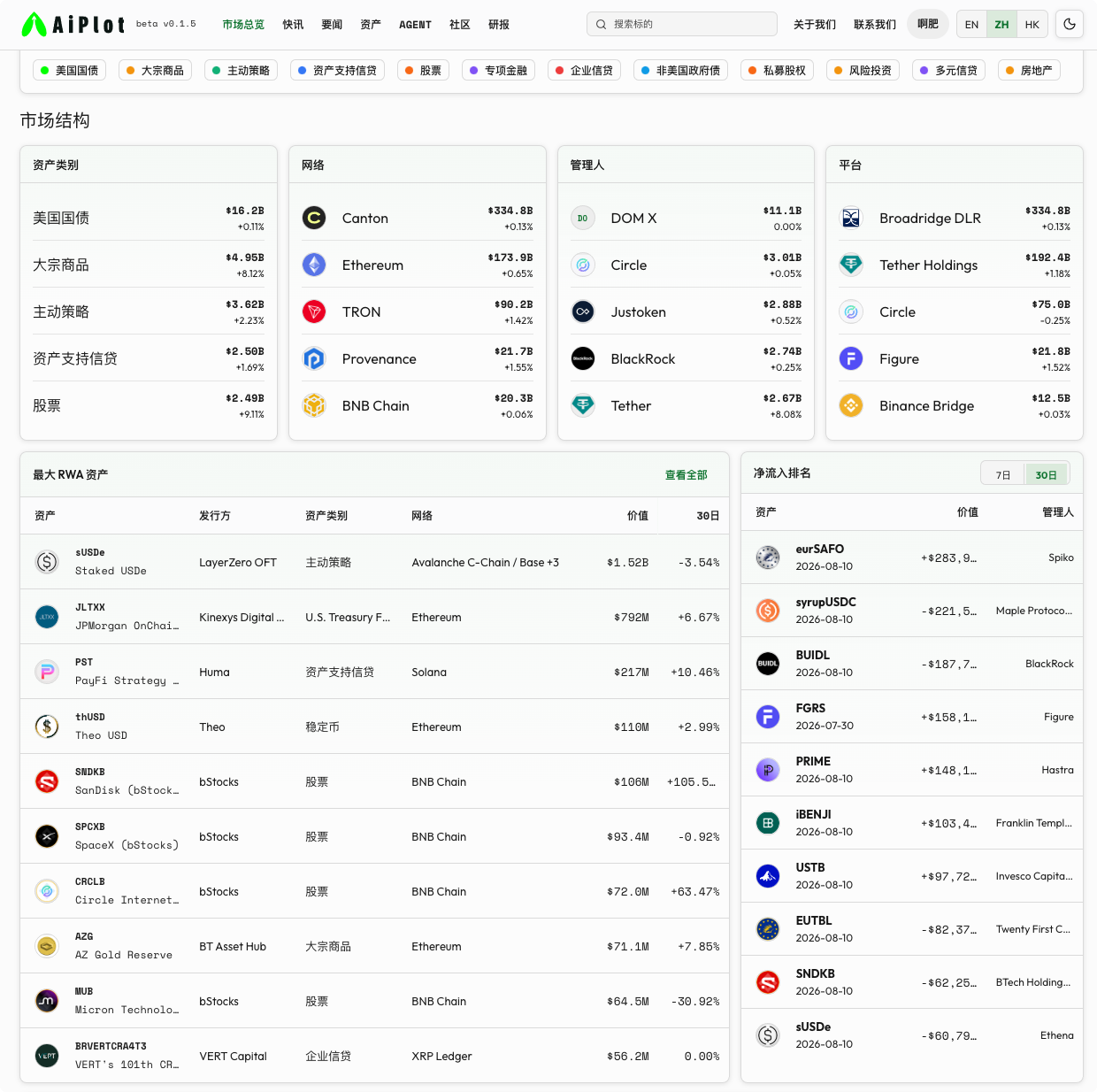
Current data from AiPlot shows that RWA is distributed across multiple networks including Ethereum, BNB Chain, Solana, Stellar, Arbitrum, Base, etc. The more chain deployments of assets there are, the higher the importance of cross-chain liquidity and unified trading entry.
This is also where the potential value of UniswapX, aggregators, and cross-chain trading infrastructure lies: they may not directly hold the underlying assets, but can fulfill asset cross-network transfer and trading needs.
Conclusion: The Next Round of RWA Opportunities May Be at the Intersection of "Assets—Liquidity—Value Capture"
In a high-interest rate environment, tokenized Treasury bonds and money market funds possess yield advantages, but capital will still be reallocated based on liquidity, redemption, and composability. Data from AiPlot has shown that U.S. Treasury bonds remain the largest category of RWA by scale, but the short-term growth of gold, active strategies, and stocks is faster.
This indicates that RWA competition is shifting from "who issues more" to "who can make assets circulate more efficiently."
The significance of Uniswap is not just that it is an established DEX, but that it may become a liquidity layer used collectively by various on-chain assets. Its entry into tokenized securities, BUIDL, Robinhood Chain, and Permissioned Pools indicates that as traditional assets enter DeFi, trading infrastructure needs to simultaneously meet liquidity and compliance requirements.
The value capture mechanism of UNI is becoming clearer but must still be validated through protocol fees, actual destruction, transaction volume quality, and RWA trading growth. Simply inferring a tenfold price increase based on "DEX leader" or "RWA narrative" does not constitute a complete investment logic.
What is truly worth tracking is whether the following three lines hold simultaneously:
- The scale of RWA assets continues to grow, and the inflow of funds comes from real subscriptions rather than cross-chain migration;
- Assets enter DEX, lending, and corporate treasury management, forming continuous usage;
- The infrastructure can transform trading and settlement activities into verifiable protocol income or token value capture.
If these three lines ultimately close, RWA will not merely be on-chain reflections of traditional assets but will become part of the new generation of financial market infrastructure.
For more data and analysis, please follow Aiplot:
https://aiplot.com/?utm_source=aicoin
📖 Community Communication:
- Telegram:
https://t.me/+IIYMcJigBAo4Mjg1
The content of this article represents the author's personal views and does not represent the position of this platform. The opinions, conclusions, and suggestions in the article are for the reference of investors only and do not constitute any investment advice related to this platform. The market has risks, and investments require caution.
免责声明:本文章仅代表作者个人观点,不代表本平台的立场和观点。本文章仅供信息分享,不构成对任何人的任何投资建议。用户与作者之间的任何争议,与本平台无关。如网页中刊载的文章或图片涉及侵权,请提供相关的权利证明和身份证明发送邮件到[email protected],本平台相关工作人员将会进行核查。