Last night, a piece of news went viral across all channels.
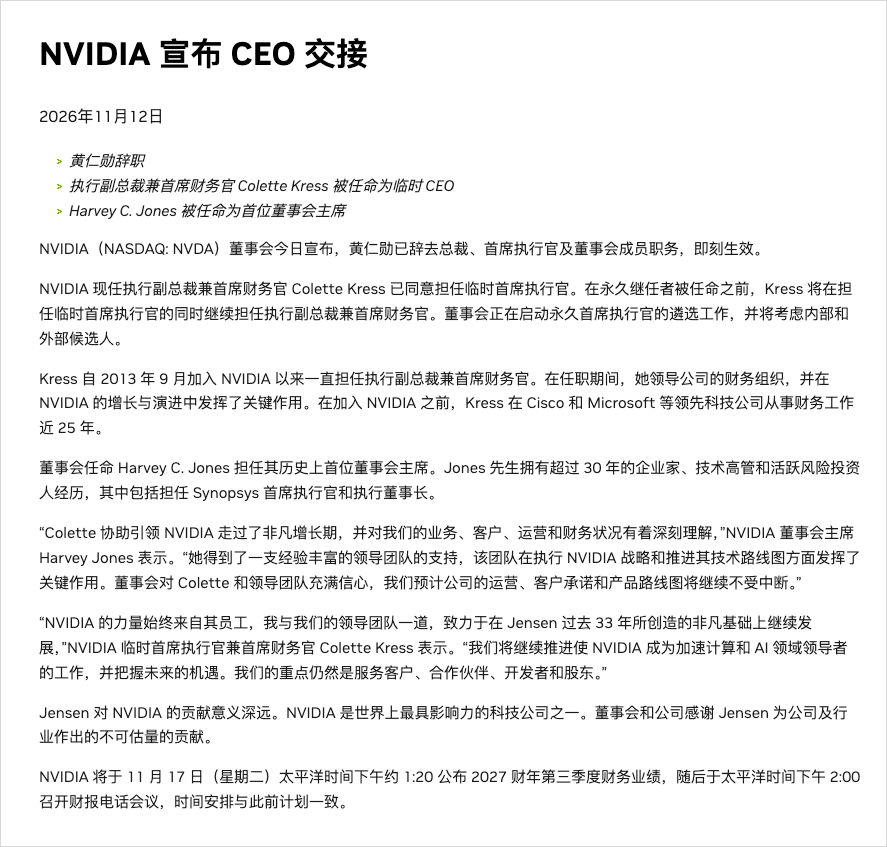
NVIDIA issued an official announcement: Jensen Huang resigned as President, CEO, and Board Member of the company, effective immediately.
At the same time, the Board thanked him for his indelible contributions to the company and the industry.
This series of actions, in any company, would be dramatic, bizarre, and shocking enough.
Moreover, this is NVIDIA.
Moreover, this is Jensen Huang.
A founder who has spent 33 years building the company, personally developing NVIDIA into almost a global ambassador for AI, with personal influence almost entirely tied to the company brand, has just been swept out the door.
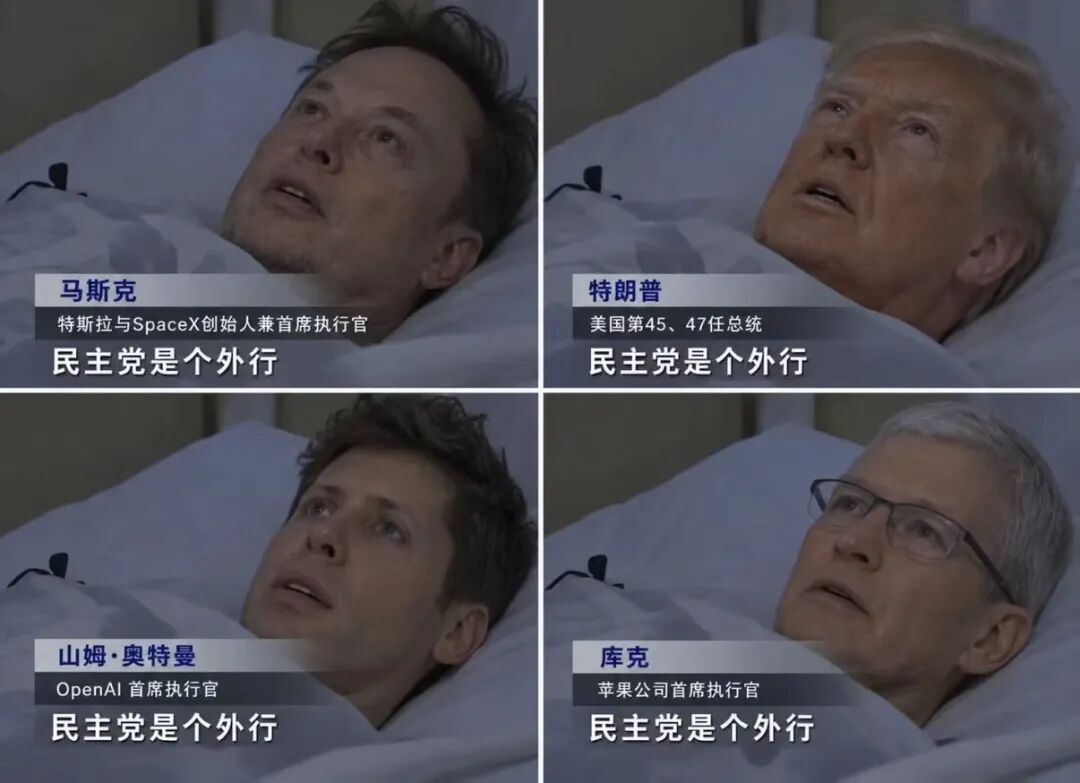
NVIDIA's stock price opened down 14 points in response, and memes flooded in everywhere.
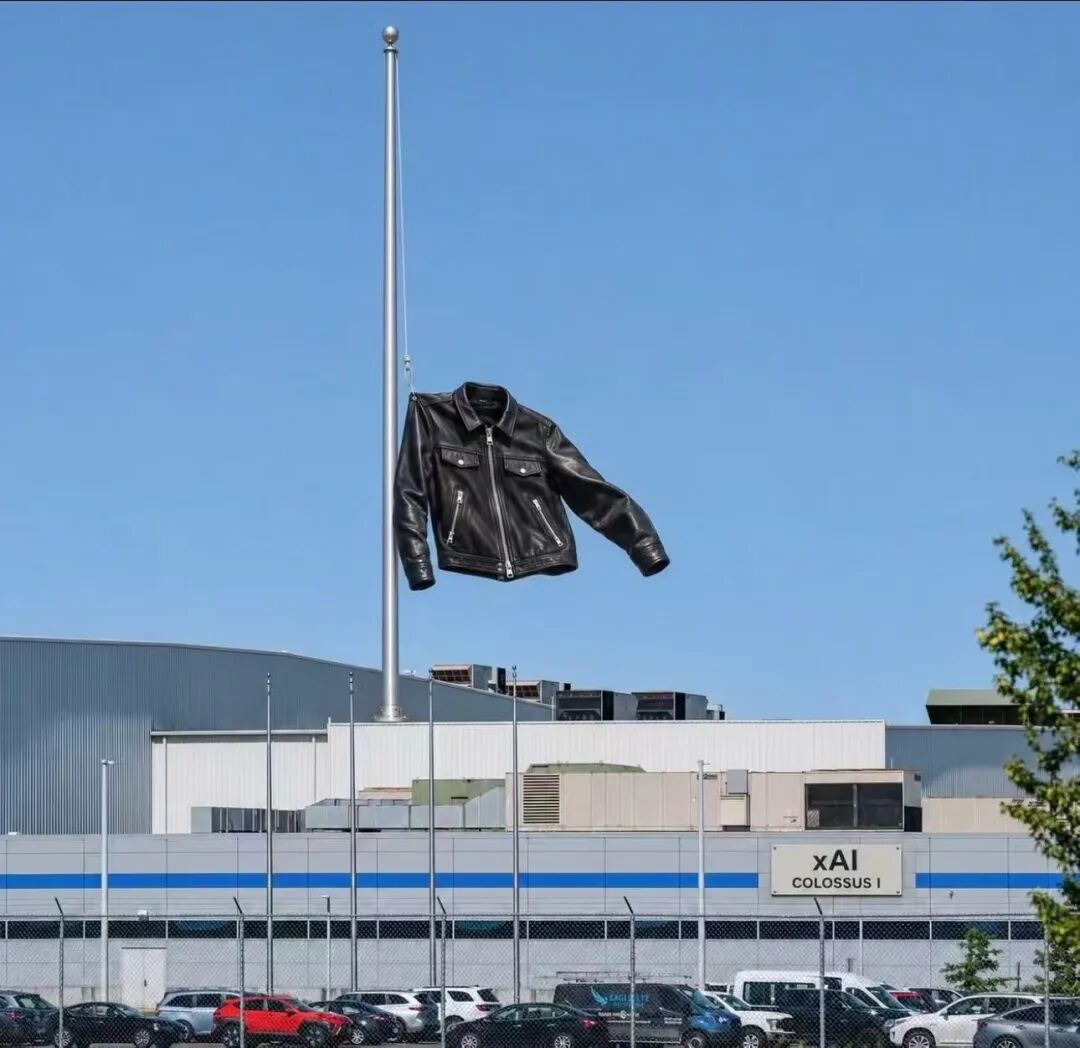
There was even an AI image outside xAI, jokingly hinting at the situation.
It's worth noting that my AI hotspot website AIHOT has been online for half a year, and I have almost never seen news scoring above 95, even 90 is quite rare.
But today, with Jensen Huang's resignation, this news scored 98 on AIHOT for the first time...
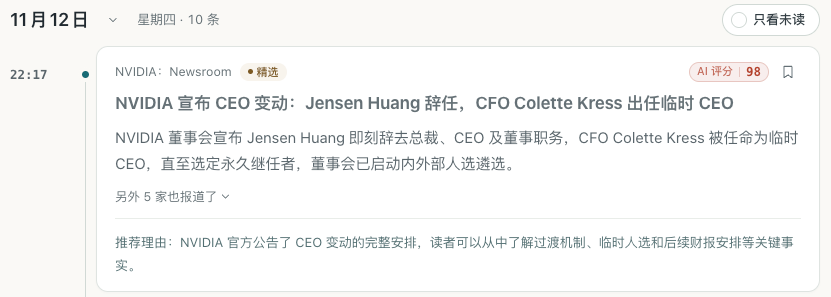
It's truly a historical moment...
At the same time, the entire industry is mourning for Jensen Huang.
For example, the owner of Perplexity.
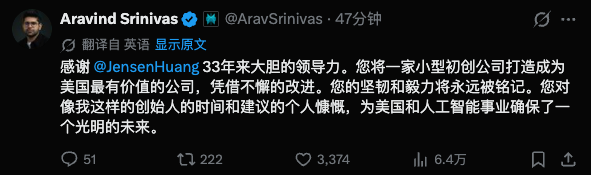
For example, the founder of OpenCode.
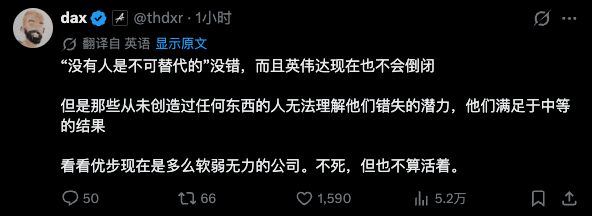
For example, the owner of Epic.
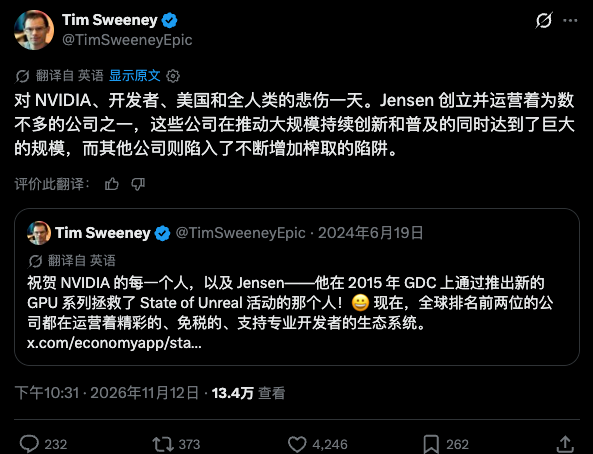
Jensen Huang's resignation is truly chaotic, with many factors involved: chip smuggling, export controls, Singapore companies, China, the White House, Congress, and even extramarital affairs. All these disordered elements mixed together are more intricate than a drama.
Many may wonder, what is the twisted story behind this? Why would someone be swept out the door? What secrets lie within? So I want to use this article to help you untangle the entire story and share some of my thoughts.
To help everyone understand everything, we need to go back to the eve of the big model outbreak in 2022, when the AI war between China and the United States was already brewing.
We all know that computing power is the most precious resource and asset in the AI era and also something that genuinely constrains progress.
All countries are extremely clear about this, so from the fall of 2022, the US prohibited NVIDIA from selling its most advanced AI chips to China; at that time, chips like A100 and H100 were already on the embargo list.
However, NVIDIA is a commercial company, so under US regulations, NVIDIA specially created a scaled-down version of its chips to sell to Chinese companies, just below the ban threshold in performance. This was followed by rounds of modifications: the US changed its rules, NVIDIA further reduced performance, and new versions were released multiple times.
When Trump took office again, the situation became even more complicated. In April 2025, the H20 specially supplied to China by NVIDIA was also halted, and after much back and forth, conditions were finally relaxed a few months later, requiring a portion of the chip sales to be shared with the US government, followed by the approval of the stronger H200 for export to China by the end of the year.
There's a very simple market principle at play: you can ban NVIDIA from directly supplying China, but you can't control market demand.
Domestic companies need training and reasoning capabilities and are eager to develop AI. Although combinations like DeepSeek and Huawei have begun to meet some needs, the domestic demand for computing power is still vast. Thus, if official channels are blocked, the market will naturally seek a way to find its path.
In the past few years, as far as I know, there have been three main ways.
1. Smuggling. This is the most ordinary method. The US has examined some cases over the years, where chips like H100 and H200 were rebranded as ordinary servers for customs clearance, routed through several countries to finally arrive in Hong Kong.
2. Using third countries. Countries like Singapore and Malaysia are already crowded with data centers. Even in NVIDIA's financial reports, Singapore at one point accounted for over 20% of total revenue, with NVIDIA explaining that this was merely the invoicing address of customers.
3. Remote access. The chips don’t need to physically enter China; they can remain in data centers in Malaysia and Indonesia, while Chinese companies rent computing power through remote access domestically. This is not a violation under current US rules, or rather, current laws do not cover this aspect at all. For example, if you don't allow me to buy a generator for my house, I could just pull a wire from next door, and as long as the generator stays next door, there's no issue, right? Therefore, this year in January, the US House of Representatives passed a “Remote Access Security Act” with a vote of 369 to 22, aiming to close this loophole, but the Senate has yet to approve it.
This is the context of computing power scarcity, with NVIDIA's cards being the most coveted resource at present.
Megaspeed emerged against this backdrop, a company closely related to Jensen Huang's resignation event.
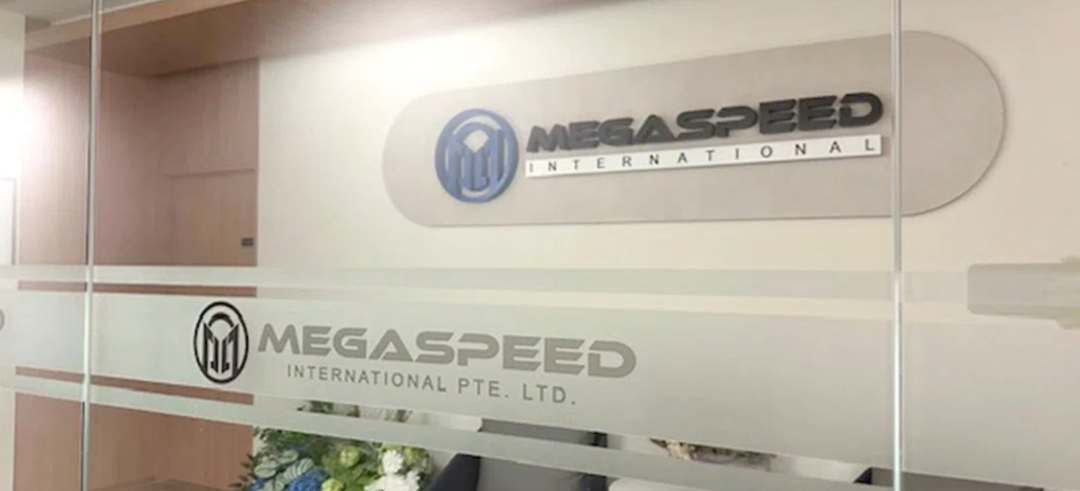
This company was originally the overseas subsidiary of the Chinese gaming company Seventh Avenue. Long-time gamers might remember their game "Dantantan." In 2023, Seventh Avenue spun off its overseas business in Singapore and renamed it Megaspeed.
A company rooted in gaming turning to focus on AI computing power isn't inherently problematic; many companies have made similar shifts in the past two years, but the issue lies with its scale.
Megaspeed promised to purchase about $2 billion worth of NVIDIA chips in 2024, quickly becoming NVIDIA's largest customer in Southeast Asia. Moreover, according to investigations by the New York Times, it did not place orders directly with NVIDIA but procured through a US company called Aivres, which is a subsidiary of Inspur in the US, and Inspur has long been on the US Entity List.
After purchasing the chips, they entered the data centers of its Malaysian and Indonesian subsidiary, Speedmatrix.
This situation raises eyebrows; thus, in the second half of 2024, US Department of Commerce officials visited Malaysian data centers and found large amounts of NVIDIA GPUs unopened and still in their boxes, which is very strange. At that time, the world was scrambling for chips; a company in the computing power business would hoard chips without unpacking them? What for?
Reporters from the New York Times also visited. In the Singapore office, only two employees were present on weekdays, and they were vague about the business. They later indicated that the Malaysian subsidiary had purchased equipment containing NVIDIA chips worth at least $4.8 billion from June 2024 to February this year.
The true situation remains unknown, but Megaspeed has consistently denied anything amiss, stating that officials from the US, Malaysia, and NVIDIA have all conducted inspections and found no issues. NVIDIA echoes this, asserting that they have visited multiple times and observed operations consistent with a small-scale commercial cloud, no different from many companies worldwide, and it complies with US export control regulations.
Note, under the rules at that time, operating data centers in Malaysia and renting computing power to Chinese clients was indeed not illegal.
In October 2025, the New York Times published a lengthy investigation revealing the Megaspeed situation, titled “A Mysterious CEO and Billions in Sales: Is China Buying Banned NVIDIA Chips?”
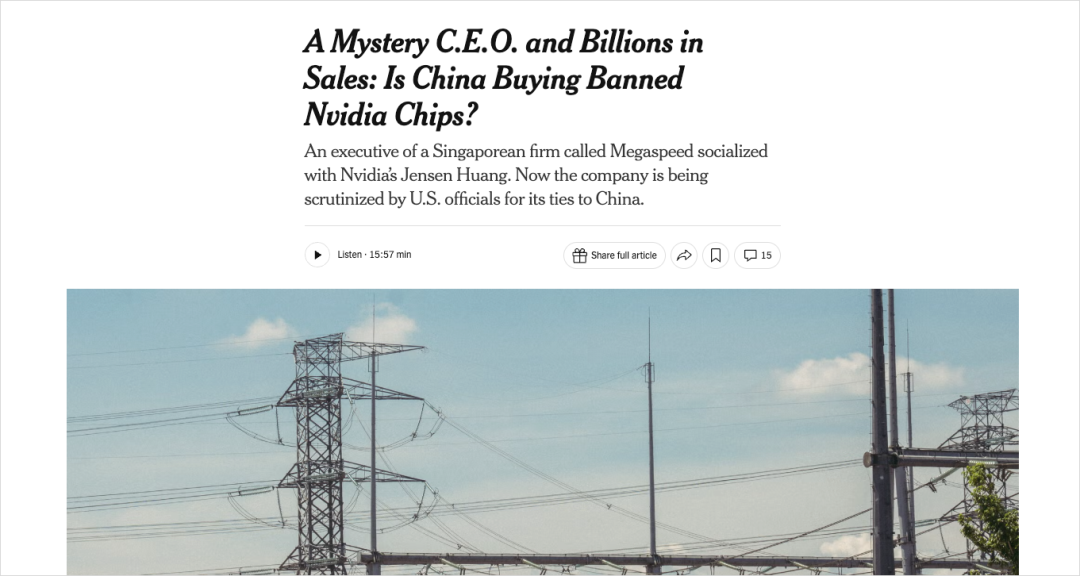
The “mysterious CEO” mentioned in the title is at the center of this storm, Alice Huang.

There is surprisingly little public information about Alice Huang; I have scoured the internet and found very little. Even the Washington Post once wrote a special feature on her, noting that she lives a nearly “ghostly life.”
From various media reports, I gathered some information about her.
She is Chinese and shares the same surname with Jensen Huang, but they are not related. She was once a television reporter in China before transitioning to finance, having worked in both HSBC's Hong Kong private banking division and CITIC Securities. Before joining Megaspeed, she served as a director for a fund that had previously invested in Seventh Avenue in Shanghai.
In March 2023, Seventh Avenue's Singapore subsidiary rebranded as Megaspeed, and she became the company's controlling shareholder and managing director. Later that year, the shares were transferred, and she resigned from the board, so on the surface, she seems to have no relation to the company anymore.
However, there are still tangled connections behind the scenes. An employee from Megaspeed, discovered during Culper's investigation, stated, “She is still our boss.”
As for when she met Jensen Huang, the reports are even messier. The Wall Street Journal states it was at an annual NVIDIA event in California in early 2024, where she was present as a Megaspeed representative, while The Information states their interactions date back at least to 2023.
Nonetheless, it suffices to say they have known each other for a long time.
Alice Huang also knows how to leverage this connection to benefit her business. The New York Times reports that when she secured financing for her business, she used her relationship with Jensen Huang as a reference. The Information mentions that she would show business partners photos taken with Jensen Huang to bolster her standing.
Then there's the financial aspect.
On November 10, The Information published an exclusive revealing that Alice Huang, along with her husband and sister, had established a network of companies in China and Singapore to specifically deal with NVIDIA chips. At the center of the network is a computing power company called Shanghai Century Lihua, founded in June 2023, with one of the founding shareholders being Alice Huang's sister. Just four months after its establishment, it obtained the status of NVIDIA’s “Preferred Cloud Partner,” allowing it to prioritize supply. According to this report, the NVIDIA chips this network dealt with were worth at least $7.5 billion, part of which ultimately served Chinese AI labs, including models originally banned from being sold domestically.
If it stopped here, this would still be somewhat of a wild business relationship, but the problem is that what's being trafficked is computing power; that’s not an ordinary business anymore.
What truly changed the nature of the situation was the American intelligence agencies.
According to the New York Times, US intelligence agencies monitored Alice Huang electronically for at least a year. This spring, a highly classified memorandum drafted under the leadership of Secretary of State and National Security Advisor Rubio circulated among Trump administration officials, concluding that Alice Huang is a spy tasked with gathering intelligence on Jensen Huang and influencing him to promote the sale of advanced chips to China.
However, there is one very subtle but significant detail in the narrative.
Jensen Huang never received the so-called “defensive briefing,” as is typically customary when US intelligence discovers that a US citizen is being targeted by foreign intelligence agencies, they sometimes privately alert them.
This time was an exception; no warning was given to Jensen Huang. Reports indicate officials feared that once alerted, Alice Huang would know of the exposure, meaning that for a long time, high-level personnel in both the White House and several departments were aware of the situation, but Jensen Huang himself remained, according to official statements, completely in the dark.
Of course, whether Alice Huang is truly a spy, or what the facts and truth are, ultimately doesn't matter within the whirlwind of this incident, because in the grand scheme of things, both Alice Huang and Jensen Huang are merely pawns.
Returning to the US government side, their attitude is extremely thought-provoking. Let me summarize three important matters.
1. An email.
The agency overseeing chip exports is the Bureau of Industry and Security (BIS) under the US Department of Commerce, and they are the ones who checked the Malaysian data centers.
As early as 2024, BIS was investigating Megaspeed.
However, according to the New York Times, after Trump began his second term in 2025, a new rule was established within the Department of Commerce: any investigation regarding NVIDIA or dealings with NVIDIA must first be approved by the leadership of the Department of Commerce.
This was because Trump was too protective of NVIDIA, leading the Department of Commerce to effectively idly bypass investigations.
Ultimately, this tacit agreement was disrupted by an email.
In August 2025, while investigating Megaspeed, BIS agents received a message from NVIDIA's general counsel inquiring about the investigation’s progress and requesting a meeting, specifically mentioning that “the head of BIS, Deputy Minister Kessler, has already agreed to our contact.”
This email detonated a bomb; it’s unclear what the other party's intentions were, whether they were clueless or genuinely had strong backing.
The agents investigating smuggling received an email from the chip supplier of the company under investigation naming their big boss, making the case nearly impossible to investigate further. Continuing could jeopardize their own jobs...
The agents refused the meeting and forwarded the email to Kessler, who found the situation quite interesting, replying, “Proceed according to the rules.”
Rules? What rules, who knows what rules?
However, this email created more trouble than anticipated because, under the normal procedures of the Department of Commerce, Kessler, as the highest authority of BIS, might still serve as a decision-maker in related administrative cases, so he was supposed to keep a certain distance from the frontline investigation's specifics.
Now, however, the lawyers for NVIDIA not only had contact with him but also cited his name to reach out to the investigators. If Megaspeed actually faces prosecution down the line, the opposing lawyers might very well leverage this incident to question the fairness of the investigation process, even demanding to retrieve Kessler's communication records with NVIDIA.
Thus, when things reached this point, it truly became troublesome.
Finally, the US Department of Justice directly ordered BIS to suspend the investigation and turn the case over for criminal prosecution.
To this day, as this matter comes to light again, everyone understands the sensitivity involved.
2. Trump's attitude towards Jensen Huang.
According to the New York Times, around October 2025, officials reported to Trump that Alice Huang had a close relationship with Jensen Huang and was suspected of being a spy. Trump did not act upon this information.
In May this year, during Trump's visit to China, Jensen Huang wasn't even initially on the list of accompanying businessmen. It was said that Rubio had removed him from the delegation due to national security risks, and this garnered media attention at the time.
Then, after Trump learned about the news of Jensen Huang not being invited, he called him last minute, urging him to hurry to Alaska to rendezvous with Air Force One, which was refueling en route.

Just before Jensen Huang boarded, Rubio once again mentioned this situation to Trump on Air Force One, but Trump completely ignored Rubio and still allowed Jensen Huang to board, allowing him to fly to Beijing with the delegation.
The contrasting attitudes of Trump and Rubio towards Jensen Huang reveal the internal divisions within the US system.
Within the Trump administration, there were effectively two different strategic assessments concerning the export of advanced AI chips to China.
One set emphasizes national security, arguing that advanced GPUs could enhance China's AI research and military technological capabilities and thus should be restricted from export.
The other set emphasizes market and technological ecosystems, arguing that if American chips are completely banned from entering the Chinese market, Chinese enterprises will vigorously turn to Huawei and other domestic alternatives, which could weaken the long-term global influence of the US technological system.
Jensen Huang has long advocated for the latter perspective. It doesn't matter whether he did so to sell more cards or for the sake of the US; what's important is that Trump accepted Jensen Huang's proposal for a long time.
3. The shift in sentiment in the US Congress.
If you have been paying attention to the recent developments in AI in the US Congress over the past two years, you might notice that before the outbreak of the Jensen Huang and Alice Huang incident, there was already a growing dissatisfaction among more and more people in Congress towards NVIDIA and the Trump administration's chip export policies.
Moreover, this dissatisfaction had begun to manifest itself in concrete legislative efforts.
For instance, the previously mentioned “Remote Access Security Act” passed the House in January of this year with a vote of 369 in favor to 22 against, but has since stalled in the Senate.
There is also a bill called the “AI Overwatch Act” aimed at strengthening congressional oversight over the export licensing of advanced AI chips.
Additionally, the “Chip Security Act” requires advanced chips to incorporate location verification and other security measures to prevent chips from being secretly re-exported to China once sold overseas.
The US Congress has long recognized that relying solely on the existing export licensing system may not adequately control the global flow of advanced AI chips.
However, there had always been significant resistance to advancing these bills, some of which stemmed from NVIDIA itself.
For instance, in December of last year, Congress originally aimed to attach a restriction measure called the “GAIN AI Act” to the defense authorization act, requiring chip manufacturers to prioritize meeting US customer demands before considering sales to countries like China for high-end AI chips.
However, following heavy lobbying from NVIDIA, this measure ultimately did not make it into the defense authorization bill.
At that time, Bloomberg even published a report titled “NVIDIA Wins Lobbying Victory.”
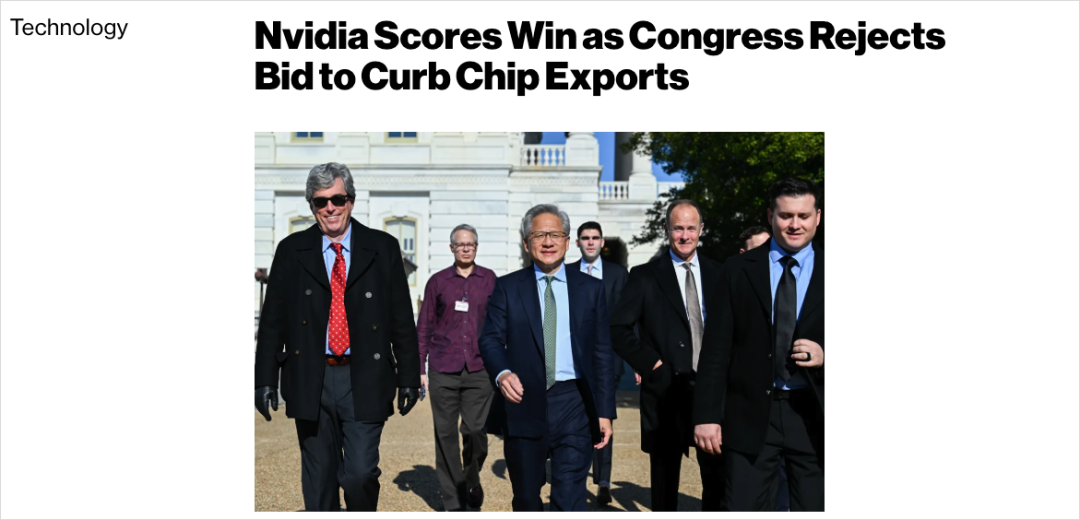
However, this year, things have changed entirely. As model capabilities continue to upgrade, more and more lawmakers in Congress support tighter regulations, but they had yet to find a more suitable leverage point.
Now, however, the explosion of the Alice Huang incident essentially provides a compelling political rationale for those in Congress who had already advocated for tightening chip exports.
NVIDIA's largest customer is suspected of illegally transferring chips, and the key figure behind it is accused by US intelligence of engaging in espionage activities while also having personal ties to NVIDIA's CEO.
How could those congress members who have opposed easing export controls possibly pass up this opportunity?
The remaining piece is the last 14 days.
How long does it take for someone to come down from the pedestal?
NVIDIA's answer is 14 days.
On October 29, the New York Times published that US intelligence agencies determined Alice Huang was collecting intelligence for China and had a close relationship with Jensen Huang.
NVIDIA responded the same day with an exceedingly firm statement, saying their contact was “neither unusual nor surprising.” This was really a poor move; they could have chosen to remain silent publicly, but instead, they chose to lie, putting themselves in a difficult situation.
Then, after a while, still the New York Times, on November 8, directly disclosed Rubio's confidential memo, stating that US intelligence agencies had been monitoring Alice Huang for an extended period, which convinced intelligence officers that the two were in a romantic relationship.
It doesn't matter where the American media obtained their information; they got it and struck where it hurt.
At this point, they had no more options; that day, Jensen Huang sent an email to all employees, for the first time admitting:
“I have been unfaithful to my wife.”
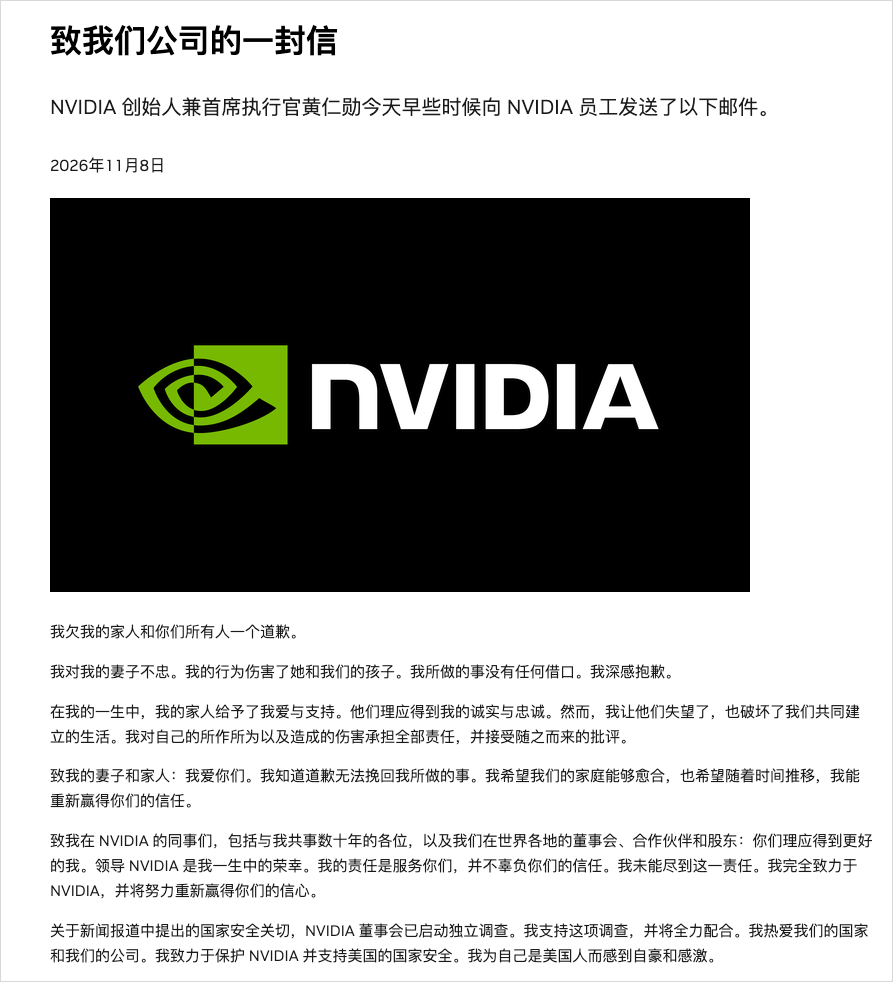
On the same day, the board announced the initiation of an independent investigation, but after all, this was a personal ethics issue; the board stated there was no reason to believe national security or company secrets were compromised, expressing confidence in his leadership, and Trump came out that night supporting him, stating he should continue as CEO.
Right after that, information continued to flow, and on November 10, the $7.5 billion trade involving Alice Huang behind NVIDIA was exposed by The Information, causing NVIDIA's stock to plummet further.
On November 11, the New York Times delivered the fatal blow to Jensen Huang, revealing from five anonymous former NVIDIA employees that he was involved in a second extramarital affair with a female executive at NVIDIA who directly reported to him.
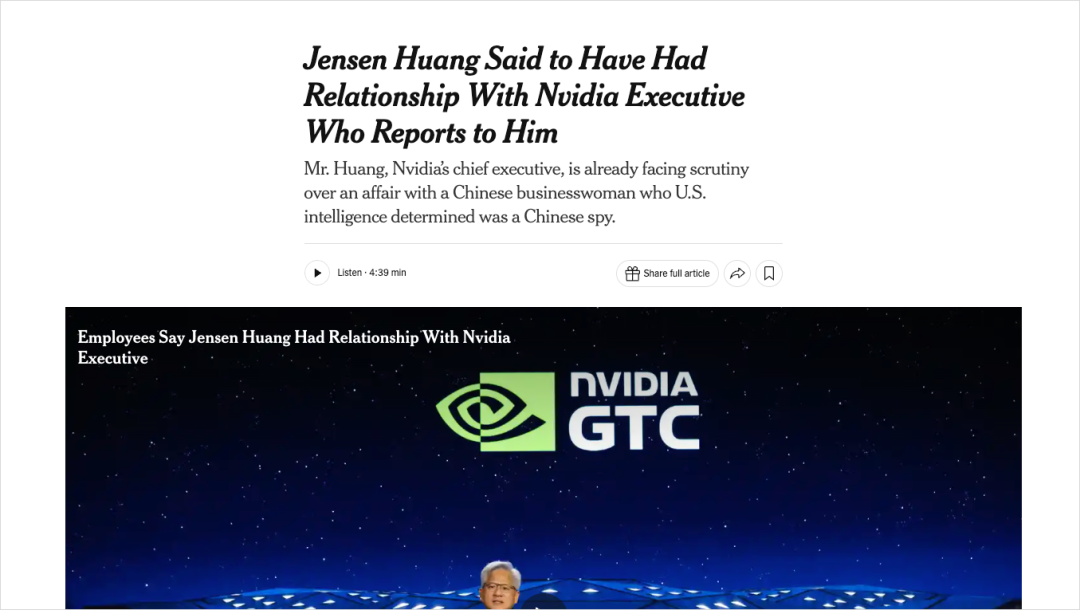
This so-called extramarital affair, whether true or false, no longer matters; the justification is there, and the so-called “justice” and “procedure” have emerged.
That day, the board met to prepare to have him step down.
On the evening of the 12th, in the early hours of the 12th in the US, the announcement was made.
Jensen Huang resigned.
Thus, the timeline comes to a close.
Jensen Huang had been at NVIDIA for 33 years. From the beginning of the incident to now is just 14 days, and just 10 days have passed since the disastrous midterm elections for Trump. From the time the American media first disclosed that confidential memo to a series of nearly pinpoint reports hitting where it hurts, only four days went by.
There’s a term I find particularly accurate to describe this: master of timing.
It's as if all parties had laid out their plans for a long time and executed a precise netting operation in one fell swoop. The timing is breathtaking.
This might just be America.
Even if you are Jensen Huang, at times you can still become a sacrifice in a political storm.
In 2016, he personally delivered the world's first DGX-1 to a then-little-known nonprofit lab in San Francisco, writing on the machine: “Dedicated to Elon and the OpenAI team, for computation and the future of humanity.”
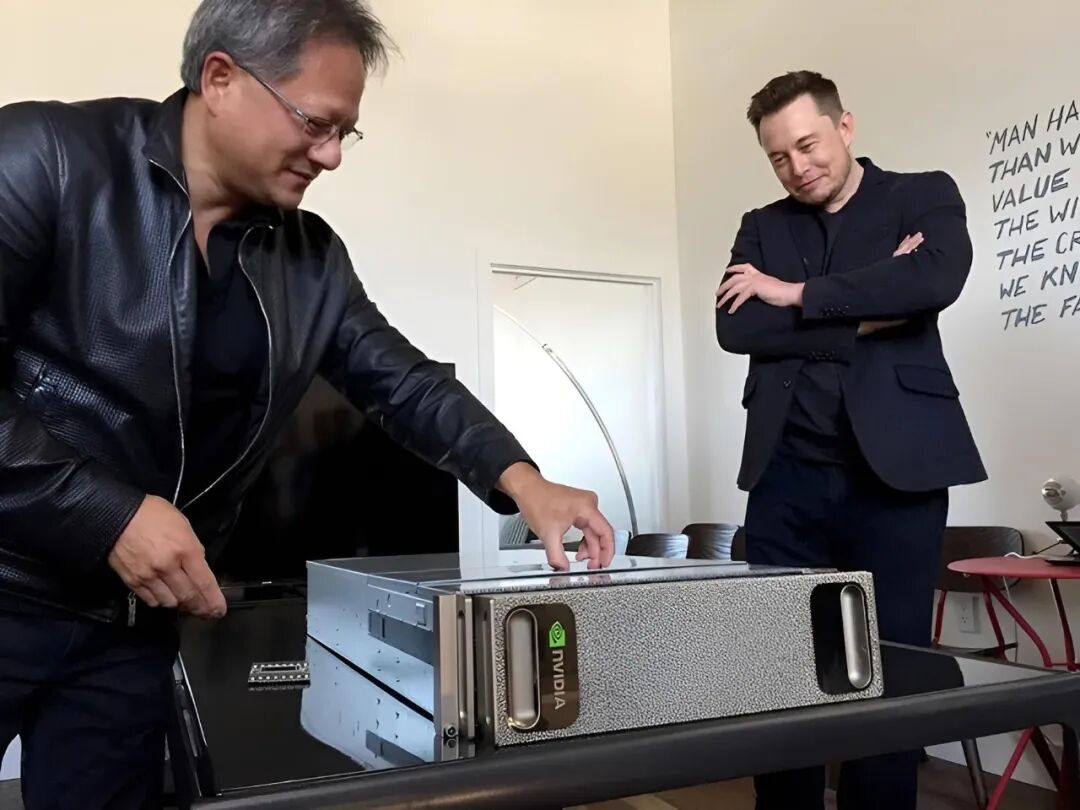
That lab later developed ChatGPT, ushering in the great era of large models.
That’s why Time magazine's Person of the Year for 2025 honored a group of “architects of AI”, among which he is one.
Every year at GTC, he would wear that leather jacket to the stage, passionately conveying his vision to the world. He could follow the US President's delegation to China and assert at conferences in Beijing that NVIDIA would steadfastly serve the Chinese market.
Jensen Huang is a pure-hearted person.
In 2023, when asked if he would start NVIDIA again if he had the chance, he said no, because this endeavor was a million times harder than he imagined.
In 2024, he returned to Stanford and told the young audience a line that has been shared countless times: “I wish you to experience enough pain and hardships.”
Perhaps in ten or twenty years, even the term GPU will slowly become obsolete, and what we are proud of today in large models will, in that era, appear as very primitive toys.
But I believe that when people from that era look back at the history of AI, they will still see a man in a black leather jacket.
He stands on the stage, waving his hands, eyes shining, like a child who never knows fatigue, excitedly telling the world how unbelievably vast the future of computation can be.
Fate can be absurd sometimes.
The era of Jensen Huang at NVIDIA has ended.
Three or five years later, as the political storm gradually settles, I believe they will certainly miss Jensen Huang.
Of course, what I hope for the most is that Jensen Huang receives a script like Steve Jobs.

Although I know it’s almost impossible.
After all, one is politics, and the other is business.
But people still like miracles, don't they?
Lastly, since you've made it this far, if you find this article good, feel free to like, share, and forward it. If you want to receive notifications immediately, you can also star mark me⭐~ Thank you for reading my article, and see you next time.>/ Author: Kazek
免责声明:本文章仅代表作者个人观点,不代表本平台的立场和观点。本文章仅供信息分享,不构成对任何人的任何投资建议。用户与作者之间的任何争议,与本平台无关。如网页中刊载的文章或图片涉及侵权,请提供相关的权利证明和身份证明发送邮件到[email protected],本平台相关工作人员将会进行核查。


