Original |Odaily Planet Daily(@OdailyChina)
Author|Golem(@web3_golem)
The date and specific mechanism for ZETA's migration to Solana have finally been set. On November 7, the ZetaChain community passed the second governance proposal for the migration to Solana with 100% approval.
The proposal indicates that ZetaChain L1 will officially cease operations at block height 20,755,000 (expected around December 9, 2026), and staking rewards will stop at the same snapshot height. ZetaScan will remain available and provide a read-only RPC archive node, running until October 31, 2027.
On the same day, users can claim ZETA on Solana at a 1:1 ratio at ZetaHub, with no deadline and no fees (including SOL). A successful migration requires only a single signature, while the ZETA balance in exchanges will be converted by the exchanges without any action needed from users.
Meanwhile, on December 9, ZetaChain’s private AI product focused on the crypto field, ZetaLabs, will also go live.
ZetaLabs extends ZetaChain's interoperability concept into the AI field, integrating AI large models, contextual memory, agent payment, and real-time market data sources onto a single platform while keeping user data encrypted. According to an official disclosure, there are already over 120,000 users on the waiting list, indicating the community's anticipation for the product.
Previously, Odaily Planet Daily analyzed why shutting down L1 would be beneficial for ZetaChain (Related reading: “Why is shutting down L1 beneficial for ZetaChain?”), and with improvements in ZETA token economics combined with the launch of the new product ZetaLabs, the reborn ZetaChain cannot be ignored by the market.
ZETA achieves Deflation, Value Capture Logic Upgrades from “Gas” to “Token”
Destroying 55 million ZETA, official commitment not to sell newly unlocked tokens in 2027
According to the second governance proposal for ZETA’s migration to Solana, the total supply of ZETA tokens will decrease after the migration is completed, with approximately 55 million ZETA to be destroyed from a base of 2.1 billion.
The token destruction comes from the validator incentive distribution (accounting for 10% of total supply, i.e., 210 million ZETA). As ZetaChain L1 is about to completely shut down, there will no longer be incentives for network validators. By the time ZetaChain L1 officially shuts down, the issued amount of validator tokens is expected to be around 155 million; thus, the remaining 55 million unissued ZETA will be destroyed.
After the migration, these 55 million ZETA will be stored in a destruction reserve controlled by the ZetaChain Foundation and will be destroyed monthly starting in 2027, with one twelfth of the total (around 4.6 million ZETA) destroyed each month on fixed dates. By the end of 2027, the total supply of ZETA will become 2.045 billion (initial supply minus destroyed amount), meaning ZETA will become a deflationary token from 2027 onwards.
Meanwhile, according to ZetaChain’s token unlocking plan during the 2024 TGE, all core contributors and investors' ZETA allocations (totaling 44.91 million) will be fully unlocked by January 1, 2027.
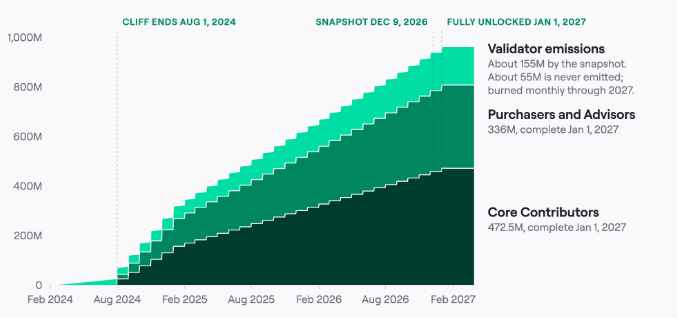
ZETA token unlocking timeline
Furthermore,ZetaChain officially commits not to sell newly unlocked ZETA in 2027 (from the user growth pool, ecosystem growth fund, protocol treasury, and liquidity incentive unlock allocations), further reducing the circulation of ZETA in the market.
Upgrading from Gas Value to Token Value
After the migration is completed, the token utility of ZETA will also undergo significant changes.
Previously, ZETA existed as the gas fee for the ZetaChain L1 network, capturing the value of active users and ecosystem development of ZetaChain L1, relying solely on staking incentives to reduce market selling pressure. The vulnerability of this token value capture logic lies in the fact that once network activity decreases or the ecosystem is sluggish, users' willingness to hold ZETA decreases, leading to a drop in token price, further reducing investors' willingness to stake, resulting in a "death spiral."
After the migration, this situation will change, and the value capture logic of ZETA will upgrade from "blockchain gas" to having practical utility as an "AI product token."
From the first quarter of 2027, users can use ZetaLabs Premium without any fees by locking ZETA; ZETA still belongs to the users. Aside from supporting USDC stablecoins and bank card purchases for AI credits, users can also choose to pay with ZETA tokens. Additionally, ZETA will continue to serve as the governance token for ZetaLabs, enabling users to vote with ZETA to determine which markets, data sources, and AI models ZetaLabs will support in the future.
In summary, the future value of ZETA will encompass three aspects: AI membership subscriptions, token purchases, and project governance. To access more advanced AI features, users will naturally develop real locking and purchasing demands for ZETA, thereby reducing the circulation of ZETA in the market and increasing some actual buying demand.
Of course, the foundation of this new value cycle for ZETA is users' willingness to lock or spend ZETA to use ZetaLabs.
ZetaLabs: A Private AI Assistant Tailored for Crypto Users
Currently, there is a wave in the crypto field using AI agents, but there remains a significant gap between ordinary AI products and the actual needs of crypto users.
For example, AI cannot timely gather real-time market data, struggles to understand users' past on-chain operations, and cannot directly connect to various services in the crypto ecosystem. Users often need to switch repeatedly between market platforms, blockchain explorers, AI chatbots and various trading tools.
The emergence of ZetaLabs aims to change this situation.
ZetaLabs is a private AI application launched by ZetaChain on Solana, specifically designed for crypto users. In addition to integrating multiple AI large models and real-time market data, its biggest feature is connecting users' privacy memories, on-chain behaviors, and market information, allowing AI to not only answer questions but also truly understand the needs of crypto users.
ZetaLabs provides better encryption adaptability and aligns with the usage habits of crypto users. Currently, over 120,000 users have joined the waiting list for ZetaLabs, and once it officially launches, ZetaLabs is sure to deliver impressive results.
Having Context Like Having a Wallet
Privacy is the cornerstone of ZetaLabs.
Currently, most AI products on the market send users' contextual memories to their large model providers, meaning users do not actually own their own "memories." This is especially risky for crypto users, as their wallet addresses, asset statuses, and investment strategies are at risk of being leaked.
With the cryptographic memory technology from ZetaChain, ZetaLabs encrypts users' chat records, research, and contextual memories, and even ZetaChain officials cannot access this information. When interacting with AI large models, the models will receive only the minimal required information to answer questions and cannot access all of a user's historical records.
ZetaLabs also inherits ZetaChain’s interoperability philosophy, turning users' contextual memories into an asset that can be taken anywhere. No AI platform should have the right to revoke, censor, or seize users' contextual memories. ZetaLabs allows users to transfer the same encrypted memories between AI such as ChatGPT, Claude, Grok, without leaking any private information.
The memories in ZetaLabs are not limited to users' chats with AI; ZetaLabs also features Bloom functionality, allowing users' on-chain operation records to solidify into private memories that are encrypted by the users themselves. This means that users' on-chain activities are no longer just scattered transaction records in different blockchain explorers but can become essential context for AI understanding of users.
For crypto users, whether it was past participation in various projects or on-chain operations, or long-term trading habits, they can all be stored through Bloom. AI can thus understand the questions by integrating users' historical activities, rather than starting from scratch with each conversation.
Crypto Radar Provides Real-Time Personalized Information
Another major pain point for crypto users using ordinary AI is that the data is often lagging and inaccurate, severely affecting investment decisions. On ZetaLabs, users can ask AI about cryptocurrencies, perpetual contracts, prediction markets, stocks, and commodities using plain language, and the AI will respond with answers combining real-time market data.
ZetaLabs also comes with a crypto radar that provides real-time personalized market information based on users' contextual memories, helping users filter out relevant content from the vast sea of market information.
This function is not merely about aggregating market news onto one page, but rather attempts to have AI provide more targeted market information based on users' focus and historical context. While a general AI agent could accomplish this task, it still requires extensive time, tokens, and data for training, presenting significant difficulty for the average crypto user.
Additionally, ZetaLabs supports the x402 protocol, facilitating integration with other AI agents, automatically purchasing on-chain micropayment services as needed, and invoking data, APIs, and capabilities provided by other agents or service providers.
Benefits of ZetaChain Will Materialize After 30 Days
On December 9, ZetaLabs will officially launch with the aforementioned premiere features. In Q1 2027, according to the official roadmap, ZetaLabs will undergo more upgrades, such as the Premium version releasing in-depth research reports targeted at specific markets, sending any on-chain transaction record to AI to receive concise analysis, incorporating tokenized stocks and market sentiment analysis, linking personal contextual memories to more applications, exploring AI quantitative strategies…
After 30 days, the new tokenomics and fresh product narrative of ZETA will enter the implementation phase. From previously connecting chains to now connecting AI, the story of ZetaChain continues.
免责声明:本文章仅代表作者个人观点,不代表本平台的立场和观点。本文章仅供信息分享,不构成对任何人的任何投资建议。用户与作者之间的任何争议,与本平台无关。如网页中刊载的文章或图片涉及侵权,请提供相关的权利证明和身份证明发送邮件到[email protected],本平台相关工作人员将会进行核查。


