
Authors: Olivia Moore, Justine Moore, a16z Partners
Translated by: Big Pliers, PANews
Editor's note: This article is translated from a deep report titled "Welcome to the B2A Economy" written by prominent venture capital firm a16z partners Olivia Moore and Justine Moore. For decades, major websites and e-commerce platforms have struggled with how to keep bot programs out by using verification codes. But now the tide has completely changed; the primary users on the internet are no longer humans, but AI agents. When AI is no longer just chatting with you but starts directly selecting products, purchasing memberships, and handling payments on your behalf, the underlying logic of doing business has been completely overturned. In this major reshuffle from doing “business with people (B2C)” to doing “business with AI (B2A),” how should companies seize the new wave of growth dividends? Which sectors will see the emergence of new giants? Here is the full translation:
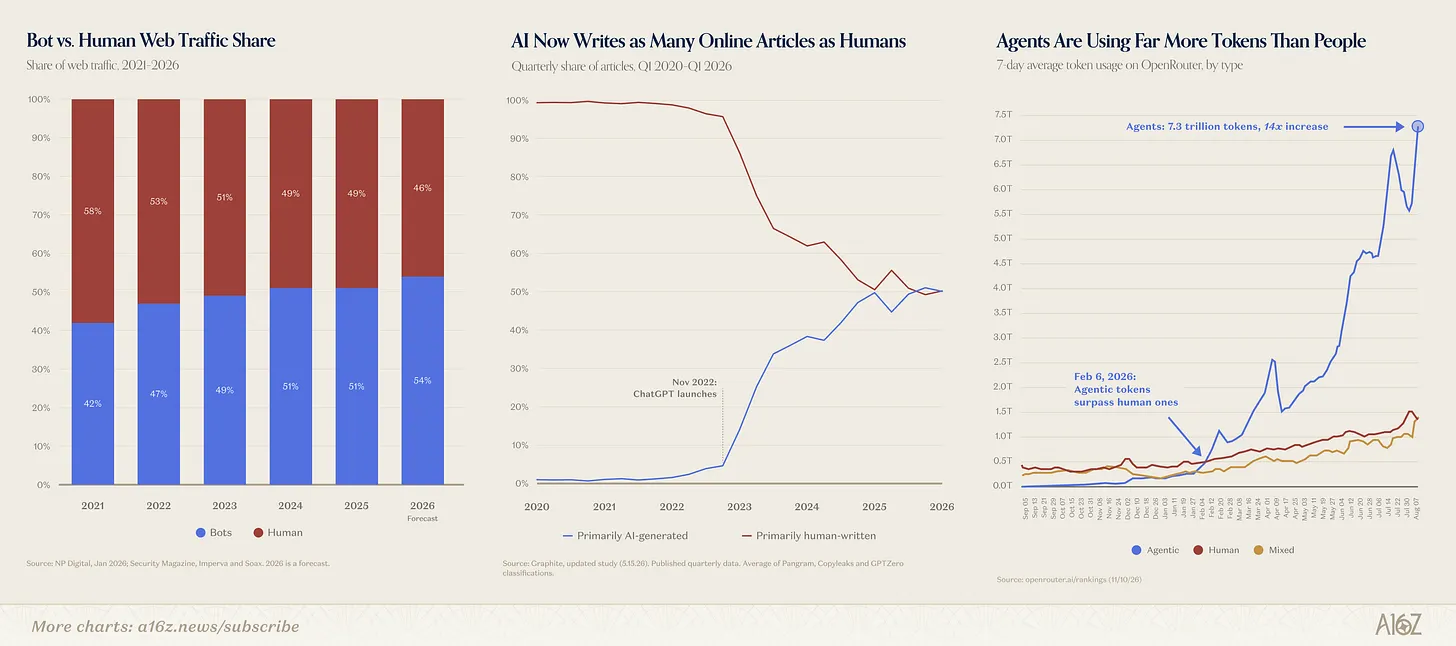
In today's internet, the primary users are no longer humans, but AI agents.
Currently, the vast majority of online traffic is generated by AI agents; over half of the newly published articles online are written by them, and even most of the code that programmers ultimately deploy and run is generated by them.
This is a typical characteristic of the early stages of a technological transformation (platform shift): it's evident that more and more people are using it, but how to monetize it and what new business models will emerge remain unclear to most.
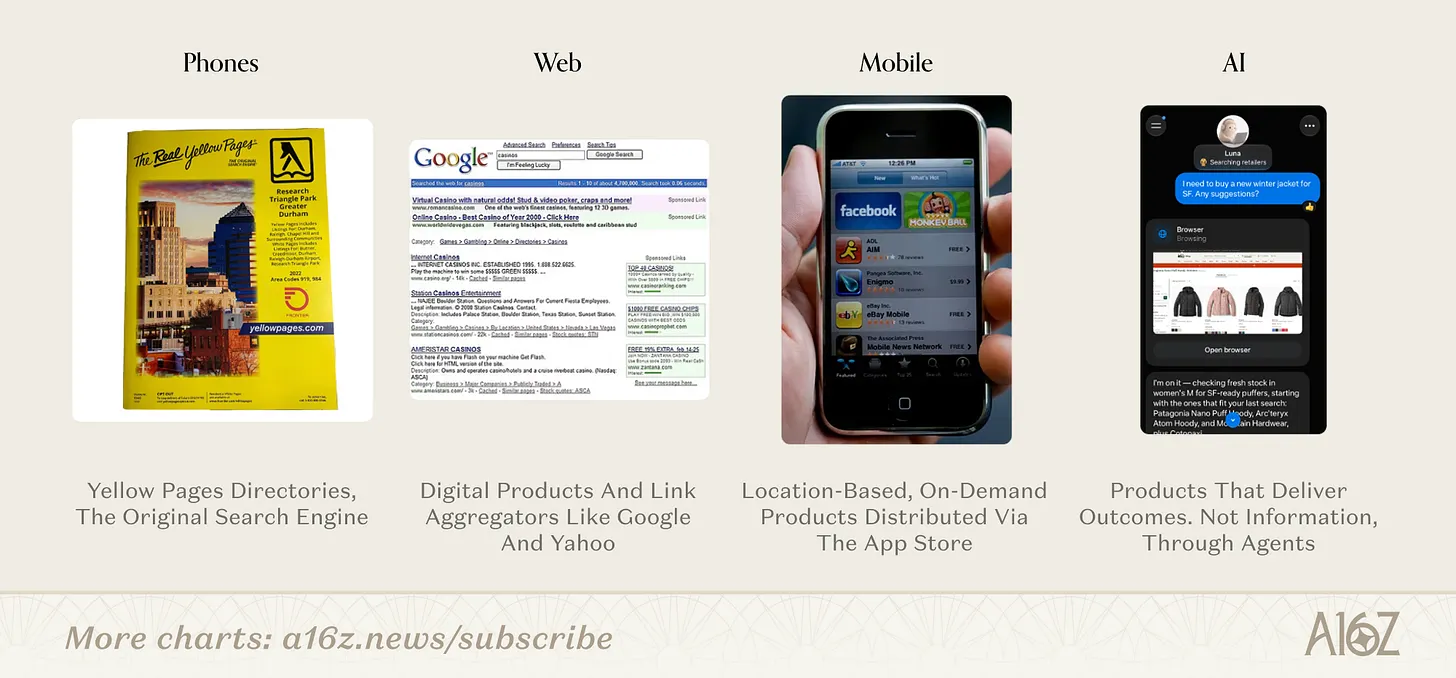
Looking back, every major technological shift changes two things simultaneously: one is "what people can do," and the other is "how businesses find customers":
- In the era of the computer internet, it was as if businesses had opened a storefront online that anyone could visit;
- In the era of mobile internet, it was like stuffing that storefront into everyone's pocket;
- Now in the AI era, AI has changed what people can do, but the transformation of "how businesses find customers (distribution channels)" is just getting started.
As AI agents evolve from simply "answering your questions" to "directly helping you get things done," they will increasingly make decisions for us: which products to use, which services to book, and where to spend our money.
Those enterprises that treat AI agents as "VIP clients" are likely to experience explosive growth; whereas those that have not yet recognized this phenomenon may find it difficult to survive. In the past few years, major e-commerce and platforms have scrambled to build walls to keep bot programs out, but now, they find themselves competing to capture the business of robots.
If AI agents can truly reach the general public and become indispensable tools in everyday life, they will unleash the largest undelivered dividend in the AI field: a genuine platform reshuffle. Every previous platform shift (from computer web pages to mobile apps) has tied together "new product features" and "new customer acquisition channels." However, the current AI is exceptionally strong in product features but has fallen short in customer acquisition channels, which is why, apart from ChatGPT, other AI products aimed at ordinary people have not truly taken off.
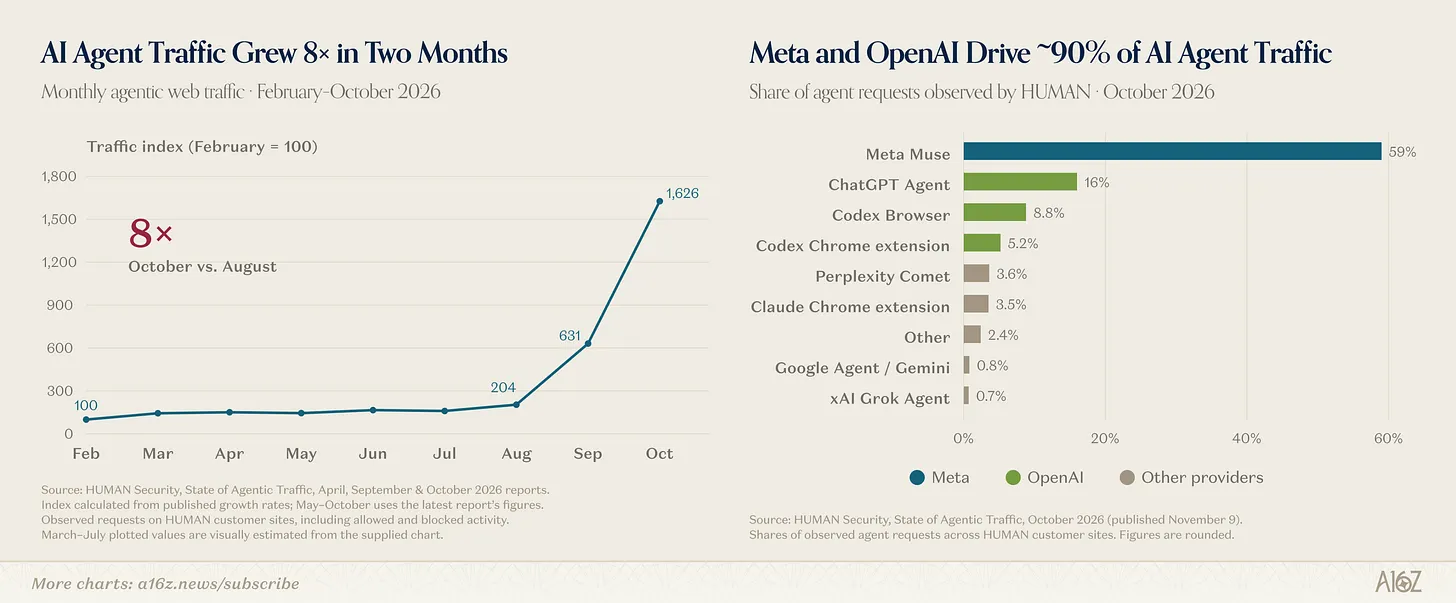
However, the signs of a drastic change in customer acquisition channels have already appeared. For many businesses, large language models like ChatGPT, Claude, and Grok have become massive and highly valuable traffic gateways. E-commerce platform Shopify's data shows that in the first quarter of 2026, traffic driven to their platform stores by AI surged eightfold year-on-year, with orders directly facilitated by AI searches skyrocketing nearly thirteenfold. Moreover, this momentum continues to gather speed: cybersecurity firm Human Security discovered that between August and October alone, traffic from AI agent browsers grew eightfold, with Muse contributing the majority (60%), while products under OpenAI together accounted for 30%.
This is akin to how creating a website is much more effective at precisely capturing customers than simply setting up a roadside billboard; theoretically, AI agents should serve as an even more powerful sales channel—because they have access to the deepest and most specific personal data and needs of users. So far, evidence has confirmed that this is indeed the case: compared to ordinary traffic, consumers referred by AI browse more seriously, have a higher conversion rate for making purchases, and are less likely to leave a webpage immediately (bounce rate). It has even been estimated that before the widespread use of AI agents, 11% of American consumers would consult AI for advice before making purchases on shopping websites.
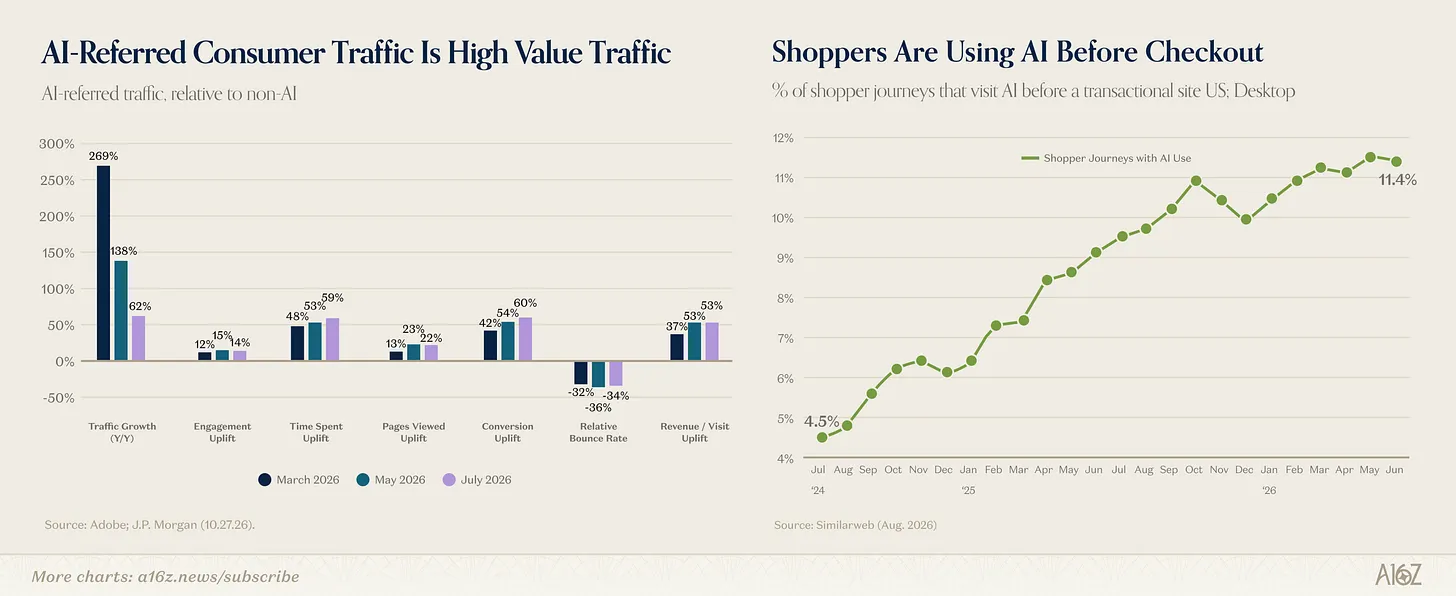
Currently, most of this AI traffic is still achieved through "simulating human browsing." This means that AI agents either take over users' browsers directly or run a virtual computer and browser in the background, clicking around on the screen like a real person to complete tasks. However, we are starting to see the emergence of a prototype for a “dedicated app store for AI agents,” powered by various connectors, plugins, and MCP protocols, which allows AI agents to directly invoke third-party tools and websites without the need to clumsily simulate clicks.
For example: we tried letting ChatGPT use plugins like Krea, Descript, and Eleven Labs to help us create and edit a video advertisement. As a result, it coordinated among these software and even successfully upsold us to upgrade Descript to a paid subscription to complete the video.
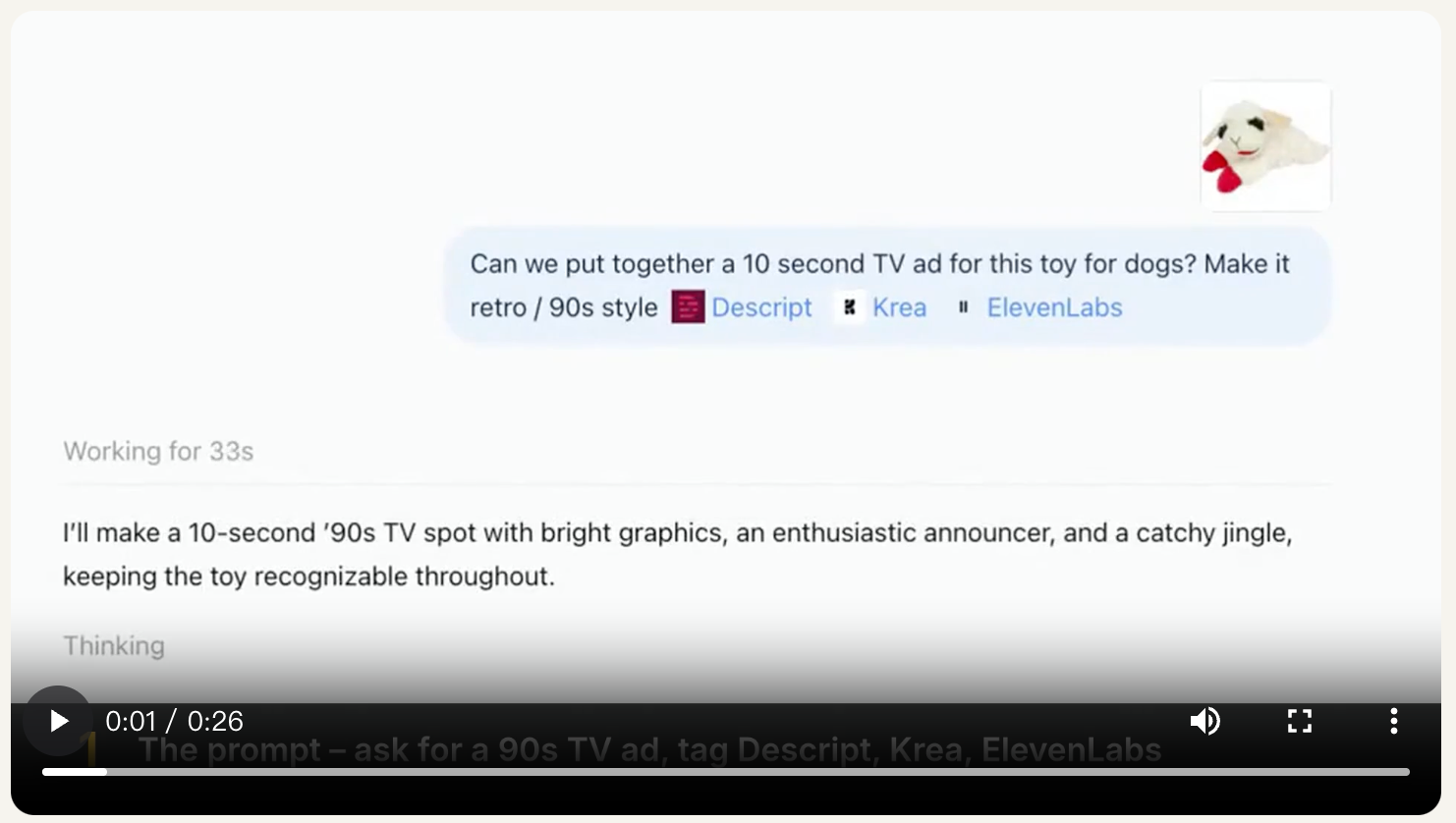
As underlying platforms begin to allow users to "lend" their account identities or tokens to other software to do work (such as “one-click login with ChatGPT account”), it will only become smoother for AI agents to assist us in registering accounts or making purchases. Eventually, human intervention won’t be necessary; AI agents themselves will be able to select and install the tools they need to perform tasks. Currently, Claude has already allowed administrators of companies to simultaneously enable various plugins company-wide. Just yesterday, OpenAI launched an enterprise version in ChatGPT, allowing companies to claim their enterprise homepage, upload product catalogs, and check on how users interact with their brand on ChatGPT in the backend.
In this new economic wave of B2A (business to agents), several types of companies are likely to profit immensely:
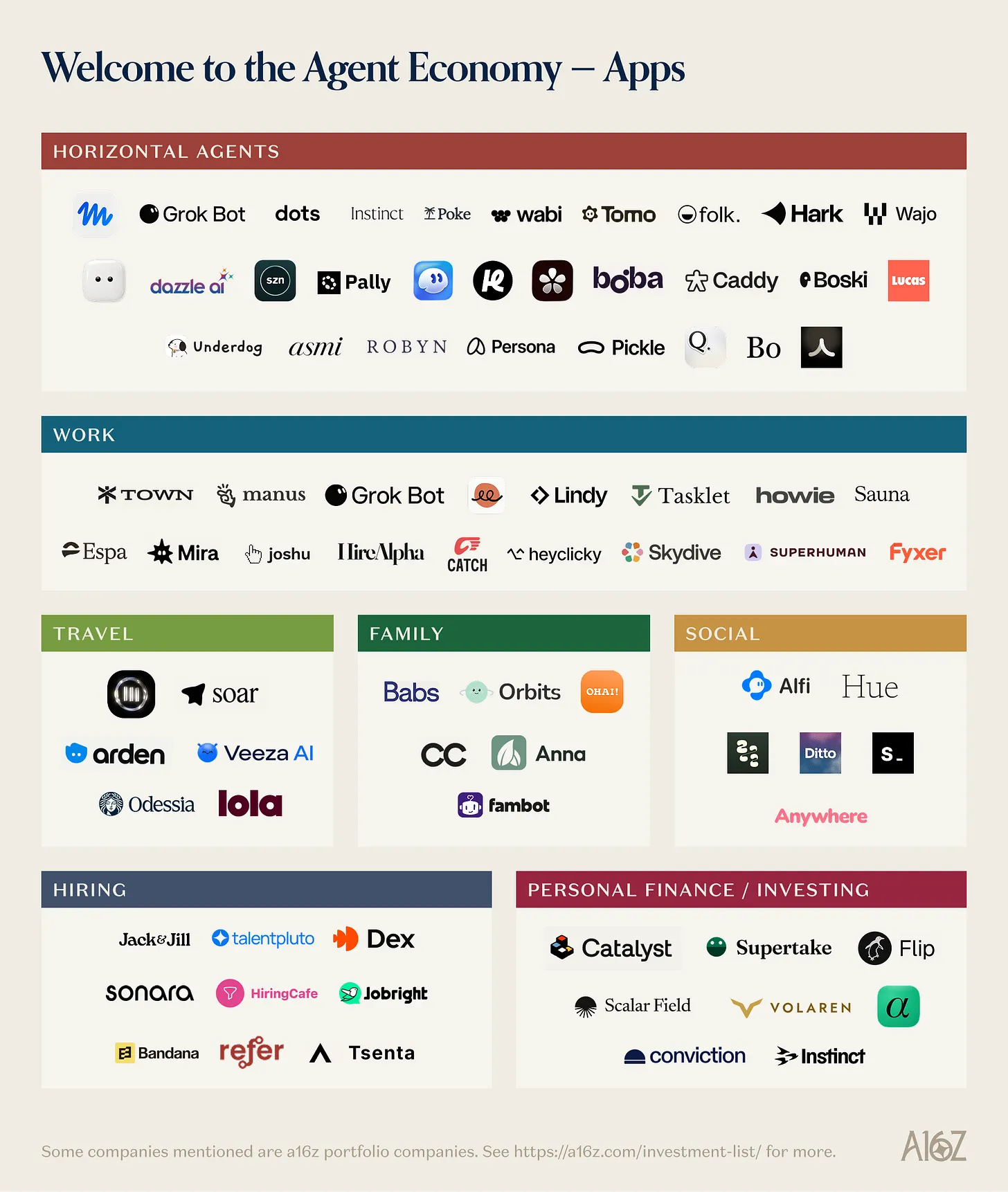
- Companies that provide AI agents and underlying models: When it comes to "AI agents for ordinary people," most people think of independent software shells like Instinct, Muse, and Wabi. However, we believe that as the operational capability of the underlying AI models strengthens, it won't be long before all products operate in the manner of "agents." In this regard, ChatGPT, with its 1.2 billion weekly active users, is facing an extremely enticing opportunity.
- New products born from AI agents: Just as Amazon couldn't exist without the internet, and without smartphones, Didi and Uber wouldn't exist either. We expect that AI agents will also give birth to new native species of this era. The specifics of what these will look like are still difficult to predict, but several trends are already apparent: for instance, fully automated micro-enterprises, transaction platforms or social networks facilitated by AI in the middle, and optimization tools that handle everything for people.
- Established companies that know how to please AI agents: Large language models have now become significant traffic sources for many websites, leading to the emergence of a new industry called "generative engine optimization (GEO)," which can be understood as AI-focused SEO. But GEO essentially only manages the step of "making AI discover you"; whereas future AI agents will go further by directly streamlining the "comparison shopping" and "settling payments" during purchases or service registrations, which represents a much larger market.
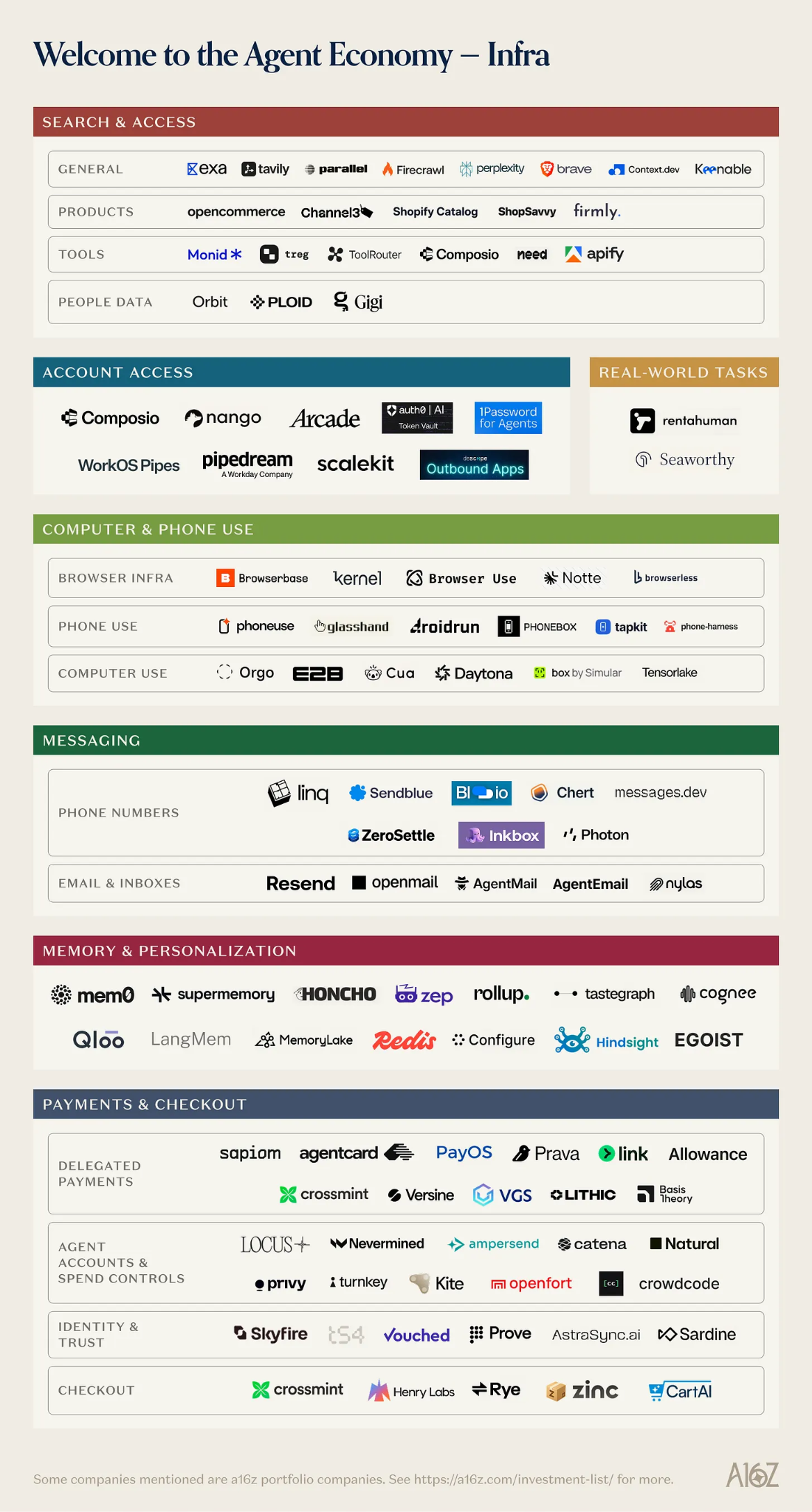
- Companies providing supporting infrastructure for AI agents: To enable AI agents to smoothly run errands in the real world on behalf of humans, they need a complete set of dedicated tools. Even though the number of AI agents is still relatively small, we are already witnessing existing payment systems, fraud detection and identity verification systems, and various communication tools (such as iMessage texting, phone calls, email, etc.) becoming overwhelmed.
Regarding how all of this will develop in the future, we already have a ready-made case study: the "programming agents" that specifically help people write code have radically changed how programmers work. As of September 2026, over 40% of code commits on GitHub, the world's largest code hosting platform, were first drafted by AI agents; just six months earlier, this percentage was only 17%.
Like the AI agents used by ordinary consumers, programming agents also need to leverage external tools to complete their tasks. For instance, if a user asks an AI agent to help build a website, it may need to handle databases, server hosting, user login validation, email functionality, and website monitoring. Throughout this process, besides the AI agent models and code-writing software themselves (such as Cursor, Codex, Claude Code, Cognition, as well as platforms like Replit, Lovable, and Base44 that allow coding by merely speaking), a whole bunch of companies providing supporting tools have also rapidly taken off:
- Supabase revealed in June 2026 that over 60% of new databases on their platform were directly created by AI tools;
- Neon stated in May 2025 that automation agents handled 80% of their new database deployment work;
- Stripe announced in June 2026 that AI agents accounted for nearly 40% of their developer documentation access, and in requests to call API resources via command line (CLI), 70% were initiated by AI;
- Vercel reported in October 2026 that the volume of website deployments triggered by AI agents surged 28 times in the past year.
Just think about it: programmers represent less than 1% of all workers globally, but if the remaining 99% of ordinary people also start using AI agents, what a stunning scene that would create?
This article is the first in our exploration series on the "agent economy." If we merely label this as "AI e-commerce," it would greatly underestimate the opportunity. Indeed, AI agents will indeed help physical goods and offline services drive sales and increase transaction volume; but more importantly, they will completely shuffle and alter the paths through which online traffic, tokens, and real money flow to various digital software products. Currently, out of fear of encountering online fraud and malicious refunds, the vast majority of large enterprises are still desperately trying to block AI agents' access traffic. However, we firmly believe that in the face of this increasingly valuable business tide, they will eventually open their arms.
In the coming weeks, we will release more informative articles and data, discussing how ordinary people are currently using AI agents, what criteria AI agents use to decide which websites and products to allocate traffic to, how supporting infrastructure around agents is being built, and the current hurdles preventing AI agents from seamlessly handling payments on our behalf.
This field is changing almost daily, and the diagram below is our current most comprehensive overview of the entire market landscape. It includes various types of AI agents themselves and covers the underlying infrastructure that supports their existence and operation.
免责声明:本文章仅代表作者个人观点,不代表本平台的立场和观点。本文章仅供信息分享,不构成对任何人的任何投资建议。用户与作者之间的任何争议,与本平台无关。如网页中刊载的文章或图片涉及侵权,请提供相关的权利证明和身份证明发送邮件到[email protected],本平台相关工作人员将会进行核查。


