Key Takeaways
- A £2 million crypto fortune ($2.7M), illicit prison communications, and a carefully orchestrated robbery converged in an unusual Scottish criminal case.
- Investigators uncovered months of planning, including surveillance, secret messages, and preparations for a potentially violent confrontation.
- A failed burglary and a late-night encounter ultimately exposed the limitations of an otherwise elaborate criminal operation.
On Nov. 10, 2026, Lord Cubie sentenced 29-year-old Robert Barr at the High Court in Glasgow, alongside accomplices Sean Favier, 26, and Iain Doyle, 37. According to the official sentencing statement published by Scotland’s judiciary, all three pleaded guilty to involvement in serious organized crime. Barr received eight years, Favier four years, and Doyle five years.
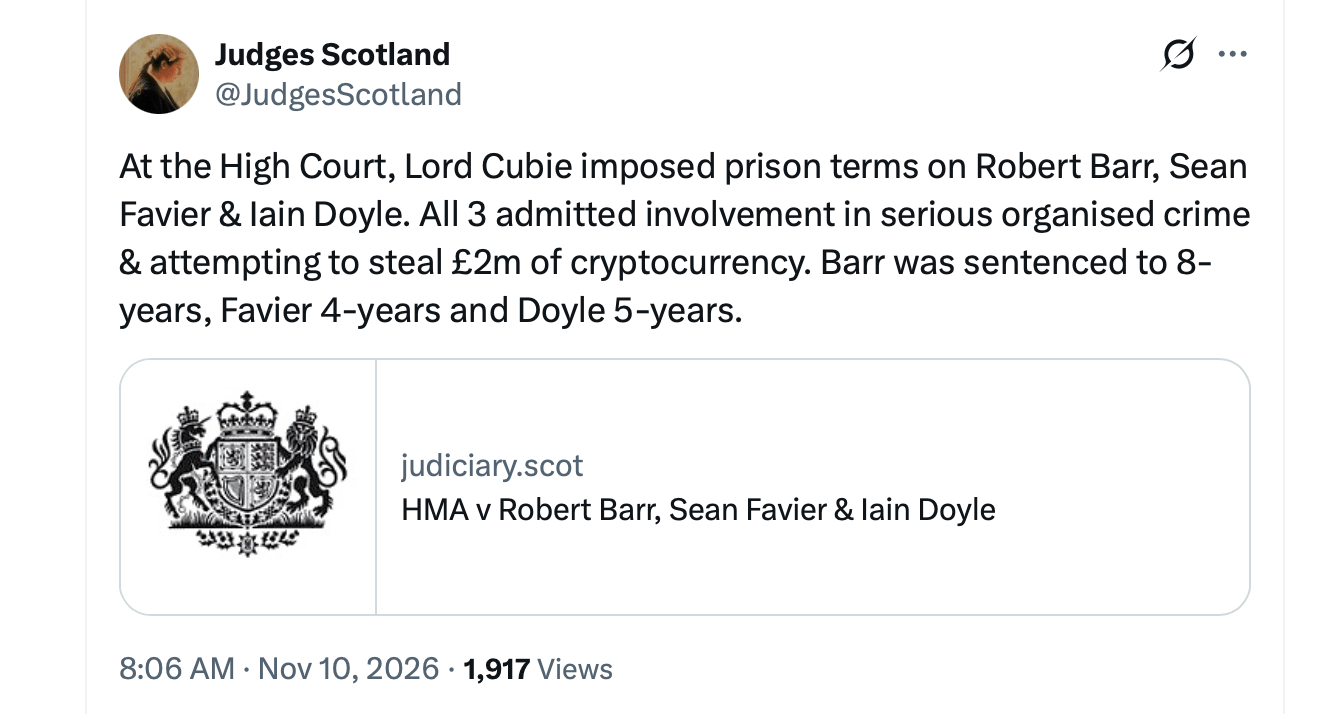
Image source: X.
Lord Cubie characterized the operation as a crime that “married 21st century computer sophistication with old fashioned housebreaking in an audacious attempt to steal cryptocurrency worth up to £2 million.” The scheme targeted a couple in Bonnyrigg, Midlothian, whose cryptocurrency holdings included assets associated with a digital currency venture.
Already imprisoned for cryptocurrency-related fraud, Barr allegedly coordinated the operation through illicit mobile phones. His accomplices were supposed to enter the victims’ residence and compel them to install AnyDesk, a legitimate remote-access application.
The judge explained the intended mechanics:
“Having control of the couple’s computer, he would input the receiving cryptocurrency address and transfer the cryptocurrency from the couple’s wallet to other accounts in his control, thus taking the value of the cryptocurrency for his own use.”
Investigators recovered extensive communications from Barr’s phone, documenting reconnaissance, surveillance, and discussions contemplating intimidation or violence.
One message demanded:
“WHEN THEY’RE IN HIS HOUSE GONNA NEED GET HIM ON TO HIS PC FAST N DOWNLOAD ANYDESK RAPID”
An earlier burglary in January 2024 produced a stolen hardware wallet, but the perpetrators could not access the crypto assets. The subsequent attempt unfolded around 11:30 p.m. on April 17, 2024, when Favier and Doyle approached the property wearing dark clothing with their faces concealed. The couple spotted them through a doorbell camera and refused entry.
Lord Cubie observed that the operation was “only frustrated because the victims had the sense not to open their front door at 11:30 p.m. at night to unknown men, dressed in dark clothing with their faces obscured.” The case comes as home invasions and so-called wrench attacks against crypto investors have been on the rise.
During sentencing, Lord Cubie dismissed Barr’s suggestion that he had been “easily led,” pointing instead to his leadership and considerable technical capabilities.
The judge stated:
“You have accepted in the narrative being the head of the organized crime group which carried out the offense and are described as a sophisticated cybercriminal with the ability to orchestrate a level of criminality rarely seen within mainstream investigations.”
Addressing Barr directly, he added:
“Your culpability is high.”
The court also considered Barr’s previous cryptocurrency fraud conviction and his willingness to organize another offense while incarcerated. Regarding Doyle, the judge rejected his claim that he merely intended to deliver a telephone, noting his awareness of potential violence. Favier’s participation was considered comparatively peripheral.
Although neither attempted theft succeeded, Lord Cubie stressed the seriousness of the criminal enterprise.
“This was a serious crime, a pre-planned and meaningful, although ultimately unsuccessful, attempt to steal a substantial asset which involved the invasion of the home of the victims, a real potential for violence, and if successful, material assistance in the financing of serious and organized crime,” the sentencing letter states.
Barr’s sentence runs from Aug. 25, 2025, when his previous term expired. Consideration of a Serious Crime Prevention Order was postponed until Nov. 17. The case demonstrates how cryptocurrency theft can extend beyond compromised software into physical coercion. Despite elaborate preparation and technical expertise, the operation ultimately failed because its intended victims maintained control of their front door.
免责声明:本文章仅代表作者个人观点,不代表本平台的立场和观点。本文章仅供信息分享,不构成对任何人的任何投资建议。用户与作者之间的任何争议,与本平台无关。如网页中刊载的文章或图片涉及侵权,请提供相关的权利证明和身份证明发送邮件到[email protected],本平台相关工作人员将会进行核查。


