Analysis of the judicial key points for the division of cryptocurrency in divorce.
Written by: Xiao Za Lawyer Team
Recently, Jensen Huang, founder and CEO of Nvidia, has attracted global public attention due to an extramarital affair crisis. According to media reports, Huang and his wife did not sign a prenuptial agreement, and if they proceed with divorce, the large number of Nvidia shares he holds and potential other digital assets will face complex division issues.
Although this is a case under U.S. jurisdiction, the Xiao Za team believes this hot topic reflects an increasingly common pain point in judicial practice: in the digital age, the proportion of cryptocurrencies (such as BTC, ETH, USDT, etc.) in marital joint property is rising, and the anonymity and decentralization of such assets pose unprecedented challenges for property identification, division, and enforcement after divorce.
According to estimates by Triple-A based on Chainalysis data, approximately 78 million people in China hold cryptocurrencies, with holders highly concentrated in the marriageable age group. As disputes involving cryptocurrencies in divorces become more frequent. So, if one party conceals or refuses to disclose cryptocurrencies, how can the other party use legal means to protect their property rights? This article will delve into the characterization, identification paths, and enforcement difficulties and strategies of cryptocurrencies in divorce litigation from the perspective of domestic judicial practice.
1. Legal Characterization: Do cryptocurrencies belong to marital joint property?
1. Administrative regulatory policies do not negate property attributes
Many parties, and even some grassroots judges, misunderstand that since the state prohibits virtual currency trading and speculation, cryptocurrencies are "illegal property" and are not protected by law, hence cannot be divided during divorce. This view confuses administrative regulatory evaluations with civil rights ownership.
China's regulatory policy on virtual currencies is indeed strict. The People's Bank of China and other departments have issued the "Notice on Further Preventing and Handling Risks of Virtual Currency Trading and Speculation," which clearly prohibits activities related to virtual currencies. However, "prohibiting business" does not equal "prohibiting possession." Simply holding cryptocurrencies is not explicitly prohibited by law. More importantly, Article 127 of the Civil Code of the People's Republic of China states: "Where the law provides for the protection of data and network virtual property, it shall apply according to the provisions." This clause establishes the civil rights status of network virtual property.
In the realm of marriage and family, Article 1062 of the Civil Code of the People's Republic of China clearly states that the income from production, operation, and investment obtained by spouses during the duration of the marriage, as well as other properties that should belong to joint ownership, constitute marital joint property. As a digital asset with exchange value and disposability, cryptocurrencies are essentially investment properties. As long as they are acquired during the marriage, regardless of how unique their form may be, they should in principle be recognized as marital joint property.
2. Affirmative attitude in judicial practice
Domestic courts have gradually formed a consensus in judicial practice: cryptocurrencies possess divisible property attributes. For example, in case (2020) Yue 0305 Min Chu 28569, the parties agreed on the ownership of virtual currencies in their divorce agreement, and the court directly supported the performance of the agreement; in case (2021) Jing 0102 Min Chu 35486, the parties agreed to split 2.4 million yuan worth of digital currency in half, and the court recognized this and ordered one party to fulfill their payment obligations. These cases indicate that the court does not refuse to address property division requests involving cryptocurrencies on the grounds of "regulatory bans," but rather incorporates them into the framework for handling marital joint property.
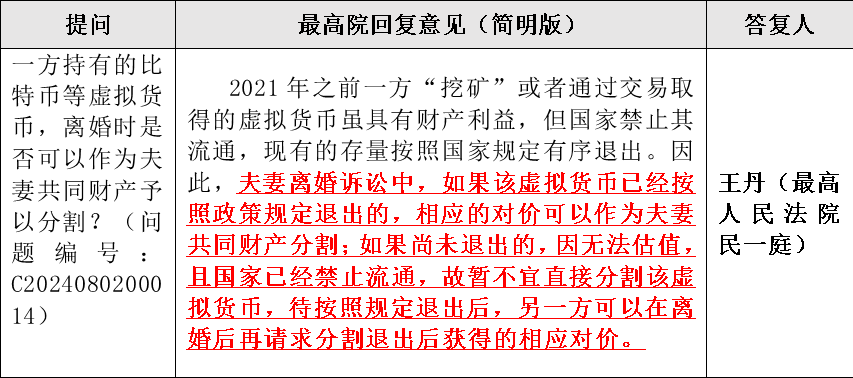
It is important to note that the Supreme People's Court has previously issued opinions on related issues, pointing out that for virtual currencies that have not exited the market, due to the inability to value them and prohibitions on circulation, it is not appropriate to directly divide the virtual currency itself for the time being. After exiting as required, the other party may request a division of the corresponding consideration obtained after the exit. However, this does not imply a complete deprivation of the right to division, but rather conditional, emphasizing the practicality of the division method — focusing on price compensation rather than physical transfer.
2. Property Identification: How to crack the problems of "difficult concealment" and "difficult evidence"
The biggest feature of cryptocurrencies is private key control and address anonymity. Once the holder refuses to cooperate, the non-holder often faces the dilemma of "invisible and intangible." In this regard, we need to construct a set of procedural tools from preliminary evidence gathering to responsibility transfer.
1. Establishing a chain of evidence for "reasonable suspicion"
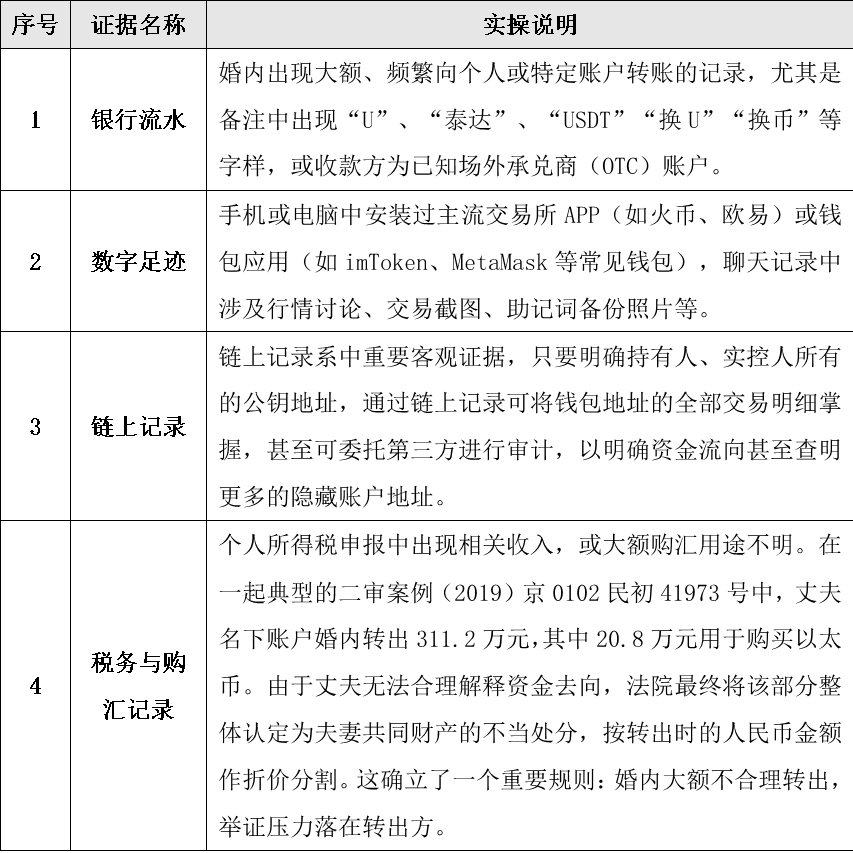
According to Article 67 of the Civil Procedure Law of the People's Republic of China, parties have the responsibility to provide evidence for their claims. In situations where the non-holder cannot directly access the other party's wallet, they must establish "reasonable suspicion" through peripheral clues, triggering the court’s investigation intervention or the transfer of the burden of proof.
In practice, the following evidence is crucial:
2. Using the property declaration system to increase concealment costs
Article 67, Paragraph 2 of the Women's Rights Protection Law of the People's Republic of China, revised in 2022, clearly stipulates: "During the divorce litigation period, both parties have the obligation to declare all marital joint property to the People's Court." This provision fills the gap in the property declaration system during the trial phase.
The court can order the holder to declare in writing the amount of cryptocurrencies held, wallet addresses, acquisition times, and sources of funds. If the holder refuses to declare or makes false declarations, according to Article 1092 of the Civil Code of the People's Republic of China, if one party hides, transfers, sells, destroys, squanders marital joint property, that party may receive less or no division of the marital joint property during the divorce.
This means that even if the court cannot forcibly transfer the cryptocurrencies, it can still achieve punitive correction of concealment behavior through skewed distribution of visible properties such as real estate and deposits. For example, if one party hides cryptocurrencies worth 6 million yuan, although the court cannot directly enforce that currency, it can decide to allocate more to the spouse when dividing an 8 million yuan property and 2 million yuan deposits, thus achieving fairness in results.
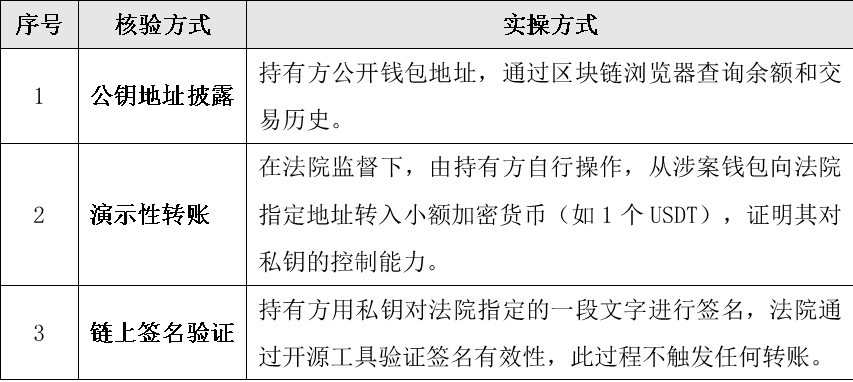
3. Secure verification of control rights
It is especially important to emphasize that verifying the control rights does not equal handing over the private key. Once the private key is leaked, the asset will be immediately out of control and unrecoverable. Therefore, lawyers and courts are prohibited from requesting private keys or mnemonic phrases. Based on the operational practices of the Xiao Za team, cost-effective verification methods that are likely to be recognized by courts include:
3. How to implement enforcement after judgment? Taking the new breakthrough of the Shanghai High Court as an example
For a long time, enforcement judges have held a cautious or even evasive attitude toward the enforcement of virtual currencies due to a lack of normative basis. Recently, the Shanghai Higher People's Court issued the "Guidelines for Standardizing the Execution of Network Virtual Property (Trial)," marking an important local judicial dynamic.
The guidelines clarify the following key points: (1) Virtual currency falls within the range of executable property. (2) Applicants for enforcement can provide property clues, and the court should respond with investigation results within 7 days (3 days for emergencies). The court may conduct inquiries, searches, and summon witnesses ex officio. When necessary, the virtual currency in the defendant's wallet may be transferred to a specialized cold wallet set up by the court for safekeeping.
Additionally, the "Guidelines for Standardizing the Execution of Network Virtual Property (Trial)" also clarify that, when conditions are met, value disposal can be conducted through compliant channels. Although these guidelines are only applicable in Shanghai and do not possess nationwide legal effect, they send a positive signal: judicial authorities are exploring the establishment of standardized processes for the enforcement of virtual currencies. Furthermore, there have been successful precedents in criminal execution practice. In a case involving illegal public fund-raising in Shanghai, the court adopted a method of "domestic commission, overseas disposal, closed-loop return" for the involved FIL currency, using a licensed platform in Hong Kong for value disposal, with funds returning to the court's case funds account. This provides a reference idea for civil enforcement, indicating that when compliant disposal channels are available, the valuation of virtual currencies is not an insurmountable technical obstacle.
Conclusion
The division and enforcement of cryptocurrencies in divorce cases is a contest of law, technology, and psychology. For the non-holder, the key is to take action early, secure evidence, and effectively utilize the property declaration system to exert pressure; for the holder, attempting to evade division by concealing cryptocurrencies not only faces the legal consequences of "less or no division” but may also receive judicial sanctions for false declarations.
The Xiao Za team suggests that in the face of such complex family disputes, parties should hire professional lawyers with knowledge of blockchain to formulate detailed litigation strategies. From pre-filing evidence preservation to evidentiary battles during the trial to property control in the enforcement stage, each link requires the intervention of professional strength. With the continuous improvement of judicial regulations, cryptocurrencies are no longer a legal gray area, and their property attributes and enforceability in the field of marriage and family are gradually being confirmed and strengthened.
免责声明:本文章仅代表作者个人观点,不代表本平台的立场和观点。本文章仅供信息分享,不构成对任何人的任何投资建议。用户与作者之间的任何争议,与本平台无关。如网页中刊载的文章或图片涉及侵权,请提供相关的权利证明和身份证明发送邮件到[email protected],本平台相关工作人员将会进行核查。


