Author: Curry, Deep Tide TechFlow
Deep Tide Introduction:
Influenced by the latest US CPI inflation data that exceeded expectations, interest rate cut expectations took a hit, and the entire crypto market faced pressure and dipped. Bitcoin lost the key psychological threshold of 74000 USD, dropping over 3% in a day, triggering over 180 million USD in long liquidations across the network within hours. Analysts from several institutions warned that short-term support has retreated to around 73000 USD. If the bulls fail to stem the bleeding, Bitcoin will further test the dense support area around 70000 USD. This means that the easing premium previously brought by interest rate cut bets is being quickly erased by the market, putting direct pressure on funds chasing highs.
The shadow of inflation once again looms over Wall Street, and the liquidity premium for risk assets is rapidly tightening.
According to The Block, after the US CPI inflation data was published, which was higher than expected, Bitcoin quickly fell from its intraday high, sequentially breaking through the psychological levels of 75000 USD and 74000 USD, reaching a low near 73200 USD. The derivatives market subsequently experienced a long squeeze, with Coinglass monitoring data showing that the total liquidation of crypto assets across the network in the past 4 hours reached 184 million USD, with over 82% of liquidations being from long positions.
The abrupt change in macro sentiment is a direct driver of this sharp decline. Previously, Bitcoin had maintained a high-level fluctuation driven by institutional funds, but this resurgence of sticky inflation directly disrupted the market's expectations for the Federal Reserve's future monetary policy easing. The CME FedWatch tool indicates that after the data announcement, traders priced the probability of a 25 basis point interest rate cut by the Federal Reserve in December dropping sharply from 81% the previous day to 56%, with the possibility of a pause in rate cuts or maintaining high rates for a longer duration significantly rising.
Core inflation unexpectedly rises, Fed's rate cut expectations hit hard
The rebound in inflation data broke the previous stability expectation.
According to data released by the US Bureau of Labor Statistics, the Consumer Price Index (CPI) in October rose 2.6% year-on-year, in line with the rebound trend, but both month-on-month and core inflation performances were higher than market expectations, showing that the service sector and housing costs still possess stubborn resilience. According to Bloomberg, following the publication of the inflation data, the US dollar index (DXY) briefly rose nearly 40 points, and the 10-year Treasury yield quickly approached the stage high of 4.45%.
The choice of macro funds is quite straightforward. According to an analyst cited by Reuters, when the risk-free yield of US Treasuries continues to strengthen at high levels, cryptocurrencies and growth tech stocks, which are extremely sensitive to the interest rate environment, are the first to be impacted, with funds quickly shifting to defensive positions.
Short-term defense at the 74000 USD level lost, 70000 USD becomes the last barrier for bulls
After falling below 74000 USD, the technical defense focus has been significantly shifted lower.
According to The Block, citing calculations by BRN market research analysts, Bitcoin has faced a breakthrough from its previous high resistance to support, with 73000 USD being the first buffer zone at present. If the spot buying does not re-establish turnover above 73000 USD, the price downside channel will be further opened.
A larger test lies at the 70000 USD level. According to the latest market brief released by 10x Research, 70000 USD is not only the historical dense area of the last breakthrough but also the key exercise price for many institutional over-the-counter options. The Coinglass liquidation heat map similarly shows that in the range of 70000 USD to 70800 USD, the largest leveraged long liquidation lines and passive buy orders currently in the market are concentrated.
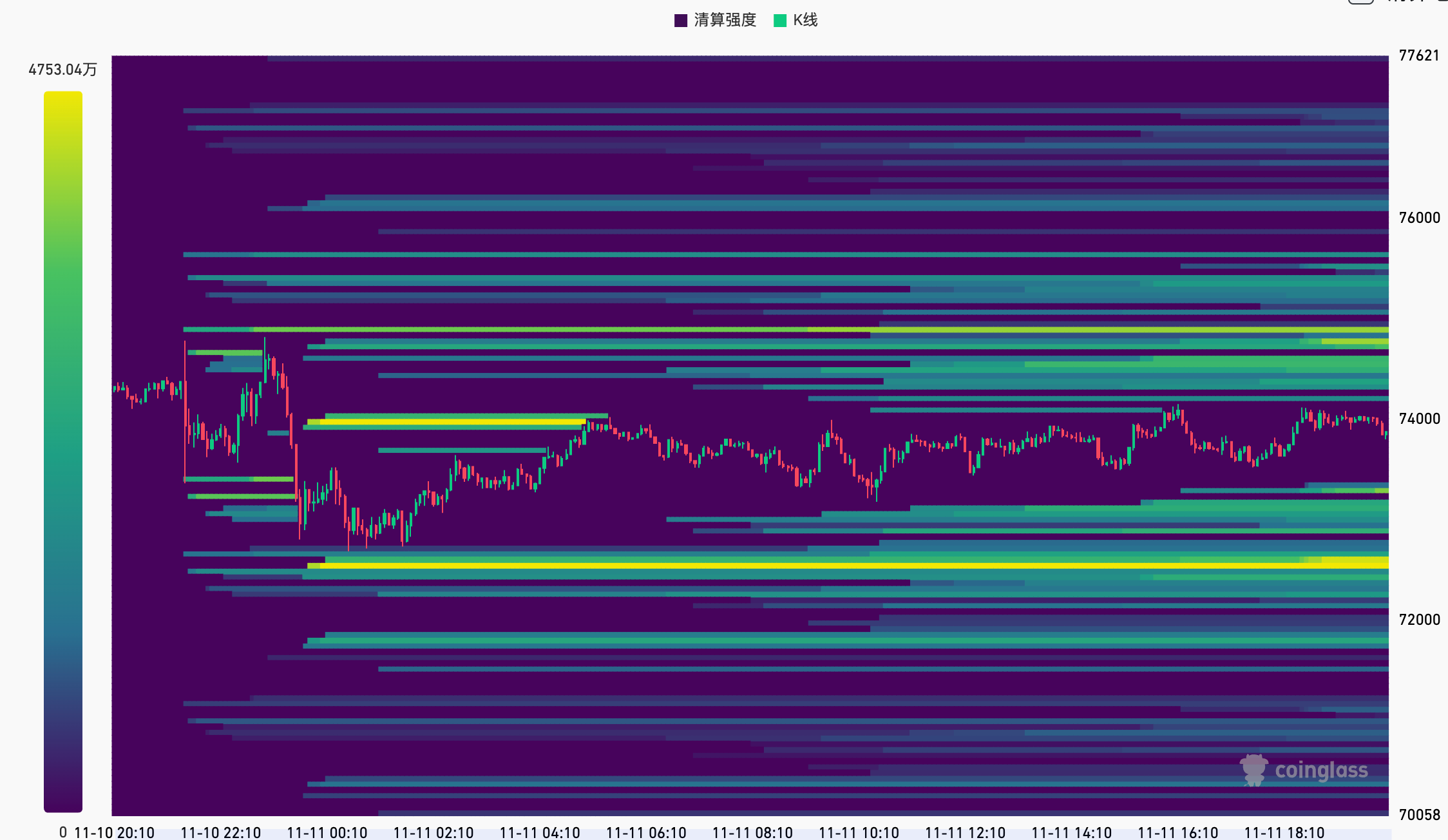
If 70000 USD is lost, it not only means that the structure of the breakout trend is completely broken but will also trigger a new round of institutional stop-loss orders and liquidation chain reactions.
High leverage in derivatives clearing, spot ETF absorption capacity faces testing
The catalyst for the downtrend is the deleveraging in the derivatives market.
According to Glassnode monitoring, prior to the data release, Bitcoin's open interest (OI) remained at historical high levels, and the funding rate also stayed above an annualized 15% for several consecutive days. This overheating leverage structure became a target for liquidity harvest the moment the macro negativity landed.
The absorption strength of institutional buying has become another key factor determining the subsequent trend. According to SoSoValue statistics, the inflow speed of US spot Bitcoin ETFs has noticeably slowed compared to previous peaks. If the spot ETF turns to net outflows under inflation negativity, it will be difficult for just the on-chain native funds to quickly absorb the selling pressure.
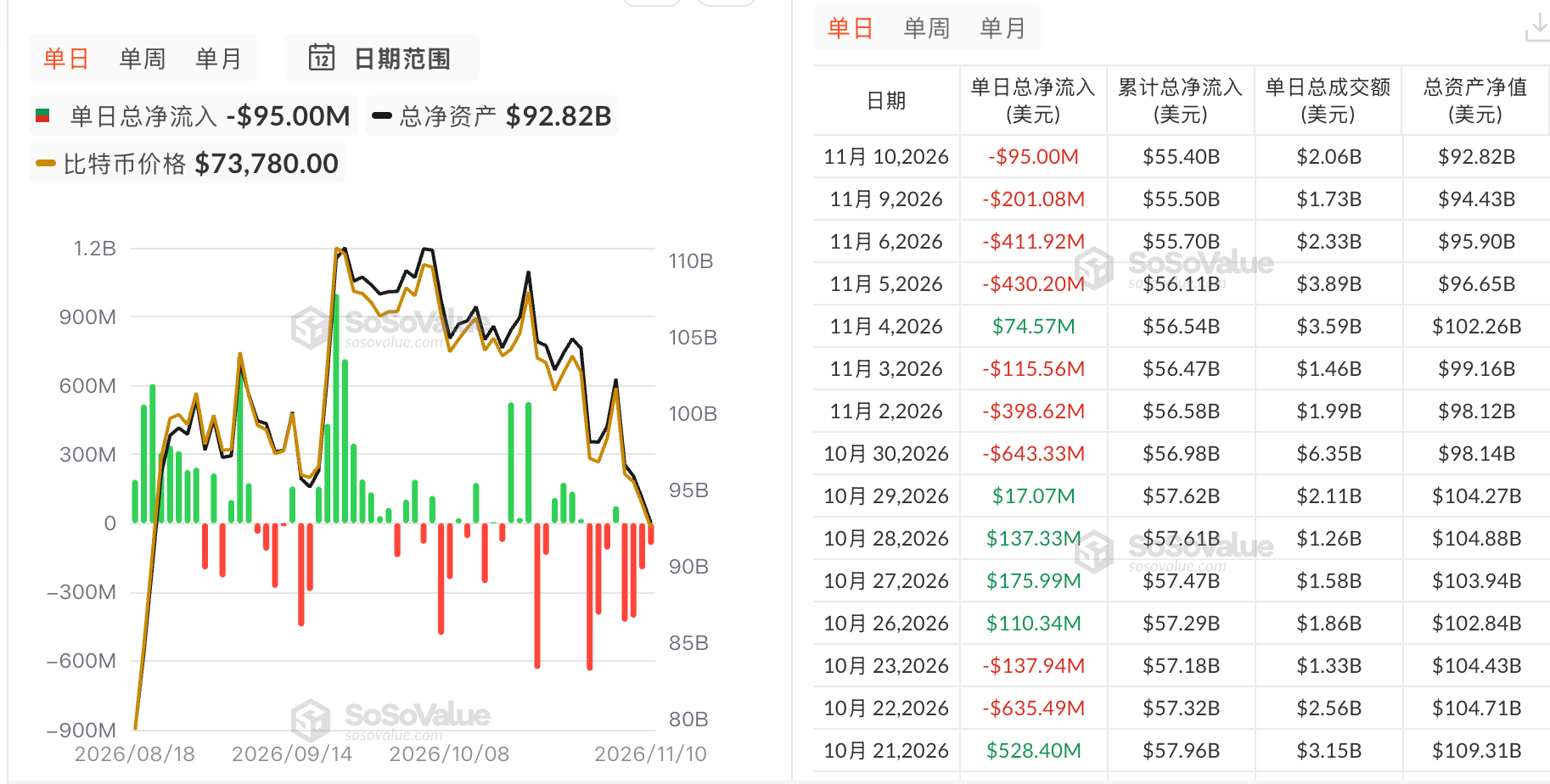
For high-leverage bulls, this inflation exceeding expectations has already executed a round of forced liquidations on the books; for spot holders, the next defensive bottom line has been clearly set at 70000 USD. This sharp decline currently presents a re-calibration of macro expectations and is not the end point of the bull market cycle.
免责声明:本文章仅代表作者个人观点,不代表本平台的立场和观点。本文章仅供信息分享,不构成对任何人的任何投资建议。用户与作者之间的任何争议,与本平台无关。如网页中刊载的文章或图片涉及侵权,请提供相关的权利证明和身份证明发送邮件到[email protected],本平台相关工作人员将会进行核查。


