Translation: Sam, Techub News
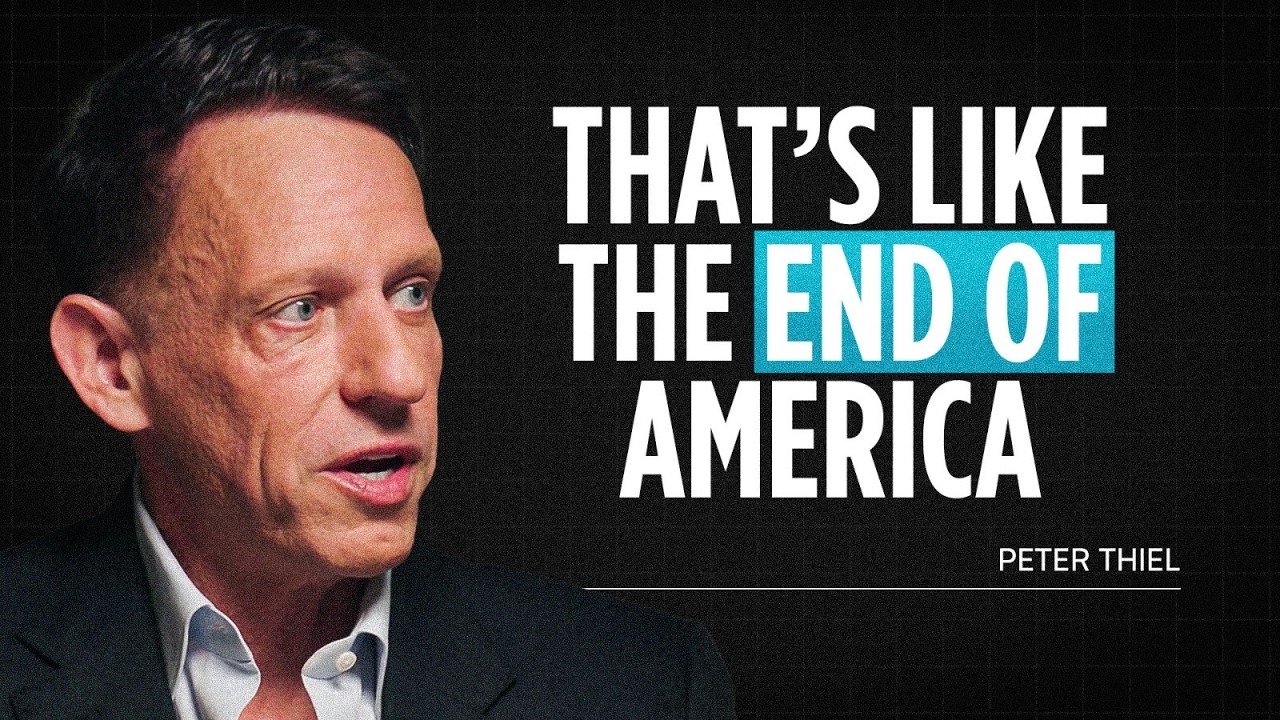
Original: Peter Thiel: The AI Crisis, Europe’s Decline & the Battle for America (MDMEETS - Essential Talks with Mathias Döpfner, YouTube, September 24, 2026, 65 minutes)
Introduction
For twenty years, Peter Thiel has been talking about "stagnation": except for computers and the internet, there has been almost no significant progress in the atomic world in the West. Now everyone is worried that AI is running too fast, and his old argument seems to be validated.
In Axel Springer's CEO Mathias Döpfner's interview show MD MEETS, this co-founder of PayPal and Palantir spoke for over an hour: the risks of AI, why China and the US are more averse to AI than Europe, his 2009 statement that “freedom and democracy are no longer compatible,” the polarization of German politics, Trump and Vance, the rise of democratic socialism in the US, and his views on longevity and immortality. The interview was recorded on the day he received the Axel Springer Award and was released on September 24. Below is a condensed transcript.
Key Takeaways
· Peter Thiel believes that AI could be bigger than the internet, with the opportunity to reignite decades of stagnant growth; now no one disputes his claim that stagnation has persisted for decades.
· Peter Thiel acknowledges that the probability of AI going out of control is not zero, but argues that slowing it down will only benefit China; to truly slow it down would require a world government with enforcement capabilities, which would be "worse than the disease."
· Peter Thiel assesses that Europe is falling behind in AI even more than France was with Minitel; he also cites data showing that all twenty of the wealthiest 50 Germans from Generation X and younger became wealthy through inheritance.
· Peter Thiel believes that the establishment of the Democratic Party in the US is failing just like the establishment of the Republican Party did; he estimates that there is about a 50% chance that democratic socialists will win the election in 2028.
· Peter Thiel states that the area he most wants to conquer in longevity is dementia; regarding “a truth that almost no one agrees on,” his response is: everyone says the antichrist is a crazy idea, but actually, they all secretly agree with him.
1. Stagnation Theory Validated by AI
Mathias Döpfner: You have been saying for years that technological progress in the West is insufficient, even using the term "stagnation." Now everyone is discussing whether AI is too fast. Have you changed your mind?
Peter Thiel: To some extent, I have. The stagnation theory I proposed twenty years ago is: since the 1970s, progress has mostly occurred in the world of bits—computers, the internet, mobile internet, software—while there has been little advancement in the atomic world; mechanical engineering, chemical engineering, aerospace, and nuclear engineering were not good fields by the 1980s. This broad slowdown is an important reason for social issues: for every winner, there is a loser, making politics a zero-sum game and increasingly polarized. The internet was an important engine of growth in the late 1990s, but it was insufficient to elevate civilization as a whole. AI could be bigger than the internet, and at least has the potential to reignite growth, bringing both good and bad along with it. The way I defend the stagnation theory is that with AI, no one disputes that the past few decades have been stagnant.
2. AI Risks, Regulation, and China
Döpfner: Recently Dario Amodei, Sam Altman, and Musk collectively warned that this beast could get out of control. Is this marketing, lowering expectations for a trillion-dollar IPO, or are they really worried that AI will overwhelm humanity?
Thiel: There are many layers to the AI debate. The scenario of something much smarter than humans escaping control, like in The Matrix or Terminator, I don’t consider to be very likely, but even if there's only a 5% or 10% chance, it’s still pretty bad. The issue is that this kind of discussion pushes people towards defense and prevention. It’s hard to say the probability is zero, but that doesn’t mean we should slow down indefinitely. If there’s no progress in any dimension, our society simply cannot function. The middle class in Europe and America expects the next generation to have a better life, which is the social intergenerational contract; once that breaks down, the whole society will malfunction in strange ways. Many people assume that a zero-growth world without AI will be a peaceful social democratic society, but I don’t see it that way; that option is far from neutral.
Döpfner: But if the US slows down while China speeds up, wouldn’t that strengthen China?
Thiel: Theoretically, it could slow down, provided the whole world really cooperated deeply, which would require an enforcible world government. The classical liberal part of me thinks that would be jumping from the frying pan into the fire; it would be worse than the disease. What’s more likely in reality is faux global governance: holding many meetings, issuing many hollow statements, while the West slows down and China continues as before. The Pope recently issued an encyclical on AI, which I would describe as an anti-AI encyclical. The Chinese Communist Party will not heed the Pope; some in the US may listen, so effectively, this encyclical serves the CCP. I’m not saying he is a communist agent, but he at least plays the role of a useful idiot.
Döpfner: Two founders of major AI platforms told me they have evidence that China is spreading anti-AI content through American social media. Do you believe it?
Thiel: I haven’t studied it closely; I tend to believe it, but I also lean towards thinking that’s not the main reason—it’s mostly of our own making. I really want to say Greta is working for the CCP; maybe she is, but she’s more like a problem created by the West. I am very tough on China and need to take competition with China seriously, but it’s often too easy to blame everything on China.
3. Why America is More Anti-AI than Europe
Döpfner: European colleagues are generally positive about AI as long as they can learn and participate. In the US, some are protesting, and in the next election, there might even be a contest over which party can best protect people from AI harm. Isn’t this almost an anti-American stereotype? Why?
Thiel: Here’s a favorable explanation for America: AI is happening in America. China is a fast follower, and Europe is lagging far behind; in Europe, businesses don’t even feel it. Take my long involvement with Palantir: sales in American enterprises have accelerated significantly in recent years because businesses feel an urgency to figure out how to transform in the age of AI. Europe hasn’t felt that urgency yet; it’s still the inertia of doing things later instead of today.
Döpfner: In the long run, is AI good or bad for democracy?
Thiel: Our free societies are facing trouble. The root cause is that there isn’t a grand narrative about future growth; people don’t feel things are getting better; everything is becoming more zero-sum. AI is not a panacea, but without it, the extreme left and right zero-sum parties will only continue to grow.
Döpfner: Technology is like a knife; you can make a great meal or commit murder. Why do we always have to make moral judgments about new technologies?
Thiel: What I’m about to say might get me in trouble: we moralize too much. I like to ask, "What is the opposite of 'good'?" The moral opposite is "evil"; the functional opposite is "bad." A Ferrari, with its high fuel consumption, is an "evil" car; a Trabant from East Germany can operate but is just worse than a Golf—it's a "bad" car. Evil things at least get things done. Faust in Marlowe's work is a false scientist who goes straight to hell; Goethe's Faust makes a pact with the devil, gaining knowledge in morally questionable ways, but ultimately finds redemption. I want to clarify that goodness is better than evil, but I would rather have Goethe's Faust than Marlowe's. Our society spends all day debating good and evil, but most things are not even evil; they are just bad. If 99% of businesses, politicians, and leaders are incompetent, that’s the issue we should really be discussing.
4. That Statement "Freedom and Democracy are No Longer Compatible"
Döpfner: Few people say you are incompetent, but in polarized discussions, some call you evil and anti-democratic, with almost all arguments based on your 2009 statement: I no longer believe that freedom and democracy are compatible. Why did you write that back then? What do you think now?
Thiel: Writing is always risky. That article was something I wrote quickly one night and sent to a colleague, asking if there was anything I shouldn't write; he said no. Looking back, the fact that I needed a second opinion indicated that the wording should have been more careful. Two weeks later, I issued a correction, making it very clear: no one's voting rights will be taken away, and democracy will not disappear. I advocate for a depoliticization of politics. The article was published in a libertarian online journal aimed at those libertarians who put too much hope in politics and want to change the world by winning elections. I believe in pure classical liberal ideas, but they don’t win easily in a democratic system. What I said has been echoed by Montesquieu and John Stuart Mill.
Döpfner: Do you sometimes enjoy provoking and stimulating debate?
Thiel: I do enjoy doing that, but that piece caused more chaos than enlightenment.
Döpfner: Social polarization, weakened centrist leadership, and yet authoritarian regimes are quite successful. Are you worried we are going the wrong way?
Thiel: I’m not a Hegelian; I don’t think the direction of history is necessarily good. There is indeed an anti-democratic trend. The problem in Germany in the 1920s and 1930s was that there were two anti-democratic parties, the Nazis and the Communists, which together received over half the votes in the 1932 elections. Once over half the populace votes for parties that want to abolish democracy, it’s almost too late.
5. Germany: The Rise of Extremes
Döpfner: Germany now has strong extremes on both sides: in Berlin, the socialists won, in Saxony, the far-right AfD won greatly, and more and more voters are shifting from the middle to the extremes. Can this trend be reversed?
Thiel: I wouldn't be a good politician and have no good advice for centrist leaders, but they systematically underestimate the scale of the problems. The UK has changed seven prime ministers in a decade, and none have had a plan to turn society around; everyone thinks being elected prime minister is their entire task. The deep structural issues, in my view, are still insufficient progress, social fragmentation, and the breakdown of the intergenerational contract. Extreme parties can’t solve the problems, but they must be taken seriously. The left-wing party took 25% of the vote in Berlin elections, 47% among voters aged 16 to 24; the youth will ultimately determine the direction of society, which is a very bad trend.
Döpfner: Can you explain the reasoning for supporting the left-wing party?
Thiel: You wouldn't suspect me of sympathizing with the Communists, would you? The reason is: at least we need to take seriously the issues young people are talking about. Rents in Berlin are too high, housing can't be built, and it's hard for the younger generation to get ahead. A portion of Germany, Europe, and even the US is governed by elder politics; society operates for the elderly.
Döpfner: Taking problems seriously is fine, but solutions are important too. The left-wing party's proposal is to nationalize real estate companies, mixed with anti-Semitic and pro-Islamist mobilization; even crime family leaders showed up on election night.
Thiel: They indeed don't have proposals, but to win, they only need to say, “At least we're talking about these issues while others are not.” When others ask me how to solve the technological stagnation, my simple answer is: I don’t have a complete solution, but the first step is to talk about it.
Döpfner: What about the other end, the AfD? Is that a conservative alternative?
Thiel: I’m reluctant to discuss the details of German politics. It reflects the failure of centrist parties that have not been able to find an inclusive economic outlook for Germany. I don’t think there are good solutions on the extreme left or right, and I doubt they know how to balance the budget.
Döpfner: On the far right, there are foreign policy issues: pro-Putin, understanding China, anti-Israel, and some are anti-Semitic as well.
Thiel: Earlier today, I shared a paradox with you: I think there should be rational debates on Ukraine, China, and Israel, but I think the AfD is wrong on all three issues. It’s not easy to be wrong on all three issues.
6. Trump, Vance, and 2028
Döpfner: You supported Trump in 2016. Ten years later, how do you assess his achievements and failures?
Thiel: The easiest answer is to ask me again in ten years. I still believe his emergence reflects the establishment's inability to handle long-term problems in America: growth, the challenges of globalization, and the endless entanglements in the Middle East. Both administrations made opposite mistakes: the first brought in a group of people who constantly fought among themselves; the second overcorrected, implementing loyalty tests, resulting in using less intelligent but very loyal individuals. My concern in America is that the exhaustion the Republican establishment faced in 2016 will next shift to the Clinton and Obama centrist establishment. The Democratic Party is the more significant establishment; if democratic socialists take over the Democratic Party, that would be a much larger issue, possibly marking the end of America.
Döpfner: In 2016, you said the existing parties and leadership were too dysfunctional and needed to be overturned. Is an overturn still necessary now?
Thiel: I don’t want the kind of overturn that democratic socialists want; that would be catastrophic. But if we just describe without making value judgments, I worry that the Democratic establishment will fail as thoroughly as the Republican establishment did, so an overturn could happen, and there is a significant risk of a leftward shift in America. The democratic socialists were formed in 1982 from several marginal socialist groups, initially only about 5,000 paying members; after Sanders’ campaign in 2016, membership surged to 50,000, with the median age dropping from 66 to 33, transforming from an old socialist group into a vibrant, young revolutionary one, full of energy and charisma. Meanwhile, establishment Democrats are saying nothing, and the SPD and CDU in Germany face the same issue.
Döpfner: You were early in supporting JD Vance; what did you see back then that others didn’t?
Thiel: I don’t want to overestimate my role. I have always had an inclination towards smart people and thought he had ideas, was open-minded, and charismatic. He was working at the venture capital fund Mithril that I co-founded and wanted to write a book in his spare time, which I encouraged; that book became a bestseller in 2016. When he ran for the Senate in 2022, I helped him financially. I am often reluctant to answer this question because it tends to dilute his own accomplishments.
Döpfner: For the next Republican candidate, Vance and Rubio are often mentioned. Who has a better chance?
Thiel: I remain a supporter of Vance, but I worry that both have a hard time winning. The more relevant question is: who will the Democratic candidate be? In a competitive election, a center-left candidate is obviously at an advantage; if it’s not competitive, it doesn’t matter. I think it’s unlikely to be competitive. If the Republicans suffer a disastrous defeat in the midterm elections in a month and a half, the Democrats will feel they can win in 2028 no matter what, and they won’t work hard to prevent democratic socialists from emerging, leading to a completely open situation. I debated with Fukuyama, where I said democratic socialists are likely to win in 2028, and he confidently said it is impossible. I don’t think history works that way.
Döpfner: So you think that’s the most likely outcome?
Thiel: Not the most likely, but you could say there’s a 50% chance.
7. Milei, Debt, and the West’s Crossroads
Döpfner: You are a fan of Milei as a disruptor. What can America and Europe learn from him?
Thiel: We are all fascinated by Argentina because we fear its past could be our future: a century of below-level growth, leaders like Perón who are charismatic but have many bad ideas. More than a hundred years ago, saying "rich as an Argentine" was a common phrase. Whether Milei can turn Argentina around or be reelected in a year remains an open question; I still think he will, because people understand there’s no turning back. Our question is whether we can learn from Argentina’s history without having to decline for a hundred years to get there. I don’t like Lenin's kind of “the worse, the better” accelerationism. People in the US and Europe are frustrated, pessimistic, and angry, yet that’s never enough to bring about positive change, and so they drift along.
Döpfner: If we were to bet now, are we nearing a turning point or the beginning of a new order dominated by authoritarian regimes?
Thiel: We should think more specifically. I’ll turn the question back to you: will the Germans push Merz out? No matter how you look at it, it’s a thorough failure, but there are good reasons to believe that nothing will happen in the next three years because everyone thinks changing people won’t improve things much. My intuition is that we will continue to drift for a long time. Macroeconomically, our welfare state is large, and taxes are already quite high, with a significant deficit. If interest rates were zero, we might maintain the deficit, but they are no longer zero, and the deficit will snowball. There are only three choices: drastically cut spending like Milei; significantly raise taxes, which would likely stifle growth; or continue borrowing, pushing the problems further down the line. Since the 2008 crisis for nearly twenty years, the answer has always been the third. My intuition is that this path is nearing its end, and we will soon be pushed toward a very non-centrist solution: either socialist-level taxes or very harsh austerity. And Merz's best idea is to borrow even more.
Döpfner: Why are you so concerned about politics?
Thiel: I probably think too much. I know myself well enough to understand I wouldn’t get elected. But politics permeates society, is both toxic and the air we breathe, so my view on it is somewhat split: I think a lot about it while trying to isolate it and ignore it.
8. Europe, China, and the AI Competition
Döpfner: The US and China are the two major players: one is an imperfect democracy, the other is a fairly efficient autocracy. Who will win in ten years? Should Europe be neutral, become China's colony, or a reliable ally of the US?
Thiel: Europe is best as a reliable ally. I am very opposed to the idea of putting the US and China on moral equal footing. But from the perspective of the US, what’s more important than whether Europe is a close ally is that Europe needs to pick itself up, get its economy running, and participate in building the future. The Concorde in the late 1960s was a joint project between the UK and France; it wasn’t free market but supersonic aviation started in 1947 when Chuck Yeager broke the sound barrier in the US, and although Europe is lagging, it could catch up or even surpass. The US should welcome that. Conversely, France's Minitel was intended to make the internet French but fell deeper into trouble. If you ask me whether Europe’s AI in 2026 looks more like Concorde or Minitel, honestly, my assessment is that Europe is even further behind than Minitel was back then.
Döpfner: Unfortunately, I agree. Why is that? How should Germany get back on the map?
Thiel: There are always too many reasons for "why." Germans often say they are afraid of failure and have a dislike for risk, and that may be true, but I want to add: perhaps there’s also a fear of success—they can achieve something but won’t take it to the max like Musk or Zuckerberg; they sell and exit at a certain point. I looked up some data: among the 50 richest people in America, only 12 are from Generation X or younger, born in 1965 or later, of which 9 made their wealth themselves; whereas among the 50 richest Germans, there are 20 from Generation X and younger, but all of them are heirs, with none having created something new or built a scalable company. Germany used to be very good at creating new businesses, in the late 19th and early 20th centuries, and even after 1945, but since around 1995, that capability has really been lost. This is something I will seriously think about tonight.
9. German Complex, PayPal, and the Founders of Palantir
Döpfner: I told you when you received the Axel Springer Award that you have spent the past ten years trying to clear Germany from your mind, rationally you have done well, but emotionally you can’t get rid of it. You were born in Frankfurt in 1967 and left at one year old; why do you still have these feelings?
Thiel: It would be strange if I didn’t. My grandparents are here, I went to English school in the US, but at home, we spoke German, so you could say I grew up between two worlds. There are many understandable reasons for Germany's issues, but finding a way to turn Germany around is very important; it is in a sense the heart of Europe, and Europe remains the core of Western civilization.
Döpfner: You shifted back to rational analysis again. I asked about feelings; what do you love about Germany?
Thiel: I always struggle to answer these questions. It’s just a part of me.
Döpfner: Tonight, you will also be joined by Alex Karp and Max Levchin, co-founders of Palantir and PayPal, both with European backgrounds. Is that commonality important?
Thiel: It may be part of the reason, but I don’t want to exaggerate. I feel that many tech company founders are both insiders and outsiders. Alex and I both attended elite Stanford Law School, which makes us insiders; I am an outsider in some respects in America, while Alex is Jewish, also bringing a bit of an outsider background. Max was a top student, incredibly charming, left Ukraine at 16, grew up in poor neighborhoods in Chicago, and has an unbelievable drive. People tend to exaggerate the outsider side because that seems a bit like claiming victimhood. I grew up in Silicon Valley, and such people are rare.
Döpfner: Are you a natural contrarian? As soon as everyone is forming consensus, you say the opposite?
Thiel: I don’t think the goal is to oppose for opposition's sake; that’s merely adding a negative sign in front of consensus, which is meaningless. The real goal is independent thought.
Döpfner: How do you cultivate this ability to not be influenced by the zeitgeist but to listen only to your own internal compass?
Thiel: I’m not good at self-analysis. Perhaps it’s because I have a deep interest in many things: history, politics, economics, science fiction, psychology. Modern society demands that people become narrow-field experts; it’s like the pin factory in Adam Smith’s writing, where everyone is responsible for one process, and though that maximizes efficiency, it obscures the big picture. I always want to know how these things fit together. Maybe I’m just trying to justify my Renaissance-type amateur hobbies, but I tell myself that in a world full of hyper-specialization, there has to be at least one generalist.
Döpfner: Do you have any hobbies that completely lack commercial justification?
Thiel: I might still play too much chess online. I used to be a chess player in school; it’s a beautiful game, one that is somewhat dangerously addictive. In my teens, I fantasized that without chess, I wouldn’t understand reality, which was probably an extreme statement.
10. Longevity and Immortality
Döpfner: You have four young children. How have they changed you?
Thiel: They completely change the time horizon in which you view the future. In a world populated only by adults, you can pretend to only look a year ahead. But my eldest daughter won’t be 81 until 2100, and you start to think about what the 22nd century will look like.
Döpfner: You invest a lot in longevity; is it just for commercial considerations or is there also a fear of death?
Thiel: Fear of death and aging, both exist. But I find it strange that this kind of thinking has not been more widely accepted and expressed. The early modern optimism of the 17th and 18th centuries was that science would improve human conditions. Hobbes said that life in the state of nature is brutish, nasty, and short, and we should make it longer, even infinitely long. Condorcet, Bacon, and Franklin all believed we could cure death and all diseases. We have surrendered this pursuit, which is a shocking social decline; people don’t even believe Alzheimer’s can be cured anymore.
Döpfner: To me, health is the only area of progress that has only benefits and no drawbacks. Can you give me your most optimistic scenario about longevity? Immortality?
Thiel: 150 years. It’s unclear why it can’t be more, and I don’t see a natural limit. People have become pessimistic because some diseases are indeed tough to treat. Nixon declared war on cancer in 1971, promising a cure within five years. Fifty-five years have passed; there has been progress, but we’re far from the goal. Roughly speaking, if biological processes are irreversible, while information computation processes are theoretically reversible, then once we can understand biology as information science, we could theoretically find ways to reverse those processes, just as computers can run forever.
Döpfner: Is it about reversing aging in the body, or uploading the mind and consciousness?
Thiel: My view is quite physical and might have some Christian elements. I wouldn’t accept being uploaded as a program that simulates me; I don’t think that’s me. Our identity is closely tied to our physical bodies. The complete Christian vision is to have an eternal body, and the soul is also transformed. The issues between transhumanism and Christianity aren't that transhumanism is too strange or extreme; from a true Christian perspective, it hasn’t gone far enough.
Döpfner: Wouldn’t immortality be boring? If everything is infinite, why would you strive for anything?
Thiel: The answer to all these kinds of questions is: it's better than the other option. I don’t think I would get bored.
Döpfner: What’s the most optimistic innovation or investment you’ve made in the field of longevity recently?
Thiel: I have been investing in biotech; it's surprisingly difficult. If I had to pick one thing, what I most want to tackle in the next few years is dementia, finding ways to slow down or even reverse cognitive decline.
11. A Truth that Almost No One Agrees On
Döpfner: Finally, I'll ask a question you probably ask candidates in interviews: state a truth you believe in but that almost no one agrees with.
Thiel: I’ve already said quite a bit today. There’s a meta-level version of this question: many things you think no one believes turn out that many people believe roughly the same. Three years ago, I started talking about the antichrist, believing it to be an extremely non-mainstream, far-out idea most people would say is insane. Now I would say it is not anti-consensus; most people feel that something akin to the antichrist is imminent, with signs of emerging totalitarianism around the world. Therefore, it’s not as anti-consensus as I thought. But the meta-level truth is: everyone says the idea of the antichrist is crazy, but secretly they all agree with me.
References
Editor’s Note: This article is based on the automatic captions of the YouTube video, organized and translated for a condensed transcript: the Q&A has been compressed, rewritten, and translated, totaling about one-third of the original interview. It is not a verbatim transcript; some verbal errors and repetitions have been removed; subheadings are added by the editor, and their order is consistent with the original interview. The subtitles have not been cross-referenced against the audio; names of people and organizations correspond to pronunciation and public information. The statements regarding German elections, collective warnings from the AI industry, the Pope's encyclical, and the composition of the wealthy in Germany and the US are based on the dialogue between the interviewers, with no independent verification made by the article. The original program is produced by MD MEETS under Axel Springer, and copyright belongs to the original author.
Disclaimer: This article is solely for informational organization and does not represent Techub News's position, nor does it constitute any investment advice.
免责声明:本文章仅代表作者个人观点,不代表本平台的立场和观点。本文章仅供信息分享,不构成对任何人的任何投资建议。用户与作者之间的任何争议,与本平台无关。如网页中刊载的文章或图片涉及侵权,请提供相关的权利证明和身份证明发送邮件到[email protected],本平台相关工作人员将会进行核查。


