Original Author: Long Yue
Original Source: Wall Street Journal
An election has led Wall Street to reevaluate the pace of AI development.
In November 2026, the results of the U.S. midterm elections were announced. The Democratic Party not only secured both houses of Congress but also won gubernatorial seats in Texas and Ohio—two states that happen to be the most concentrated areas for data center construction in the United States.
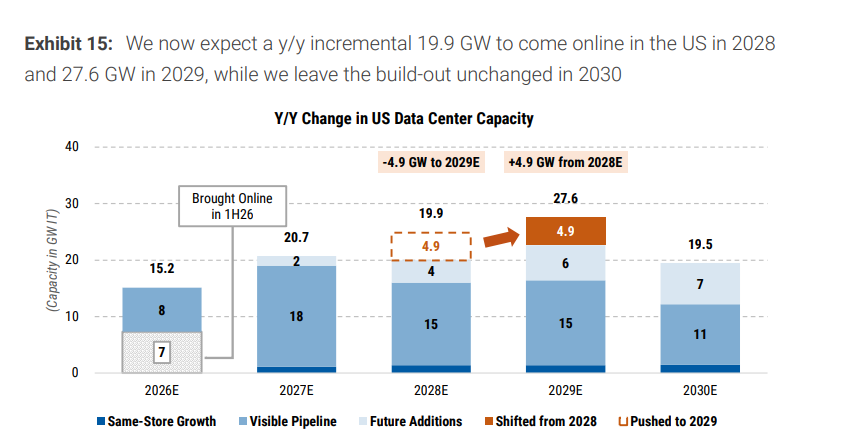
According to Morgan Stanley's latest research report "Buy the Drop: AI Investment Opportunities Post the US Midterms", following the Democratic Blue Wave, the construction of U.S. data centers is expected to see about 5GW of capacity pushed from 2028 to 2029, equivalent to 20% of the new capacity added in the U.S. that year and 10% of the new capacity added globally.
The immediate result of this delay is: U.S. data center GW new capacity is expected to decrease by 4% year-on-year in 2028, while rebounding by 38% in 2029; globally, growth is expected to be 9% year-on-year in 2028 and 20% year-on-year in 2029.
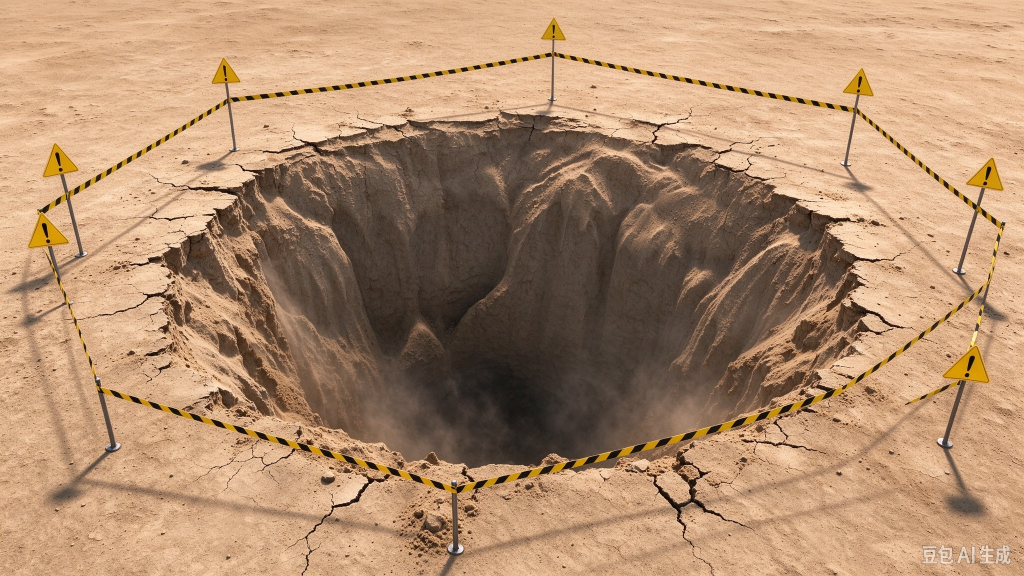
The U.S. midterm elections also seem to have "dug a pit" for the upstream AI supply chain—it is called 2028. Morgan Stanley is concerned that a significant delay in data centers "could create a 'air pocket' in the technology supply chain in 2028, leading to weakened pricing power or inventory accumulation. There may even be a slowdown in orders, normalization of profit margins, and downward adjustments in earnings, despite the robustness of AI demand itself."
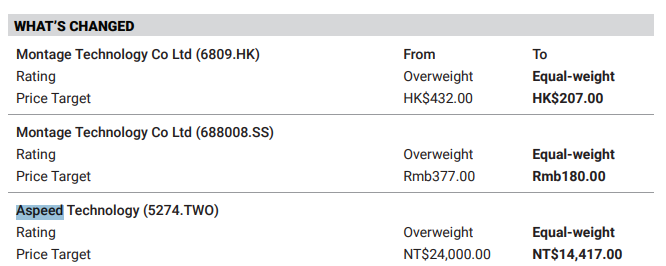
Regarding the impact of the 2028 "air pocket," the upstream cloud semiconductor sector is at the forefront. Analysts have promptly downgraded target prices for Asian cloud semiconductor suppliers such as Aspeed, citing risks of project delays in the U.S. for the next 2-4 quarters; the old memory sector has also seen downgrades, based on earlier expectations that pricing power has "peaked."
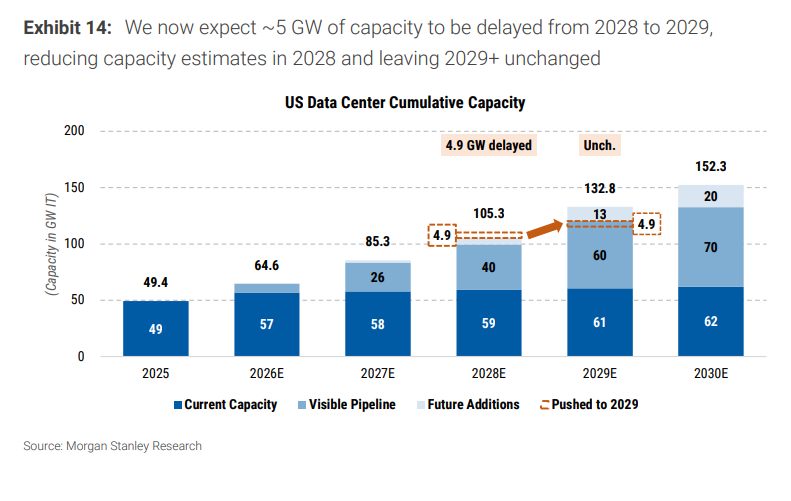
Path chart for accumulated capacity of U.S. data centers: showing a reduction from 110GW to 105GW in 2028
Why 2028? How the election dug a pit
The immediate trigger for the delay in data centers comes from the U.S. midterm elections.
The Democratic Party won multiple gubernatorial positions, including Texas and Ohio. Among them, newly elected Texas Governor Gina Hinojosa's campaign program includes pausing new data center approvals until stronger protective measures are enacted by the Texas Legislature. Newly elected Ohio Governor Amy Acton has proposed a conditional pause on new data centers and new permits, requiring projects to cover 100% of natural gas, water, and electricity costs, and use union labor.
Analysts assess that projects under construction in 2027 will be largely unaffected because "newly elected governors are unlikely to disrupt projects already under construction." The risk of delays is concentrated on the 2028 projects that have yet to commence.
The report points out that Texas and Ohio previously accounted for about 4.9GW (IT metric) of data center capacity exposure in 2028. This batch of projects faces delays due to new approval processes.
Meanwhile, ERCOT (the Texas power grid) has reached about 474GW in interconnection applications, over five times its historical peak demand, with data centers accounting for about 90% of the new electricity requests. The power bottleneck has long existed; the election results have only layered uncertainty on top of this.
The "pit" in the upstream supply chain: cloud semiconductors first
What does this gap in 2028 mean for the upstream AI supply chain?
Morgan Stanley’s Asian semiconductor team quickly followed up with a report "Cloud Semis: Peak Growth, Less Upside", pointing out that cloud semiconductors "Peak Growth, Less Upside."
Aspeed is a core supplier of server motherboard management controllers (BMCs), directly benefitting from the data center expansion cycle. Montage, a data center semiconductor company, produces memory interconnection chips for server DRAM.
Target prices for both companies have been significantly downgraded:
- Aspeed: Target price reduced from NT$24,000 to NT$14,417, a decline of about 40%
- Montage: Target price reduced from HK$432 to HK$207, a decline of about 52%
Analysts explain that the core logic behind the downgrade is: "The U.S. team expects about 20% of the new capacity for U.S. data centers in 2028 may shift to 2029, potentially affecting the 2028 earnings of cloud semiconductor suppliers."
The "peak pricing power" of old memory: sooner than expected
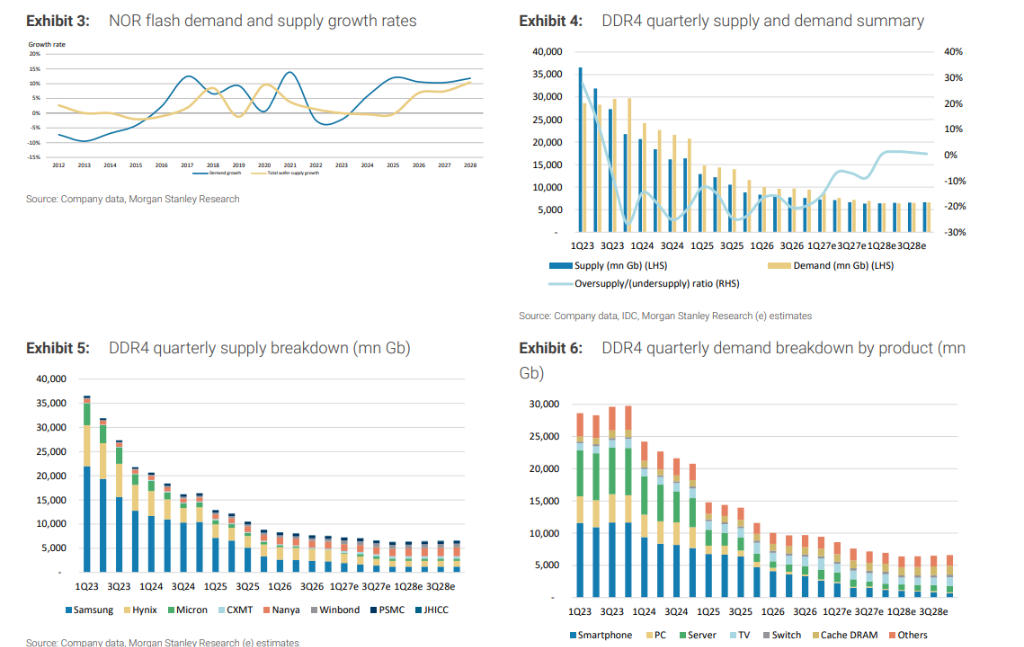
At the same time, Morgan Stanley's old memory research team released a report "Old Memory: Peak Pricing Power? Reduce exposure.", downgrading Winbond, GigaDevice, Powerchip, and Macronix from overweight to neutral, with Phison being downgraded to underweight.
The report specifies that the analysis is limited to DDR3/4, SLC/MLC NAND and NOR, excluding the mainstream DDR5 or TLC/QLC NAND markets.
The core judgment is: "The pricing advantage of old memory is no longer sufficient."
The report lists three pressures:
- Visibility of cloud spending worsens
- Weak consumer demand
- Supply and demand are expected to normalize by 2028
The most direct trigger factor is precisely the shifting pace of U.S. data center construction. "The technology supply chain may experience an air pocket in 2028, potentially leading to declining pricing power and inventory accumulation."
The report emphasizes that these companies' 2026 EPS is actually still being revised upwards, the downgrade is fundamentally about "managing cycle turning points" rather than a collapse in profitability.
The recent tension does not need to dissipate immediately for the stocks to begin repricing: a narrowing of shortages is enough to weaken incremental pricing power before profits peak.
Large cloud vendors: capital expenditures unchanged but timing misaligned
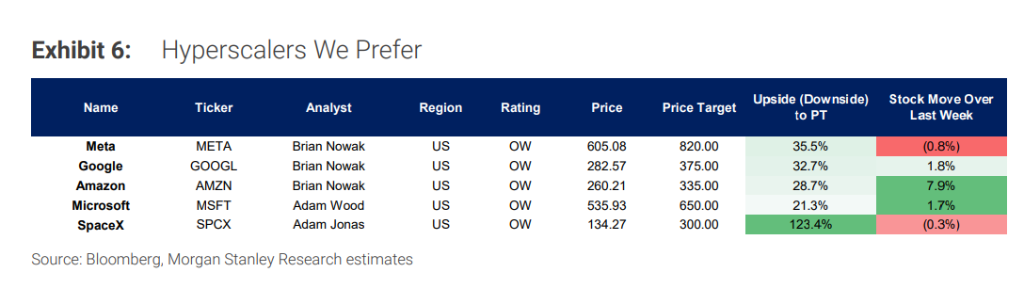
Despite project delays, Morgan Stanley maintains its capital expenditure forecasts for hyperscale cloud vendors: Google/Alphabet a total of $375 billion/$400 billion in 2027/2028, Meta $225 billion/$250 billion, Amazon $355 billion/$365 billion, Microsoft $238 billion/$298 billion, all unchanged.
The report argues that these companies will still "build capacity as much as possible" because products supported by large language models target billions of users and still have over 30% capital return rates.
However, "how much money to spend" and "when to complete construction" are two different things.
The report points out that the effects of delays are more about "postponing rather than canceling." Some projects may shift from Texas and Ohio to more favorable states like Tennessee and Louisiana. Overseas, Morgan Stanley predicts that there may be 20GW of potential spillover demand moving towards Asia and Europe, the Middle East, and Africa.
Meta aims to achieve a 10x improvement in computing efficiency by 2027; Google’s TPU 8t and 8i offer up to 2.7 times improvement in training performance and 80% improvement in inference cost-effectiveness compared to the previous generation.
These efficiency improvements are seen as buffers against capacity constraints.
Silicon Valley confidence vs Wall Street caution
Regarding the "air pocket" in 2028, the market does not have a singular voice.
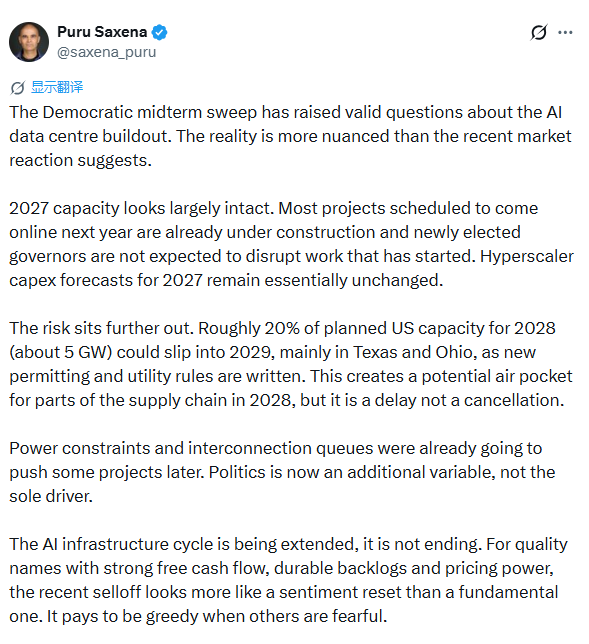
Investor Puru Saxena (founder of AlphaTarget) posted on social media, providing a judgment that is fundamentally consistent with Morgan Stanley but more concise: "The Democratic Party’s midterm election victory has indeed raised reasonable questions about AI data center construction, but the reality is more complex than the market's recent reaction."
He pointed out that capacity in 2027 is "basically intact" because most projects set to launch next year are already under construction, and newly elected governors are expected not to disrupt already initiated projects.
"The AI infrastructure cycle is being extended, not concluded," he wrote, referencing an investment adage: "It is worthwhile to be greedy when others are fearful."
This aligns with Morgan Stanley’s core stance—but Wall Street's analysis is more detailed: Companies in different supply chain segments, geographical locations, and capital structures face distinctly different risks.
The scarcity of data center assets that are built and secured with electricity will increase; financing quality differentiation will deepen; neoclouds and new projects will face stricter scrutiny, while large cloud vendors will further consolidate advantages due to scale and capital strength. Morgan Stanley states:
Financing remains available, but the midterm elections should deepen quality differentiation.
Who will fill the pit in 2028?
Morgan Stanley’s entire analytical framework points to a core conclusion: AI demand has not disappeared, but the misalignment of construction pacing will create a real supply chain pressure window in 2028.
This "pit" is not caused by technological failures but is the result of a state-level election, a batch of new permitting requirements, and the 474GW backlog of ERCOT interconnection applications.
Electricity—not chips—is becoming the new bottleneck in this AI race.
The report ultimately suggests that investors pay attention to three categories of opportunities: large cloud vendors, selected data center supply chain targets, and software enablers and AI application adopters.
We believe the market’s reaction is overdone, postponing some projects from 2028 to 2029, rather than undermining the overall logic of capital expenditure.
免责声明:本文章仅代表作者个人观点,不代表本平台的立场和观点。本文章仅供信息分享,不构成对任何人的任何投资建议。用户与作者之间的任何争议,与本平台无关。如网页中刊载的文章或图片涉及侵权,请提供相关的权利证明和身份证明发送邮件到[email protected],本平台相关工作人员将会进行核查。


