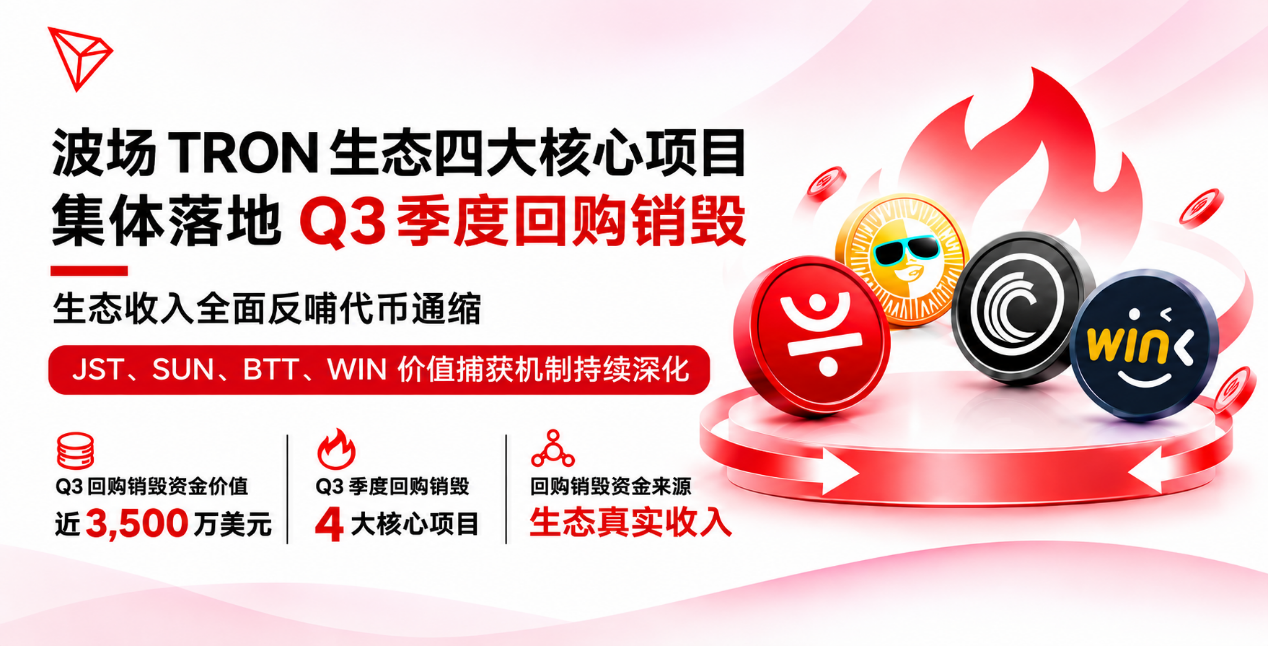
In the third quarter of 2026, the TRON ecosystem's token economic mechanism made substantial progress: the four core projects JUST, SUN.io, BitTorrent, and WINkLink completed their corresponding quarterly buybacks and burns in October, further shrinking the supply of JST, SUN, BTT, and WIN, marking the implementation of the eco buyback and burn mechanism across more core projects.
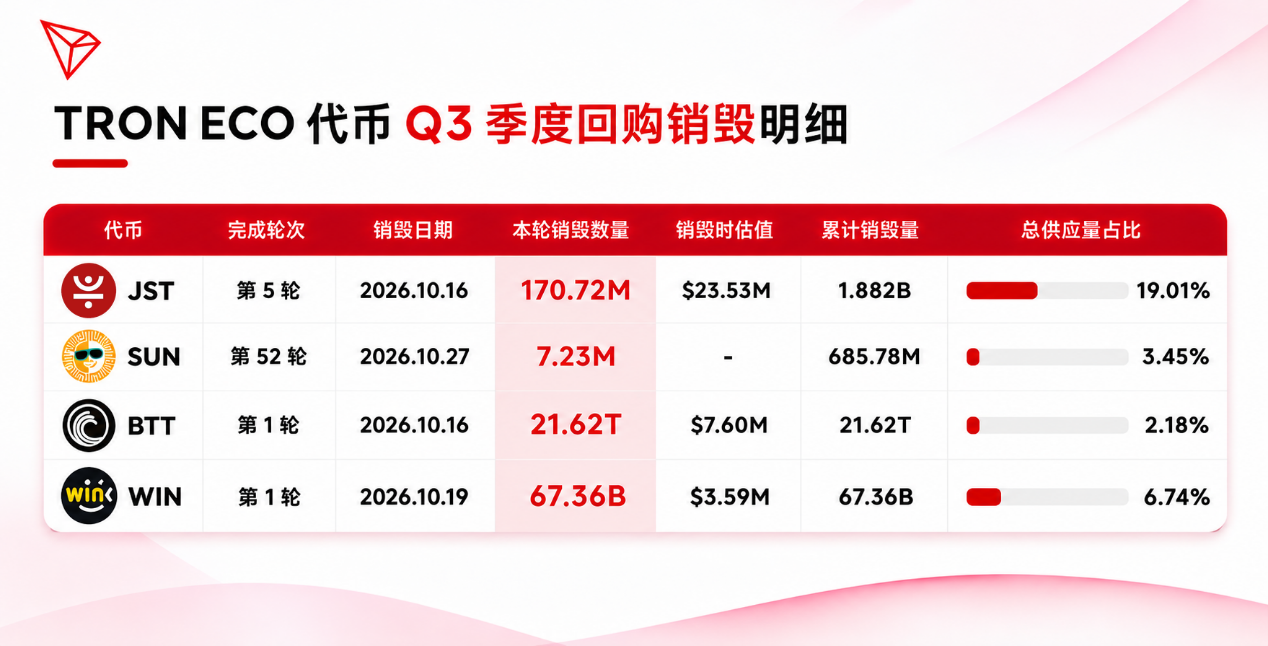
From the specific execution status, the four projects showed a clear pattern of “existing projects continuing steadily, and newly launched projects executing for the first time.” JUST and SUN.io continued the existing buyback and burn mechanisms, completing the latest quarterly burns on October 16 and October 27, respectively: JST completed the fifth round of burns as scheduled, burning approximately 171 million JST, with a cumulative burn total reaching 1.882 billion, accounting for 19.01% of the initial issuance; SUN completed the 52nd round of burns, burning approximately 7.23 million SUN, with a cumulative burn total reaching 686 million. Meanwhile, BitTorrent and WINkLink completed their first quarter buybacks and burns on October 16 and October 19, permanently burning about 21.62 trillion BTT and 6.736 billion WIN, accounting for 2.18% and 6.74% of their respective initial issuance. At this point, all four core tokens of the TRON ecosystem have entered a normalized buyback and burn phase, and ecological deflation has entered a new stage of multi-project collaboration.
More noteworthy than the scale of the burns is that the value transmission mechanism between the projects in the TRON ecosystem and the token economy is also accelerating toward perfection. On the one hand, the JUST ecosystem completed a key upgrade of the JST buyback and burn mechanism, with funding sources fully covering JustLend, GasFree, and USDD ecosystem businesses, managed and executed by JUST DAO; SUN.io continuously deepened its multi-business revenue support system, providing stable funding support for token buybacks. On the other hand, BitTorrent and WINkLink directly linked their decentralized business revenue and oracle service income to the quarterly buyback and burn mechanism, further broadening the application boundaries for ecological value capture.
The four core projects advancing their buyback and burn mechanisms through multiple businesses and paths mark the successful establishment of a value cycle system within the TRON ecosystem, “based on ecological project business revenue, with market buyback and burn as the path, and supply shrinkage promoting value growth.” This system not only clarifies the path for ecological operational results to translate into the token economy but also allows the dividends from ecological development to more directly benefit every user.
TRON Ecosystem Q3 Buyback and Burn Approaches $35 Million: Continuous Accumulation of Deflation Results for Four Tokens, Business Revenue Drives Value Capture Deepening
This quarter's centralization of buyback and burn has further expanded the accumulated burn scale for TRON ecosystem tokens and promoted the continuous upgrade of the token value capture mechanism. From the progress of the mechanisms, both JUST and SUN.io steadily executed existing plans, continuously reducing token supply; at the same time, the JST buyback and burn mechanism had a brand new upgrade, adding GasFree business revenue, further broadening the sources of buyback funds. BitTorrent and WINkLink transformed the buyback and burn mechanism supported by operational revenue into actual execution results through their first quarterly buyback and burn.
In terms of execution results, the value of the buyback and burn for TRON ecosystem projects in this quarter has approached $35 million. Among them, JST completed its fifth round of buybacks and burns, permanently burning approximately 171 million JST, valuing around $23.53 million at the time of burning; BTT completed its first quarterly buyback and burn, permanently burning approximately 21.62 trillion BTT, with a value of around $7.6 million at the time of burning; WIN completed its first quarterly buyback and burn, permanently burning approximately 6.736 billion WIN, valued at about $3.59 million at the time of burning; SUN.io completed the 52nd round of buyback and burns, adding a burn of about 7.23 million SUN.
JUST: JST Cumulative Deflation Ratio Exceeds 19%, Buyback Funding Mechanism Completes New Upgrade
As an important on-chain financial infrastructure in the TRON ecosystem, the JUST ecosystem completed its fifth round of JST buyback and burn on October 16, 2026. This round saw the burning of approximately 171 million JST, valued at about $23.53 million at the time of burning; the buyback funds mainly came from JustLend's third-quarter net revenue of $9.28 million and historical reserve funds of $10.34 million.
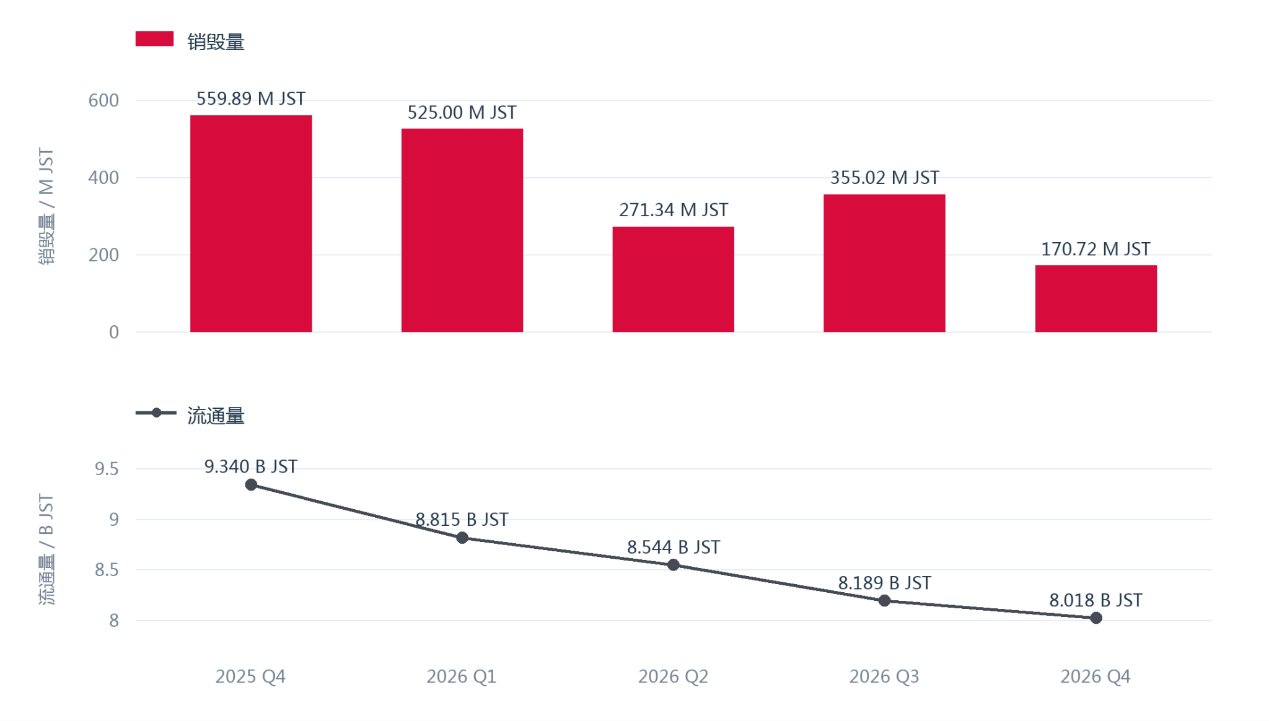
As of now, the historical cumulative amount of JST burned has reached 1.882 billion, accounting for 19.01% of the initial issuance, the highest cumulative burn ratio among the four projects. The normalized buyback and burn mechanism directly drives a continuous contraction in token supply: with the mechanism continuously implemented as planned, the total circulating supply of JST has decreased from 9.340 billion in Q4 2025 to 8.018 billion, with a cumulative decrease of approximately 1.322 billion, showing a clear trend of continuous contraction in token market supply.
While the scale of burns continues to accumulate, with the completion of the fifth round of buybacks and burns, the historical reserve previously used for buybacks and burns has been fully utilized, and the JST buyback and burn mechanism has also welcomed a key upgrade. On October 23, JUST completed a brand strategy upgrade, integrating JustLend, USDD, and GasFree under a unified brand, with all business lines and JST buyback and burn executions being managed by JUST DAO; the JST buyback and burn mechanism has been upgraded accordingly.
The new buyback and burn mechanism further incorporates revenue from the GasFree business line into the buyback pool, based on the income sources of JustLend (formerly JustLend DAO) and USDD. Meanwhile, the treasury reserves will maintain a long-term value of no less than $50 million; JUST DAO has extracted a reserve fund of $20.34 million from the historical revenue of GasFree and treasury surplus funds and plans to gradually invest this in subsequent buybacks starting in Q4. As of November 10, its treasury reserves are valued at up to $141 million.
This series of adjustments signifies that the funding sources for the JST buyback and burn mechanism now comprehensively cover all business lines under the governance organization of JUST DAO, specifically the incomes generated from JustLend, GasFree, and USDD after meeting standards, further clarifying the value transmission path between the development of JUST's on-chain financial business and token buyback and burn.
SUN.io: Cumulative Buyback and Burn of Over 685 Million SUN, Multi-Business Revenue Supports Normalized Buybacks
SUN.io relies on its continuously expanding business matrix to deepen a multi-faceted business revenue support system for buybacks and burns. On October 27, 2026, SUN.io completed its 52nd round of SUN buyback and burn, newly burning 7.23 million SUN, with a cumulative burn total reaching 685.78 million, accounting for 3.45% of the initial issuance, demonstrating the ongoing execution capability of the buyback and burn mechanism.
In terms of funding sources, SUN.io has formed a multi-business revenue buyback mechanism covering SunSwap V2, SunPump, and SunX, incorporating decentralized transaction fees, platform protocol income, and net income from derivative business into the SUN buyback system. Among these, SunSwap V2 allocates 0.05% of each transaction amount for buybacks and burns; SunPump allocates 100% of its platform protocol income for buybacks; and SunX allocates 50% of its net income after deducting operational costs for buybacks, officially joining buybacks in April 2026 with its 50th phase.
As of the 52nd round of destruction, SunSwap V2 and SunPump have contributed a cumulative total of 388.02 million and 285.88 million SUN respectively, accounting for approximately 98.3% of the total cumulative destruction of SUN, making them the main sources of current buybacks and burns. With SunX further integrated into the buyback mechanism, SUN.io has formed an even more diversified income support structure.
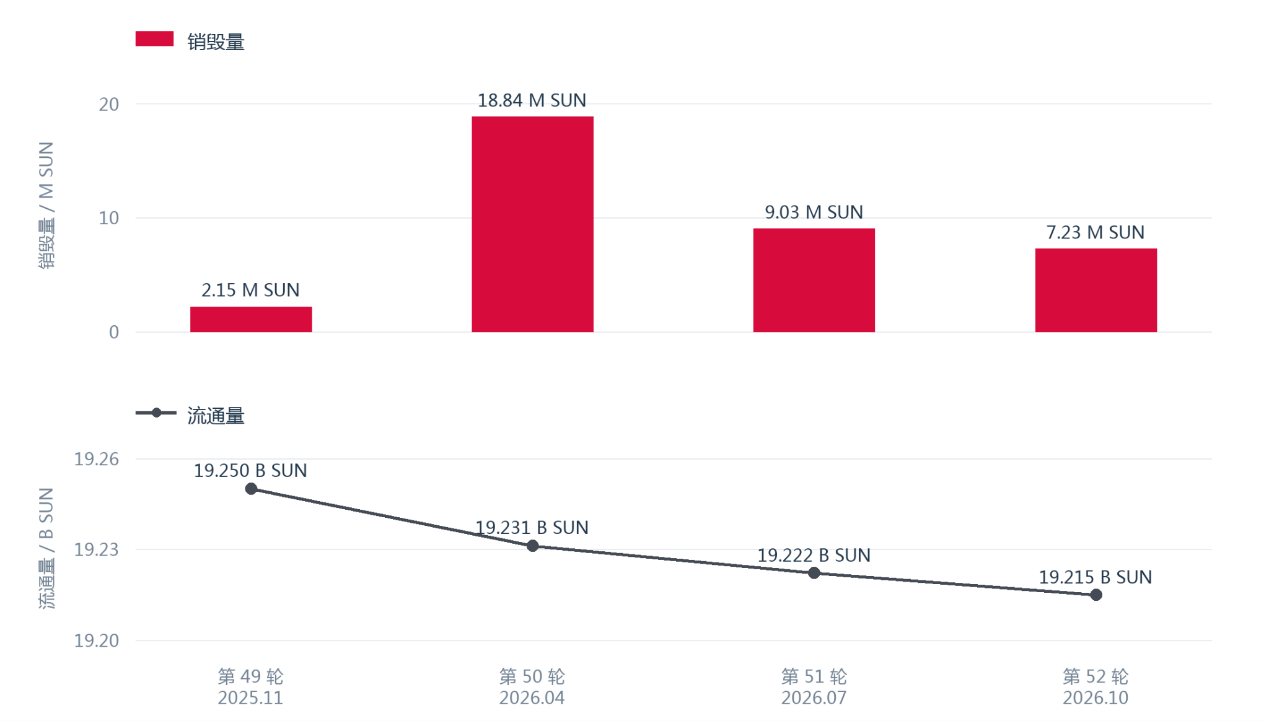
From the recent execution pace, since April 2026, SUN has burned approximately 18.84 million, 9.03 million, and 7.23 million separately. With the accumulation of burns, the current circulating supply of SUN has dropped to around 19.215B (about 1.9215 billion).
By combining the operational results of different product lines with the SUN buyback and burn mechanism, SUN.io has built a long-term operational system where multi-business operations and token deflation mutually promote each other, providing a broader operational foundation for the continued improvement of the SUN value capture mechanism.
BitTorrent: First Round Burn of 21.62 Trillion BTT, Decentralized Business Revenue Realizes Quarterly Buyback System
As JUST and SUN.io continue to deepen existing mechanisms, BitTorrent also welcomed important progress in its token economic mechanism. On October 16, 2026, BitTorrent successfully completed its first quarterly buyback and burn of BTT, permanently burning 21.62 trillion BTT, which accounts for 2.18% of the initial issuance, valuing around $7.6 million at the time of burning, marking that BTT officially implements a buyback and burn mechanism supported by decentralized business revenue, executed quarterly.
On October 17, BitTorrent simultaneously completed a brand strategy upgrade, becoming an open infrastructure for Web3 and AI, with a product matrix that includes P2P file transfer BitTorrent, decentralized computing network BTTInferGrid, and cross-chain expansion solution BTTC. The brand upgrade further clarifies its business matrix, providing a clearer operational foundation for BTT buyback funding sources.
Under this business matrix, according to established arrangements, BitTorrent will allocate 100% of decentralized business revenue for BTT buyback and burn, with funding sources covering BitTorrent's download acceleration and in-app services, BTTInferGrid decentralized computing power leasing, as well as BTTC network fees and other business scenarios. This arrangement expands the BTT buyback funding sources from distributed transmission businesses to decentralized AI computing and cross-chain infrastructure fields, directly linking the business revenues generated from different application scenarios to BTT buyback and burn.
The completion of the first round of buybacks and burns also means that BTT's long-term buyback and burn plan officially enters the actual execution stage. In the future, BitTorrent will continue to advance buybacks and burns quarterly, disclosing execution status through official dashboards and on-chain records, further enhancing the transparency and traceability of the token economic mechanism.
WINkLink: First Round Burn of 6.736 Billion WIN, Oracle Business Revenue Opens New Path for Value Capture
WINkLink also achieved its first quarterly buyback and burn. On October 19, 2026, WINkLink completed the first round of WIN quarterly buyback and burn, permanently burning 6.736 billion WIN, accounting for 6.74% of the initial issuance, valued at about $3.59 million at the time of burning. In terms of the number of tokens burned, the first round of WIN burns was the highest among the four projects, reflecting the actual execution scale of its first quarterly destruction.
In terms of mechanism arrangement, as an important oracle infrastructure in the TRON ecosystem, WINkLink allocates 100% of the protocol income generated from oracle services to WIN buybacks, concentrating on quarterly burns. This means that the protocol revenue generated by the oracle business will convert according to established mechanisms into WIN buyback funds, reducing token supply through permanent destruction.
The completion of this first round of burns not only marks the official implementation of the WIN buyback and burn mechanism but also further extends the income-driven buyback system of the TRON ecosystem into the realm of on-chain data services. As the oracle business continues to operate, future WIN burn scales will continue to execute, with its token economic mechanism more directly tied to business performance.
Business Growth and Token Economy Deeply Linked, Acceleration of TRON Ecosystem Value Release
With the successful launch of quarterly buybacks and burns in the TRON ecosystem by the four core projects: JUST DAO, SUN.io, BitTorrent, and WINkLink, the TRON ecosystem has successfully built an intrinsic value transmission closed loop of "real business revenue—open market buyback—on-chain permanent destruction—continuous reduction in circulation." This mechanism completely anchors decentralized real business profits as the underlying support, combined with standardized and predictable periodic destruction actions, accurately tightens the total supply of circulating tokens from the supply side, while continuously reinforcing the value anchoring of core assets from the demand side, truly linking ecological operational results to the direct conversion path for token economic growth momentum, comprehensively accelerating the value reassessment and release of key governance assets like JST, SUN, BTT, and WIN.
More than the total scale of single-round burns, a key point for long-term value lies in the native business revenue-generating capabilities and sustainability behind the buyback funds. The buyback funds for the four projects are rooted in their respective real business scenarios, independently generating stable cash flow: JUST DAO aggregates the revenue from JustLend's SBM lending market and staking sTRX, GasFree transfer service revenue, and eligible USDD protocol net profits; SUN.io builds a multi-channel cash flow reserve capable of withstanding market cycle fluctuations based on SunSwap's transaction fee sharing, SunPump platform protocol income, and SunX business income; BitTorrent injects decentralized business revenue directly into the BTT buyback pool; WINkLink permanently consolidates all oracle business income as a regular deflation fund for WIN.
Although the four projects cover different business tracks, they all anchor real business income to establish the token buyback and burn mechanisms, ensuring compliance, diversity, and stability for the funding sources of buybacks, while allowing the entire ecological deflation logic to be built entirely on a solid commercial foundation, thoroughly breaking away from the traditional path dependent on subsidy-based marketing destruction, and giving the deflation process of ecological tokens long-term sustainable intrinsic motivation.
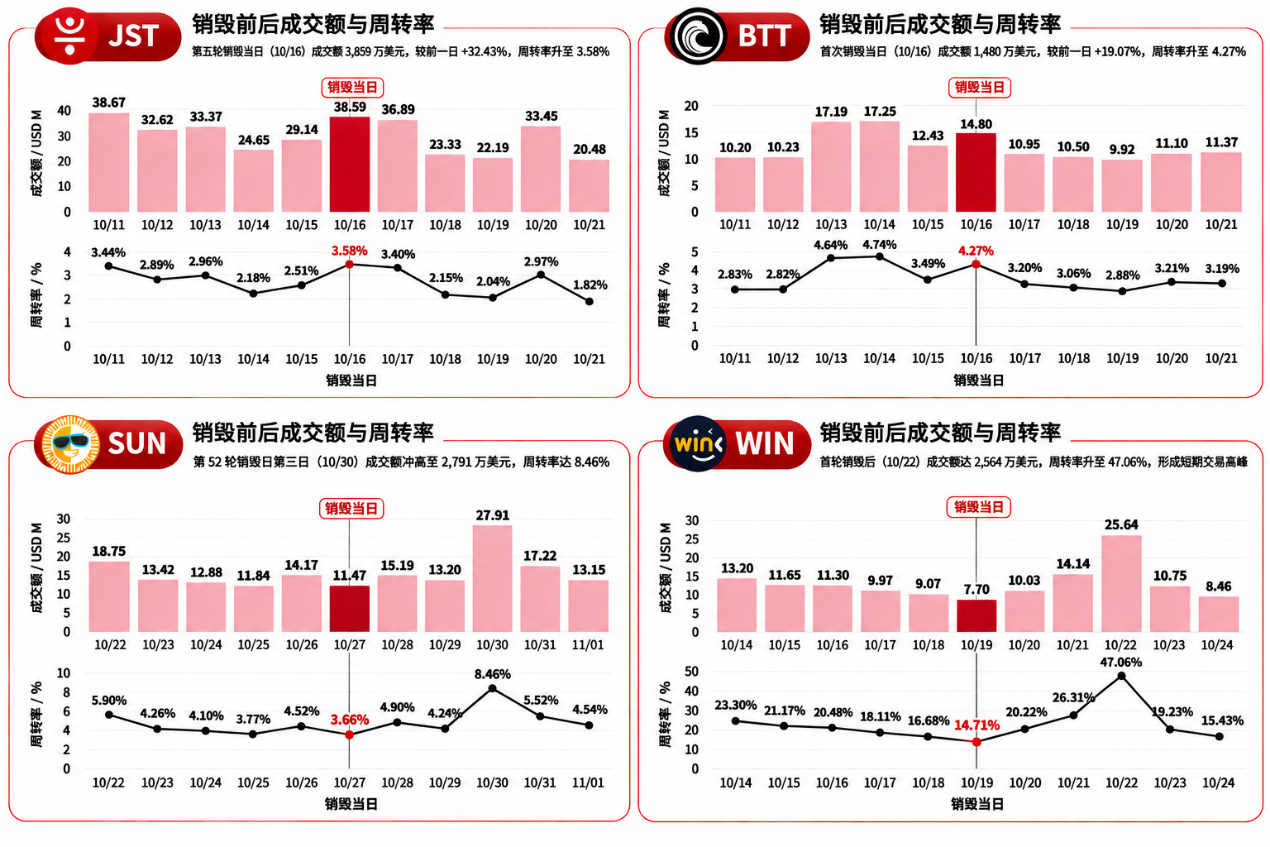
This real financial buyback and burn action has swiftly triggered positive resonance in liquidity and asset prices in the secondary market. From the short-term heat of the execution cycle, the trading activity of each token showed a stepwise increase before and after the destruction: on the day of the JST burn, the global spot trading volume surged to $38.59 million, a daily increase of 32.43%; on the day of BTT's first destruction, the trading volume reached $14.8 million, a weekly growth of 19.07%; the daily average spot trading volumes of SUN and WIN respectively reached $17.33 million and $13.80 million within five days after the destruction, increasing 21.96% and 25.04% compared to the five days before the destruction.
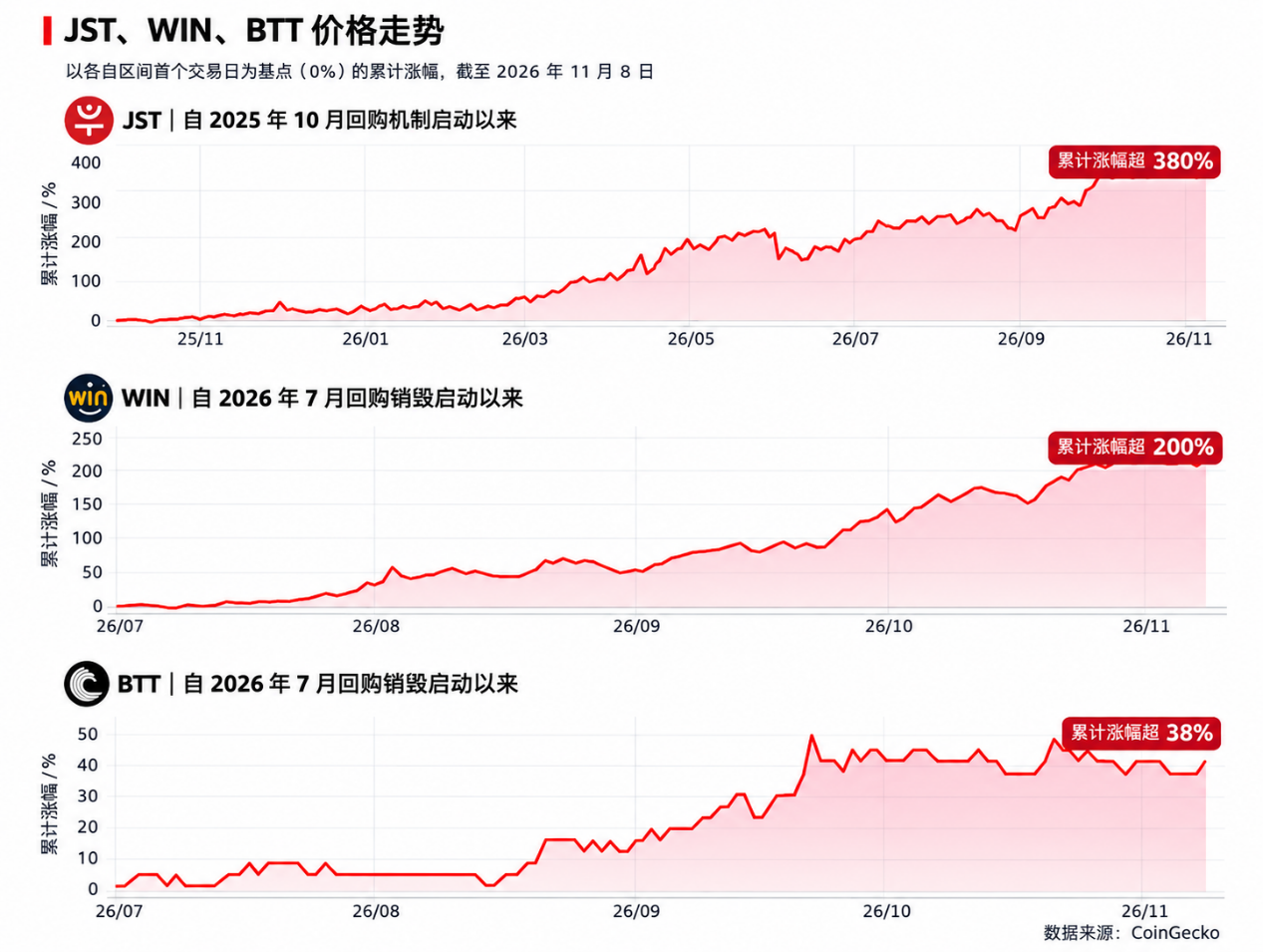
Looking at the extended cycle, continuous contraction on the supply side coincides with price increases in assets. Since the launch of the buyback mechanism in October 2025, JST has risen from a low point of about $0.030 to a peak of $0.146 on November 8, with a cumulative increase of over 380%. After the buyback and burn launched in July 2026, WIN saw an increase from $0.00002 to a peak of over $0.00006 on November 4, with a cumulative increase of over 200%; BTT rose from $0.00000026 to the current $0.00000036, with a cumulative increase of over 38%. This market performance reflects the support of improved supply-demand relations for asset valuation, with deflationary value effects supported by real business continuously being released.
Compared to the short-term fluctuations in market conditions, the deeper core value of the buyback and burn mechanism lies in establishing a sustainable, fully traceable value transmission path between ecological business development and the token economy. The two ends of this path are clear: on one end, ecological projects continuously provide stable and predictable cash flow income sources through ongoing expansion of application scenarios and iterative enhancement of product services; on the other end, business revenues that meet public rules are directed for open market buybacks and directly reduce the circulating supply of tokens through on-chain permanent destruction, binding ecological operational outcomes with the token economy in a completely transparent and verifiable way.
From the steady advancement of multi-round buybacks and burns for JST and SUN to the formal implementation of the first quarterly burns for BTT and WIN, the TRON ecosystem has successfully connected the complete value transmission chain of “business development—revenue accumulation—token buyback—supply contraction.” This transformation further solidifies the economic model resilience of the four ecological tokens, and promotes the ecological value capture from early single-point project practices to a comprehensive expansion towards multi-project interconnection and multi-business collaboration, clearly reflecting TRON ecosystem’s commitment to deepening business value transmission mechanisms beyond mere application scenario construction.
In the future, as core businesses like on-chain finance, decentralized transactions, distributed infrastructure, AI computing services, and oracle services continue to expand, the income-driven buyback and burn mechanism of the TRON ecosystem will gain even more diversified underlying business support, with business growth and token deflation forming a continually reinforcing positive feedback loop, ultimately transforming the long-term ecological dividends released by the ongoing expansion of the TRON commercial landscape into shared asset value gains for every token holder.
免责声明:本文章仅代表作者个人观点,不代表本平台的立场和观点。本文章仅供信息分享,不构成对任何人的任何投资建议。用户与作者之间的任何争议,与本平台无关。如网页中刊载的文章或图片涉及侵权,请提供相关的权利证明和身份证明发送邮件到[email protected],本平台相关工作人员将会进行核查。


