Author: Uniswap
Translation: TechFlow
TechFlow Introduction: Wall Street has long operated on an order book mechanism, while the US Securities and Exchange Commission (SEC) innovation exemption requires the deployment of automated market makers (AMM) on public blockchains. This command officially takes effect on September 17, 2026, establishing a new compliant trading category called “Tokenized Securities Trading Venue (TSV)” and granting eligible venues a five-year registration exemption.
To date, the cumulative trading volume of tokenized stocks on the Uniswap protocol has exceeded $20 billion. This article, based on the Uniswap official interpretation of the innovation exemption, directly explains how AMM is reshaping traditional market-making and around-the-clock settlement systems, as well as how developers can utilize Uniswap v4 permissioned liquidity pool hooks to construct a compliant tokenized securities market.

Wall Street relies on order book operations, while the SEC's innovation exemption requires automated market makers (AMM) to operate on public blockchains.
On September 17, 2026, the exemption grants a five-year exemption for a newly defined venue category, the “Tokenized Securities Trading Venue (TSV).” TSV trades tokenized stocks within the National Market System (NMS) via permissioned liquidity pools.
As long as the stipulated conditions are met, these venues are not required to register as securities exchanges or alternative trading systems (ATS), and complying liquidity providers (LP) will not be classified as securities dealers.
So far, over $20 billion in stock tokens have been traded on the Uniswap protocol. This trading volume primarily comes from products like Robinhood Stock Tokens and xStocks, as well as issuers like Ondo and Dinari. Stock exposure has now been tokenized on-chain, and shareholder rights may be the next step.
The US stock market is worth up to $79 trillion. Automated market makers (AMM) will change how these assets are traded, the liquidity providers involved, and the market-making entry barriers. Below is our interpretation of the order and its implications for teams building on the Uniswap protocol.
AMM Upgrading Market Infrastructure
AMM automates most of the work done by professional market makers. Anyone can directly deposit assets into a smart contract to provide liquidity. This widens the pool of participants able to engage in market making, increases market competition, and opens up new paths for issuers to build liquidity.
Liquidity pools operate 24/7, supporting night, weekend, and holiday trading. Currently, thousands of front-end interfaces around the world are connected to use AMM, enabling any newly created market to immediately access global distribution channels.
AMM also expands the selection of trading pairs for assets. For example, NVIDIA stock is traded in US dollars on traditional exchanges. On-chain, it can trade paired with tokenized S&P 500 funds, money market funds, or cryptocurrencies.
Pairing highly correlated assets (e.g., NVIDIA and the S&P 500 index) can reduce the relative price risk for liquidity providers. With the help of an automated routing system, traders can still use any other asset for direct purchases.
We can now see the initial formation of such markets. In August this year, ten tokenized stocks and ETFs began trading on the Robinhood Chain, quoting SPY. Three months later, over 40 assets have established SPY liquidity pools, generating over $900 million in transaction volume across 130,000 wallet addresses.
The demand for on-chain stocks is real and continues to grow. TSV provides financial institutions with a new path to meet this demand.
Operation Mechanism of TSV
TSV provides AMM liquidity pools for approved participants on public, permissionless blockchains. Compared to traditional securities exchanges, TSV bears lighter regulatory obligations, and liquidity providers (LP) are not required to register as dealers.
Running on AMM also changes how the settlement mechanism operates. In the current traditional system, brokers route your orders, exchanges or wholesalers handle execution, and exchanges clear and settle deliveries with clearinghouses and depositories.
In TSV, trading and settlement are atomically completed in the same on-chain transaction: either both parties’ funds and assets complete delivery simultaneously, or everything rolls back without happening at all, eliminating the need for a central counterparty.
Listed companies have a say in whether their stocks are traded on TSV. TSV must notify stock issuers 30 days in advance and provide an opportunity to raise objections. Once a stock is listed, any application accessing that liquidity pool can offer trading services to approved users.
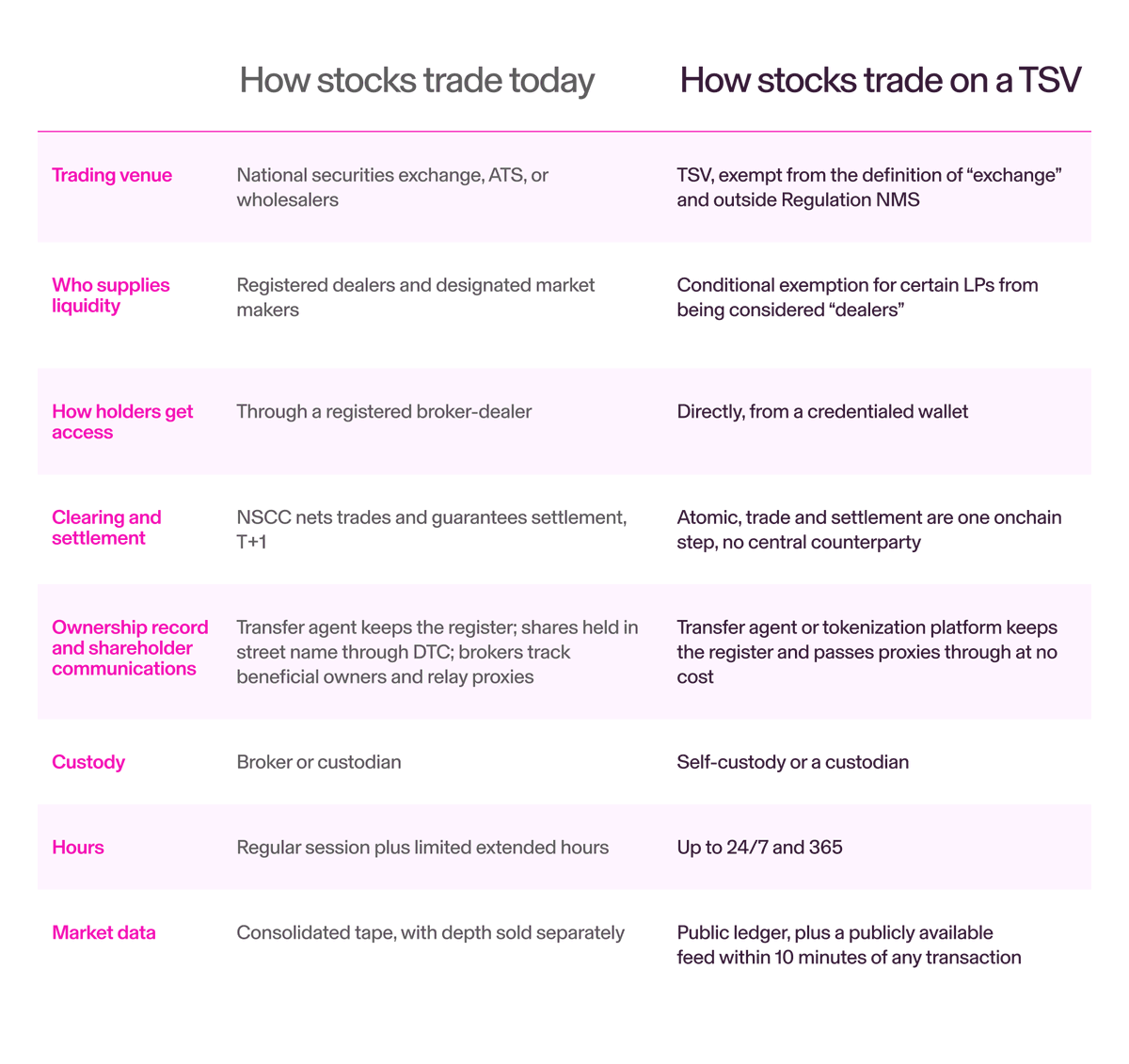
Figure: Comparison of traditional securities trading models and Tokenized Securities Trading Venue (TSV) regarding trading venues, liquidity provision, clearing and settlement, and trading hours
To obtain exemption qualification, trading venues must meet a series of compliance conditions, including public fee disclosures, access control, asset and trading volume limits, and trading halt mechanisms. So, how to enforce these rules on-chain?
Uniswap v4 supports robust market structure customization capabilities through a hooks mechanism, and our Permissioned Pools hook provides a solid infrastructure base for trading venues.
Permissioned Trading Venues on Uniswap
Since its launch in 2018, the Uniswap protocol has processed over $4.5 trillion in trading volume across more than 30 blockchains, with its core smart contracts never experiencing security breach incidents.
Uniswap v4 allows development teams to highly customize the operational logic of liquidity pools. Hooks are programmable codes that trigger automatically at specific nodes (e.g., before or after trade execution). Actual trade execution and fund settlement still occur on the underlying protocol, but operators can decide who can trade, what assets can be traded, and when trading can occur.
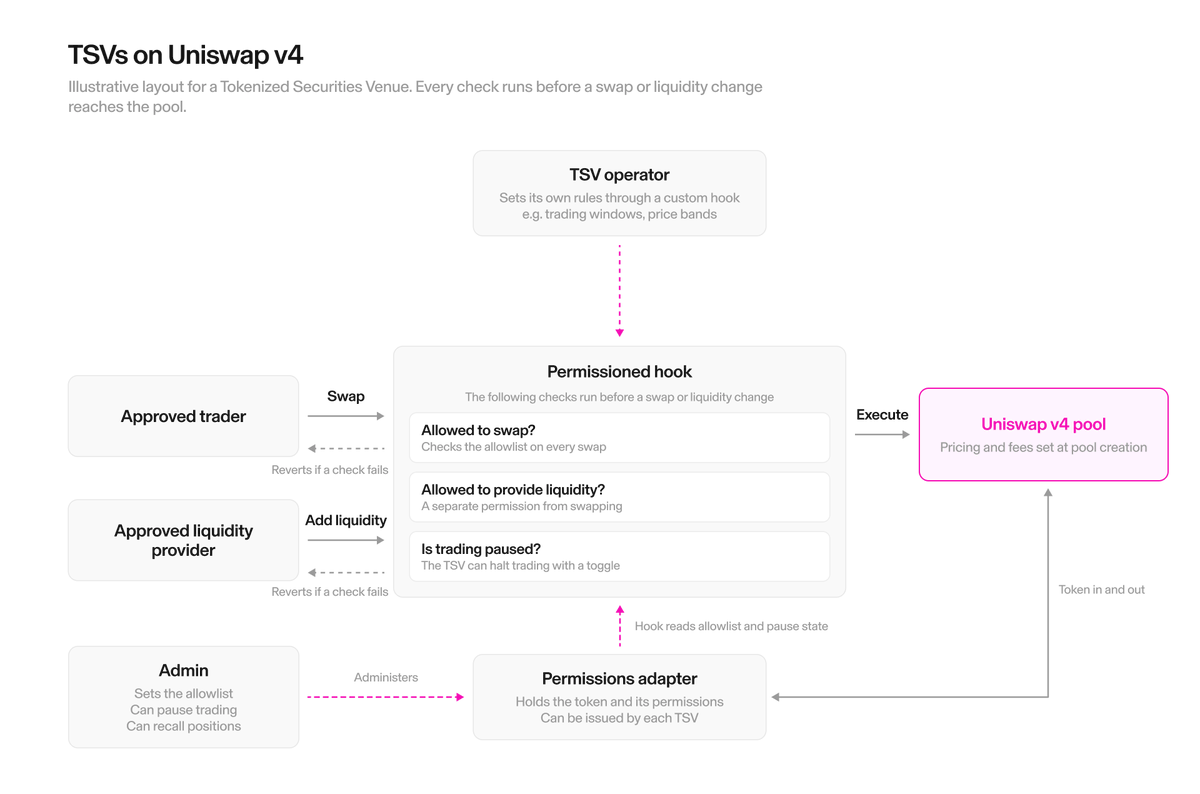
Figure: Diagram of tokenized securities trading venue (TSV) permission hooks and liquidity pool structure based on Uniswap v4
Building Together with Uniswap Labs
Introducing stock assets on-chain is just the starting point; deeper changes involve the evolution of market-making methods and who qualifies to be a market maker. As the implementation of this exemption progresses, we hope to collaborate with various teams to explore the specific forms of these new markets in practice.
TSV Operators: We can provide you with a detailed demonstration of how to use hooks to implement whitelisting control, trading halt pauses, and other liquidity pool-level compliance controls.
Asset Issuers: We can assist you in understanding how tokenized stocks are traded on AMM and the capability boundaries of the Uniswap protocol.
Liquidity Providers (LP): We can share research data on the real behavioral characteristics of AMM liquidity and key changes occurring in permissioned liquidity pools.
If you are exploring how to build, issue assets, or provide liquidity within the framework of the innovation exemption, feel free to contact us.
Disclaimer: Uniswap Labs does not operate, control, or participate in the daily operations of any tokenized securities trading venue. Any trading venue built on the Uniswap protocol operates independently and is fully responsible for its design decisions, legal analyses, and compliance with applicable laws (including the innovation exemption and its various prerequisites).
The innovation exemption is temporary and conditional, and changes may occur in the future. This article is for informational reference only and does not constitute legal, financial, or investment advice, nor does it constitute an offer or invitation to buy or sell any securities or digital assets or to provide liquidity for them.
免责声明:本文章仅代表作者个人观点,不代表本平台的立场和观点。本文章仅供信息分享,不构成对任何人的任何投资建议。用户与作者之间的任何争议,与本平台无关。如网页中刊载的文章或图片涉及侵权,请提供相关的权利证明和身份证明发送邮件到[email protected],本平台相关工作人员将会进行核查。


