Written by: Sam, Techub News
Introduction
In the mission document "EF Mandate" released by the Ethereum Foundation in March this year, there is a statement: Ethereum is a liberating technology that frees people from power relations imposed without genuine consent, freeing them from environments where "dissent comes at a heavy cost."
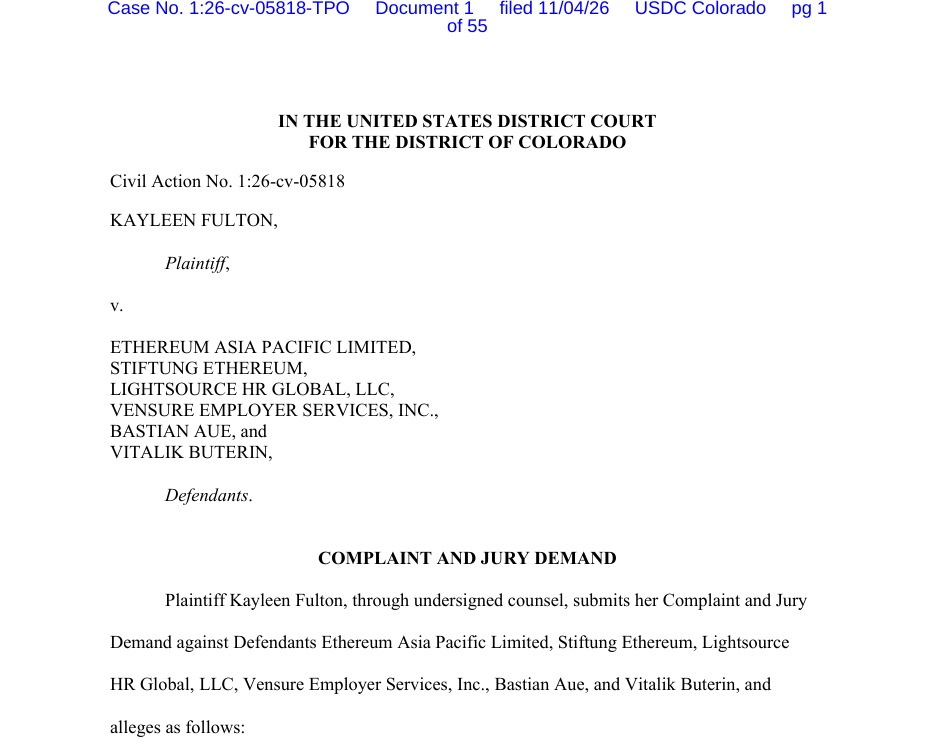
A 55-page lawsuit submitted to the U.S. District Court for the District of Colorado on November 4 quoted this statement verbatim, claiming that the Foundation did not apply this principle to its own employees. The plaintiff is Kayleen Fulton, known in the Ethereum community as Nixo, who was responsible for the Foundation's Protocol Support team and also served as the host coordinator for the Ethereum protocol upgrade core meetings All Core Developers. Among the six defendants she is suing is Foundation board member Vitalik Buterin. Recently, a post on the Reddit Ethereum forum titled "Where Dissent Imposes A Heavy Price" has become a hot topic, using precisely this statement.
Core Summary
- In the lawsuit, Kayleen Fulton claims that the Foundation used a mission document containing a "Source Seppuku License" as a condition of employment, requiring employees to affirm their stance by a deadline or be considered to have resigned; 79 employees had previously voted to request the removal of this clause, but it was retained in the final version.
- Kayleen Fulton claims she informed management in writing on March 24 that she was diagnosed with ovarian cancer, and on March 25, she and colleague Trent Van Epps led the submission of a joint letter signed by 53 people; on April 6, the two organizers were fired by then co-executive director Bastian Aue, 30 minutes apart, without being informed of the reasons.
- The lawsuit cites parts of recordings from Fulton’s conversation with Vitalik Buterin on May 1, in which Vitalik discussed that "if you reward disruptive behavior with results, everyone will know that such performances are a way to push results internally at EF."
- Fulton has presented 11 claims based on the Americans with Disabilities Act, the Family and Medical Leave Act, and Colorado’s anti-discrimination laws, requesting the court to declare that her signed resignation agreement and the arbitration clause in Singapore cannot prevent her from suing.
- The above statements are all unilateral claims made by the plaintiff and have not yet been tried by the court; as of the time of publication, neither the Ethereum Foundation, Vitalik Buterin, nor Bastian Aue have publicly responded.

1. A Mission Document Stating "Seppuku"
According to the lawsuit, on February 25, 2026, Foundation board member Aya Miyaguchi distributed version 1.4 of the "EF Mandate" to all employees. On page 11, it introduces a segment titled "Source Seppuku License" with "We have like-minded partners... Let us borrow a few words from them": Authors, maintainers, editors, or redistributors must adhere to the commitments in the license, or "commit seppuku"; the final sentence reads, "If we fail to uphold our solemn commitments to Ethereum and the Infinite Garden, may we fall on our swords in ritualistic fashion."
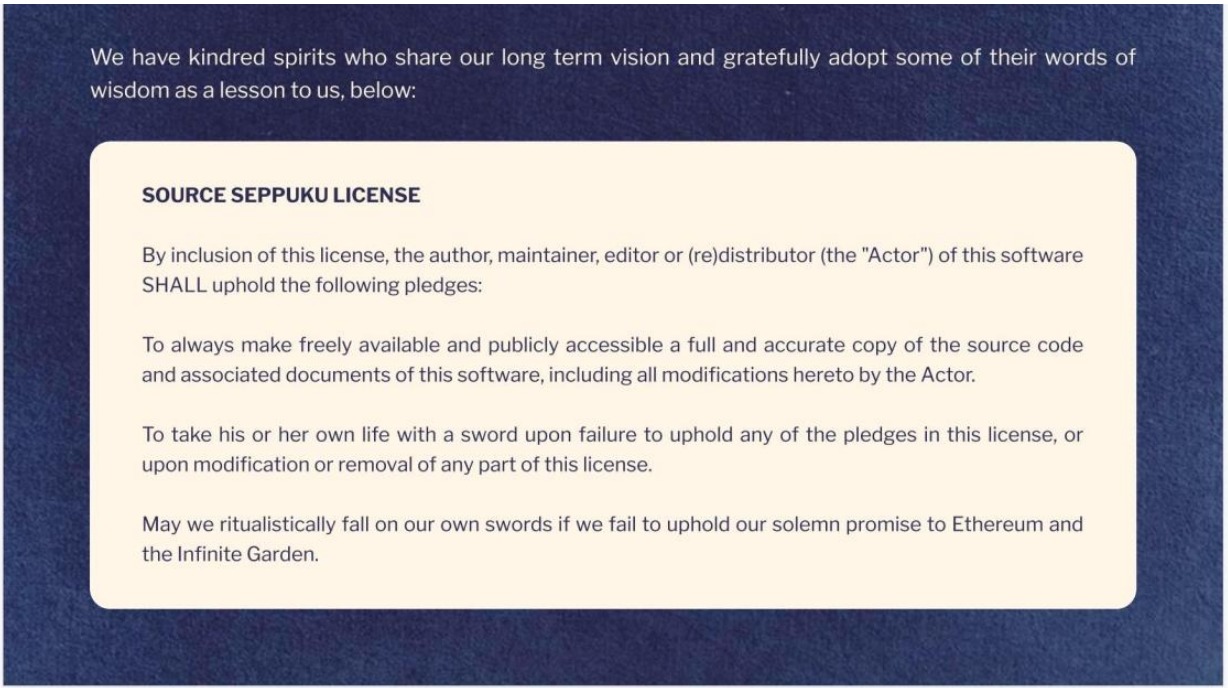
The lawsuit states that employee opposition began the same day. Trent Van Epps wrote on the internal channel on February 27 that the seppuku license "must be removed; if this is the litmus test for agreeing with CROPS, then I fail"; on March 2, he initiated a removal proposal, which 79 employees voted in favor of. Some employees inquired in writing whether signing meant they had to commit suicide; others mentioned that a colleague had just recently committed suicide the previous year. On March 5, Vitalik told employees that the document was still being revised, "especially the parts that everyone is most concerned about and confused about will see major changes."
On March 13, the Foundation officially released the "EF Mandate." According to the description in the lawsuit, the vow was unchanged, merely converted into a small footer graphic with cartoonish fonts, three cartoon cats, and a winking anime character, leaving only one searchable text: "If the Foundation fails to uphold its solemn commitment to Ethereum, may the Foundation fall on its sword." The Foundation further wrote the full text onto the Ethereum chain. The version of the Mandate currently on ethereum.org still retains this segment.
The lawsuit quotes Vitalik defending this decision that day: "Being harmless like Mozilla is also a possible choice and fully aligns with CROPS, but we feel that the kind of harmlessness in that sense is not the temperament we need right now." Then co-executive director Hsiao-Wei Wang stated that she did not support applying Milady-style aesthetics to a mission document with a millennial vision, to which Vitalik responded, "The controversial nature of these aesthetics is one of the focal points."
2. Three-Day Deadline and a Letter Signed by 53
The lawsuit states that on Friday, March 20, Bastian Aue sent a notice to all staff: the Mandate "is not suitable for everyone," those who cannot agree should "make the only decent decision, leave EF"; everyone must submit a form by the following Monday, "failure to submit will be treated as a decision to leave." Some employees asked if signing meant they would not have to commit seppuku, and Aue replied that was "part of the art piece of the Mandate," a deliberately chosen cultural reference, "not taken literally"; when asked who agreed to include that part, he wrote, "If you are asking who broadly agreed to include it, that would be me." Later that day, the form added an explanation that this commitment "is not related to the literal meaning of seppuku."
The next day, Vitalik wrote that this suddenness was intentional: "This kind of hard cut cannot be designed by a committee, so this announcement is undemocratic."
According to the lawsuit, Fulton was diagnosed with ovarian cancer on March 19, and on March 24, she emailed Aue, two board members, and the HR department to explain her condition and upcoming treatment, requesting that her employment status not be changed. Aue and the two board members did not respond.
On March 25, Fulton and Van Epps sent a joint letter to the board and all employees, with signatures ultimately reaching 53 people, about half of the department in question. The letter read: "We agree with the overall direction of the Mandate, but cannot sincerely affirm under these conditions... We will continue to fulfill our duties, we will not resign." Two days later, Aue announced that the signatures would be taken as an affirmation of the Mandate’s content, writing, "If I could do it all over again, I would definitely handle many aspects differently." All 53 signatories retained their jobs.
3. April 6: Two Organizers Fired 30 Minutes Apart
The lawsuit describes April 6 as follows: at 8:10 AM (Mountain Time), Aue posted a long message in the all-staff channel, stating that opinions could only serve as "input for decision making, not pressure." If he could not persuade decision-makers and undermined confidence in EF, "maybe it would be better for you to contribute to Ethereum outside of EF." Twenty minutes later, he fired Van Epps in a video meeting; at 9 AM, it was Fulton’s turn.
Fulton stated that Aue said in the call that the decision was his alone, that he had lost confidence in her, while also stating she had a "great resume," "broad support among colleagues," and "was not considered deficient in any responsibilities," but he never provided a reason. He also suggested that if the external organization EthStaker was willing to take her, the Foundation could continue to pay her salary for a year. That afternoon, the Foundation's Singapore affiliate, Ethereum Asia Pacific Limited, sent a resignation agreement requiring her to sign within three days, waiving all claims including those for disability discrimination, or "no severance or other benefits will be provided." She signed within three days but withdrew it through a lawyer eight days later. On May 14, the company’s lawyer responded, insisting the agreement was valid, the arbitration clause enforceable, denying any unlawful treatment or retaliation, and still failing to specify the reason for her termination.
The lawsuit also noted that within the same week, two of the three coordinators in the protocol department announced their departures, and one went on leave; Hsiao-Wei Wang began her leave on April 6 and resigned on June 18.
4. The Recording from Svalbard
This lawsuit names Vitalik as a defendant, keying in on a conversation on May 1. The lawsuit states that on that day, during the Soldøgn Interop conference held in Longyearbyen, Svalbard, Norway, Fulton, who was responsible for recording the meeting, and Vitalik discussed her termination; halfway through the conversation, the recording device was handed to her, capturing the latter part of the discussion; Norway permits one-party recording of conversations.
According to the lawsuit, Fulton asked him how he viewed an organization that immediately fired an organizer after an employee disclosed a cancer diagnosis. Vitalik did not deny this premise but stated that the question was about "what kind of interaction you want to reward internally at EF," "if you reward disruptive behavior with results, everyone will know that performing such acts internally and externally is a way to push results at EF." The lawsuit notes that he acknowledged that, in hindsight, employees should have been given weeks instead of three days to decide whether to agree with the Mandate.
Based on this, the plaintiff asserts that a serving board member explained the firing of a cancer patient as a means of intimidation. Among her 11 claims, she accused Vitalik, as a board member involved in passing and maintaining the Mandate and ultimatum, of aiding and abetting discrimination and retaliatory dismissal, and included him as a defendant under claims of intervention and retaliation under the Family and Medical Leave Act, as well as intentional infliction of emotional distress. The lawsuit states that, to the best of the plaintiff's knowledge, Vitalik "approved, ratified, or acquiesced" to the termination decision, but there is no evidence that he issued direct orders.
5. What the Lawsuit Is About
Fulton's 11 claims include: discriminatory dismissal and retaliation in violation of the Americans with Disabilities Act, intervention and retaliation in violation of the Family and Medical Leave Act, discrimination and retaliation in violation of Colorado state anti-discrimination laws, unlawful confidentiality clauses, improper termination in violation of public policy, and intentional infliction of emotional distress. She seeks compensation for unpaid wages and future salary, compensatory and punitive damages, and requests the court to declare that the resignation agreement cannot prevent her from suing, nor is she obligated to arbitrate in Singapore or anywhere else. The lawsuit claims her original salary was $195,000, and her health insurance terminated 12 days before her second surgery.
The first procedural hurdle is arbitration. The resignation agreement stipulates that disputes are to be arbitrated at the Singapore International Arbitration Centre under Singapore law, and the Foundation party claimed the agreement was valid in a lawyer's letter in May; Fulton argues that the signature was under pressure of a three-day deadline and loss of health insurance, and that Singapore law does not provide rights she is entitled to under U.S. federal law and Colorado state law. The question of whether the case will be tried in Colorado or sent to Singapore may be the first issue to be decided.
A final detail from the lawsuit: Fulton is still hosting All Core Developers meetings outside of the Ethereum Foundation. As the lawsuit states, "The Foundation fired her, but the engineers building Ethereum did not."
References
2. Ethereum Foundation Blog: The Promise of Ethereum: Introducing the EF Mandate (2026-03-13)
3. ethereum.org: Full Text of the EF Mandate
4. Reddit r/ethereum: Where Dissent Imposes A Heavy Price
Editor’s Note: The facts in this article are primarily based on the complaint submitted by the plaintiff Kayleen Fulton, representing one side's statements and allegations, not yet reviewed by the court or responded to by the defendants. The internal chat records, emails, and recorded conversation quotes mentioned come from the lawsuit; the original Mandate text conforms to the version published by the Ethereum Foundation's official website. Quotations have been translated by the editor. As of publication, the Ethereum Foundation, Vitalik Buterin, and Bastian Aue have not responded through public channels.
Disclaimer: This article is for informational reporting only and does not constitute any investment advice.
免责声明:本文章仅代表作者个人观点,不代表本平台的立场和观点。本文章仅供信息分享,不构成对任何人的任何投资建议。用户与作者之间的任何争议,与本平台无关。如网页中刊载的文章或图片涉及侵权,请提供相关的权利证明和身份证明发送邮件到[email protected],本平台相关工作人员将会进行核查。


