Translation: Sam, Techub News
Original:Where Dissent Imposes A Heavy Price (Reddit r/ethereum)
Introduction
Editor's Note: On November 4, Kayleen Fulton (Nixo), former head of Protocol Support at the Ethereum Foundation, filed a lawsuit in the U.S. District Court for the District of Colorado against the Ethereum Foundation, co-executive director Bastian Aue, and Vitalik Buterin. She claims that she was fired after leading the opposition against the "source code license" in the foundation's mission document "EF Mandate" and disclosing a cancer diagnosis. This long article posted on Reddit's Ethereum forum, authored by someone who claims to have invested over a decade in Ethereum, compares the lawsuit to the "EF Mandate" paragraph by paragraph, arguing that the foundation's leadership has violated the principles they established and proposing corrective measures. The opinions in the article are solely those of the author, and the content of the lawsuit represents the plaintiff's side of the statement and has not yet been reviewed by the court; the foundation and the parties involved have not publicly responded.
The following is the full translation.

A court document submitted last week filled in the missing pieces of the series of high-profile departures from the Ethereum Foundation this year. The "Mandate," which escalated the conflict, clearly states in its own words how the leadership should have acted originally and what needs to be done now.
Over the past few days, I have read this lawsuit multiple times and written this article to share my findings. It describes the damage caused to the foundation's legitimacy, damage it inflicted upon itself, which also impacted the entire ecosystem.
Mandate
On March 13 of this year, the Ethereum Foundation released a document titled "Mandate," claiming it was part charter, part declaration, and part internal guide. I have read many mission statements, and few seem sincere or useful, but this one actually is quite good in most respects. I have spent over a decade of my life on Ethereum, and the values listed in the document clearly articulate the reasons I became involved in this field. Its core is CROPS: ensuring Ethereum remains resistant to censorship, open source, protecting privacy, and secure.
I am writing this article because I believe that Ethereum and decentralized technology stacks are crucial technologies for safeguarding personal freedoms, and they can only realize their potential under careful management. Because of this belief, my personal life and career revolve around this ecosystem, and that makes this article difficult to write: the evidence clearly shows that the Ethereum Foundation's leadership has failed in its management responsibilities. I am writing this to shed light on what has happened, why it has caused profound harm to the entire Ethereum ecosystem, and how to correct the course.
When the "Mandate" was released, divisions emerged within the foundation, followed by a wave of speculative high-level departures. Almost no details were available to the outside world before Kayleen Fulton, former head of Protocol Support at the foundation (most in the ecosystem call her Nixo), filed a lawsuit in Colorado federal court. This lawsuit fills in the blanks we have been speculating about earlier this year, especially regarding how newly appointed co-executive director Bastian Aue suppressed dissent within the foundation (including from board members) and demanded everyone demonstrate unquestioning obedience, a practice that is directly contrary to the "Mandate" he himself supports.
The "Mandate" states that the foundation "is not the parent, owner, or ruler of Ethereum." It says the foundation will "acknowledge mistakes when we make them, especially when we make big mistakes, with humility and decorum, and honestly and clearly explain why our views have changed." It says: "We work with good faith to uphold high standards: resilient systems are built by those who can express differences clearly without malice and maintain curiosity under pressure." It further describes Ethereum itself as a liberatory technology that frees people from "power relations imposed without genuine consent or environments where dissent comes at a heavy price."
The lawsuit lists defendants including the foundation's Swiss and Singapore entities, two nominal employer service companies, co-executive director Bastian Aue, and Vitalik Buterin. This is a document from the plaintiff's side, meaning it represents one perspective and interpretation of the facts, and the foundation has yet to respond. However, most of the content described is drawn from the foundation’s own internal channels, and I know and have interacted with enough people who were there at the time to tell you: it accurately depicts what happened.
Just a few days after the "Mandate" was released, it faced the kind of test that it champions: those who maintain curiosity under pressure and express dissent clearly without malice. Those who expressed dissent most cautiously and best met the standards of the "Mandate" were fired, and the culture of open collaboration within the organization did not survive after they left.
Suicide Clause
I mentioned at the beginning that I generally agree with the content of the "Mandate." So, why would people who originally collaborated for a common goal that was important to them begin to argue about it?
Page 11 of the "Mandate" features an illustration titled "SOURCE SEPPUKU LICENSE." This license is a "ready-made product," a joking permit from the Milady NFT circle, which makes Bored Ape look like Rhodes Scholars. The only public source I could find was a page on the Remilia (the company behind Milady NFT) wiki created on February 5 of this year, 20 days prior to the draft of the "Mandate" being sent to employees. In any other context, it would just be awkward and inconsequential.
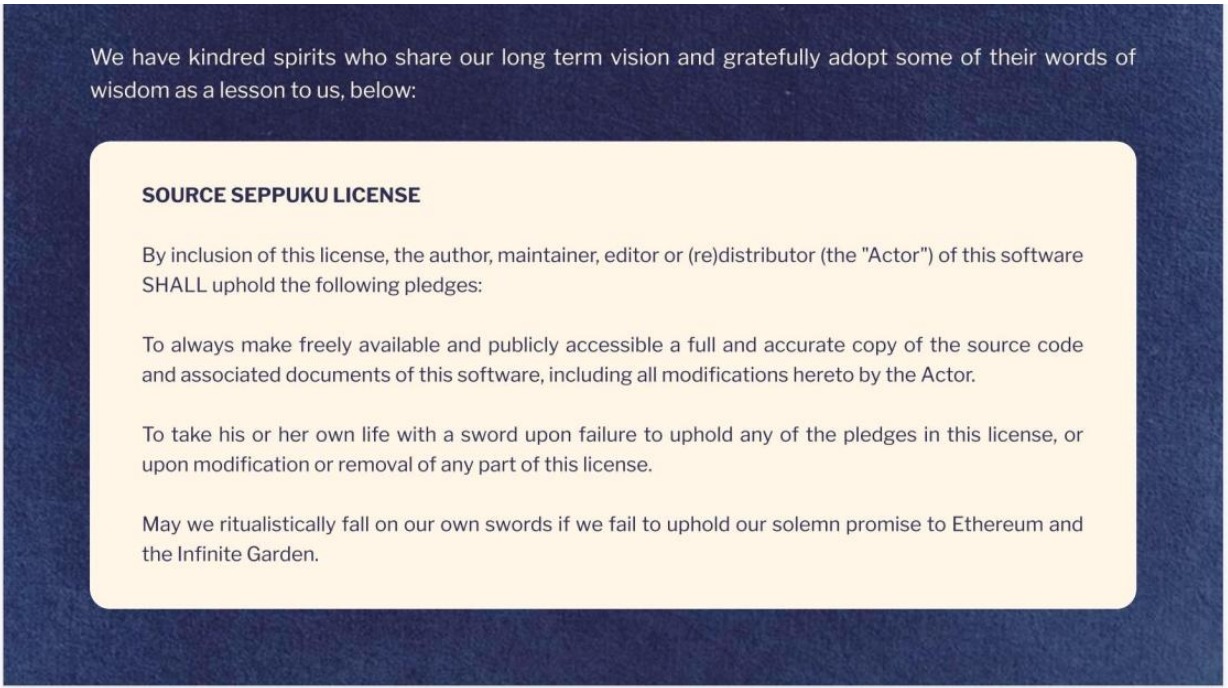
This clause stipulates that any "author, maintainer, editor, or redistributor" should "commit seppuku with a sword if they fail to fulfill any commitment in this license, or modify or delete any part of this license." Below it, the foundation added its own line: "If the foundation fails to fulfill its solemn commitment to Ethereum, may the foundation commit seppuku," followed by a heart emoji.
Some defend this by saying it was just an ill-timed joke from leadership, akin to a line from Michael Scott in "The Office." The problem with a joke is that it has to resonate with the audience you are facing, and the audience here is the foundation's employees. On February 25, board member Aya Miyaguchi sent the draft to them, asking them to adopt it as their own. They told the board in writing how they felt about it on the board's own channel. Two days after the draft was sent, Trent Van Epps wrote that the license "must be deleted." By March 2, there was already a formal deletion proposal, and 79 employees voted in favor. One employee wrote to management asking if signing meant he had to commit suicide. Another employee said he had just lost a colleague to suicide the year before. On March 5, Vitalik Buterin told employees that the "Mandate" was under revision and "there would be significant changes, especially in the areas where the most concern has been expressed." It seemed that decency would prevail.
On March 13, the board released it unchanged, every word intact, instead created as a small footer graphic, using a font similar to Comic Sans, tilted and embellished with glitch effects, beside some cartoon cats. The word "seppuku" was deleted from retrievable text; searches on the page found nothing. Subsequently, the foundation wrote this document into the Ethereum blockchain.
This last detail haunted me. Regardless of what you think of this license, the board had the voting results, had a week, and had written objections presented before it, yet it took a week to redesign the style of this clause rather than delete it. Buterin explained this choice on the day of the release: in principle, being "harmless like Mozilla" was not a problem, "but we feel that that kind of harmlessness is not the temperament we need right now." As the lawsuit states: "An organization does not spend a week redesigning a clause it finds meaningless."
Vitalik Buterin is a principled and deep thinker, so it is hard for me to understand how all this makes sense to him. The dissent was raised in the board's own channel, including the colleague lost to suicide. He committed to major changes three days later. Yet this joke was sent out unchanged, re-styled, and recorded on the blockchain. He is neither an indifferent nor malicious person, so I can only speculate that his statement about "the contentiousness of these aesthetics being one of the focal points" was either a judgment error or someone gave him advice that went against his own values.
Ultimatum
On March 18, Fulton wrote in the all-employee channel that she "cared less about the association with seppuku or Milady and was more concerned that a nearly unanimous opinion was openly ignored and then dismissed," and that "there is almost no trust between the board and other parts of the organization."
Co-executive director and board member Hsiao-Wei Wang publicly replied that her concerns "are critical to the future of EF." While Wang agreed with this concern, another co-executive director Bastian Aue responded to Fulton on the morning of March 20, Friday, saying: "However, the time for sharing concerns about the Mandate is now past. It is time for execution."
Two hours later, the ultimatum came. Every employee was required to submit a form by the end of the day Monday. The form had two options. The first was: "I personally commit to following the direction set forth in the Mandate, pledge to help transform it into well-argued strategies in my area of responsibility, and commit to focus singularly and wholeheartedly on achieving the critical tasks necessary to realize it. From today until my last day at EF." The second was: "I cannot confidently make the above commitment and wish to apply for additional months of compensation and leave EF as soon as possible." Anyone who did not resonate with this document was invited to "make the only decent decision and leave EF." There was also a line: "Failure to submit will be regarded as a decision to leave."
When asked why the default option was resignation, Aue wrote: "It must default to leaving to ensure that everyone who stays actively makes a commitment." When asked who agreed to include this suicide pledge, he said: "If you're asking who agreed to that in a broader sense, it was me."
One engineer asked if signing this form meant he had to commit suicide. The response he received was that this pledge was "part of the Mandate artwork, a cultural reference just like other elements in the document, deliberately chosen, but not taken literally." Later that day, the form was modified to specifically clarify that this pledge "has nothing to do with literal seppuku."
Clearly, he did not realize the absurdity: an organization modifying its loyalty form to clarify it does not actually require suicide, while insisting everyone must sign it to keep their job.
The next morning, Buterin wrote that the abruptness was indeed the point: "Such rigid division is precisely not something the committee can design, hence this announcement is undemocratic." The deadline was later extended by two days, but this requirement was not retracted.
The Letter
At this moment, those who truly built Ethereum did what the "Mandate" hoped to see. From March 24 to 25, members of the protocols department, the researchers and coordinators running the protocol upgrade process, drafted a collective response in a channel. In this channel, department coordinator Tim Beiko, Fulton’s superior, moved management out so employees could speak freely. He also reminded everyone, "For many, walking away is not a viable option for various reasons (economic, benefits, etc.)."
The letter was sent to the co-executive directors, board, and all employees on March 25, issued by Fulton and posted in her name in the channel; it was drafted by her and Van Epps coordinating. The letter stated:
We agree with the general direction of the Mandate but cannot sincerely state so under these conditions. We intend to continue contributing to Ethereum in accordance with the values of CROPS and self-sovereignty. We will fulfill the responsibilities assigned to us; we will not resign. Many of us signed our commitment to the Mandate under pressure of fear of losing our jobs and livelihoods. We believe their responses in the survey were coerced and meaningless.
Every EF employee I know who signed the pledge stated they disagreed strongly but wanted to keep their jobs. They were led to feel a false sense of "true choice": sign or leave the job that centered their lives. One person I communicated with at the time described their team as "demoralized," which led to a complete collapse of trust in the organization's leadership. For these individuals, this was not just a job; Ethereum had personal significance for them, and their voices were ignored in favor of a leader who had just told them "the time for giving feedback had passed."
The letter garnered 49 signatures when sent, eventually reaching 53, about half of the protocols department. This letter endorsed the direction of the "Mandate," declined to express a stance under coercion, stating that the signatories would continue working without any threats. It epitomized almost word-for-word what "clearly expressing differences without malice" and "maintaining curiosity under pressure" looks like in practice. One signatory wrote at the time that this letter "restored a bit of choice for us" when employees felt deprived of agency and voice.
Two days later, the ultimatum collapsed. On March 27, Aue announced that he would "consider the signatures on the protocols department letter as expressions of discontent regarding the process and form while acknowledging their individual commitments to the Mandate's content." He also wrote: "If given a second chance, I would certainly handle many aspects differently." Furthermore, he claimed to "take personal responsibility very seriously to ensure EF becomes an organization where such incidents do not occur again." The 53 signatories initially kept their jobs; it seemed the letter had worked.
Things Can Change in 20 Minutes
On Monday, April 6, at 8:10 AM, Aue sent a lengthy message to all employees detailing how the foundation makes decisions. In it, he said concerns can be raised "as inputs to their decisions rather than attempting to exert pressure." "Tone is important here, especially in public spaces. If you find yourself getting increasingly agitated, you are likely moving from input to pressure." If rational input does not lead to change and "damages your confidence in EF," then "for you, for EF, and for Ethereum, perhaps a better alternative is to find a way to contribute to Ethereum outside of EF."
At 8:30, he fired one of the letter's organizers, Trent Van Epps, without explanation. At 9:00, he fired Fulton. Just seven months earlier, Beiko had rated her as "far exceeding expectations" in her performance review and granted her a 21.9% raise.
During the call, she was told that the decision was made solely by Aue, that her "resume was excellent," she had "broad support among colleagues," and she "was not considered lacking in any responsibility." He refused to explain why he was firing her and instead offered to continue paying her salary for a year as long as she went to work elsewhere. Thirteen days earlier, she had written to Aue, Wang, Miyaguchi, and HR to inform them of her cancer diagnosis, upcoming treatment, and requested not to change her employment status. Aue, Wang, and Miyaguchi did not respond.
That afternoon, she received a severance agreement requiring her to waive all claims, accompanied by a Singapore arbitration clause, giving her three days to sign or be terminated "without any severance pay or other benefits." Her health insurance was set to expire at the end of the month. Among the 53 signers of that letter, the two who were fired were the very ones who helped organize it.
Within the week, two of the three coordinators in the protocols department (including Beiko) announced their departures, and the third went on extended leave. Hsiao-Wei Wang, the co-executive director who had called this dissent "critical to the future of EF," began her leave the day the firings occurred, resigning in June. Departures continued until September: the Protocol Support team was disbanded, and most signers of the letter had resigned or been fired.
No matter how Aue interprets the text of the "Mandate," what he implemented was obedience, not the principles proclaimed by the foundation.
Principles Became Fashionable
As an external observer at the time, I found this a bizarre act of self-harm from the foundation, resulting in many respected long-term contributors being forced out, either fired or pressured into leaving. Those most invested in the ecosystem, those who have walked this decade with me, disappeared in droves without explanation, sometimes hinting they had signed non-disclosure agreements. I could not explain it at the time, but the records in the lawsuit, using the leadership's own words, filled in those blanks one by one.
Three and a half weeks after the firings, Buterin explained the firings to Fulton in a recorded conversation. He acknowledged that employees should have had weeks to decide, not been pressured to respond in three days. When asked what he thought about an organization that immediately fired an employee after her organized action following her cancer diagnosis, he did not deny the premise. He said the issue was "what kind of interactions you want to reward internally at EF" because "if you reward disruption with results, everyone will know that putting on such a show internally and externally is a way to push results at EF."
The "Mandate" states that Ethereum exists to free people from what Buterin used to justify this decision: "power relations imposed without genuine consent or environments where dissent comes at a heavy price." That same document also states that the foundation's way of operating "is neither capricious nor coercive."
Looking at these two documents, "Mandate" and the lawsuit, the irony overwhelms.
Who Should Be Held Accountable?
I have great respect for Vitalik Buterin. He is thoughtful, analytical, and kind, but from the beginning, his ability to judge ideas has been stronger than his ability to judge people.
My personal understanding is that he placed trust in the wrong person at the wrong time; for him, Aue was more persuasive than researchers, core developers, and even his board colleague and co-executive director Hsiao-Wei Wang, who had already clearly stated that this meaningless conflict risked the organization's entire future.
But to be clear, Buterin is not a bystander: he defended keeping this license, he justified the aesthetics when Wang opposed them, he claimed the abrupt introduction was intentional, and later explained the firings in terms of what EF should reward.
Of course, others may draw their own conclusions from the lawsuit, but in any case, the institutional facts will not change. 79 employees requested the deletion of a phrase. Half the protocols department refused to be coerced and courteously stated so. The board rejected the former, accepted the latter, and then purged the two individuals who wrote the letter. Whether this is a result of someone’s temperament or a shared belief, this is what the institution did, and it bears the name of Ethereum, also receiving Vitalik’s endorsement.
Course Correction
I am writing this article because the foundation has told us how it will act when it makes grave mistakes, and that passage is the way out: "We will acknowledge mistakes, especially when we make big mistakes, with humility and decorum, and honestly and clearly explain why our views have changed and what our new views are."
If the Ethereum Foundation wants to regain legitimacy among those who build this protocol every day, it should act according to the principles of the "Mandate," take responsibility for its wrongdoings, and demonstrate through actions.
It should start with a statement from the board using wording like: the ultimatum was wrong, treating a respected collective dissent as a threat was wrong, and the firings on April 6 were wrong. Half of this, Aue has already stated in his own words on March 27.
Then, it should repair the internal culture that suppresses open discussion and any form of dissent. The foundation is not a soulless corporation. It is a steward of its own legitimacy, and that legitimacy is worth more than any price paid to reconcile with a cancer patient whom it wrongfully fired.
Removing this license from the "Mandate" would express the respect that its employees and community should have received from the beginning. That draft has already been permanently recorded on-chain, but a new version can also be recorded, indicating that the organization’s leaders care more about principles than blind obedience from those building this protocol.
Those who signed that letter are true believers willing to stand up for the values of Ethereum. EF once employed such a group of people: they would courteously say no to power and then continue working. Many of them have now left, and the foundation has thus become poorer. Those who remain are watching what happens next, and all those building on Ethereum are watching too.
The board owes those who stayed something: the "Mandate" commitment to them: acknowledging that the ultimatum and the firings on April 6 were wrong, and "with humility and decorum, honestly and clearly explain" the consequences that follow. Only then can the foundation become a place where people can "clearly express differences without malice" and still keep their jobs.
The clause that Aue agreed to include in the official version of the "Mandate" states: "If the foundation fails to uphold its solemn commitment to Ethereum, may the foundation commit seppuku." He told EF employees that anyone unable to uphold the "Mandate" should "make the only decent decision and leave EF." By the standards he set for everyone else, it is now his turn to make that decent decision.
References
1. Reddit r/ethereum: Where Dissent Imposes A Heavy Price
3. Ethereum Foundation: EF Mandate (PDF)
Editorial Note: This article is translated from the long post on Reddit about "Where Dissent Imposes A Heavy Price," fully translated without cuts. The subheadings are translated as per the original, and quotes are rendered according to the lawsuit and the original text of the "EF Mandate"; the views in the article are solely those of the original author and do not represent Techub News's stance. The facts quoted in the original text primarily come from Kayleen Fulton's lawsuit, which is the plaintiff's side statement and has not yet been reviewed by the court; as of the time of publication, the Ethereum Foundation, Vitalik Buterin, and Bastian Aue have not publicly responded. Illustrations are screenshots of the "source code license" referenced in the lawsuit.
Disclaimer: This article is for informational reporting only and does not constitute any investment advice.
免责声明:本文章仅代表作者个人观点,不代表本平台的立场和观点。本文章仅供信息分享,不构成对任何人的任何投资建议。用户与作者之间的任何争议,与本平台无关。如网页中刊载的文章或图片涉及侵权,请提供相关的权利证明和身份证明发送邮件到[email protected],本平台相关工作人员将会进行核查。


