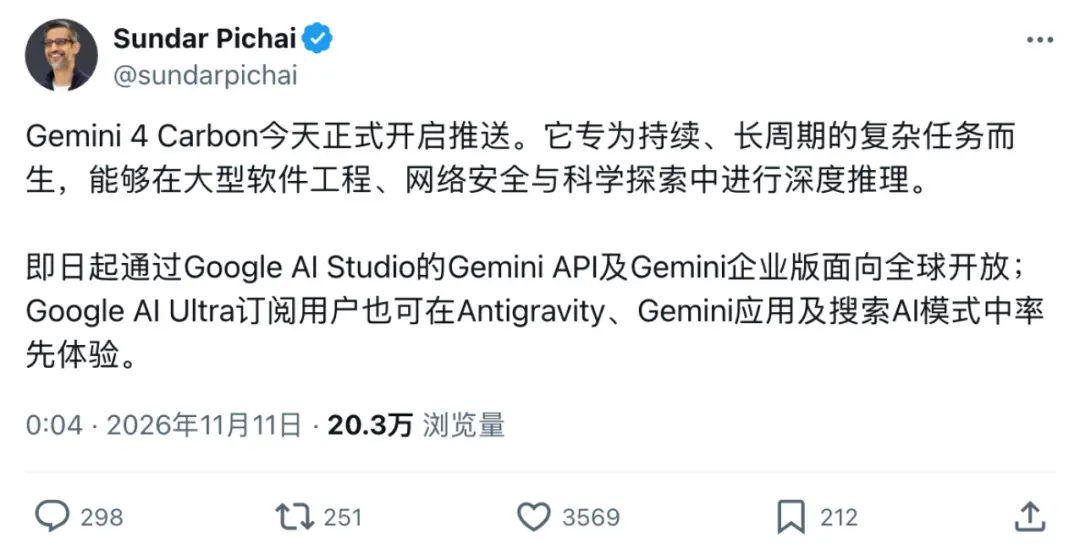
Pichai officially announced: The new generation flagship Gemini 4 Carbon is now open globally. Paid API developers, enterprises, and Google AI Ultra users can now access it through AI Studio, Gemini applications, and Antigravity.
Pichai clearly stated on X: It is designed for continuous, long-term complex tasks, performing deep reasoning in large software engineering, cybersecurity, and scientific exploration.
Two weeks ago, when it debuted, it jumped to the top of the Artificial Analysis chart with a score of 59, surpassing Fable 5.2, Opus 5.5, GPT-6 Astra, and GPT-6.1 Sol on multiple charts.
1. The most explosive capability: /swarm, the whole AI team works the night shift
The most stunning breakthrough this time is the ace feature launched on the Antigravity platform — /swarm multi-agent swarm mode.
With just one prompt, Carbon can have the entire AI team work the night shift.
In conjunction with the newly released AlphaProof Code framework by DeepMind, within just four weeks, the AI intelligent swarm generated 6.5 million lines of proof, validating the compiled code of Signal's core encryption — something that would originally take human experts years to complete.
The swarm’s real-world performance in large construction projects is also impressive:
The restoration project of Google Platform 37 office building included 7 documents and 206 blueprints. The engineer entered /swarm and a prompt before going to bed, and upon waking, a 3D interactive building was generated;
A single prompt reconstructed the entire construction process of the Eiffel Tower, also made into an open-world game where a pelican rides a bicycle over the rooftops of Mountain View headquarters;
It recreated the 61-key mechanical structure of an antique piano from the 1780s, placed into a 3D model of Toronto's Koerner Hall, allowing real-time reverberation to be heard;
Real-time rendering of large underwater scenes of Atlantis;
Given a materials science thesis, it casually made a set of fabric mechanics simulation tools, displaying real-time stress changes of 110 fibers.
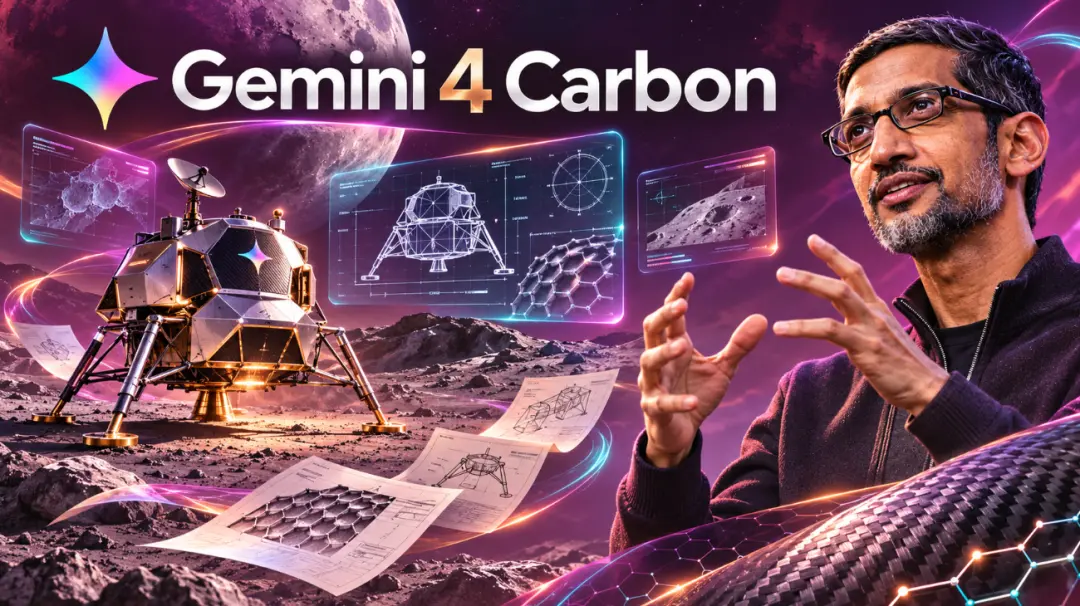
2. 3D Restoration: Old photos and blueprints become a three-dimensional lunar module
The team handed Carbon old photos and blueprints of the "Apollo lunar module," which fully restored the entire module in three-dimensional space — both the complete cabin and the interior dashboard are clearly visible.
The real machine performance here is no slouch either:
Purely using the formulas of general relativity, it generated the "Gargantua" black hole from "Interstellar";
Real-time simulation of ink diffusion on rice paper;
One phrase generated a 3D development world.
In direct comparison with Fable 5.2, the demo effect is nearly the same, but Carbon saved nearly two-thirds of the cost compared to Fable.
3. Rankings and Prices: All three major production evaluations topped, with even lower costs
Highlights of evaluation performance:
GraphWalks test scored exceptionally high with 96.2%;
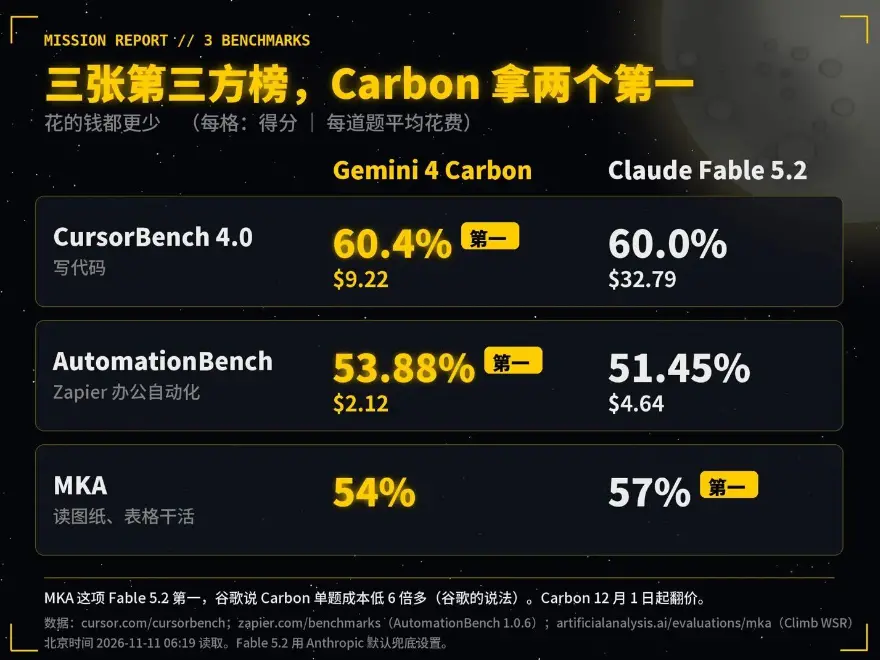
CursorBench 4.0, Perplexity WANDR, and Zapier’s three real production evaluations all claimed the top spot, outperforming Fable 5.2;
In the multimodal knowledge agent benchmark MKA released jointly by Google and Artificial Analysis, Carbon ranked second globally with 54.3%;
Dominik Picheta, the father of the Nim programming language, conducted an independent anti-cheat test KillSwitch-Bench, placing Carbon ties for first globally with Fable 5.2;
The hedge fund giant Balyasny, covering 23 cutting-edge models in a real financial research examination, secured first place overall;
The cloud security unicorn Wiz used Carbon to scan the two major SaaS service providers and discovered real zero-day vulnerabilities in under 2 hours — an assessment that originally would have taken several weeks was completed in one afternoon, protecting tens of thousands of downstream companies before hackers could strike.
The pricing is surprisingly affordable: $2 per million tokens input, $10 output, with caching enjoying a 95% discount. While sweeping the first places in all three major production evaluations, the average cost per task is over half less than that of the second place.
4. A free gift package for scientists: 10,000 people with top access for six months
This time, Google also announced a plan: providing up to 10,000 top scientists worldwide with free access for up to six months.
Covering fields such as physics, chemistry, biology, materials science, and climate science, the goal is to address those hypotheses that have been "set aside due to complexity" — such as searching for room-temperature superconductors, unraveling complex protein folding to cure cancer, and simulating plasma turbulence in controllable nuclear fusion.
This set of tools has already proven itself in research: in the CASP17 protein prediction blind test, it helped scholars increase the retrieval volume of elusive viral protein homologs by 40 times.
Google's vision is straightforward: to make “giving a prompt before bed and waking up to receive results” a daily occurrence for scientists.
免责声明:本文章仅代表作者个人观点,不代表本平台的立场和观点。本文章仅供信息分享,不构成对任何人的任何投资建议。用户与作者之间的任何争议,与本平台无关。如网页中刊载的文章或图片涉及侵权,请提供相关的权利证明和身份证明发送邮件到[email protected],本平台相关工作人员将会进行核查。


