Doing cryptocurrency payments in Dubai may be more complicated than expected.
Written by: Shao Jiadian
Imagine a scenario: an Asian merchant sets up a sales company in Dubai and hopes to receive payments in Dirhams. The local buyer holds USDT, and an Asian payment institution plans to accept this currency on the checkout page, convert it into Dirhams, and send the payment to the merchant. If this institution only has a transfer and settlement license from the Dubai Virtual Assets Regulatory Authority (VARA), can it operate this business model compliantly?
Doing cryptocurrency payments in Dubai may be more complicated than expected. The buyer only clicks to pay once on the checkout page, but the backend must receive the currency, convert it, and settle it to the merchant. If the platform intends to complete these steps itself, a VARA license may not be sufficient. This article follows the payment process to see how far the VARA permission extends and in what circumstances a license or registration from the Central Bank of the UAE is still required.
01 When is VARA enough?
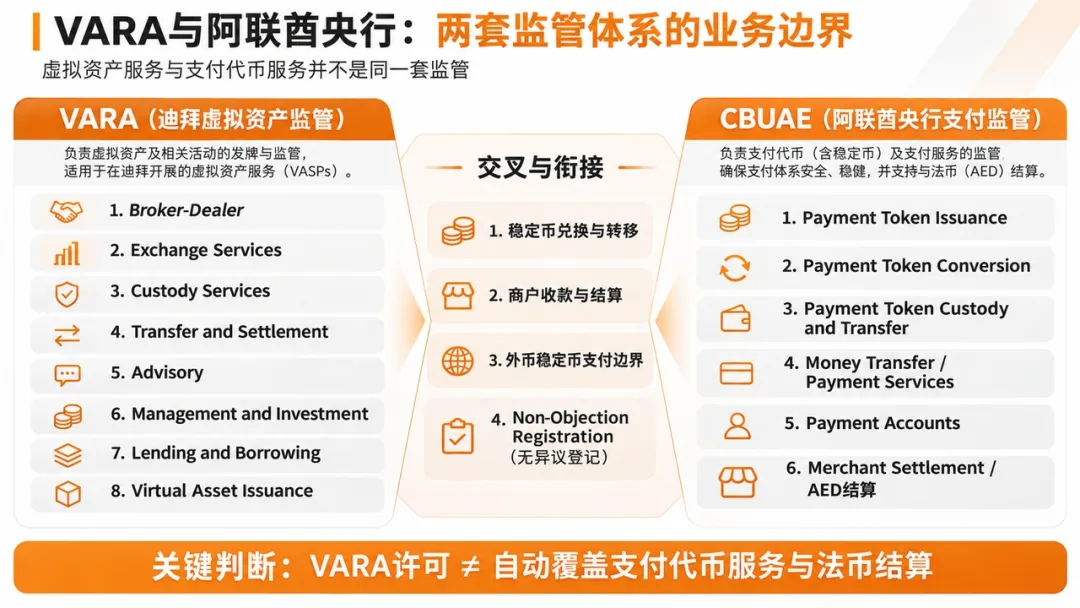
If a platform transfers BTC for investment customers and accepts USDT on a product checkout page, both may involve on-chain transfers. To determine whether VARA's license is sufficient, one must first distinguish whether the platform is transferring investment assets or processing a payment for goods. Within Dubai and its free zones under VARA jurisdiction, if the institution only handles investments in non-payment tokens like BTC and ETH, cryptocurrency trading, and related custody and transfers—without involving payment for goods, token-to-fiat exchanges, remittances, or other Central Bank-regulated financial services—these activities do not require a separate payment license or registration from the Central Bank. Each transaction, custody, and transfer has its corresponding VARA licensing scope and must be provided by an authorized entity.
The new Central Bank Law effective September 16, 2025, also distinguishes between investment and payment. Article 61 includes the use of virtual assets for payment services under Central Bank licensing regulation. Article 187 excludes virtual assets used for investment, token-to-token exchanges, or trading swaps from the applicability of this Central Bank law; related activities remain governed by other relevant regulations. When using virtual assets for payments or exchanging them for currency, this article requires that regulations set by the Central Bank regarding these activities must be applied. If the platform operates currency exchanges for payment tokens like USDT, it must also consider the regulations from the Central Bank’s Payment Token Services Regulations.
Specifically regarding the VARA transfer and settlement license held by this institution, it governs the transfer of virtual assets between wallets, addresses, or different entities. The rules effective from June 19, 2025, require licensed entities to also comply with applicable Central Bank payment and remittance regulations. Cross-border transfers and settlements must be legally managed and completed in all jurisdictions involved in the transactions.
02 Can a buyer pay in USDT and the merchant receive Dirhams for the order?
If the buyer directly sends USDT to the local sales company in Dubai to pay for ordinary goods, this route is not feasible. According to Article 2(7) of the Central Bank’s Payment Token Services Regulations, local merchants wishing to accept tokens for ordinary goods or services can only receive Dirham payment tokens issued by Central Bank-licensed issuers. Foreign currency payment tokens issued by registered issuers can only be used to purchase virtual assets or their derivatives.
Some stores in Dubai have tried to accept Dirham payment tokens. In September 2026, Network International piloted the DDSC at the Marks & Spencer store in Dubai Festival City. Buyers used wallets supporting DDSC to scan the cashier's QR code, and merchants had the option to either let DDSC into their wallet or settle in Dirhams. The pilot used Dirham payment tokens issued by a Central Bank-licensed issuer.
So what if the buyer pays in USDT, and the payment institution converts it into Dirhams before giving it to the merchant? If the platform knows that the buyer is using USDT to pay for ordinary goods bills while offering services regulated by the Payment Token Services Regulations, Article 2(4) prohibits licensed or registered entities from processing this transfer while providing payment token services. The merchant ultimately receiving Dirhams does not change the purpose of this USDT transfer. If the buyer exchanges through compliant channels and then pays for the goods with their available fiat currency, the exchange and payment must be processed according to their respective regulations. Whether the two transactions are independent in practice depends on who controls the exchange proceeds and when the payment is settled.
There are also products in the market that confirm payments on cryptocurrency platforms, where merchants settle in Dirhams. In August 2026, Dubai Duty Free launched Crypto.com Pay at physical stores and on its official website. Eligible UAE residents can authorize their Crypto.com account during checkout and receive Dirhams at the duty-free shop. Foris DAX Middle East FZE, which provides this service, holds the VARA virtual asset service license and also has the Central Bank’s stored value facility license (SVF). Crypto.com explicitly states on its UAE website that Crypto.com Pay is provided under the SVF license.
In both of these arrangements, merchants can receive Dirhams. The DDSC pilot disclosed the tokens used by the buyers. The announcement from the duty-free shop did not specify what currency was actually deducted for each transaction, at what step the exchange occurred, nor did it disclose the complete funding path. Other payment institutions wishing to create similar products still need to consider who handles the tokens for the buyer, who completes the payment, and what services each is authorized to provide.
If the merchant sells directly through an Asian company, and the payment is ultimately remitted back to Asia, the payment institution still needs to assess where it is and who it provides services to. Article 2(1) governs both payment token services provided within the UAE and services offered to locals. Even if the merchant is based outside UAE, as long as the platform operates such services within Dubai or its VARA-governed free zones, this set of regulations still applies. The term UAE as described in Article 2 does not include financial free zones like the Dubai International Financial Centre (DIFC). VARA's jurisdiction also does not cover DIFC, where financial services are subject to the regulatory framework overseen by the DFSA.
03 What does the platform need to apply to the Central Bank for if it collects and converts currency itself?
If the platform intends to collect or convert currencies itself, it must first confirm whether the currencies involved are what the Central Bank refers to as payment tokens. The Payment Token Services Regulations will come into effect on August 31, 2024. This type of token mainly refers to virtual assets priced in fiat currency and claiming to maintain their value in reference to that fiat currency or payment tokens of the same kind; USD-pegged stablecoins like USDT and USDC are under discussion. Even if the platform has not yet connected to merchant orders, as long as its provided services fall within the regulation's scope and there are no applicable exclusions or exemptions, it must have the corresponding qualifications from the Central Bank.
First, let's examine how the platform collects currency. If the platform, as a business, custody payment tokens for customers, or uses private keys to hold, store, and transfer such tokens, or receives, holds, and transfers payment tokens on behalf of the clients, it involves the custody and transfer of payment tokens. To operate this business, in principle, requires the Central Bank's permission for payment token custody and transfer (Payment Token Custodian and Transferor). If the institution has obtained the virtual asset custody qualification granted by the capital markets regulatory authority (CMA, formerly SCA) or relevant local licensing authority, it can apply for a no-objection registration for foreign currency payment token custody and transfer according to Article 8(3). Merely having a VARA transfer and settlement license cannot be regarded as custody qualification. Fulfilling registration requirements also awaits Central Bank approval.
Next, we consider who is converting the currency. If the platform is earnestly buying and selling payment tokens in spot trade as a business or allows parties to post and accept selling offers, it falls under the category of currency exchange described in the regulations. To conduct this business, it must obtain the Central Bank's payment token conversion license (Payment Token Conversion) or obtain no-objection registration through applicable channels. The registration channels described in Article 8(1) are directed towards operators of virtual asset trading platforms as defined in the regulations. The Central Bank will verify its platform operation qualifications and regulatory authority, and once approved, it can conduct exchanges within the registration scope. Having only a VARA transfer and settlement license cannot be leveraged to apply for this registration.
The exemptions under the Payment Token Services Regulations target specific activities. If a business is already licensed under retail payment or stored value facility regulations, or should originally have been licensed under these rules, the corresponding regulations apply. Article 39 states transitional provisions whereby, after the transition period ends, licenses under older rules no longer cover related cryptocurrency asset businesses. When a product involves storage, exchange, and transfer simultaneously, applicable rules and granted scopes must be checked item by item. To apply for the above two Central Bank licenses, the entities must be companies established in the UAE, excluding financial free zones (Article 6). If planning for the same company to operate other businesses, the restrictions in Article 17 regarding operational scope must be verified.
04 How does the payment reach the merchant's account?
Ultimately, the payment is credited in Dirhams, which also depends on who handles the fiat currency receiving and settlement. If the payment institution itself provides the merchant with fiat currency acquiring, payment aggregation, payment accounts, or fund transfer services, it must have Central Bank permission for that activity or other statutory authorization; VARA licenses do not cover these services. If the payment also needs to be sent to Asia, the corresponding cross-border currency transfer must also be within the range approved for the actual service provider.
Merchants can enter into direct contracts with banks or payment institutions that possess the corresponding qualifications, allowing them to manage funds and take responsibility for settlements. If the Asian payment institution only performs its approved business and does not actually provide or facilitate the regulated services, it does not need to acquire the same qualifications for the services directly provided by its partner. Currency exchange, custody, and transfer can also be performed by entities with the corresponding qualifications. If currency exchange is part of the VARA transfer and settlement service, it must be carried out by institutions that have obtained VARA exchange service licenses. Choosing institutions outside the emirate of Dubai requires VARA approval. The institutions handling transfer and settlement still must be accountable to complete the service for the client.
If the merchant's payment contract is signed by an Asian payment institution, which collects and remits the payment, and handles refunds, while the bank merely opens an account for it and executes transfers, the payment service is still being handled directly by the Asian payment institution, which needs to have the corresponding qualification. When discussing roles, one can look through the actual process: who the merchant contracts with, who has access to the wallet and accounts, who receives payment instructions, and whom to approach if the funds do not arrive.
There is also a division where only interfaces or wallet software are provided, controlled by customers or licensed institutions. If the technical team meets the relevant exclusion conditions, they may not need a license for the supported payment services. Even if the team does not handle funds, when actually providing regulated services such as initiating payments, it must still be judged according to the relevant rules. The same applies to activities conducted directly or indirectly through smart contracts providing or facilitating regulated financial services under the new Central Bank Law, Article 62.
What step should Dubai companies take first?
If the aforementioned Asian payment institution modifies the checkout page to allow buyers to pay directly with fiat currency, the first batch of merchants can contract with qualified partners to handle payments and settlements directly, while the Dubai company is initially responsible for product integration. Once the business stabilizes, the institution may then consider whether to handle settlements itself. If the Dubai company plans to aggregate payments and manage transfers and refunds, it must confirm and obtain the necessary qualifications before switching, as well as adjust merchant contracts and funding processes accordingly.
If you are preparing for the first batch of UAE merchants or already in discussions with local banks or payment institutions for cooperation, feel free to bring a prepared order to discuss with Mankun. We can start from this order and identify which aspects can be implemented in the first phase, what cooperation conditions must be settled in advance, and when it is worthwhile to consider converting parts of the business to self-operated.
免责声明:本文章仅代表作者个人观点,不代表本平台的立场和观点。本文章仅供信息分享,不构成对任何人的任何投资建议。用户与作者之间的任何争议,与本平台无关。如网页中刊载的文章或图片涉及侵权,请提供相关的权利证明和身份证明发送邮件到[email protected],本平台相关工作人员将会进行核查。


