Ichor Holdings (ICHR) stock price has significantly dropped from $60 to $31 at the time of writing this third analysis. However, in my view, Ichor remains a very good "Strong Buy" stock. It is still an excellent company, just positioned in the right place—one of the semiconductor companies well-positioned in the AI ecosystem—yet at the wrong time—during the recent round of AI sell-off—while doing the right thing by participating in AI infrastructure development. The reason I say this is that the stock price has fallen from a 52-week high of $113, seemingly without any fundamental reason. In fact, the company's data remains very solid. Conversely, this downturn mainly stems from the broader semiconductor sector sell-off around AI infrastructure companies over the past few weeks. Nevertheless, I think Warren Buffett's saying "be greedy when others are fearful" precisely captures this situation. Because in this case, I still can't find any fundamental reason to argue that ICHR isn't a good company worth holding. That is why I am further increasing my position in Ichor and reaffirming my "Strong Buy" rating.
Next, I want to explain in detail why I believe ICHR is still a fundamentally solid company that is trading at a huge discount. Based on this, I am raising my price target to $104, while the current stock price is about $31.

[Original image location: Figure 1 (Author)]
Model Assumptions
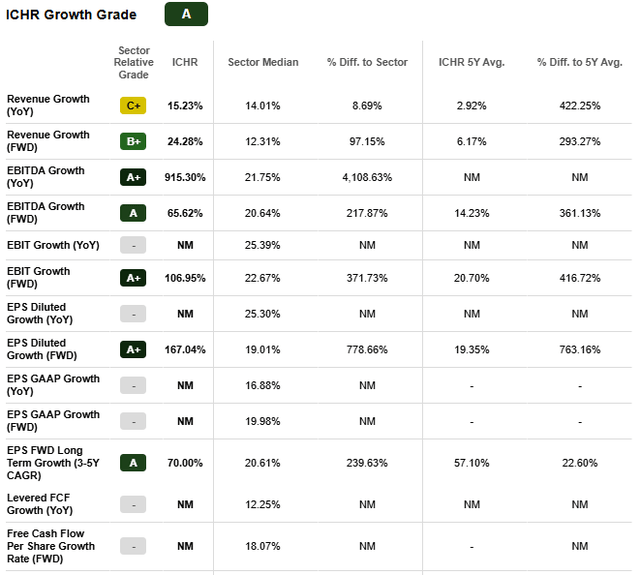
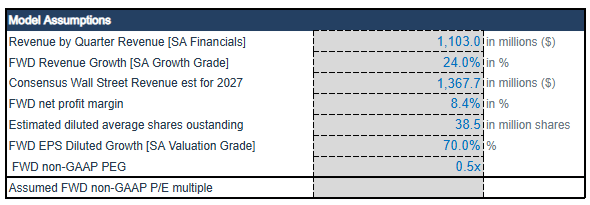
Let's start with my assumptions about the company's future growth. First, according to data released by Seeking Alpha (SA), the company's quarterly TTM revenue is $1.1 billion. This is a very important figure as it forms my revenue baseline and serves as my starting point for forecasting revenue for 2027. The next variable is the forward revenue growth rate. According to SA Quant Ratings, as shown in Figure 2 below, ICHR's forward revenue growth rate is 24%. However, the company indicated in the third quarter of 2026 that it expects the full-year revenue growth rate to reach 30%. In this case, I choose to adopt the management's guidance. Therefore, if the revenue of $1.1 billion grows at a rate of 30%, my expected revenue for 2027 would be approximately $1.367 billion.
[Original image location: Figure 2: ICHR Growth Grade (Seeking Alpha)]
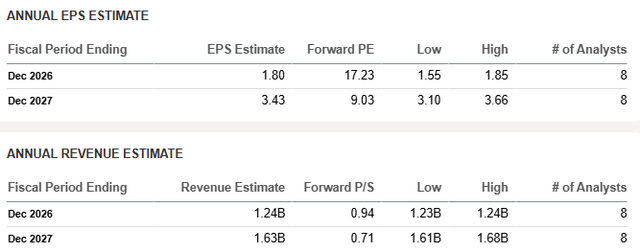
$1.367 billion is actually lower than Wall Street's consensus expectation of $1.63 billion. I choose to retain $1.367 billion as my 2027 revenue forecast because I believe this allows for some margin to address potential negative revenue surprises in the coming quarters.
[Original image location: Figure 3: Market Consensus Revenue Expectations (Seeking Alpha)]
The next variable is the forward diluted EPS growth rate. If you look at Figure 2, you will see that the current forward diluted EPS growth rate reaches 167%, which I believe is too high, as the industry median is only 19%, and the company's historical average over the past five years is also only 19.35%. In my view, this suggests that the current forward EPS growth rate is likely an outlier and does not represent a sustainable real growth trend in the future. Therefore, I turn to the forward EPS long-term growth rate, which refers to the future 3-5 years CAGR. Again, referring to Figure 2, you will see that this number is significantly lower and more reasonable. The current long-term growth rate is 70%, while the past five-year average is 57%. My understanding is that ICHR's long-term EPS average growth rate over the past five years has been around 57%, and now it has reached 70%, making it more likely to achieve that target growth rate in the future. That is why I use 70% as the forward diluted EPS growth rate.
[Original image location: Figure 4 (Author)]
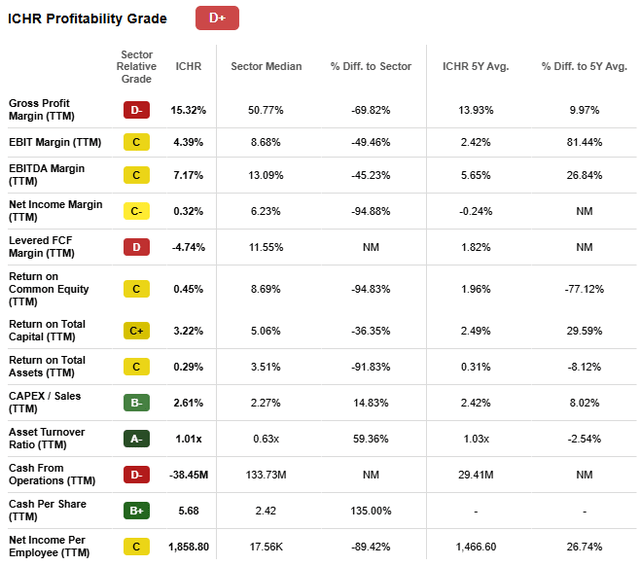
The next variable is the forward net profit margin. Historically, as shown in Figure 5 below, ICHR's TTM net profit margin is -0.24%. On the other hand, the company's long-term goal has always been to reach 13% or higher. In the third quarter of 2026, the company reported an operating profit margin of 8.4%. Therefore, I used the same 8.4% to calculate the forward net profit. Although this is a historical number and does not have a direct relationship with future guidance, I believe it balances the company's past averages with its long-term goals.
[Original image location: Figure 5: ICHR Profitability (Seeking Alpha)]
Regarding the diluted average shares outstanding, ICHR estimated diluted shares in the third quarter of 2026 earnings call to be 38.5 million shares. Currently, I do not expect any significant dilution events that could substantially increase the diluted share count. Therefore, I keep this number unchanged, continuing to use 38.5 million as the diluted average shares outstanding.
Considering the $1.367 billion in revenue and an 8.4% forward net profit margin, I arrive at an expected forward net profit of $114.9 million, as shown in Figure 7.
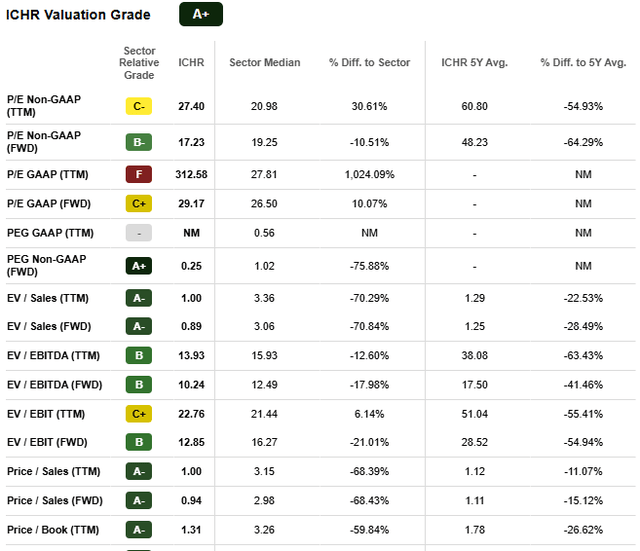
Now the last question remaining is to determine what valuation the market should pay for each unit of future growth of ICHR. Looking at Figure 6 below, I think an A+ valuation grade makes this question quite easy to answer. First, the company's forward non-GAAP PEG is only 0.25 times, while other companies in the industry trade at an average of 1.02 times. Theoretically, this means that Ichor is trading at a noticeable discount relative to its peers. Second, the company's forward non-GAAP P/E ratio is 17.23 times, while peers are trading around 19.25 times, which also reflects a discount compared to the industry median. What truly interests me is that ICHR's forward non-GAAP P/E ratio has averaged 48.23 times over the past five years. But even at a valuation of 48 times, the corresponding forward non-GAAP PEG would still be only around 0.69 times, remaining below the industry median of 1.02 times.
[Original image location: Figure 6: ICHR Valuation Grade (Seeking Alpha)]
That said, I am not even intending to price Ichor based on the average valuation from the past five years, although I know that valuation is still very cheap. But it at least enhances my confidence since even at higher valuation multiples, ICHR can still be considered trading at a discount. Therefore, to allow for some safety margin, I set my forward non-GAAP PEG at 0.5 times. This is twice the current 0.25 times forward non-GAAP PEG, and I believe this level is quite reasonable and easily achievable. Perhaps once this target is truly reached, I will have more reasons to raise my price target further. But for now, at a 0.5 times forward non-GAAP PEG, the corresponding forward non-GAAP P/E ratio would be about 35 times. This still falls below the average of 48 times over the past five years and retains some safety margin for potential surprises in revenue and EPS.
Valuation
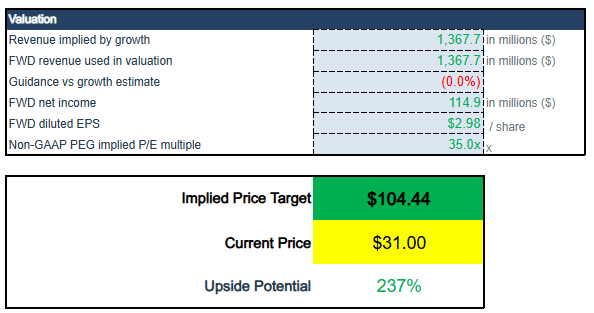
Putting all the data together, I arrive at a forward non-GAAP EPS of $2.98. Compared to the analyst consensus expectation of $3.43 in Figure 3, this is actually a slightly conservative estimate. If I then multiply $2.98 by an implied forward non-GAAP P/E of 35 times, the target price I obtain is $104, which is 237% higher than the current stock price, as shown in the figure below.
[Original image location: Figure 7 (Author)]
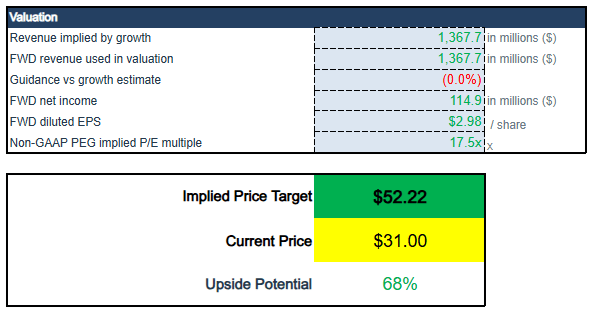
Looking from another angle, if I value at the current 0.25 times PEG, which corresponds to about 17 times forward non-GAAP P/E, my target price is still 68% higher than the current price, as shown in Figure 8 below.
[Original image location: Figure 8 (Author)]
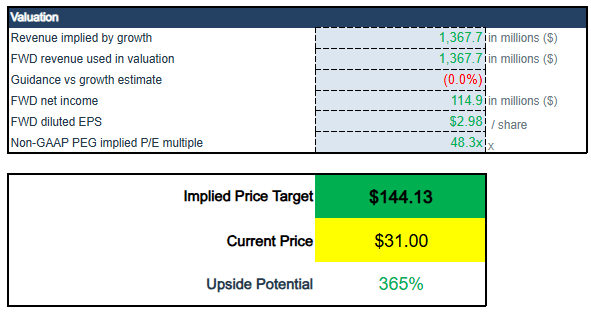
If I value based on Ichor's average forward non-GAAP P/E of 48 times over the past five years, then the target price would reach $144, as shown in the figure below. This means there is a 365% upside from the current price. Ultimately, whether analyzing using current valuation data or future growth expectations, ICHR is still in a very obvious discount state.
[Original image location: Figure 9 (Author)]
Key Risks
The first risk arises from ICHR being part of the AI ecosystem, which has currently been severely impacted. Investors seem indifferent to how good the fundamentals or financial data of companies like ICHR are. My point is that as long as ICHR is still part of the semiconductor industry, regardless of how much the previous quarter's EPS exceeded expectations, it will continue to be influenced by AI panic and related sell-offs. This means that market sentiment will play a huge role in ICHR's and many other AI-related companies' stock performances in the coming months—or even years, who knows. Unless the market sees clear evidence of how hyperscalers and sovereign governments can truly monetize massive AI investments, this situation will continue to occur. As of now, I believe the market has not really seen the answers to "how to monetize" and "how much can be monetized." What we currently see is only hyperscalers recording massive capital expenditures reaching trillions of dollars.
ICHR is also a relatively small player in the semiconductor industry. The company currently has a market cap of about $1.16 billion, making it still quite small. Therefore, when AI panic and tech stock sell-offs happen, stocks like this typically take an exceptionally hard hit. The long-term risk here is that some of these companies' free cash flow levels may not be sufficient to support a return to business during a slowdown in AI capital expenditures or even declining demand.
Finally, my price target is based on a series of assumptions, which ultimately can change. For example, I expect a diluted EPS growth rate of 70%, but it is entirely possible for it to revert to the historical trend level of 57% over the past five years. The operating profit margin may also fall below 8.4%, especially considering that the average over the past five years has actually been close to 0%. These situations can happen. And if they do, then undoubtedly, my current price target will become invalid.
Final Thoughts
As mentioned at the beginning of the article, ICHR is a classic case of "be greedy when others are fearful." In my opinion, ICHR does not require much additional justification, and I do not need to intentionally raise my valuation assumptions to prove how cheap the company really is. From different perspectives, my analysis indicates that this is still a fundamentally sound company that is trading at a very low valuation. At the current price of $31, I will undoubtedly continue to buy Ichor Holdings in large amounts.
免责声明:本文章仅代表作者个人观点,不代表本平台的立场和观点。本文章仅供信息分享,不构成对任何人的任何投资建议。用户与作者之间的任何争议,与本平台无关。如网页中刊载的文章或图片涉及侵权,请提供相关的权利证明和身份证明发送邮件到[email protected],本平台相关工作人员将会进行核查。


