The turmoil in the US stock market had just calmed down for two days, followed closely by the non-farm payrolls that greatly exceeded expectations, and the October CPI also significantly exceeded expectations, both of which are noticeably higher than our predictions and market consensus. It can truly be said that troubles come in waves.
Just a few hours before the data release, Federal Reserve Governor Waller stated that if the inflation rate rises by 0.3%, it would support a direct rate hike of 50 basis points in December. As soon as he finished speaking, the actual inflation rate rose by 0.4%. Because of this, the market reacted extremely violently. US Treasury rates approached 5% again, the dollar rose, and gold dropped by 2%.
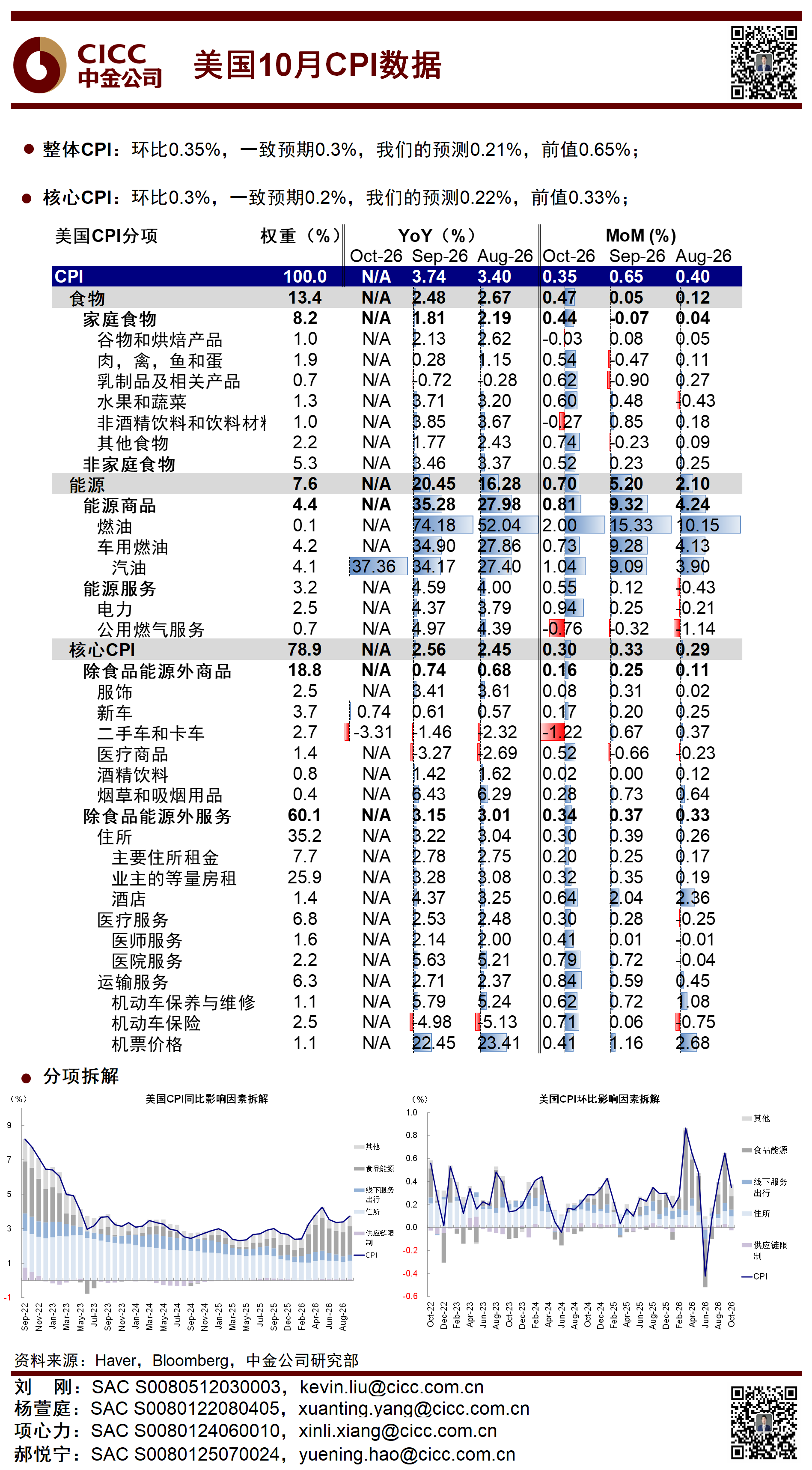
🏵️ Due to the government shutdown last October, this time only month-on-month data was released, without year-on-year data. Figure 1
1️⃣ Overall CPI: month-on-month 0.35%, consensus expectation 0.25%, our forecast 0.21%, previous value 0.65%;
2️⃣ Core CPI: month-on-month 0.30%, consensus expectation 0.22%, our forecast 0.22%, previous value 0.33%.
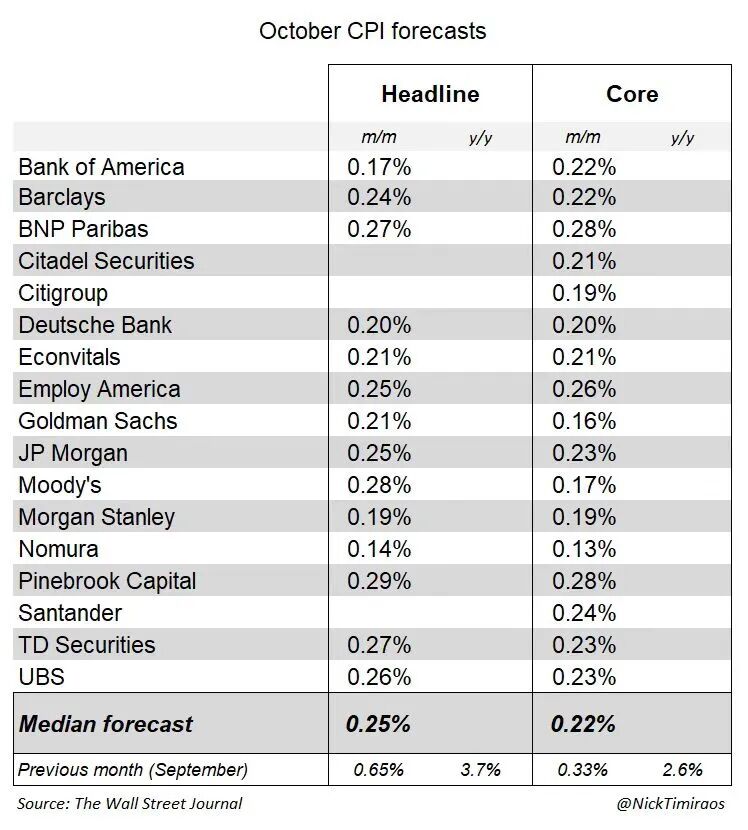
This data is somewhat unusual, being higher than most market predictions (median 0.25%) including our own, and such occurrences are rare. Figure 2
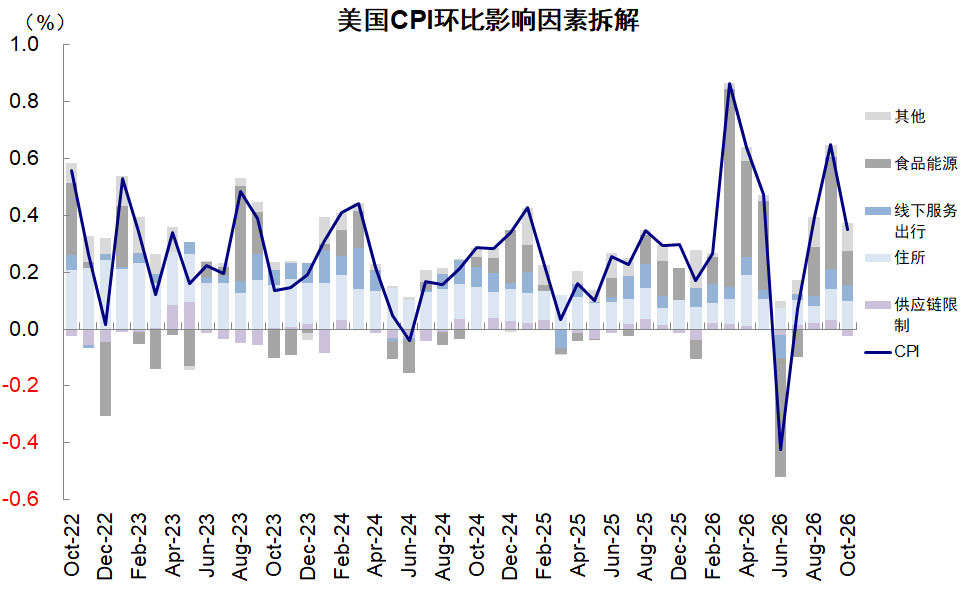
From the breakdown, the food component in overall CPI and rent, medical services, hotels, and auto insurance in core CPI all exhibited high month-on-month growth, with core services maintaining month-on-month growth of over 0.3% for three consecutive months, which is not a good sign. Figure 3
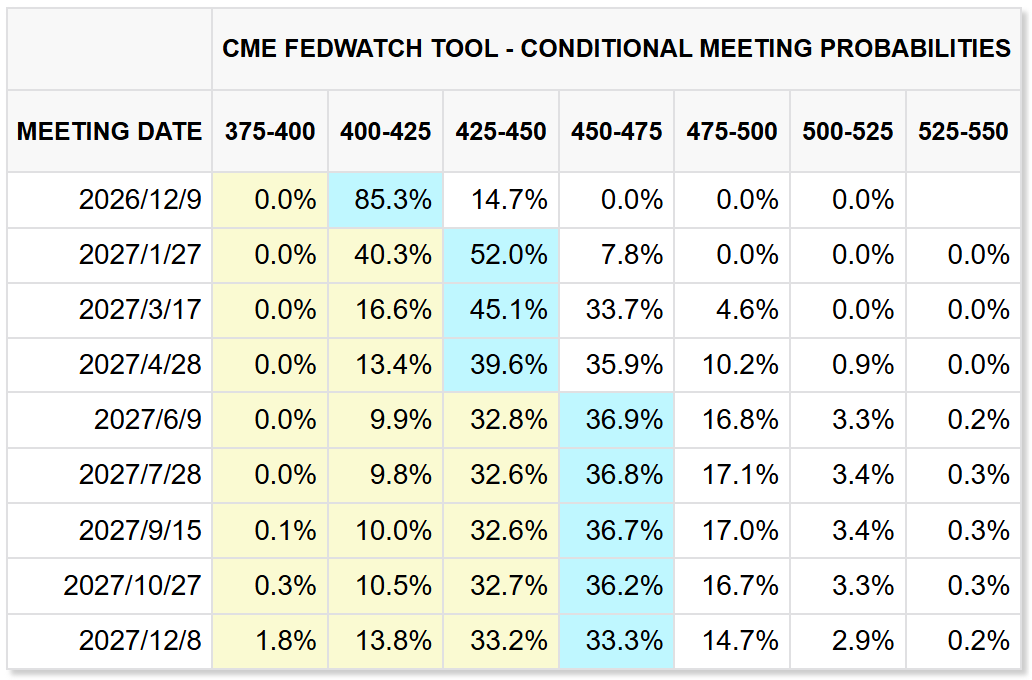
🏵️ This data, combined with last Friday's unexpectedly strong non-farm payrolls October Non-Farm: Too Many Good Points, undoubtedly strengthens the probability of a rate hike in December. Currently, the market expects an 85% probability of a rate hike in December, and while a single hike of 50 basis points has not yet become mainstream, the market now anticipates another rate hike next year. Figure 4
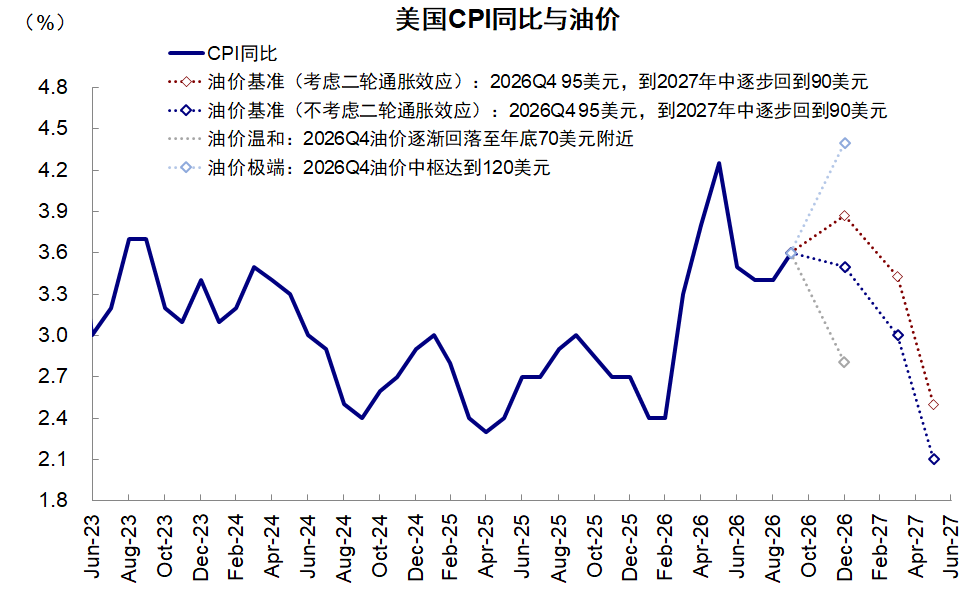
We still believe that the Federal Reserve lacks the necessity for continued large rate hikes: 1) Traditional demand does not support it. 2) Inflation is expected to rapidly decline next year under a high base; we forecast that by May 2027, the year-on-year CPI will drop to 2-2.5%. Figure 5 3) AI expectations are cooling down. However, this turning point may not occur until early next year.
🏵️ For a market that has just experienced a sharp drop and is still emotionally unstable, this is not good news.
The current market needs two catalysts: either significant progress in AI (good news for the industry) or the end of tightening expectations from the Federal Reserve, or even expectations of easing (good news for liquidity), and these two catalysts are mutually influential.
Currently, the critical points are expected to occur early next year: 1) The quarterly reports disclosed in January are expected to continue applying pressure on ROIC, which will require a new narrative from AI; 2) The Federal Reserve's policy inflection point is more likely to occur early next year—first, inflation will decline early next year, and second, if there is no progress in AI, growth expectations will further be revised down; 3) The new Congress will take office in January, clarifying the sequence and priorities for policy advancement.
Therefore, in Have US Stocks Dropped "Enough"?, we suggested remaining cautiously on the sidelines until these two catalysts are clarified, managing positions and structure well. The current probabilities and odds are unclear. The probabilities involve the two catalysts mentioned above; on the odds side, for instance, we estimate that in extreme cases, if AI’s contribution to profits drops to zero, the current high growth of 40% would fall to around 10%, which could correspond to a 10% downside for broad indices. If such a situation occurs, the odds will increase, providing better opportunities for entry.
免责声明:本文章仅代表作者个人观点,不代表本平台的立场和观点。本文章仅供信息分享,不构成对任何人的任何投资建议。用户与作者之间的任何争议,与本平台无关。如网页中刊载的文章或图片涉及侵权,请提供相关的权利证明和身份证明发送邮件到[email protected],本平台相关工作人员将会进行核查。


