Author: Yang Chen, Wall Street Insights
Federal Reserve officials are showing increasing concern about inflation, with a more hawkish stance taking shape.
This year, FOMC rotating voting member and Dallas Federal Reserve President Lorie Logan stated on Tuesday that the Federal Reserve needs to raise interest rates at least two more times and that the pace this winter may be faster than this fall. On the same day, Federal Reserve Governor Christopher Waller urged the consideration of a 50 basis point rate hike at the December meeting. Meanwhile, the U.S. October CPI data exceeded expectations, with core inflation rising 0.3% month-on-month, further strengthening the market's expectation of tightening policy.
Nick Timiraos from the "New Federal Reserve News Agency" emphasized that Logan stated today that after the stronger-than-expected inflation data in October, the Federal Reserve may need to expedite the pace of interest rate hikes.
Driven by these statements and the inflation data, U.S. Treasury yields rose significantly. The two-year U.S. Treasury yield jumped 19 basis points in a single day to 4.74%, marking the largest single-day increase since Trump announced tariffs in April of this year; the dollar strengthened against all major currencies.
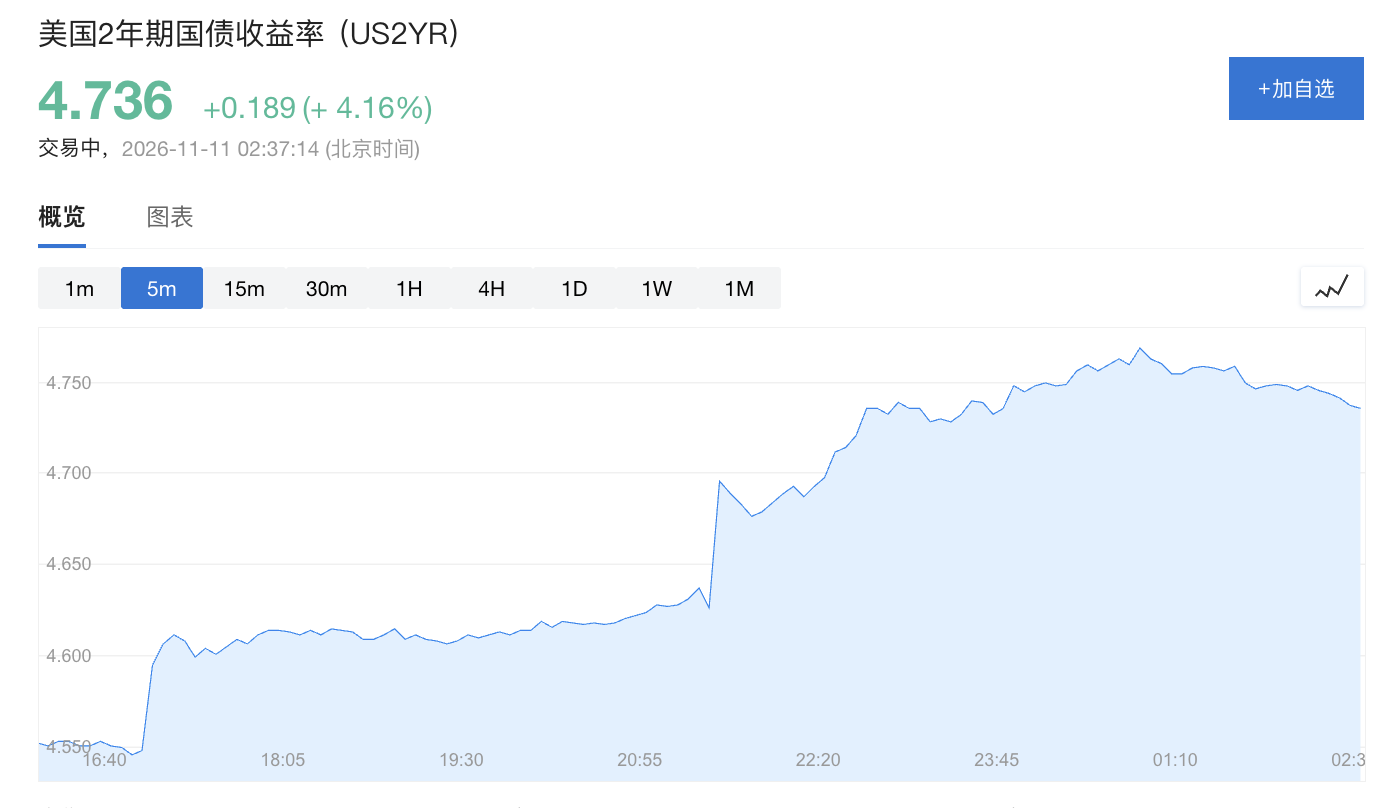
Chart: U.S. two-year Treasury yield jumps to 4.736% intraday
The market responded quickly to hawkish signals, with investors moving their expectations for the Federal Reserve's interest rate path forward over the next few months, though they remain cautious regarding a 50 basis point hike in December.
Federal funds futures data show that the market currently prices in a 25 basis point rate hike in December, followed by another 25 basis points in January, and possibly one more in April; previously, the market widely expected rate hikes in December and March next year.
At least two more rate hikes, pace may accelerate
Logan made it clear on Tuesday at a meeting in Houston: "Given the current economic outlook, I believe the Federal Open Market Committee needs to implement at least two more rate hikes of 25 basis points each."
She also added, "The pace of rate hikes this winter may be faster than the progression so far this fall," but the specific path will still depend on economic data and financial conditions.
Logan stated that the current monetary policy stance is still supporting the economy and, to some extent, elevating inflationary pressures. The stock market has seen strong gains this year, and credit conditions remain relatively loose, overall still providing a tailwind for economic activity.
She noted that two more rate hikes would push the target range for the federal funds rate to 4.25% to 4.5%, which would have a moderate limiting effect on the economy.
The Federal Reserve kept rates unchanged during its meeting on October 27-28, after raising rates by 25 basis points in September, the first rate hike of 2023, aimed at curbing inflation that has exceeded the 2% target for over five years. At the September meeting, most officials predicted at least one more rate hike this year.
Recently, several Federal Reserve officials have reiterated this judgment in public remarks but tend to maintain a gradual pace. Waller is among the most hawkish, clearly stating that a 50 basis point rate hike should be considered at the December meeting.
Inflation pressure is widespread and poses persistent risks
Logan clearly expressed concerns about the inflation outlook. She stated that inflation pressures are no longer limited to goods and services highly related to energy and AI infrastructure but are showing a broader spread. Heightened global tensions are exacerbating supply chain disruptions, further pushing up price pressures.
She also expressed caution regarding the Federal Reserve's preferred inflation gauge, the Personal Consumption Expenditures (PCE) price index, set to be released later this month, suggesting that October data may show a rebound trend similar to that of the CPI.
Logan warned, "The longer inflation remains above target levels, the greater the risk that it becomes entrenched as a behavioral norm."
She stressed that while inflation is expected to gradually decline after price pressures in energy and manufactured goods ease, "the broader inflation trend is more likely to persist." In this context, she called for restrictive policy measures to achieve an appropriate balance between inflation and job prospects.
免责声明:本文章仅代表作者个人观点,不代表本平台的立场和观点。本文章仅供信息分享,不构成对任何人的任何投资建议。用户与作者之间的任何争议,与本平台无关。如网页中刊载的文章或图片涉及侵权,请提供相关的权利证明和身份证明发送邮件到[email protected],本平台相关工作人员将会进行核查。


