Author: Rex St. John
Translation: Deep Tide TechFlow
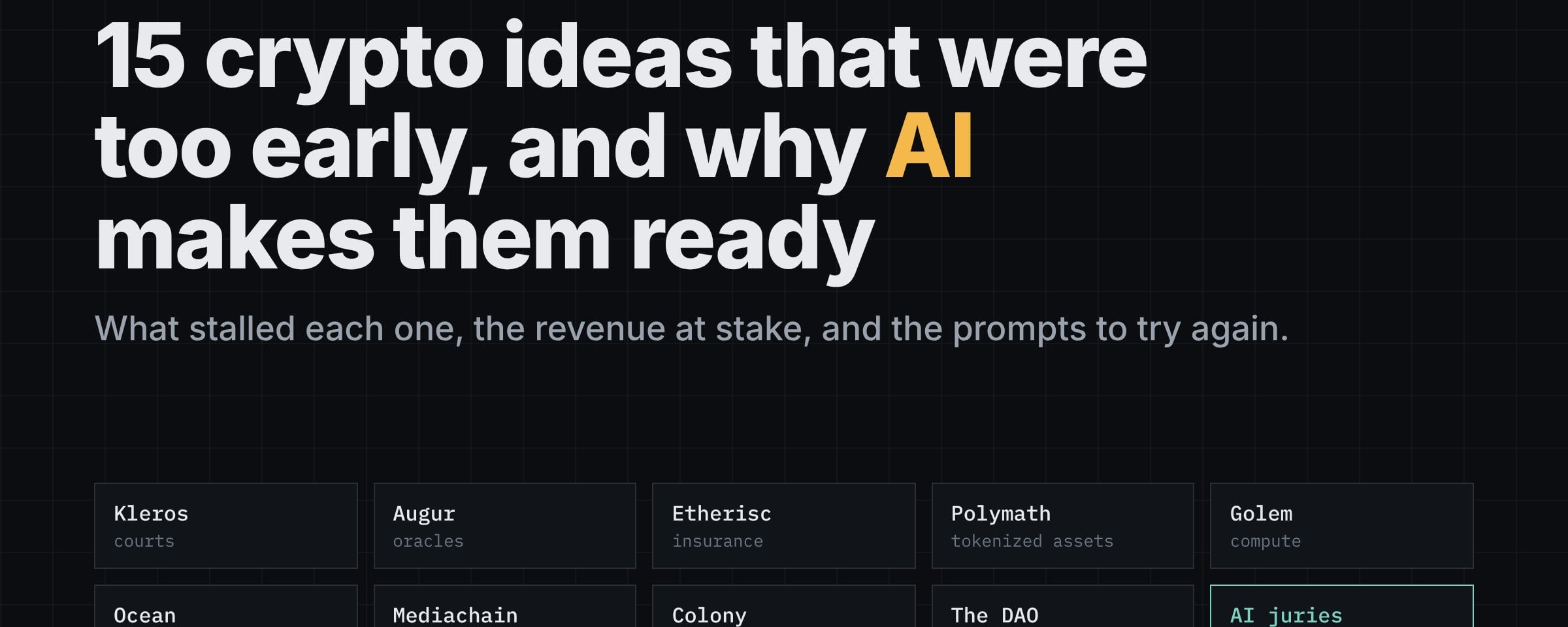
Deep Tide Overview: Between 2014 and 2019, early crypto projects such as Kleros, Augur, Etherisc, and Golem attempted to bring commercial arbitration, prediction markets, mutual insurance, and decentralized computing power onto the blockchain, but were hindered by inefficient and easily bribed human voting mechanisms, highly volatile governance tokens, and exorbitant settlement costs, leading most to face liquidity exhaustion and cyclical failures.
After 2023, multi-model AI juries have driven the costs of real-world judgments down to a few cents, AI agents have become the main actors in high-frequency on-chain transactions, and with the maturity of stablecoins worth about $310 billion and sub-second public chains like Solana, the three bottlenecks have been simultaneously broken. This article summarizes 15 early tracks worth restarting, their revenue potential, and practical validation prompts.
Why Many Good Ideas Were Cut Short
Between 2014 and 2019, the best ideas in the crypto industry failed not because of logical errors. They faltered because the three underlying infrastructures they relied upon did not exist at the time: a mechanism to resolve complex real-world issues at extremely low costs, a currency unit with price stability, and a blockchain that is fast enough and cheap enough to settle very small amounts.
Industry Evolution Context. Bitcoin proved that value settlement can be accomplished without the need for a central authority, and the launch of Ethereum in 2015 expanded it into programmable applications. Subsequently, a large number of projects tried to move all other economic activities onto the blockchain.
This wave of exploration covered arbitration courts (Kleros), universal question oracles (Augur), data markets (Ocean), computing power markets (Golem), micropayments (BAT, Lightning), and machine payments (IOTA).
It also included identity verification (uPort, Sovrin), content curation (Steemit, token curation registry), insurance (Etherisc), content provenance (Po.et, VeChain), labor markets (Colony, Gitcoin), and autonomous organizations (The DAO).
Unresolved Challenges. Smart contracts can only verify computable factors: signatures, balances, and hash values. But nearly all truly valuable contracts depend on off-chain real-world outcomes. Was the work delivered on time? Were the claims legitimate? Was the flight actually delayed?
At the time, each project shifted such decisions onto humans: token holders voting, staking jurors, manually curating content. Humans are slow to react, costly, and easily bribed in small circles, and they are unlikely to vote over a dispute worth $4.
The result was a long period of thin trading in related markets, and the entire economic model could only be sustained by the tokens themselves, leading most projects to collapse during the two cycles of 2018 and 2022.
Roots of Change. After 2023, four critical turning points emerged:
· Drastically Reduced Judgment Costs. Large language models can read contracts, deliverables, and evidence and make judgments in just a few seconds and at a few cents cost. Juries composed of different model families vote in blind formats, making them harder to bribe than human jurors, and they will never be absent.
· AI Agents Become User Subjects. Software agents are now taking on actual work, procuring services, and signing agreements. Compared to humans, they are more in need of contracts, payments, and reputation systems, and their transaction amounts are generally too small to rely on human arbitration.
· Stablecoins Have Reached a Critical Mass. According to Spark data, by mid-2026 the supply of stablecoins had reached approximately $310 billion, allowing contracts to be settled directly in dollars, without the need to bear the risks of highly volatile governance tokens.
· Public Blockchains Have Become Fast and Cheap Enough. Solana can complete settlements within 1 second, with transaction fees as low as a fraction of a cent, making per-transaction payment and case-by-case arbitration economically viable.
The pattern that emerges is very simple: to explore those old ideas that were previously stuck on the premise that “decisions must be made by a trusted third party.” This is precisely the bottleneck that AI can eliminate, and this is why these ideas are worth re-exploring now.
Ranking Ideas by Revenue Potential
The following rankings consider both the revenue ceilings that can be accessed by re-entering the market, and the current readiness of each underlying requirement. Market data cited in this article are noted, and the “revenue potential” levels reflect my judgment on the reasonable capturing space for new entrants, not precise predictions.
1. Online E-commerce Arbitration Courts (Kleros, OpenBazaar Arbitration)
· Early Attempts: Have staked tokens and randomly selected jurors to decide disputes between strangers, replacing the platform’s own customer service team.
· Reasons for Stagnation: Jurors needed to review cases one by one, requiring real time and funds, making them applicable only for disputes of several hundred dollars or more. The volume of transactions lagged, and small-scale juries were easily bribed.
· Changes Brought by AI: Juries composed of different model families can decide $4-level disputes in just seconds for a cost of a few cents, and each vote and reasoning can be made public. Agents purchasing from agents are generating millions of tiny disputes that are simply unmanageable by humans.
· Revenue Potential: High. In 2025, global merchants are expected to lose $33.79 billion due to 261 million chargeback transactions (Mastercard); the online dispute resolution software market alone reached approximately $1.76 billion (Mordor Intelligence), with pay-per-use having great commercial prospects.
2. Real-World Problem Oracles Lacking Ready APIs (Augur, Truthcoin, Decision Markets)
· Early Attempts: Allowed anyone to bet on any real-world issue, with token holders responsible for reporting the final outcomes.
· Reasons for Stagnation: Subjective issues (e.g., “Was the bill actually passed?”) relied on slow and easily manipulated human votes for judgments. As a result, liquidity flowed towards sporting events and political elections where ready API data sources existed.
· Changes Brought by AI: Model juries can directly read settlement rules and sources of information, make judgments on fuzzy outcomes, and provide complete reasoning for appeals and reviews. This opens up a large number of long-tail prediction markets that had previously been unable to launch due to no one being able to settle them.
· Revenue Potential: High. As of October 2026, transaction volumes on U.S. prediction markets reached $120.7 billion (DeFi Rate). Outcome judgments are a common weakness for all prediction platforms and can be sold as a universal service to all.
3. Automated Insurance with No Claims Adjusters (Etherisc, Nexus Mutual, Peer-to-Peer Mutual Pools)
· Early Attempts: Covered two directions. Parametric insurance automatically pays out when preset indicators trigger, like flight delays or insufficient rainfall; mutual insurance allows members to share risks and vote on each other’s claims.
· Reasons for Stagnation: Parametric insurance can only cover events with clear data sources; mutual pools involve member voting for claims, which is slow and difficult to coordinate, with members facing conflicts of interest since each payout directly deducts from their shared fund. Also, pricing premiums in highly volatile tokens deterred both insured parties and regulators.
· Changes Brought by AI: Claims have been decided by neutral model juries based on policy terms and evidence materials, with no vested interests in outcomes. Trigger conditions can be written in natural language (e.g., “The Department of Agriculture or two news organizations report that there has been a decrease in crop yield”), and judgment is based on documentary evidence, significantly expanding the insureable risk range, with claims processed entirely using stablecoins.
· Revenue Potential: High, but slow to start. Because licensed insurance companies or compliant mutual organizations are still required as underwriting partners. By 2025, the parametric insurance market alone will reach about $19.4 billion, with an annual growth rate of approximately 12% (GM Insights). The fastest path to market is to first sell the claims adjudication capability to existing insurance companies.
4. Task Labor Markets with Escrow Settlement (Colony, Gitcoin, Bounties Network)
· Early Attempts: The contractor deposits the bounty in an escrow contract to publish tasks, which are automatically released upon successful acceptance of the work.
· Reasons for Stagnation: There still needs to be someone to determine if the work is completed. This person is usually the contractor themselves, leading to all the defaults and disputes seen on traditional freelance platforms.
· Changes Brought by AI: Neutral juries directly assess the acceptance standards against the actual deliverables (e.g., code repositories, research reports, or design drafts). More importantly, AI agents now simultaneously act as both workers taking orders and end-contract buyers, with transaction volumes exceeding what any human review can handle.
· Revenue Potential: Moderate to High. By 2025, Upwork earned $788 million in revenue based on over $4 billion in task transaction volumes (Yahoo Finance). Native task markets for agents can charge lower fees and handle larger transaction volumes with smaller amounts.
5. Data and Media Copyright Licensing (Ocean Protocol, Ujo, Mycelia)
· Early Attempts: Allow creators and data owners to directly sell access, and enforce royalty sharing via smart contracts.
· Reasons for Stagnation: At the time, there weren't many paying buyers in the market, and once data was sold, there was no way to verify how buyers actually used it.
· Changes Brought by AI: AI labs have become real buyers. Reports indicate that Reddit and Google’s licensing agreements are worth about $60 million per year, and News Corp and OpenAI’s five-year agreement totals over $250 million (Quartz).
Even if agreement terms are written in natural language (e.g., “Not to be used for modeling that directly competes with the licensor”), model juries can cross-check against audit records.
· Revenue Potential: Moderate to High. Currently, large contracts are mainly held by a few leading copyright entities, but the real incremental gap is at the long tail end: millions of small creators who cannot afford to negotiate licensing agreements independently.
6. Machine Micro-Payments (BAT, Lightning, IOTA)
· Early Attempts: Real-time billing for article readings, API calls, or kilowatt hours, with individual settlement amounts refined to fractions of a cent.
· Reasons for Stagnation: Human users are extremely resistant to frequent manual confirmations of small payments, and high transaction fees along with price volatility consume the meager profit margins.
· Changes Brought by AI: AI agents do not mind executing payments of 26 cents a hundred times a day. By September 2026, the x402 standard had processed about 198.9 million transactions, totaling about $52.7 million (TRM Labs).
· Revenue Potential: Currently low, potentially huge in the future. TRM Labs' own screening also found that the majority of this transaction volume does not yet qualify as genuine commercial activity from agents. The payment rails are already laid out; what is truly lacking is a mechanism that empowers buyers to trust unfamiliar sellers, a problem that ideas 1 and 7 address.
7. Using Reputation and Margin Instead of Full Collateral (Bloom, ETHLend)
· Early Attempts: Implementing non-full collateral lending based on on-chain historical credit records, freeing itself from the constraints of traditional over-collateralization.
· Reasons for Stagnation: Creating new wallets involves no cost, and borrowers can easily discard their old wallet along with any negative credit records; as a result, lenders still require 150% over-collateralization for risk control.
· Changes Brought by AI: The historical judgment records of an agent (timely delivery counts, loss records) are challenging to forge and the cost of abandoning and rebuilding accounts is high; when combined with on-chain collateral that can be forfeited by the jury's vote, business commitments gain real enforceability. This is the “agent bond” template.
· Revenue Potential: Moderate. Early precision-paying clients are not traditional lending agreements but various agent trading markets that urgently require a reputation rating system.
8. Proof of Real Identity (uPort, Sovrin, BrightID)
· Early Attempts: Creating a cross-platform portable digital identity system to prove that “a real person exists behind the screen.”
· Reasons for Stagnation: At that time, no mainstream application urgently needed this capability, and users were naturally reluctant to spend time completing cumbersome verification processes.
· Changes Brought by AI: What has changed is not the technical solution but the rigid demand. As robots and AI agents proliferate, “having a real human stand behind” suddenly becomes a pay-for feature. As of April 2026, the World report has certified 18 million real human users (Decrypt).
· Revenue Potential: Winner takes all and the market volume is significant. However, this is already a crowded space with heavy capital investment. The real gap available to new entrants is binding each automated agent to an accountable real individual or entity.
9. Enforceable Rule Organizations (The DAO, Aragon)
· Early Attempts: Fully relying on smart contract code and token voting to automate the management and operation of an organization.
· Reasons for Stagnation: Code cannot accurately express the governance rules that humans actually care about (e.g., “No funds can be disbursed to internal personnel without public disclosure”), and voting participation rates are generally low, making them easy targets for manipulation by whales.
· Changes Brought by AI: Organizational charters are rewritten in natural language, and each governance proposal is checked by model juries against the charter before funds are issued from the treasury. This is the “DAO Charter” template.
· Revenue Potential: Small to Moderate. While the treasury funds across chains are substantial, the fee space for purely tool software is limited and is better characterized as a risk management review service for treasuries for sale.
10. Community Curated Quality Lists (Token Curation Registry, Steemit)
· Early Attempts: Screening by staking tokens on list items to maintain a high-quality roster (such as quality advertisers, credible news sources, etc.).
· Reasons for Stagnation: The staking game mechanism eventually shifted attention toward token speculation rather than quality screening, and voters didn’t bother to read the content submitted for review seriously.
· Changes Brought by AI: Admission standards are defined in natural language, with model juries reviewing each submitted entry against the standards and providing detailed reasoning, while the cost of external challenges is very low.
· Revenue Potential: Small to Moderate. The strongest application form of this capability is to embed it within other large products as a core component, such as app store reviews, vendor directory management, or AI model market rankings.
11. Content Provenance Certificates (Po.et, Ascribe)
· Early Attempts: Timestamps attached to creative works to prove who the first creator of the work is.
· Reasons for Stagnation: A timestamp can only prove that a file existed at that point in time but cannot verify who created it, and there was hardly anyone in the market to verify comparisons.
· Changes Brought by AI: The explosion of AI-generated content has made “whether this material is true or false, and who holds the copyright” urgent for newsrooms, courts, and content platforms. Model juries not only look at hash values but can also assess the entire evidence chain.
· Revenue Potential: Moderate. Mainly aimed at publishing institutions and large content platforms for sales. Mainstream content credential technology standards have taken shape, allowing for the direct construction of upper-level verification services based on existing standards.
12. Supply Chain Traceability (VeChain, IBM Food Trust)
· Early Attempts: Tracking the end-to-end flow records of goods from farm picking to supermarket shelves on a shared distributed ledger.
· Reasons for Stagnation: Typical “garbage in, garbage out.” Blockchain ledgers cannot discern whether the label content on the packaging is genuine.
· Changes Brought by AI: The actual assistance is not as magical as advertised. Large models can cross-verify various documents (inspection and quarantine certificates, commercial invoices, photo evidence) at scale to identify superficial fraud, but they still cannot see what’s inside a sealed box.
· Revenue Potential: Moderate, but long customer expansion cycles for enterprises. Do not promote the underlying ledger system from the get-go, but instead, directly intervene with uniformity verification tools targeting compliance reviews.
13. Legally Binding Tokenized Assets (Polymath, Harbor, tZERO, and securities tokens from 2018)
· Early Attempts: Tokenizing company equity, commercial real estate, and credit assets for round-the-clock turnover and instant settlement.
· Reasons for Stagnation: Tokens are essentially just receipts. The legally effective clauses (restrictive covenants, cash flow distribution order, transfer restrictions, default handling mechanisms) are trapped in PDFs that chain code cannot understand, and no court has accepted on-chain records as final legal evidence.
The result is that only the simplest standardized assets have emerged: as of March 2026, approximately $23.6 billion of tokenized assets, most of which are still U.S. Treasuries and money market funds (Cointelegraph citing DeFiLlama data).
· Changes Brought by AI: Legal agreement texts themselves can directly be used as contract terms based on which the jury can judge. Whether related to covenant breaches, payment due dates, or transfer restrictions, decisions will be made based on original legal documents and evidence, with each decision being anchored on-chain.
As long as the agreement stipulates that the jury's decision has final arbitration effect, under the New York Convention, its arbitration results can gain judicial enforcement in most countries.
· Revenue Potential: High. The entry point is the issuance and management fees for complex assets such as private credit, commercial papers, and real estate that have so far been bypassed by the tokenization tide. However, the team cannot push forward solely with technology; they must work with licensed issuers and hire lawyers to draft compliant arbitration clause templates.
14. Shared Infrastructure and Computing Power Markets (Golem, iExec, Helium, Filecoin, Akash, io.net)
· Early Attempts: Incentivizing strangers to contribute idle GPUs, storage space, wireless network coverage, or mapping data with tokens, then selling computing power and resources at lower prices than traditional cloud vendors.
· Reasons for Stagnation: This direction has consistently failed to establish a working model. Token subsidies have indeed bought a massive supply-side node base, but real financial demand has never formed at scale.
Messari estimates that the entire DePIN track’s on-chain real revenue will only be about $72 million in 2025, while the corresponding total market cap for tokens is as high as about $10 billion (Decrypt citing Messari data).
The root cause lies in the lack of trust: enterprise buyers cannot confirm whether a node they do not know has completed computing tasks, ensured uptime, or provided effective network coverage, and no one steps in to make judgments in cases of default. Enterprise customers are paying for “Service Level Agreements (SLA),” not tokens.
· Changes Brought by AI: Twofold transformation. First, AI agents themselves are savvy buyers; as long as the node is verified through records, they will pass the tasks to the provider with the lowest quote without hesitation.
Secondly, model juries can adjudicate appeals regarding service quality claims based on operation logs, benchmark tests, and inference proofs, directly forfeiting the collaterals staked by the supplier if standards are not met; this effectively applies the “agent bond” mechanism to hardware services, filling the most lacking link in such networks.
· Revenue Potential: Huge if the trust issue can be solved. Because the demand for AI inference is large, but the validated real paying demand is still very small. It is advisable to first introduce a specific SLA commitment for particular computing tasks; avoid trying to create a marketplace for all categories right from the start.
15. Intellectual Property with Real Legal Contracts (Mediachain, Ascribe, IPwe, Story Protocol)
· Early Attempts: Registering all pieces of music, artistic creations, technology patents, and commercial brands on the chain, and then completing authorizations and automatically paying royalties through smart contracts.
· Reasons for Stagnation: On-chain tokens do not equate to legal property rights. The rights that are genuinely protected by law are documented with copyright offices, patent offices, and paper-signed license agreements, and integrating a work into this system often requires legal intervention and the payment of registration fees per item. Hence, the blockchain holds a legal derivative that is not accepted by the legal circles, with actual commercial authorization still relying on email negotiations.
· Changes Brought by AI: AI agents can now draft standard legal agreements and submit registration materials: drafting straightforward legal articles for license agreements, preparing and submitting copyright registrations, trademark applications, or rights transfer texts, and then anchoring signed documents with official receipts on the chain using hash values.
The same contract can then function as an “agentic contract,” with the jury making decisions based on performance and automatically transferring royalties, achieving alignment between on-chain records and legal registration records.
· Revenue Potential: High. In 2025, global retail sales of licensed products are expected to reach $389.8 billion (Licensing International), and AI model training data licensing is emerging as a new buyer (as mentioned in earlier concept 5). The real market gap lies with independent creators and small inventors who can’t afford to hire dedicated lawyers for single piece registrations.
It should be noted that public registration agency services must be reviewed by practicing lawyers to avoid unauthorized legal practice violations; a prudent starting point is to first target copyright registration and standard licensing services that individuals are entitled to apply for themselves.
Overview of Key Points
The top three ideas perfectly combine large markets worth tens of billions with technologies that are already mature and available, and should be chosen as the primary breakthrough points. What is meant by “readiness” here is that relying on existing AI models, stablecoins, and the Solana public chain, the R&D teams can complete development and bring products to market within a quarter.
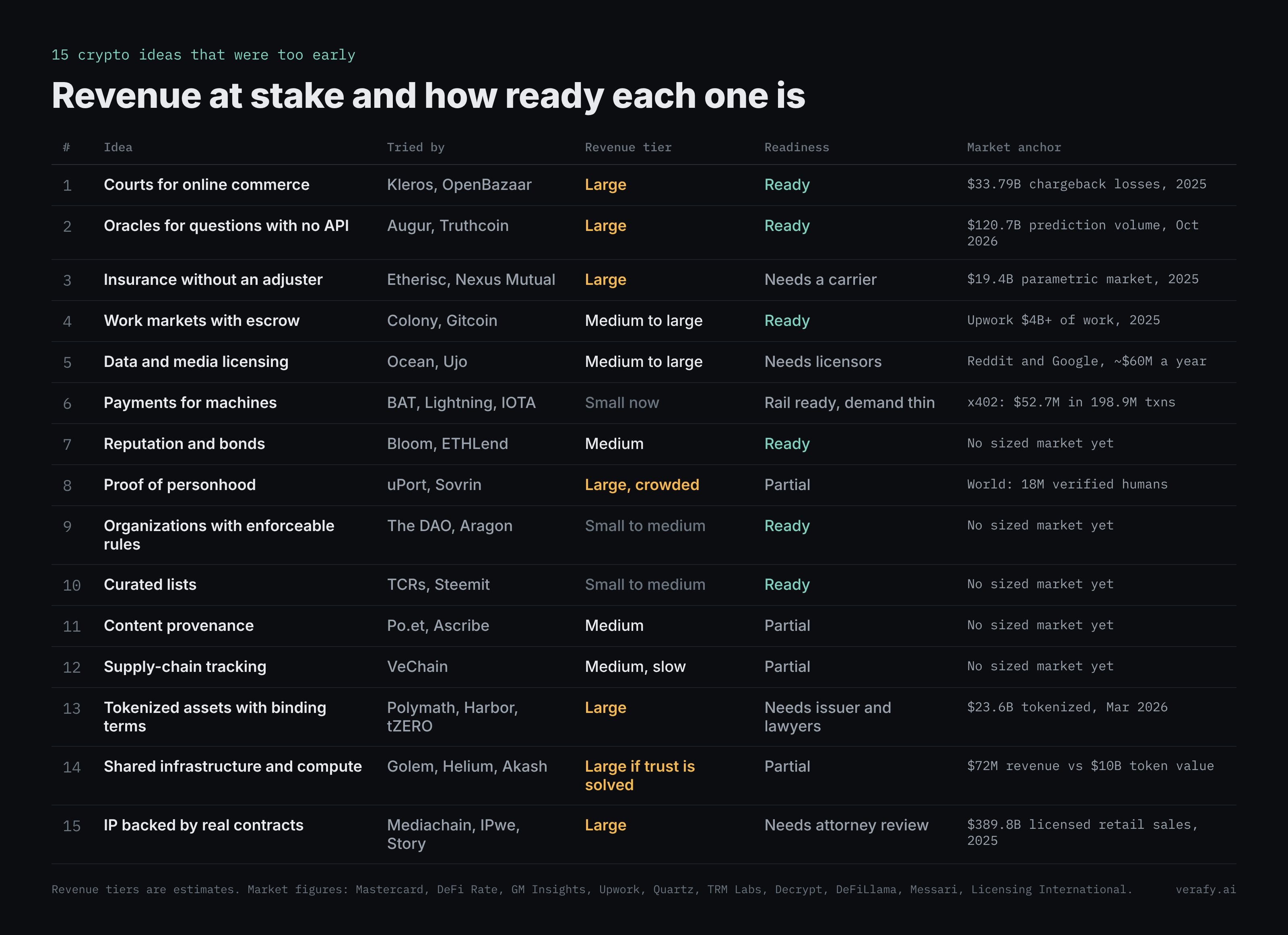
Figure: Overview of market revenue scale and AI era landing readiness for 15 early crypto concepts
Reworking Validation Prompt Library
Before testing a direction, please first execute the general review prompt and then run the targeted execution prompts for the respective concept. The following prompts are primarily written for programming AI agents integrated with Verafy Harness and its template library (templates/prompts/); if you choose other R&D frameworks, simply replace them with corresponding toolchains.
General Review Prompt (run this segment first regardless of which concept you are studying):
You are re-evaluating an early crypto concept that was attempted but conditions were not mature at the time: [fill in the concept name], with the early representative attempt being [fill in the project name].
1. Research and analyze the reasons for the stagnation of this concept at the time, and categorize them as follows: reliance on human judgment, lack of stable currency, lack of high-speed low-cost settlement, regulatory hindrance, lack of real demand. Please attach data or literature sources for all.
2. For each of the above stagnation reasons, clearly determine whether they are resolved or still pending at present (with conditions of AI jury, stablecoins, Solana public chain), and be straightforward about any unresolved challenges.
3. Define the minimum viable product (MVP) plan only for the key pain points that have been resolved, target a single type of paying customer, and ensure that the product can be developed and delivered within four weeks.
4. List the only key validation indicators that can prove the feasibility of the plan within 90 days. Strict constraint: do not propose a token issuance plan, and do not speculate on any unverified market demand.
Special Validation Prompts for Each Concept:
· Online E-commerce Arbitration Court: “Build a dispute adjudication service for procurement orders below $50 between agents. Each order is accompanied by a receipt condition smart contract written in natural language. In case of a dispute, summon a five-model jury to make a decision against the order, deliverables, and communication records, and release escrow funds according to the judgment results. Focus on tracking the cost of each judgment and the proportion of appeals by the losing party.”
· Real World Problem Oracle Lacking API: “Build a result adjudication service for prediction markets. Input market questions, settlement rules, and source lists; output a sealed judgment containing each juror’s vote and reasoning, and set an appeal window. Select 200 previously disputed settled markets for backtesting and report the consistency rate with final results.”
· Automated Insurance without Claims Adjusters: “Select a specific underwriting scenario (flight delays, parcel losses, or vulnerabilities in smart contracts). Write claims payout triggering terms in natural language, build a claims jury based on submitted evidence, and calculate pricing based on historical claims data. Finally, draft a one-page project proposal to pitch for claims adjudication trial opportunities to licensed insurance companies.”
· Task Labor Market with Escrow Settlement: “Build a bounty task board based on hackathon and super funding templates, allowing AI agents to claim tasks and submit GitHub links for delivery. After the model jury assesses against publicly stated acceptance standards, automatically release the bounty. Focus on tracking the median time from submission to actual payment and overall dispute rates.”
· Data and Media Copyright Licensing: “Design a licensing agreement for small creators selling AI training rights, with all usage terms written in natural language. Specify the audit evidence materials that the licensee must submit, and the execution mechanisms for the jury to determine defaults. Contact and secure ten communities of creators interested in grouping together for licensing, and draft a collaboration proposal for an AI laboratory.”
· Machine Micro-Payments: “Integrate x402 per-use billing agreements for a high utility value API, while binding performance guarantees in the form of agent bonds to each payment. Compare statistics on the re-purchase rates of paying agents with and without performance guarantees.”
· Replacing Full Collateral with Reputation and Margin: “Develop a set of public reputation scores for agents based solely on past sealed judgment records (on-time delivery logs, win/lose dispute records, margin forfeiture records). Integrate it into an agent trading market and test whether higher reputation scores actually help agents win more work orders.”
· Real Identity Proof: “Rather than creating a new identity verification system, act as the binding bridge: create an agent bond tied to existing identity verification or corporate real-name authentication providers, which can penetrate back to the real individual or entity once forfeited. Interview five agent trading markets to confirm if they are willing to set this as a mandatory entry requirement.”
· Enforceable Rule Organizations: “Select a real DAO organizational charter, utilize the DAO charter template to encode and land it, and then replay the organization's last 50 treasury funding proposals for review by the model jury. Report which proposals should have been intercepted by the jury and the specific reasons for each interception.”
· Community Curated Quality Lists: “For a specific catalog (e.g., MCP server catalog), write a clear set of inclusion standards in natural language. Have the jury scrutinize each entry in the current list, publicly releasing reasoning-backed review judgment results, and open a low-threshold challenge feedback channel.”
· Content Provenance Certificates: “Build a verification tool, receiving media files, content credentials, and their claimed sources, for the jury to adjudicate the validity of the entire evidence chain. Retrieve 100 known true or false material samples from collaborating news media editorial rooms for testing.”
· Supply Chain Traceability: “Skip building the underlying ledger directly. First, build a document consistency verifier for a specific compliance review system (conflict minerals or organic certification), specifically tagging cross-contradictions among certificates of origin, commercial invoices, and waybills. Compare the detection performance against 100 shipments to that of human professional auditors.”
· Legally Binding Tokenized Assets: “Select a real private credit loan agreement, encode its restrictive covenants and cash flow distribution terms into an agent contract, draft arbitration clauses explicitly stating that the jury’s decision has final legal binding force, and simulate extending a one-year performance term with a substantive default scenario. Compile a list of items that must be jointly signed and confirmed by licensed issuers and compliance lawyers.”
· Shared Infrastructure and Computing Power Markets: “Offer just one clearly committed performance guarantee service: ‘If a 7B model inference task is not completed within 60 seconds, the computing node's collateral will be immediately forfeited.’”
“The computing provider pre-stakes agent bonds, and the model jury adjudicates performance complaint based on logs and inference proofs, with buyers compensated from the bond. Test if staked nodes win more paid orders than unstaked ones.”
· Intellectual Property with Real Legal Contracts: “For the entire portfolio of independent musicians, have agents draft standard licensing agreements in concise legal terms, prepare and submit copyright registrations, and anchor signed contracts and official receipts on-chain using hashes.”
“Then encode this agreement as an agent contract, running three simulated licensing orders and one default scenario to transfer royalties according to judgments, while listing which steps still need final review by practicing lawyers.”
How to Choose Directions and Core Risks
Prioritize those old bottlenecks where “human judgment” was the problem and where buyers are already paying for inefficient, expensive human evaluations today. Following this clue, the first areas worth pursuing are online e-commerce arbitration, prediction market dispute settlements, and insurance claims audits.
Three Must-Answer Checkpoints Before Building:
· Has anyone been paying for slow human adjudication services (like chargeback processing teams, insurance claims specialists, prediction market settlement officers)?
· Can dispute issues be settled solely based on the digital evidence visible to the jury? If someone needs to be sent on-site to open boxes for inspection, AI cannot help.
· Does the model still hold without issuing tokens? The failure of the previously mentioned early concepts was partly due to their reliance on tokens to sustain operations rather than being funded by real customers.
The Four Persistent Real-World Risks:
· Model juries might collectively err. Large models trained on similar corpuses have common cognitive blind spots, so it’s essential to make reasoning processes public, retain human appeal review channels, and continuously monitor the consistency rate between AI judgments and human reviews.
· Evidence materials may be maliciously forged. The upper limit of jury judgment depends on the quality of the evidence they see; original certificates must be anchored on-chain with hashes, and it should be assumed that oral statements submitted by transaction parties are untrustworthy.
· Highly regulated industries still have high entry barriers. In insurance, securities, and credit fields, regulatory compliance checkpoints remain, and AI only eliminates the bottleneck of human adjudication efficiency, not the need for industry licenses.
· Some tracks still show thin real demand. While machine micro-payments and decentralized computing power markets have laid functional tech infrastructure, verified real paying demand remains minute; it's crucial to establish real retention and repurchase data before large expansions.
免责声明:本文章仅代表作者个人观点,不代表本平台的立场和观点。本文章仅供信息分享,不构成对任何人的任何投资建议。用户与作者之间的任何争议,与本平台无关。如网页中刊载的文章或图片涉及侵权,请提供相关的权利证明和身份证明发送邮件到[email protected],本平台相关工作人员将会进行核查。


