Author: AiPlot Research Institute
Focus: RWA / Digital Assets / Financial Infrastructure In-depth Analysis
Website: https://aiplot.com/?utm_source=aicoin
The recent most notable change in the RWA market is not the sudden explosion in total scale, nor the launch of a new project, but a significant migration of funds within the same type of assets.
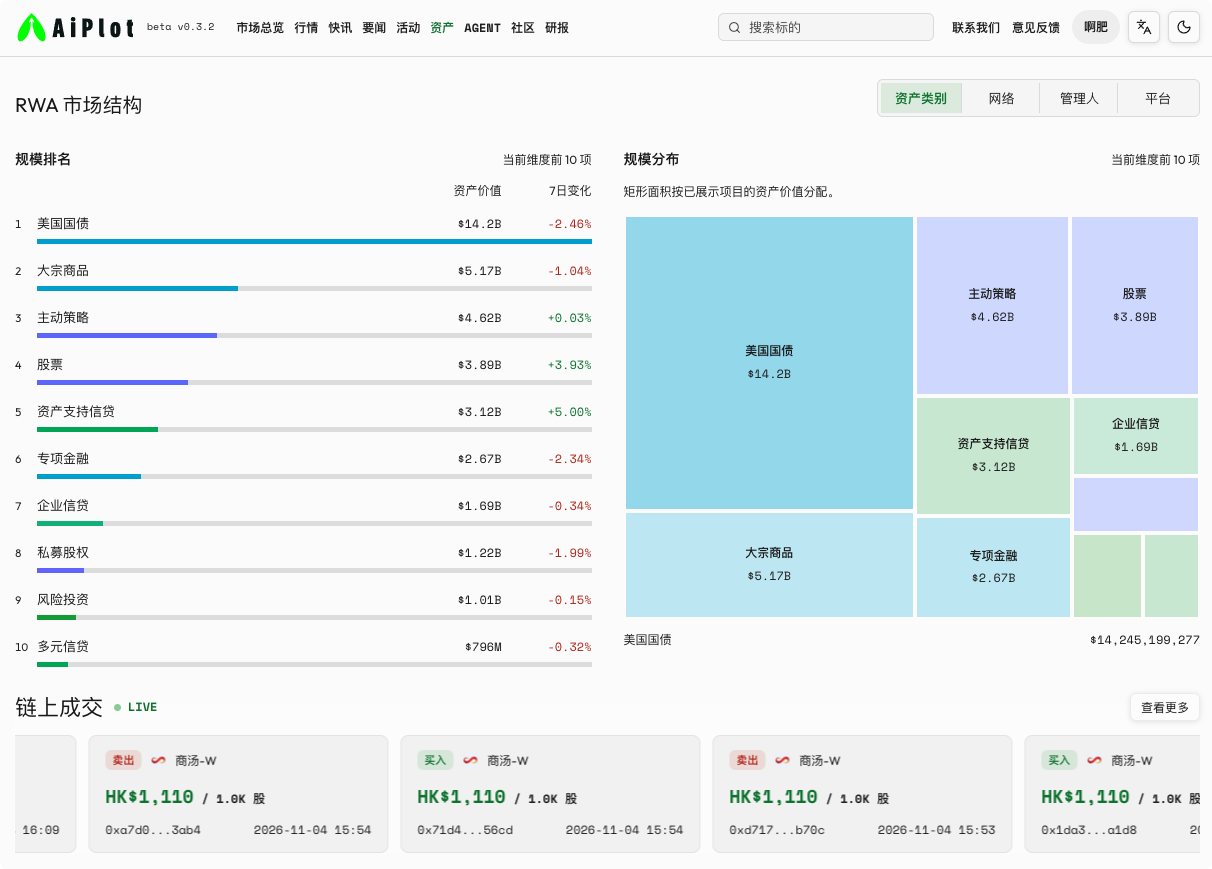
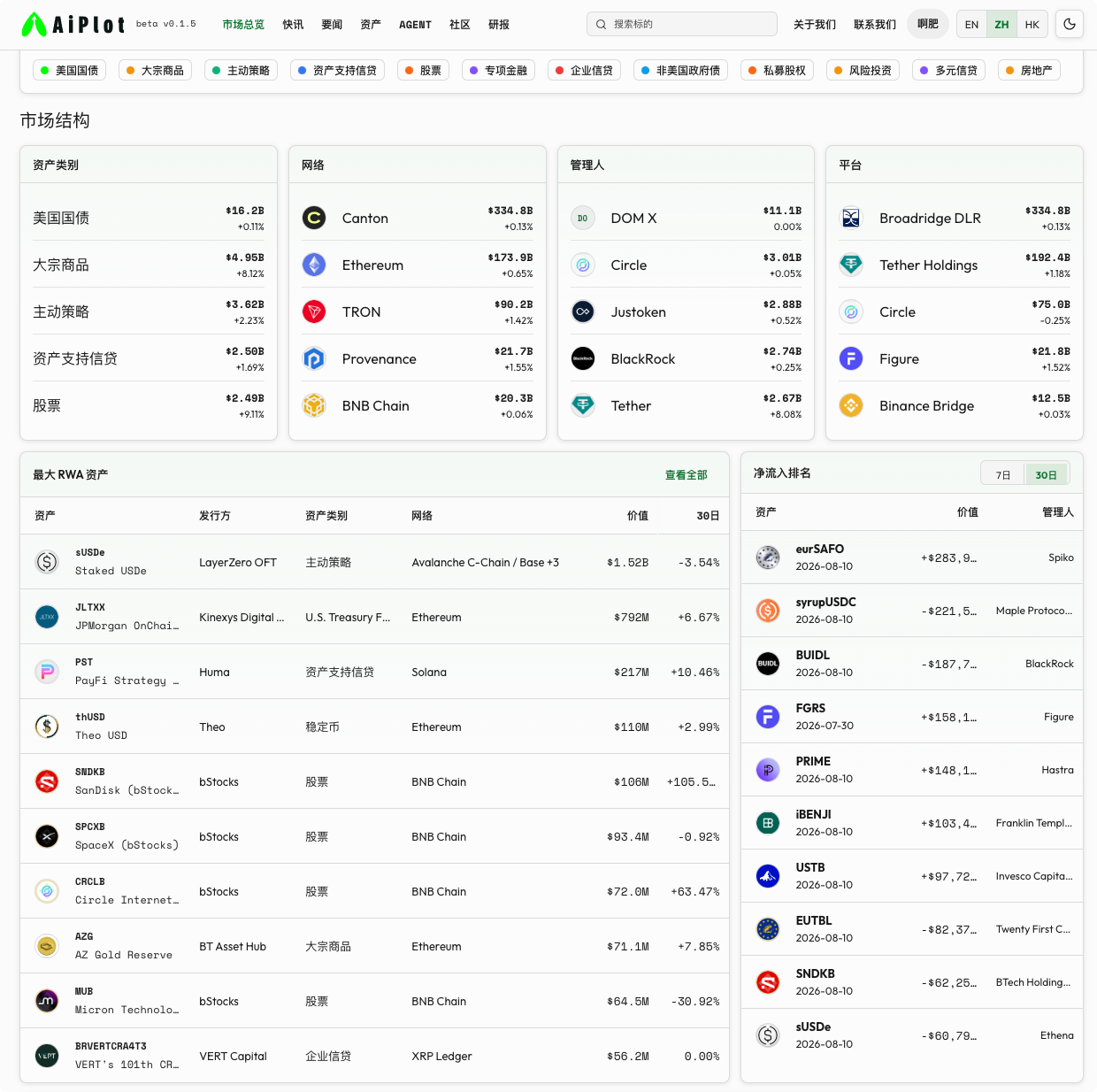
According to market tracking, the on-chain distribution scale of BENJI increased by approximately 399 million dollars, making it the largest inflow product of the week; during the same period, BlackRock BUIDL decreased by approximately 249.1 million dollars, Circle USYC decreased by approximately 141 million dollars, Tether Gold's XAUT increased by approximately 161.4 million dollars, and Spiko's eurSAFO increased by approximately 106.4 million dollars.
The message conveyed by this set of data is more important than whether the "total scale of RWA is up or down":
RWA is not a unified safe haven fund pool. Funds can quickly shift between different issuers, different yield products, different currencies, and different underlying assets.
If one only looks at the total amount, it is easy to conclude that "RWA changes little"; however, when broken down by product, it can be seen that institutions and protocols are re-selecting on-chain cash management tools.
The core judgment of this article is: The significant growth of BENJI is not just a victory for a single product from Franklin Templeton; it reflects that on-chain funds are beginning to pay more attention to verifiable fund structures, cross-chain availability, distribution networks, and compliance boundaries. However, at the same time, the outflows from BUIDL and USYC cannot simply be explained as the products losing competitiveness; they more likely involve large fund repositioning, protocol migration, changes in yields, and substitution between funds.
1. First, look at the complete fund flow: What is happening in RWA is "repositioning," not simple withdrawal
From October 31 to November 8, the total distribution scale of tracked products was approximately 23.21 billion dollars, with organic changes in the same products increasing by approximately 23.18 million dollars, and the changes brought by newly included products being 0.
During the same period, major inflows and outflows were as follows:
- BENJI: Inflow of 399 million dollars;
- XAUT: Inflow of 161.4 million dollars;
- eurSAFO: Inflow of 106.4 million dollars;
- BUIDL: Outflow of 249.1 million dollars;
- USYC: Outflow of 141 million dollars;
- JTRSY: Outflow of 50.5 million dollars.
Combining the above six main products, the net change was approximately 226.2 million dollars. Among them, the three inflow products collectively increased by approximately 666.8 million dollars, while the three outflow products collectively decreased by approximately 440.6 million dollars.
This indicates that funds did not leave the on-chain real assets unidirectionally, but rather were reallocated among different products. The inflows of BENJI, XAUT, and eurSAFO partially offset the outflows of BUIDL, USYC, and JTRSY.
Therefore, when studying RWA, it is not appropriate to directly compare total scales across different websites. A more effective approach is to first break down whether it includes stablecoins, tokenized stocks, crypto strategy funds, double-counted fund shares, and whether it is calculated by issuance volume, circulation or underlying asset value.
2. Why BENJI became the biggest winner this week
BENJI represents a share of the Franklin OnChain U.S. Government Money Fund. According to RWA.xyz data, this fund invests in government securities, cash, and repurchase agreements; BENJI was launched in 2021 and is a U.S. registered mutual fund that processes transactions and records share ownership using blockchain technology.
BENJI's total asset value is approximately 1.23 billion dollars, increasing by approximately 74.17% over the past 30 days; the 7-day APY is about 3.25%, the management fee is 0.20%, and there are approximately 1,139 holders.
BENJI increased by 399 million dollars in just one week, with a growth rate of about 48.7%. The absolute scale and growth benchmarks from the two data sources are not exactly the same, but they point to the same conclusion: BENJI has recently seen a very noticeable influx of funds.
BENJI's advantage is not just that "it can yield government bond returns." In the tokenized money market fund space, yields typically do not form significant long-term differences. The factors that truly influence large fund migrations also include the following aspects.
1. A clearly defined legal structure
BENJI corresponds to shares of a U.S. registered money market fund, rather than yield-bearing tokens issued by crypto projects. Its legal issuing entity is Franklin Templeton Trust, the legal structure is a statutory trust under the laws of the State of Delaware, and the regulatory framework is the Investment Company Act of 1940.
This structure makes it easier for institutions to understand: what they are buying is a share of the fund, and the blockchain is responsible for transaction processing and ownership record-keeping, rather than making an arbitrary income promise.
2. Fund shares are more tightly integrated with on-chain records
BENJI’s characteristic is not to issue an additional tracking product outside of the fund, but to combine share records with the blockchain system. It can be classified as distributed tokenization, and its token supply corresponds to the fund's net asset value.
For institutional users, this structure is easier to incorporate into compliance review, asset registration, and internal risk control processes than "yield tokens with price mappings provided by third parties."
3. The chain’s coverage expands distribution capability
BENJI has been deployed on multiple networks including Stellar, Base, Arbitrum, Ethereum, Aptos, Avalanche, Solana, and Polygon.
BENJI's main networks are Stellar, Ethereum, Base, Avalanche, Polygon, Arbitrum, and Solana.
This does not mean that the liquidity on each chain is the same, nor does it mean that users can freely cross-chain among all networks. However, multi-chain distribution indeed expands the possibility of the product entering digital asset platforms, wallets, protocols, and institutional systems.
4. Clear subscription and redemption mechanisms
BENJI supports daily subscriptions and redemptions, with a minimum investment amount of 20 dollars, but investor eligibility is still limited to U.S. investors and requires KYC completion; tokens can only be transferred within the whitelist range.
This just underscores a common misconception: tokenization does not equal permissionless free trading. The on-chain nature of BENJI increases recording and settlement efficiency, but it remains a fund product constrained by investor eligibility and transfer rules.
3. The outflow from BUIDL and USYC does not signify the invalidation of tokenized government bond logic
In the same week, BUIDL decreased by approximately 249.1 million dollars, and USYC decreased by approximately 141 million dollars.
If one only looks at the ranking changes, it might be mistakenly assumed that the market is abandoning the tokenized government bond products from BlackRock and Circle. However, this judgment is overly simplistic.
The outflow from BUIDL may be a large fund adjustment
BUIDL is one of the most representative tokenized government bond funds in the institutional market. It has a large scale and often serves institutions, trading platforms, and on-chain protocols. For such products, a single institution redeeming, a protocol migrating funds, or adjusting collateral structures can lead to weekly fluctuations of hundreds of millions of dollars.
Thus, the reduction of 249.1 million dollars in BUIDL on a weekly basis needs to be understood first as a funding flow event, rather than direct evidence of deteriorating product fundamentals.
What truly needs to be monitored going forward is:
- Whether the outflow persists for weeks;
- Whether the number of holders declines synchronously;
- Whether the outflow is concentrated on a single chain;
- Whether any protocols have migrated from BUIDL to other funds;
- Whether there are changes in fund net value, yields, and redemption mechanisms.
The competitive pressure on USYC may stem from product positioning
USYC is a short-duration yield product within the Circle ecosystem. It has strong ties to stablecoins, institutional settlement, and on-chain cash management, but it may also face competition from various alternatives, including BENJI, BUIDL, USDY, OUSG, and new short-term government bond funds.
When on-chain funds increasingly emphasize multi-chain distribution, legal structures of funds, or specific protocol compatibility, the shift of funds from USYC to BENJI does not mean that investors are abandoning short-term government bonds, but may instead indicate that they have changed the vehicle for obtaining short-term government bond returns.
This is where the RWA market parallels the traditional fund market: the underlying assets are similar, but the issuer, distribution channels, fee structures, liquidity, and legal packaging will still affect funding choices.
4. What the growth of XAUT signifies: gold begins to play the role of "on-chain macro hedge"
XAUT increased by approximately 161.4 million dollars during the same period, and the growth of the gold token does not completely belong to the same funding demand as that of BENJI.
BENJI mainly addresses issues of dollar cash management and short-term yields, with sources of yields related to U.S. government securities, cash, and repurchase agreements. XAUT, on the other hand, offers exposure to gold prices, bearing the functions of macro hedging, currency risk hedging, and asset allocation during risk events.
In an environment where U.S. employment data exceeded expectations and December rate hike expectations increased, short-term U.S. government bond products and gold do not necessarily move in the same direction. Investors may hold both simultaneously, but for different purposes:
- BENJI is closer to an on-chain cash management tool;
- XAUT is closer to on-chain hard assets and macro hedging tools;
- eurSAFO provides euro-denominated short-term yield assets.
Thus, the inflow of XAUT cannot be simply interpreted as a comprehensive shift of funds toward safe havens. It is more likely indicating that some funds are beginning to increase exposure to assets with correlations different from U.S. interest rates, U.S. credit, and tech stock risks.
5. The growth of eurSAFO indicates that RWA is showing signs of monetary stratification
eurSAFO increased by approximately 106.4 million dollars, with a growth rate of about 5.9%.
Prior discussions about tokenized money funds have long revolved around dollars and U.S. government bonds. However, the growth of eurSAFO indicates that on-chain cash management does not rely solely on the dollar.
The demand for euro-denominated assets may arise from several factors:
First, European investors and institutions need to reduce their dollar exposure and utilize local currency assets for cash management.
Second, after the gradual development of euro stablecoins and euro on-chain payment infrastructure, there is a need to connect with low-risk yield assets.
Third, new ways of combining EU fund products with digital asset distribution channels are beginning to emerge.
The RWA Weekly shows that eurSAFO has been deployed across multiple networks including Starknet, Stellar, Ethereum, Base, Etherlink, Polygon, Arbitrum, and Solana.
If this product continues to grow, competition in the RWA market will expand from "who has the most tokenized U.S. government bonds" to "who can provide compliant on-chain cash management tools for different currency regions."
6. The macro environment explains why funds are being reordered
The internal migration of funds within RWA does not occur in isolation; it is related to the macro environment during the same period.
According to data from the U.S. Bureau of Labor Statistics, non-farm employment in the U.S. increased by 165,000 in October 2026, with an unemployment rate of 4.1%, showing employment growth significantly higher than the monthly average over the previous 12 months.
This can directly affect the attractiveness of tokenized cash management assets, but the impact is not as simple as "interest rates rise, all RWA goes up."
If rate hike expectations increase, relative attractiveness for short-term government bonds and money market funds might enhance. But at the same time, the market will reassess valuations of risk assets, financing conditions, and U.S. dollar liquidity. Funds might withdraw from highly volatile tech stocks and crypto assets to enter cash management tools; or they might increase allocations to gold or non-dollar assets due to concerns about U.S. interest rates and U.S. assets.
Therefore, the simultaneous inflows of BENJI and XAUT are not contradictory. The former offers short-term yields in dollars, while the latter provides exposure to different macro risks.
7. The collapse of AI tech stocks: why this affects RWA fund flows
On November 5, the NASDAQ Composite Index dropped by approximately 5.5%, the NASDAQ 100 Index fell by about 6.4%, and the Philadelphia Semiconductor Index declined by around 12%; Reuters reported that major tech stocks lost about 2.5 trillion dollars in market value that day.
This drop is not only about changes in corporate profit expectations but also involves reassessments of the speed of AI data center investments, local permits, constraints on power and water resources, and financing capacities in a high-interest environment.
AI-related risks transmit to the RWA market through three channels.
First, the risk appetite channel
When tech stocks plummet, investors typically reduce leverage and exposures to risk assets. Crypto assets, due to continuous trading and high liquidity, often become quick-to-liquidate assets.
Second, the interest rate channel
If employment data is strong, the market raises the probability of interest rate hikes, leading to pressure on growth stock valuations, enhancing the relative attractiveness of short-term government bonds and money market funds.
Third, the collateral channel
Some on-chain protocols may use tokenized government bond funds, stablecoins, or other real assets as collateral. When risk assets decline, protocols may adjust their collateral structures, resulting in increased scale for certain RWA products while causing decreases for others.
Thus, the inflows and outflows in RWA are not merely "which fund investors prefer" but can also be the result of combined effects from protocol liquidations, collateral replacements, and deleveraging.
8. The real mistake to be wary of: treating on-chain scale growth as net fund inflows
The most common misinterpretation in RWA data is equating changes in asset value directly with net subscriptions by investors.
For example, with gold tokens, asset sizes may increase due to rising gold prices, even if the number of tokens does not significantly change. The value of fund-related RWAs can also be influenced by net value changes, supply changes, cross-chain transfers, and adjustments in issuing entity registrations.
Therefore, determining whether BENJI has actually absorbed 399 million dollars in new funds requires further observation:
- Whether the token supply has increased;
- Whether actual subscriptions of fund shares have occurred;
- Whether the number of holders has grown;
- Whether on-chain transfers and active addresses have increased;
- Whether the acquisitions are from new wallets or transfers between protocols;
- Whether there are cross-chain bridges causing duplicate or temporary statistical changes.
10. The next competitive point in RWA: not who issues, but who can retain funds sustainably
The tokenized government bond market has entered a product competition phase. In the future, the factors determining product rankings will include not only the issuing brand but also the following capabilities.
1. Distribution capability
Whether asset management institutions can connect their products to wallets, trading platforms, lending protocols, stablecoin payment systems, and institutional asset management platforms will determine whether their scale can continue to grow.
2. Portfolio compatibility
The competition among BENJI, BUIDL, and USYC is not just about yield rates, but also about collateral eligibility, liquidation efficiency, cross-chain deployment, and protocol integration capabilities.
3. Fund visibility
Institutions and protocols are placing increasing importance on whether assets can be viewed, validated, and audited in real time. The value of blockchain records is not in automatically granting liquidity to products, but in making asset supply, holders, and transfer records easier to verify.
4. Redemption and cash conversion
For cash management products, daily subscription and redemption, settlement speed, and certainty of fund arrival are often more important than the narrative of on-chain transactions.
5. Multi-currency and multi-asset portfolios
When the U.S. dollar, euro, gold, and other government debts can all operate on-chain, institutions can adjust their portfolios according to interest rates, exchange rates, and macro risks. The RWA market will no longer just be a single U.S. government bond track, but will evolve into a cross-asset, cross-currency, and cross-chain digital cash management market.
Conclusion
The most important signal of fund flows in RWA this week is that BENJI, XAUT, and eurSAFO simultaneously gained funds while BUIDL, USYC, and JTRSY experienced outflows. This structure indicates that the market is not simply exiting RWA but is rather re-selecting products, issuers, currencies, and asset categories.
The growth of BENJI indicates that competition among on-chain cash management products is shifting from pure brand competition to comprehensive competition regarding legal structures, fund registrations, multi-chain distributions, subscription and redemption mechanisms, and protocol compatibility.
The outflows from BUIDL and USYC remind us that a decrease in the scale of leading products does not necessarily equate to fundamental failure; it must be combined with assessments of the number of holders, supply, fund flows, and network data to determine whether it is a short-term adjustment or a long-term migration.
The growth of XAUT and eurSAFO indicates that the RWA market is showing more apparent layering of assets and currencies: short-term dollar yields, gold macro hedges, and euro cash management are beginning to coexist.
This is also a sign of RWA entering its next phase. In the future, the market will not only ask "which assets are tokenized" but will also ask:
Which on-chain assets can continually attract funds across different macro environments and become part of institutional cash management, collateral allocation, and cross-chain settlements?
For more data and analysis, please follow Aiplot:
https://aiplot.com/?utm_source=aicoin
📖 Community Communication:
- Telegram:
https://t.me/+IIYMcJigBAo4Mjg1
The content of this article represents the author's personal views and does not represent the platform's position. The opinions, conclusions, and recommendations in this article are for reference only and do not constitute any investment advice related to this platform. The market carries risks, and investments should be made with caution.
免责声明:本文章仅代表作者个人观点,不代表本平台的立场和观点。本文章仅供信息分享,不构成对任何人的任何投资建议。用户与作者之间的任何争议,与本平台无关。如网页中刊载的文章或图片涉及侵权,请提供相关的权利证明和身份证明发送邮件到[email protected],本平台相关工作人员将会进行核查。