Author: Jae, PANews
On November 8, Ethereum co-founder Vitalik Buterin made a statement on X that shook the long-standing consensus on ETH valuation in the crypto market.
He believes that instead of anchoring ETH on the logic of "fee destruction supporting value," he prefers to position it as a Store of Value (SoV). This statement effectively serves as a public correction to the widely propagated narrative of "Ultrasound Money" for ETH over the past five years.
Currently, Ethereum is experiencing a contradictory boom: the network's transaction volume is increasing, user costs are dropping, but the income generated from each transaction, along with the fees and the subsequent amount of ETH burned, is decreasing.
When the Gas destruction mechanism, once viewed as the ballast for ETH prices, can no longer hold, the roughly $260 billion ETH market cap urgently needs to find a new valuation anchor. Vitalik’s answer is to shift toward “value storage.”
To become a Store of Value, first overcome the “the more you use, the more you buy” barrier
Value storage is the new path Vitalik identifies for ETH.
The past valuation logic of ETH was that users pay fees, the system destroys ETH, and holders indirectly benefit from improved scarcity; the new logic, however, is that Ethereum provides sufficiently secure, neutral, and reliable financial infrastructure, making ETH an asset that the entire ecosystem is willing to hold, stake, and use over the long term.
Tom Lee, chairman of Bitmine, also agrees, stating that ETH is not a “cash flow” token model like HYPE or LIT, but a pure and trusted collateral.
For example, users can hold ETH, stake the tokens in the network to earn rewards, or use them as collateral to obtain liquidity in lending markets like Aave. The related staking assets can also enter other DeFi scenarios.
In simple terms, ETH is not just an asset stored in wallets but can also serve as foundational collateral supporting financial activities.
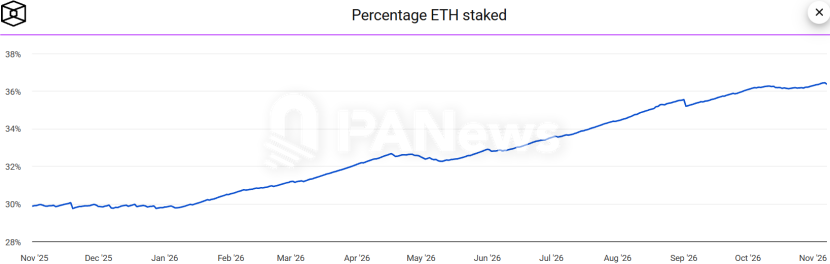
The most direct demand comes from staking. Data from The Block shows that as of now, the proportion of staked ETH accounts for 36.36% of the circulating supply, up from 29.91% last year. A large number of tokens are locked in validator nodes, indicating that a considerable portion of the chips are not used for short-term speculation but are undertaking network security functions.
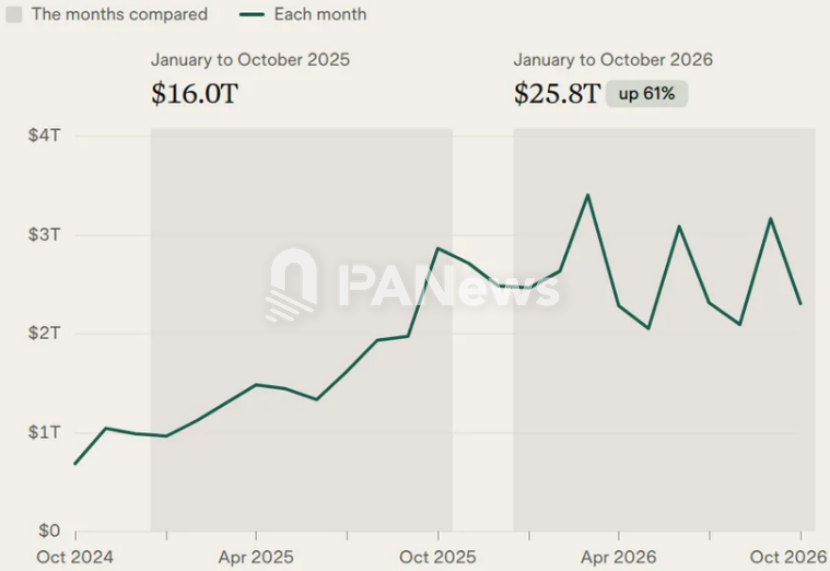
However, the Ethereum ecosystem is facing the issue of value transmission disconnection. Ethereum Institutional research points out that in the first ten months of this year, the total amount of stablecoin transfers on the Ethereum mainnet reached $25.8 trillion, a year-on-year increase of 61%.
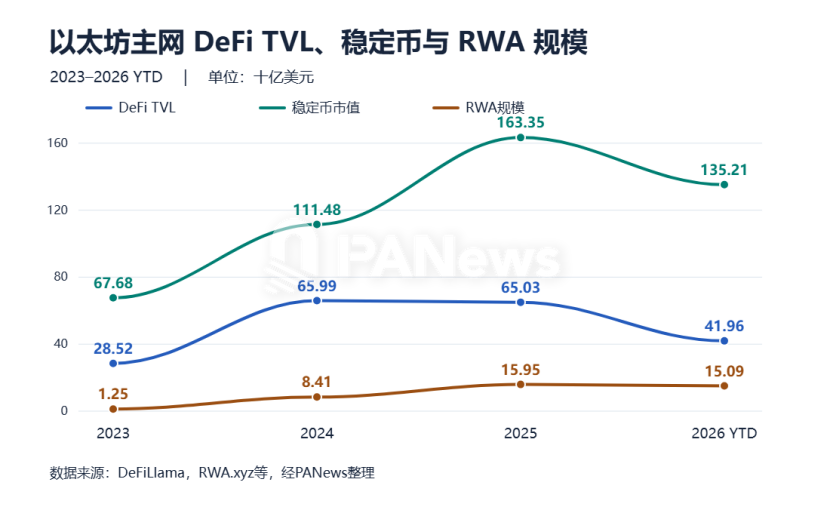
Data from DeFiLlama shows that the mainnet DeFi TVL is about $4.2 billion, stablecoin market value exceeds $135 billion, and RWA scale has also reached $15 billion.
Various dimensions indicate that the value of Ethereum as financial infrastructure is continuously solidifying, but just because the infrastructure is used does not mean that the native token will be continuously bought. One institution issued $1 billion in tokenized government bonds on Ethereum, with collateral being real-world bonds, returns coming from interest, and settlements completed using USDC, requiring only a small amount of ETH as Gas fees for on-chain interactions. Even as the scale of assets on Ethereum continues to grow, it may not necessarily translate into net buying demand for ETH.
This is the biggest test for the “ETH value storage theory.” Value storage has never been achieved simply through self-declaration; ETH needs to prove itself as indispensable foundational capital for on-chain financial activities, rather than just “fuel” purchased on demand when using the network.
ETH value diversion: Burn rate drops by over 90%, L2 takes the lion's share
Although the narrative focus for ETH will shift towards "value storage," the Gas fee destruction remains an important pillar in its valuation framework, and the issue of value transmission disconnection has already been reflected in the cliff-like decline in ETH burning volume.
Vitalik calculated a figure: if a token can burn $1 billion in fees each year, at a 4% discount rate, the theoretical present value would be approximately $25 billion. However, trading fees are not stable cash flows; treating peaks as the norm to project future value simply cannot withstand the scrutiny of cycles.
Based on ETH's market cap of about $260 billion, it would need to burn $10.4 billion in fees each year to sustain under a 4% discount rate. This figure has already drifted far beyond current realities.
In terms of burning volume, the system burned about 1.48 million ETH in 2022, while this year, as of now, it has only burned about 13,000 (valued at approximately $27.3 million), a drop of over 99% in terms of quantity.
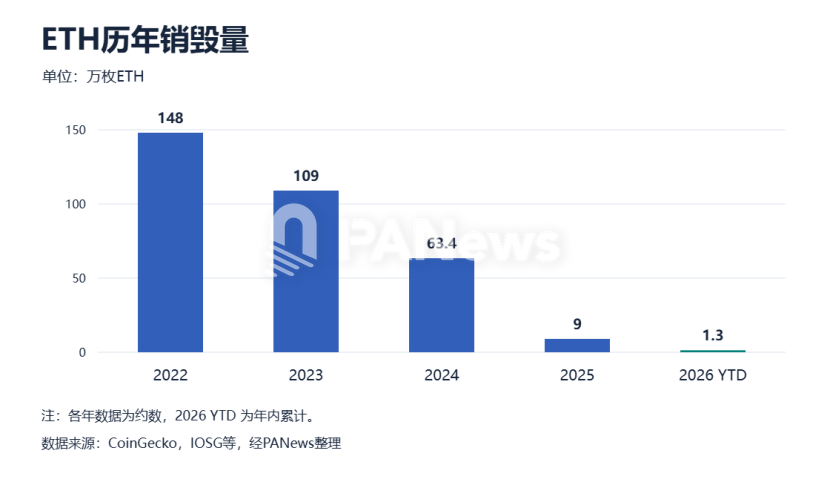
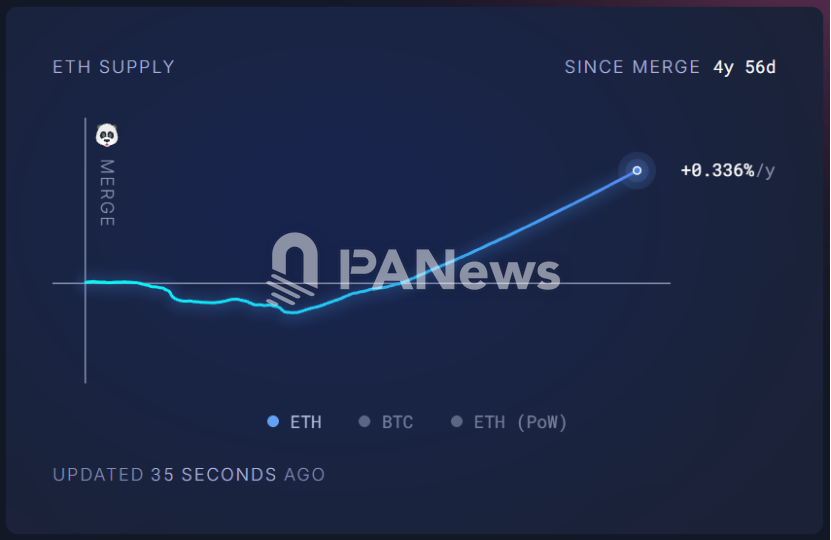
In fact, ETH transitioned from a state of net deflation back to net inflation as early as February last year, and the inflation rate has continued to rise, the deflation promise of “Ultrasound Money” has long been “broken.”
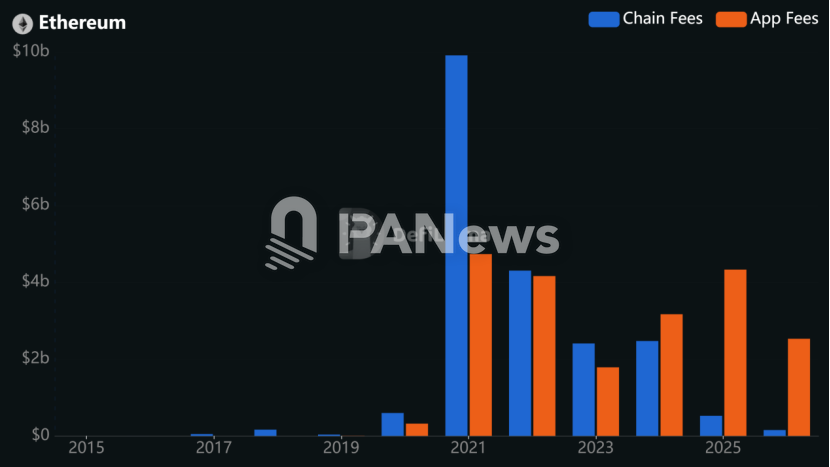
The shift in Ethereum's value distribution is also a recurring issue. If we compare the Ethereum ecosystem to a business entity, the revenue of the underlying network is continuously flowing towards L2 and application layers.
Data from DeFiLlama indicates that the fees generated on the Ethereum chain were surpassed by the application layer on the mainnet as early as 2024. Since the beginning of this year, the mainnet has earned about $15.2 million in fees, while the application layer's fee scale has reached as high as $252.9 million, with a difference of more than 16 times between the two.
Layer 2 represents the most typical example of value diversion in the Ethereum ecosystem.
Take L2 leader Base as an example; it relies on Ethereum for underlying settlement and security while having its own execution environment and user entry. It charges end users transaction fees, then pays Ethereum for data publishing and settlement costs; the difference is its on-chain gross profit.
Data from growthepie shows that in the past 30 days, the top 3 Ethereum L2s achieved a total on-chain profit of about $5.71 million, with Base contributing $2.49 million alone. During the same period, the total settlement fees paid to the Ethereum mainnet were only about $48,000, with Base’s payment even lower at $18,500, which is less than that of Robinhood Chain.
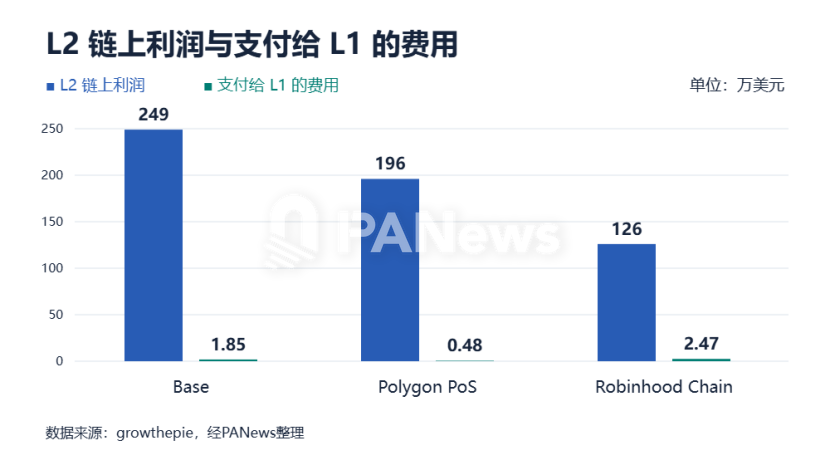
This means that the vast majority of the value of transaction fees remains with L2 and has not flowed to the Ethereum mainnet, thus not translating into profits for ETH holders.
A longer-term concern lies in the shift of brand and user perception. As more and more users complete all on-chain operations through L2s like Base and Arbitrum and almost no longer interact with Ethereum, the service and brand perceived by users will increasingly belong to L2 and front-end applications.
Expansion opens new scenarios; fee reduction may cultivate new growth
Conversely, the continuous decline in transaction fees may not necessarily be a bad thing.
The implementation of scaling technology fundamentally reduces the unit cost of transactions. In the past, a single transfer would cost several dollars, making many high-frequency and small-value scenarios nearly impossible. However, when costs drop to a few cents or even lower, previously economically unviable scenarios such as high-frequency payments by AI agents, micro-transactions, and automated strategies have the potential to grow.
Nevertheless, whether this new demand can coalesce into a large enough transaction volume to offset the decline in unit fees through economies of scale remains to be seen over time.
Tom Lee also pointed out that ETH's turn towards value storage will enable it to capture value in the upcoming tokenization and AI supercycle.
Today, Ethereum can no longer rely on high Gas fees to support destruction and drive up prices. Vitalik's statement seems more like a proactive expectation management: instead of clinging to a gradually ineffective deflationary narrative, it is wiser to acknowledge early on that the value proposition of ETH is undergoing a shift.
In the past, Ethereum needed to prove to the market that it could collect enough fees to support destruction. In the future, it needs to demonstrate that even as fees become cheaper, ETH remains worth holding.
免责声明:本文章仅代表作者个人观点,不代表本平台的立场和观点。本文章仅供信息分享,不构成对任何人的任何投资建议。用户与作者之间的任何争议,与本平台无关。如网页中刊载的文章或图片涉及侵权,请提供相关的权利证明和身份证明发送邮件到[email protected],本平台相关工作人员将会进行核查。


