Author: Shenchao TechFlow

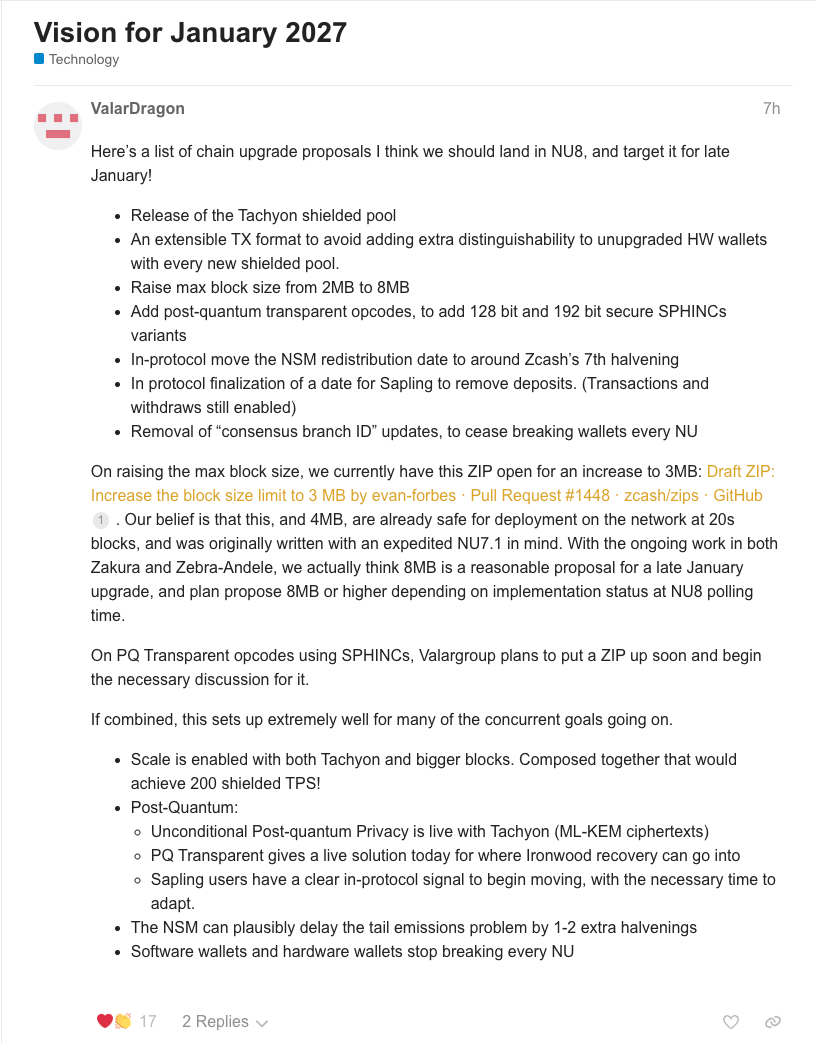
On November 10, 2026, Zcash community developer ValarDragon proposed the concept of the NU 8 network upgrade in the official Zcash forum proposal thread, targeting a launch window at the end of January 2027. The proposal covers iterations of the privacy pool, block expansion, and updates to cryptographic defenses.
The core of the proposal is to introduce a brand new Tachyon shielding pool and increase the maximum block size to 8MB while introducing quantum-resistant signature opcodes. If this architecture is implemented, Zcash's shielded transaction throughput is expected to reach 200 TPS, aiming to overcome the performance bottleneck that privacy public chains have faced in the long term.
Block Expansion to 8MB Sparks Controversy Over Light Client Bandwidth
Expansion is the central topic of this discussion. The current Zcash network maintains a high-frequency block production rhythm with a 2MB block size limit; previously, the community proposed a block expansion ZIP draft targeting 3MB. ValarDragon believes that with underlying optimizations, the network can directly jump to an 8MB capacity.
Compared to the existing 2MB specification, the 8MB limit expands block capacity by four times, and is about 2.67 times greater than the 3MB draft, providing the computational foundation to achieve 200 TPS. However, this requires full nodes to handle more data within a single block production window, thus raising the hardware threshold and ongoing bandwidth requirements.
Core engineer str4d raised objections. str4d emphasized that the out-of-band communication (OOB) and private information retrieval (PIR) standards that light wallets currently rely on have not yet been established. Directly pushing for 8MB expansion will increase the data synchronization pressure on mobile light clients, necessitating a balance between bandwidth and throughput.
Dual-Line Construction of Hidden and Transparent Layer Quantum Defense System
In terms of security design, the proposal outlines a layered defense mechanism. The new Tachyon shielding pool will utilize the ML-KEM ciphertext encapsulation mechanism for creating an unconditional post-quantum privacy system. This ensures that even with the potential for quantum computing to break codes in the future, it will not be able to decrypt past on-chain transaction graphs.
For transparent addresses, the proposal plans to add support for 128-bit and 192-bit SPHINCS signatures (such as SLH-DSA). This design aims to provide pre-emptive quantum-resistant security for transparent assets that have not migrated to the shielding pool, as well as scenarios such as the Ironwood disaster recovery path.
Transaction Format Upgrades and Controversy Over Branch Identifier Changes
In terms of transaction structure, the proposal suggests integrating the ZIP 248 specification. This specification reconstructs the scalability of the transaction format, allowing hardware wallets to eliminate the metadata fingerprints exposed when new shielding pools are added, blocking external on-chain analytics from tracking transactions through differences in device signatures.
The proposal advocates for the removal of the mechanism that forcibly changes the Consensus Branch ID with each upgrade round to reduce the adaptation fractures in the wallet ecosystem caused by forks. str4d reminds that this parameter is a critical protective barrier against replaying cross-fork transactions, and a substitute anti-replay mechanism must be established before its abolishment.
Asset Pool Downturn Governance and Promotion Node Constraints
Regarding the lifecycle management of asset pools, the proposal does not continue the hard freezing measures implemented on the Sprout pool during the NU 7 period, but instead sets a specific point in time at which new deposits will cease in the Sapling pool at the protocol level. Existing users can still freely initiate transfers and withdrawals within this pool, retaining sufficient migration buffer time.
The proposal further redistributes the Network Sustainability Mechanism (NSM) node adjustments to around the 7th halving of Zcash. According to a schedule of halving every four years, this adjustment will postpone the tail issuance pressure by 4 to 8 years. Currently, there are only about two and a half months left until the end of January 2027, and the technical roadmap can be referenced at the official Tachyon roadmap.
Currently, ValarDragon's proposal is in the public technical verification stage on the official forum. The development team will subsequently need to complete a rigorous technical review around the PIR standards and alternative replay protection measures. Once consensus on the code is achieved, the proposal will officially enter the finalization stage and be submitted for community governance voting on NU 8.
免责声明:本文章仅代表作者个人观点,不代表本平台的立场和观点。本文章仅供信息分享,不构成对任何人的任何投资建议。用户与作者之间的任何争议,与本平台无关。如网页中刊载的文章或图片涉及侵权,请提供相关的权利证明和身份证明发送邮件到[email protected],本平台相关工作人员将会进行核查。


