Old money goes on-chain, old coins lift the sedan
Kuli, Deep Tide TechFlow
Deep Tide Commentary:
On November 9th, the New York Stock Exchange selected Avalanche for the settlement of tokenized stocks, resulting in AVAX increasing by about 10%. On the same day, Formation filed to establish a tokenized stock trading venue on Solana. However, regulatory rules state that for large-cap stocks, at most one share can be traded on-chain for every 400 shares.
If you saw AVAX surge yesterday, the reason was the New York Stock Exchange.
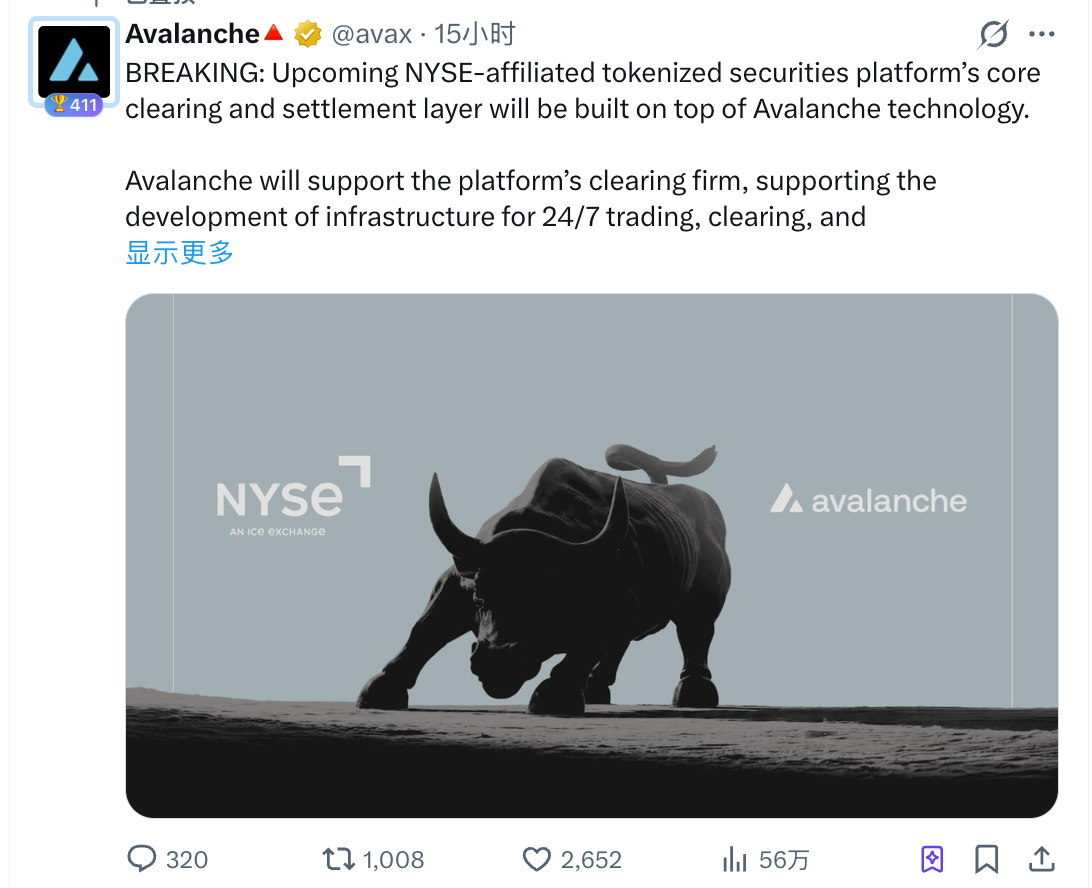
On November 9th, Ava Labs announced that the tokenized stock platform being developed by the New York Stock Exchange has selected Avalanche as the ledger for clearing and settlement. The platform aims to enable round-the-clock trading, pending regulatory approval.
On that day, AVAX jumped from $7.82 to $8.85, an increase of about 10%. The open interest in contracts increased by about 26% on the same day, with Binance and Bybit accounting for 77% of that. The initial influx was clearly from leveraged money speculating on the story.
On the same day, Solana also had good news.
A new company called Formation Securities notified the U.S. Securities and Exchange Commission that it plans to open a tokenized stock trading venue on Solana, aiming to launch in early 2027.
When these two points are put together, it evokes the trend that old money is going on-chain, and old coins are being speculated anew.
However, after reviewing the actual plans from both sides, you might not feel so optimistic about the conclusion. Wall Street is indeed going on-chain, but mostly onto chains it can control. Money is flowing into companies that sell technology and channels, leaving very little of what truly empowers and impacts coin prices.
The NYSE buys the technology itself, with minimal impact on AVAX
From the cooperation details, the New York Stock Exchange is not using the Avalanche public chain but a customized private chain that meets its regulatory requirements. It decides which institutions can access it and who runs the nodes.
Dennis Lee, head of digital issuance at the NYSE, has discussed the reasons for choosing it: fast, stable, predictable costs, and control over who can enter. The focus is clearly on the control of the final chain, which a public chain cannot provide.
So how much toll does this chain have to pay to AVAX?
The answer is very little, and it's determined by Avalanche itself. Before December 2024, each validating node on this private chain must stake 2,000 AVAX; institutions that want to go on-chain must first buy the coins on the market. To attract enterprises to go on-chain, Avalanche lowered the threshold by upgrading to Etna, changing it to about 1.33 AVAX per node per month, which is destroyed upon payment. Transaction fees on the chain can also be paid with its own tokens.
If the NYSE runs 30 nodes, it would burn less than 480 AVAX in a year, valued at around $4,000, which is negligible compared to AVAX’s market cap of about $3.9 billion...
The entire network is also at this scale. According to a calculation by VanEck in September, around 850 such nodes would contribute approximately $160,000 to the main network in a year. So, institutions are indeed coming in, but they are not buying much AVAX anymore.
Solana got the ticket but not the trading volume
In comparison, Solana appears more like a public chain should.
Formation is not an established Wall Street institution, but an old player on Solana. In October of this year, the decentralized exchange Orca and the lending protocol Loopscale on Solana merged to form Formation. The Formation Securities making the announcement is their newly established securities business, with trading technology directly authorized from Orca.
On November 9th, Formation Securities notified the U.S. Securities and Exchange Commission that it plans to operate a tokenized stock trading venue on Solana, claiming to be the first on Solana.
The plan is roughly as follows:
After approval from the listed company, stocks are converted into tokens by the issuers Superstate and Securitize. Investors, after identity verification, will hold stock tokens in their wallets and trade them around the clock using stablecoins. The delivery of stocks and money is completed in the same Solana transaction, with dividends and voting rights akin to common stocks, and these stock tokens can also be used in approved on-chain applications. The first batch plans to list stocks from three companies, starting trading in early 2027.
Why choose Solana?
Formation provided three reasons: fast, inexpensive, and there are already over $5 billion in tokenized real assets on Solana. They have been working on this for more than a year and a half, and in April 2025, Orca co-signed with Superstate and the Solana Policy Institute to submit a plan to the U.S. Securities and Exchange Commission for trading stocks on a public chain.
The biggest difference from the NYSE is that this uses a public Solana, and only the trading pool has a threshold. Every transaction is a Solana transaction, and transaction fees are paid in SOL.
They can afford to do this due to the innovative exemption issued by the U.S. Securities and Exchange Commission on September 17. The exemption requires trading contracts to be deployed on the public chain, essentially reserving a seat for public chains.
But regulators clearly do not intend to allow on-chain U.S. stocks to grow large all at once.
For large-cap stocks like the S&P 500 and Russell 1000, each venue can trade a maximum of 75 stocks, and the on-chain trading volume of each cannot exceed 0.25% of its average daily trading volume from the previous month. In other words, out of every 400 shares traded, at most only 1 share can be completed on-chain. Other stocks are relaxed to 2.5%. After exceeding the limit a second time, trading is suspended for three months.
A single transaction fee on Solana is already less than one cent, and with the capped trading volume, this pie will not grow significantly in the short term.
As for the initial three stocks, they are even more intriguing. "For tokenized stocks to succeed, it is essential that the listed companies see their value," said Christopher Montagano, president of Formation Securities.
Yet the stocks he brought in are from Exodus, Forward Industries, and Galaxy. One company makes crypto wallets, another holds about 8.5 million SOL as Solana’s treasury company, and the last is one of the backers of Forward.
In plain terms, the first batch of U.S. stocks traded on Solana is still lifting the sedan with insiders from the crypto circle.
A Familiar Taste
If you followed Goldman Sachs during that wave in September, the way AVAX is rising now should look very familiar.
On September 29th, Goldman Sachs' treasury bond fund connected to the Avalanche private chain, and in a single day, AVAX rose by about 12%, hitting a six-month high of $11.92. After six weeks, it fell back down to around $7.8, retracing about one-third. This time with the NYSE, we are seeing a similar script unfold.
Now, crypto has indeed been accepted by Wall Street. The NYSE, DTCC, Goldman Sachs, and Nasdaq have all been transferring clearing, custody, and distribution to blockchain within a year while regulators have specially issued a five-year exemption. This blockchain technology is becoming the infrastructure of Wall Street.
However, the way it is being accepted is not the kind that is beneficial for long-term increases in coin prices.
Old money wants the settlement speed of blockchain and round-the-clock trading, not the coins themselves. They build private chains, collecting only a small toll for tokens; even if it goes on a public chain, the trading volume is capped by regulators.
The technology has been bought, but the coin prices haven’t gone along with it, which may be the key reason why existing crypto projects can attract catalysts but cannot achieve monumental changes.
免责声明:本文章仅代表作者个人观点,不代表本平台的立场和观点。本文章仅供信息分享,不构成对任何人的任何投资建议。用户与作者之间的任何争议,与本平台无关。如网页中刊载的文章或图片涉及侵权,请提供相关的权利证明和身份证明发送邮件到[email protected],本平台相关工作人员将会进行核查。


