In the crypto market, is there a way to make money:
That doesn’t require studying candlestick charts, chasing trends, predicting bull and bear markets, or watching the market every day?
The answer might be a bit boring: Regularly buy Bitcoin and hold it long enough.
This doesn’t sound like a brilliant investment strategy, in fact, it seems a bit foolish.
But historical data provides a noteworthy conclusion: during the completed historical cycles, long-term dollar-cost averaging in Bitcoin has shown a relatively high probability of profit.
Of course, this does not mean it won’t lose money.
If you start investing at a peak, encounter a long bear market, or panic sell along the way, the results could be entirely different.
Today, we will clarify this: why is dollar-cost averaging in Bitcoin effective? How good is the historical data? What situations might cause this strategy to fail?
1. What is true dollar-cost averaging in Bitcoin?
First, let’s clarify a concept.
Many people say they are dollar-cost averaging but are actually doing something else:
Buying more when the market goes up, pausing when the market dips; seeing which altcoin is hot and can't resist putting some money to chase it.
This is not true dollar-cost averaging.
What is being discussed here is a simple strategy:
- Only buy BTC, without extending the strategy to various altcoins.
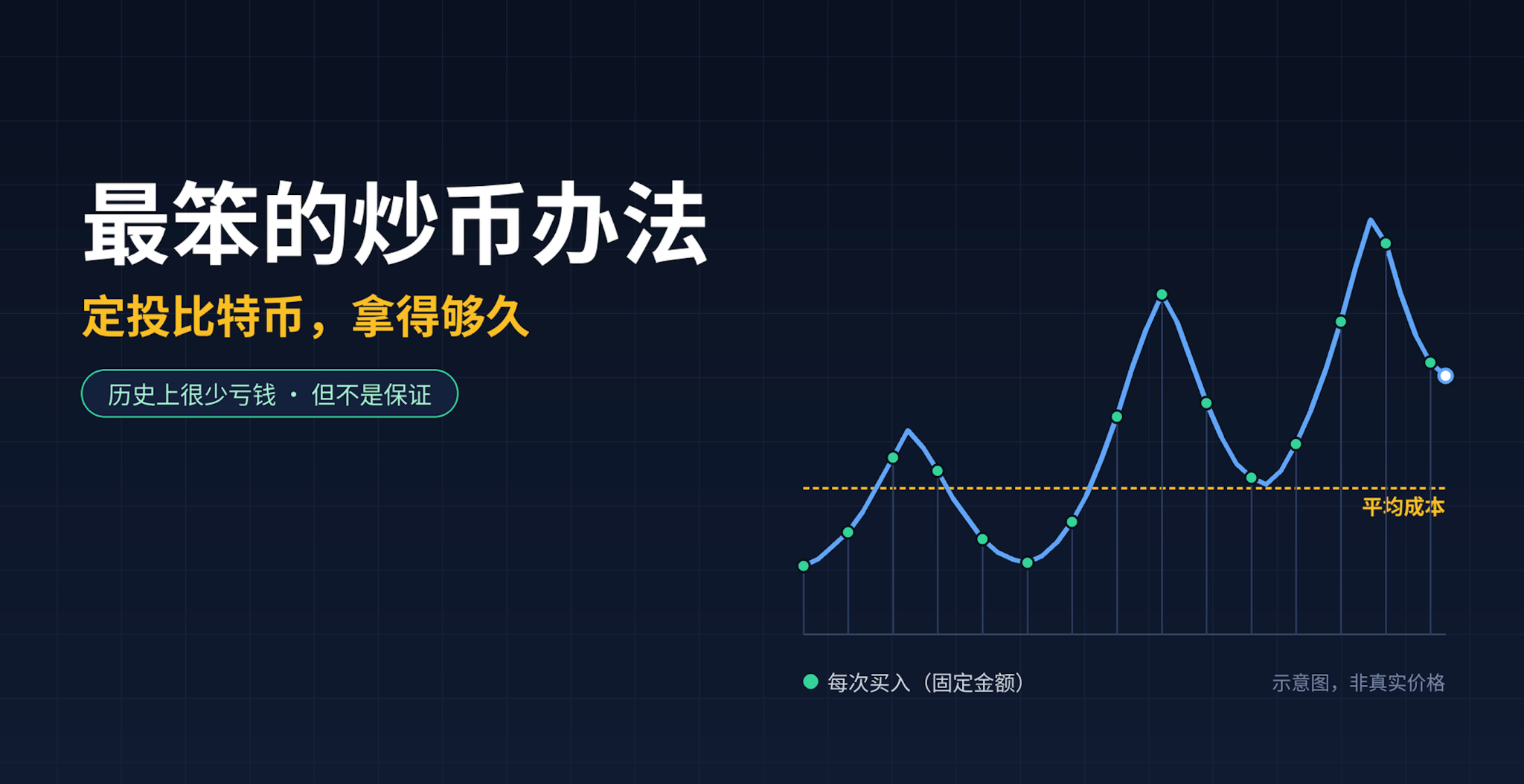
- Fixed amount, for example, buying $100 weekly.
- Fixed frequency, do not randomly change the plan due to price rises or falls.
- No timing, do not attempt to predict short-term tops and bottoms.
- No leverage, do not borrow money to invest, only use spare money that won’t be needed for a long time.
- Long-term hold, ideally over years, aiming to traverse a complete market cycle.
The core of this strategy is just two words: discipline.
You don’t need to judge whether Bitcoin will rise or fall tomorrow; you just need to execute the established rules continuously.
Its biggest advantage is not buying at the lowest point but not needing to accurately predict the lowest point.
2. Historical Data: Why is it Considered a Strategy Worth Analyzing?
Let’s look at some representative historical statistics.
1. Four-Year Average: Historically Achieved Full Profit
Data from Blockstream indicates that, during its historical window, dollar-cost averaging in Bitcoin for four consecutive years, regardless of the starting historical date, resulted in profit.
It should be noted that this refers to a rolling four-year dollar-cost averaging window in historical backtesting, not that buying BTC at any time and holding it for four years will necessarily yield profit.
2. Over Two Years of Averaging: Profit Probability Significantly Increases
According to data from CoinDesk Research cited by Onramp, Bitcoin dollar-cost averaging strategies sustained for over 24 months have a historical profit ratio of approximately 97%.
This indicates that as investment time extends, the impact of short-term price fluctuations on the final results gradually weakens.
3. Investing $100 Weekly: What Gains Can Accumulate Over Five Years?
The same source provides an example:
From 2019 to 2024, if you invest $100 weekly, the total invested would be approximately $26,000, with a historical return of about 202%.
The key here is not that you bought right each time, but that you consistently accumulated BTC and gained long-term returns as the market rose.
4. The Longer You Hold, The Lower the Historical Probability of Loss
Historical data compiled by coinpro also shows:
- Holding for three years has a historical loss probability of about 0.70%;
- Holding for ten years has a historical profit ratio of 100%;
- Holding for a few days to weeks, the loss probability is close to 50%.
However, these figures are influenced by the statistical interval, start and end dates, and return calculation methods, so they cannot be viewed as definitive future win rates.
5. Buying at Historical Highs Doesn’t Necessarily Mean You’ll Be Always Trapped
In December 2017, Bitcoin reached about $19,783.
Afterwards, it experienced substantial retracement, but by early 2021, Bitcoin broke back through that price range.
In November 2021, Bitcoin set another historical high. After that, the market entered a bear cycle, and those dollar-cost averaging could accumulate more BTC during the decline.
There is a significant difference here:
Making a one-time purchase at a peak means waiting for the price to exceed your entry cost again; consistent dollar-cost averaging allows you to gradually reduce your overall holding cost through subsequent low purchases.
This is why dollar-cost averaging and one-time buying cannot be evaluated using the same historical return logic.
3. Why is Dollar-Cost Averaging Effective? There Are Actually Three Mechanisms Behind It
Historical data is simply the outcome; what’s truly essential is understanding the underlying logic.
First: Price Declines Are Not Necessarily Bad.
Assuming you invest $100 weekly:
- If BTC is $100,000, you can buy 0.001 BTC;
- If BTC drops to $80,000, you can buy 0.00125 BTC;
- If BTC falls to $50,000, you can buy 0.002 BTC.
With the same $100, the lower the price, the more BTC you can purchase.
This is the core mechanism of dollar-cost averaging: through continuous purchases, you accumulate asset quantities across various price ranges.
Of course, this does not mean that the greater the volatility, the higher the returns. The premise still is that the asset can ultimately recover and achieve long-term growth.
Second: You Don't Have to Guess When the Market Hits Bottom.
The short-term market is influenced by macroeconomic conditions, liquidity, policies, institutional funding, and market sentiment, among other factors.
Even professional investors find it difficult to continuously accurately gauge tops and bottoms.
The essence of dollar-cost averaging is to give up this extremely difficult task.
You don’t need to decide whether today is the lowest point, nor do you need to invest all your money at once for fear of missing out on a rise.
Third: Counteracting Human Nature is More Important Than Researching Indicators.
The main issue for many investors is not that they don’t know how to hold long term, but that they find it hard to actually do it.
They worry about missing out when the market rises and can’t resist chasing the highs; when the market falls, they fear losing it all and can’t help but cut losses.
Dollar-cost averaging turns the investment behavior into fixed rules, reducing the interference of emotions in trading decisions.
Ultimately, it doesn’t make you smarter but aims to minimize your chances of making mistakes.
4. But Don’t Be Too Quick to Celebrate: Dollar-Cost Averaging Also Has Clear Loss Scenarios
If you only look at historical profit data, it’s easy to develop a misconception: just dollar-cost average BTC, and time will definitely make you money.
This is not the case.
1. Investing at Historical High Points May Still Lead to Significant Short-Term Losses.
In October 2025, Bitcoin surpassed $126,000, hitting a new historical high.
After that, the price saw a significant retreat.
If investors began dollar-cost averaging near the peak, they could still face substantial paper losses in the short term.
Additionally, the four-year dollar-cost averaging window that started in October 2025 has not yet been completed.
Thus, the historical performance of dollar-cost averaging over the past four years cannot directly prove that these investors will continue to profit in the future.
2. Long-Term Holding Means You Must Endure Bear Markets.
As of November 6, 2026, Bitcoin is oscillating around $76,000.
Compared to the historical high of $126,000, the retreat is about 40%.
This means that even if you recognize the long-term value of Bitcoin, you must accept the possibility of significant retracements along the way.
If an investment drops by 30% or 40%, it may affect your life and emotions; in that case, that money may not be suitable for long-term dollar-cost averaging.
3. Leverage Can Directly Undermine the Logic of Dollar-Cost Averaging.
On October 10, 2025, a massive liquidation occurred in the crypto market, approximately $19 billion of leveraged positions were liquidated within 24 hours.
This illustrates a very real issue:
Dollar-cost averaging requires time, while leveraged trading may not give you the chance to wait for time to work in your favor.
Even if you believe Bitcoin will rise in the coming years, if there’s a forced liquidation along the way, it doesn’t matter if you are right in the long term.
4. Custody Risks Should Not Be Ignored Either.
Long-term investing not only requires consideration of what to buy but also how to secure the assets.
Risks from trading platforms, lost private keys, stolen accounts, and erroneous transfers can jeopardize the long-term accumulated assets.
Price increases do not guarantee that your assets are secure.
True long-term holding requires consideration of both investment risks and asset custody risks.
5. Why Can You Dollar-Cost Average Bitcoin but Not Simply Apply It to Altcoins?
This is a question many beginners easily overlook.
The historical performance of Bitcoin does not mean that all crypto assets have the same long-term growth potential.
Statistics from CoinGecko show that by the end of 2025, about 53.2% of tokens recorded by GeckoTerminal had ceased trading and were classified as failed projects.
Among those, around 11.6 million tokens failed in just 2025.
What does this mean?
If you dollar-cost averaged into certain popular altcoins during the last bull market, years later you might face not just a price decline but potentially find the project with no liquidity and even completely ceased trading.
The core differences between Bitcoin and altcoins lie in long-term survival capability, market liquidity, consensus foundation, and asset structure.
Therefore, do not einfach directly apply Bitcoin's historical long-term dollar-cost averaging performance to the entire crypto market.
Dollar-cost averaging is not a universal strategy; choosing the wrong asset could make time your enemy.
6. In 2026, Should We Still Believe in Four-Year Cycles?
There’s also a question worth discussing:
In the past, the Bitcoin market often formed four-year cycles around halvings.
But as institutional capital, spot ETFs, macro liquidity, and participation from traditional financial markets continue to increase, the market structure is undergoing changes.
Analysts from organizations like Grayscale and JPMorgan have also discussed the idea that the traditional four-year cycle may change.
This means that the past cycles may not repeat exactly in the future.
We could see longer periods of sideways movements, deeper retracements, or different rising paces than before.
Therefore, historical data for four-year dollar-cost averaging is more suited to be a form of historical experience rather than a promise of future returns.
7. If You’re a Beginner, How Can You Truly Execute Dollar-Cost Averaging?
If you want to try this method, you can start by establishing a simple set of execution rules.
Step 1: Determine Your Funds.
Only use spare money that won’t be needed for at least four years.
Do not invest living expenses, emergency funds, or money needed for short-term use.
Step 2: Set a Fixed Amount.
For example, invest $50 weekly, $100 weekly, or $200 monthly.
The amount doesn’t need to be large; the key is that it should not affect your normal life even during consecutive declines.
Step 3: Stick to a Fixed Frequency.
You can choose weekly or monthly, without being overly concerned about specific dates.
What truly matters is consistent execution, not seeking the so-called best dollar-cost averaging days.
Step 4: Do Not Change the Asset Randomly.
Do not change your original BTC dollar-cost averaging plan to chase hot trends just because one altcoin suddenly spikes.
Step 5: Do Not Use Leverage.
Dollar-cost averaging is about long-term asset accumulation, not leveraging contracts to amplify returns.
Step 6: Regularly Review, Not Daily Monitoring.
You can check every six months:
- How much have you invested in total?
- How much BTC do you hold?
- What is your current average cost?
- Is your fund allocation still reasonable?
- Are your custody and security measures reliable?
Focus your energy on rules and risk management, not daily price predictions.
8. Finally: Why Might the Stupidest Method Be More Effective Than Many Clever Moves?
The crypto market has never lacked smart people.
Some study technical indicators, some chase trends, some track whales, and some are looking for the next hundred-fold coin.
But for the average investor, the real difficulty may not be finding a profitable strategy, but finding one that can be executed long-term and is less likely to be undermined by emotions.
The value of dollar-cost averaging in Bitcoin lies here.
It does not guarantee that you buy at the lowest point, nor that you make money every year, and it certainly does not guarantee the next four years will repeat history.
It simply offers a relatively simple way to participate:
With fixed funds and fixed rules, continuously accumulate an asset with a long market record.
But always remember:
Historically, time has stood by Bitcoin long-term investors.
Whether that will hold true in the future, no one can guarantee.
Moreover, true long-term investing doesn't just depend on whether you can endure bear markets, but whether you have enough funds, risk tolerance, and awareness of asset security to last until the next cycle.
Risk Disclaimer: This article is for the purpose of financial knowledge dissemination only and does not constitute investment advice or profit guarantees. The prices of Bitcoin and other digital assets are highly volatile; past performance does not guarantee future results, and investors may lose their entire principal. Please independently assess your risk tolerance.
免责声明:本文章仅代表作者个人观点,不代表本平台的立场和观点。本文章仅供信息分享,不构成对任何人的任何投资建议。用户与作者之间的任何争议,与本平台无关。如网页中刊载的文章或图片涉及侵权,请提供相关的权利证明和身份证明发送邮件到[email protected],本平台相关工作人员将会进行核查。