Author: Matt Cronin, a16z
Translated by: Deep Tide TechFlow
Deep Tide Introduction: In the face of severe delays commonly encountered in advanced chip manufacturing plants, new nuclear reactors, and AI data center construction, the construction capacity of American tangible infrastructure has become the biggest bottleneck constraining the country's technological competitiveness. The policy team at top Silicon Valley venture capital firm a16z reviewed a century of engineering history and analyzed the deep-rooted causes behind institutional stagnation.
The article sharply points out that the current paralysis in approvals cannot be attributed to the negotiation costs of a democratic system, nor to reasonable environmental protection demands, but rather to a bureaucratic system that has established an incentive mechanism focused on evading compliance risk while being completely unaccountable for project delivery results. The report proposes five specific paths to breaking through based on the latest Senate bill.
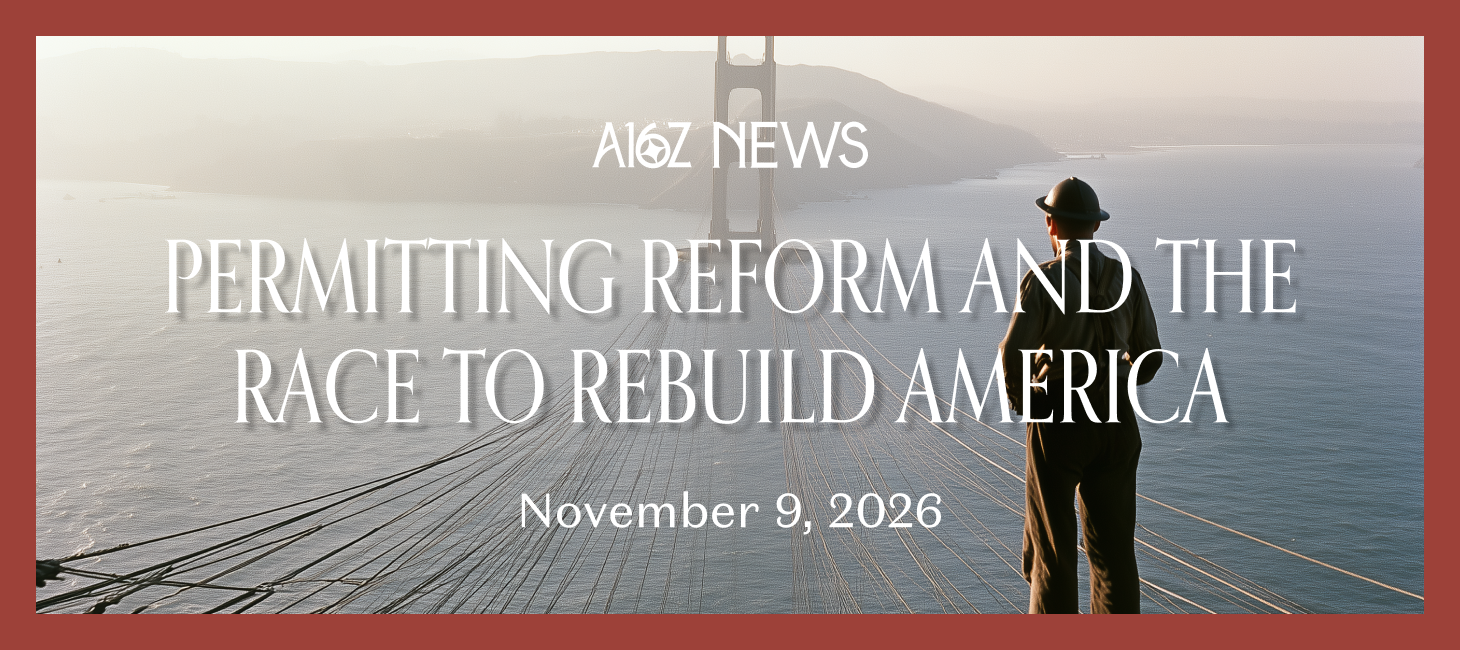
Centennial Engineering Changes: From the Golden Gate Bridge to the Expensive Public Toilet
Amid seemingly insurmountable engineering and technical challenges at the beginning of the Great Depression, San Francisco initiated the construction of the Golden Gate Bridge. This project had long been ridiculed by naysayers as "a bridge that could never be built."
Workers operated amidst surging undercurrents, dense fog, and strong winds, completing the world's longest and tallest suspension bridge at that time in just over four years. Construction broke ground in January 1933, and it officially opened for traffic in May 1937, with a total cost of only $35 million.
This achievement is comparable to the Empire State Building, which was completed in just 410 days, a full month ahead of schedule. That was a golden era for "builders," where conquering seemingly impossible engineering marvels was a routine occurrence across the United States.
However, nearly a century later, just five miles from the Golden Gate Bridge, the city of San Francisco initiated another public project: a public toilet in Noe Valley.
This single toilet booth, covering only 150 square feet and accommodating just a metal toilet and baby changing table, was originally budgeted to cost up to $1.7 million, with a projected timeline of more than two years.
After sparking strong criticism across the country, the city government accepted a prefabricated toilet donated by the community and received pro bono technical support from design and engineering teams. Even so, because this donated toilet still had to undergo a lengthy review and approval process involving more than six government departments, including the arts commission, it ultimately cost taxpayers around $200,000 and took a full 18 months to realize.
The Nationwide Spread of Project Stagnation and Declining Manufacturing Capability
It's easy to view the Noe Valley public toilet as an extreme case of local administration; however, the same tragedy is repeatedly unfolding in major public projects across the United States:
California High-Speed Rail Project: Of the initial $33 billion budget, $13 billion has already been spent, yet the core segment of the track laying from Los Angeles to San Francisco has yet to be completed, with the latest estimated total project cost ballooning to $128 billion.
Nuclear Reactor Construction: In the past twenty years, only two large nuclear reactors have been built from scratch in the U.S., both delayed by over seven years and exceeding budgets by approximately $23 billion, while the peak years of nuclear power construction in the U.S. could yield four to five reactors annually.
Arizona Copper Mine Development: This ore deposit could satisfy a quarter of the U.S. copper consumption needs, but it has been stalled for nearly thirty years since its discovery in 1995, mired in federal environmental reviews and overlapping lawsuits, with the approval cycle from exploration to production extending over 35 years.
550-Mile Interstate Transmission Line: This project took 17 years to finally be delivered, while the actual physical construction lasted only 2 years, with the remaining 15 years consumed by lengthy government approval and legal entanglements, and its sister project also took 15 years.
West Virginia Gas Pipeline: The project is 94% complete but has been stalled in legal disputes over approval permissions for nearly ten years, ultimately needing specific legislative action from Congress and directives from the Supreme Court to be cleared for operation.
These absurd cases, if seen as isolated incidents, are indeed laughable, but they represent a concentrated eruption of America's deeper institutional ailments. Communities nationwide are facing aging and decaying infrastructure, increasingly decrepit public buildings, and an outdated electrical grid that can no longer support a modern digital economy.
Data reveals a shocking decline: in 1997, the U.S. accounted for 25% of global manufacturing value added, but this has now shrunk to 16%; if there is no fundamental intervention in the institutional environment, this share is expected to drop further to 11% by 2030.
Ironically, these severe project stagnations are not due to a lack of tools. Compared to builders a century ago, we now possess unparalleled computing technology, substantial capital reserves, and engineering expertise. We should be able to commence construction at the fastest and safest pace in history; however, reality is just the opposite. What exactly is constraining the construction hands of America?
Democratic Systems Are Not the Determining Variable in Engineering Lag
A popular narrative blames construction stagnation on democracy itself, claiming that the intricate voices of multi-party negotiations hinder executive efficiency, arguing that only a single dominant voice can achieve efficient advancement. This viewpoint disguises dismaying administrative inefficiency as an inevitable cost of a free society, creating a false dichotomy between civil rights and effective development.
While this argument seems compelling at first glance, seeing that some authoritarian countries abroad can build entire cities, computing centers, and industrial ports in a short time, it is logically untenable when viewed from a historical perspective.
Historical examples abound where authoritarian regimes have met dismal failure in major industrial projects. Even when authoritarian systems push for construction, they often fall into the abyss of inefficiency and resource waste, with their assessment mechanisms prioritizing sheer extensive production capacity over economic profitability, ultimately resulting in a plethora of neglected ineffective assets.
It has been proven that as long as the government creates the right institutional soil, democratic systems can exhibit extraordinary engineering construction speed. In 1956, the U.S. Congress established designated construction funds, a unified national engineering standard, and clear delineation of federal and state responsibilities, completing nearly half of the national interstate highway system's mileage operational in just ten years.
Modern democracies still demonstrate powerful infrastructure breakthroughs: Spain has built over 3,800 kilometers of high-speed rail network, second only to China, and at construction costs significantly below the international average; Taiwan, relying on a one-stop administrative approval channel for industry and seamless provision of land, electricity, and water resources, can complete advanced process wafer manufacturing plants in about two years.
Thus, it is evident that the organizational form of governance is not the key variable determining construction speed. The core lies in whether industrial policies truly empower engineering construction: a clear authorization system, standardized access requirements, predictable financing support, effective governing bodies, and a regulatory framework that compels the government to provide conclusive results without continuously creating delays.
Environmental Protection Should Not Become an Excuse for Indefinite Delays
Another common misconception equates lengthy and complex approval processes with the necessary costs of ensuring environmental safety, mistakenly believing that strict approvals are the only barrier to ecological protection.
This viewpoint's intuitive logic seems straightforward: the fewer projects initiated, the less pollution there will be. However, global industrial production will not simply vanish; when construction stagnates domestically in the U.S., high-energy, high-emission manufacturing activities will merely shift to overseas regions with more lenient environmental standards, ultimately exacerbating global ecological degradation.
Endless bureaucratic approval processes do not genuinely save the natural environment. Canada and Australia also hold strict reputations in environmental protection, yet the average approval period for mining and major energy infrastructure projects in both countries is only two to three years, while similar projects in the U.S. often take decades.
The core secret to Canada and Australia's success lies in focusing on substantial environmental protection standards while minimizing procedural delays. The true emphasis of environmental protection should be on whether projects are safe and whether emissions meet standards rather than wasting time in a bureaucratic loop of document circulation.
The Real Core Problem: Rewarding Compliance Processes Instead of Assessing Delivery Outcomes
The root of the current paralysis in U.S. infrastructure lies in its deep entanglement of excessively cumbersome compliance processes with an accountability-free exemption mechanism.
The most representative institutional obstacle is the National Environmental Policy Act (NEPA). Unlike substantive laws that establish specific environmental safety standards, NEPA is essentially a purely procedural law. It does not mandate projects to achieve certain environmental effects but requires federal agencies to compile detailed and complex reports assessing each potential environmental impact.
This leads to engineering projects being trapped in a quagmire of pure procedural review for years. A final Environmental Impact Statement (EIS) often exceeds thousands of pages, taking over four and a half years and costing millions of dollars, yet a report this thick as a dictionary does not materially enhance ecological safety.
More critically, NEPA grants opponents an indefinite weapon for judicial litigation. Any dissatisfied project competitor or lawsuit group can seize upon minor procedural flaws in thousands of pages of reports to take the agency to court, dragging projects down with prolonged injunctions. Completing one round of review does not provide legal certainty, as opponents can continually initiate overlapping lawsuits at various stages.
This procedural absolutism even undermines green infrastructure intended to improve the environment. It has successively obstructed the approval and advancement of numerous clean nuclear power stations, large geothermal power projects, interstate high-voltage transmission corridors, and urban rail transit projects.
This mechanism continues to spread across various industries, causing immense internal friction for tangible projects and communities nationwide. Ultimately, innovators and builders suffer double institutional exploitation: on one hand, they pay exorbitant regulatory fees and legal costs to government agencies, and on the other hand, they fork out endless compliance research costs to external consultants, completely suffocating construction speed in layers of defensive documentation.
Bipartisan Solutions: Five Reform Pillars Centered on Effectiveness
What is the secret of countries that can efficiently promote construction? The answer is: rewarding responsible project delivery, rather than encouraging delays and deferrals.
Fortunately, there is currently a bipartisan consensus in Washington pushing for reforms to the approval system. Whether it is traditional fossil fuel industry executives, renewable energy developers, heavy industrial builders, or commercial banks, there are calls to restructure the system. The Bipartisan American Affordability and Jobs Act of 2026, jointly proposed in the Senate, along with related House counterpart bills, offers a clear legislative roadmap to break the deadlock.
The final bill must achieve substantial breakthroughs in the following five core pillars:
Limit Procedural Review: The Supreme Court has clearly confirmed NEPA as merely a procedural law. The new bill should legally solidify this principle, dictating that while administrative agencies correct NEPA report flaws, construction projects cannot be indiscriminately halted; establish expedited judicial review channels to quickly resolve reasonable disputes; and explicitly define that purely based on federal loans or loan guarantees, comprehensive NEPA reviews for private development projects should not be triggered.
Enforce Hard Deadlines: Congress should establish legally binding strict timeframes for approvals across all federal departments, equipped with sufficient approval review professionals, and establish legally enforceable remedies for pending cases past the deadline, forcing agencies to perform their duties on time.
Establish One Project, One Review Principle: Designate a single leading agency and require all federal participating departments to complete joint reviews under a unified coordination mechanism and compact timetable; for state or tribal reviews that meet federal substantial environmental standards, the leading agency may directly accept mutual recognition to avoid redundant reviews, aligning fully with the models of Canada, the European Union, and Australia.
Make Permits Final: Clearly prohibit courts from issuing stop-work orders based solely on procedural flaws; administrative authorities should not indiscriminately revoke already approved legal permits unless faced with unforeseen extreme circumstances; if a project is halted due to illegal government interference, project parties have the right to restore permits, full litigation cost reimbursement, and corresponding economic loss compensation as per law.
Simplify Permitting: Widely expand the applicability of Categorical Exclusions, allowing routine and low-risk construction activities to pass swiftly without lengthy and tedious environmental assessment procedures; establish a cross-departmental shared mechanism for categorical exclusion lists; and Congress should actively promote cooperation mechanisms between federal and state governments to pre-complete environmental, utility networks, and land use zoning three-in-one reviews for qualifying industrial bases, enabling compliant enterprises to break ground in weeks instead of spending years awaiting approvals (drawing from the successful experience of Taiwan).
Reviving Construction Capacity: It's Time for Congress to Clear Obstacles
The above bipartisan reform proposals will completely detach the procedural dead weight that hampers national progress while robustly defending natural ecology and preserving the vitality of a free society, enabling America to regain the confidence to build.
The Golden Gate Bridge was once mocked as "a bridge that could never be built." Four years later, after overcoming every detractor's obstacles, it stands majestically on the Pacific shore.
Today's America is still the country that once created countless engineering miracles; the only difference is that today's institutional system empowers the naysayers and dilly-dalliers while binding the hands of builders.
This situation must be thoroughly reversed. America has not lost the ability to construct great projects; we have merely buried this potential in red tape and self-defensive bureaucratic procedures.
We are a great nation ready to resume construction; it is time for Congress to clear institutional roadblocks and unleash the future!
免责声明:本文章仅代表作者个人观点,不代表本平台的立场和观点。本文章仅供信息分享,不构成对任何人的任何投资建议。用户与作者之间的任何争议,与本平台无关。如网页中刊载的文章或图片涉及侵权,请提供相关的权利证明和身份证明发送邮件到[email protected],本平台相关工作人员将会进行核查。


